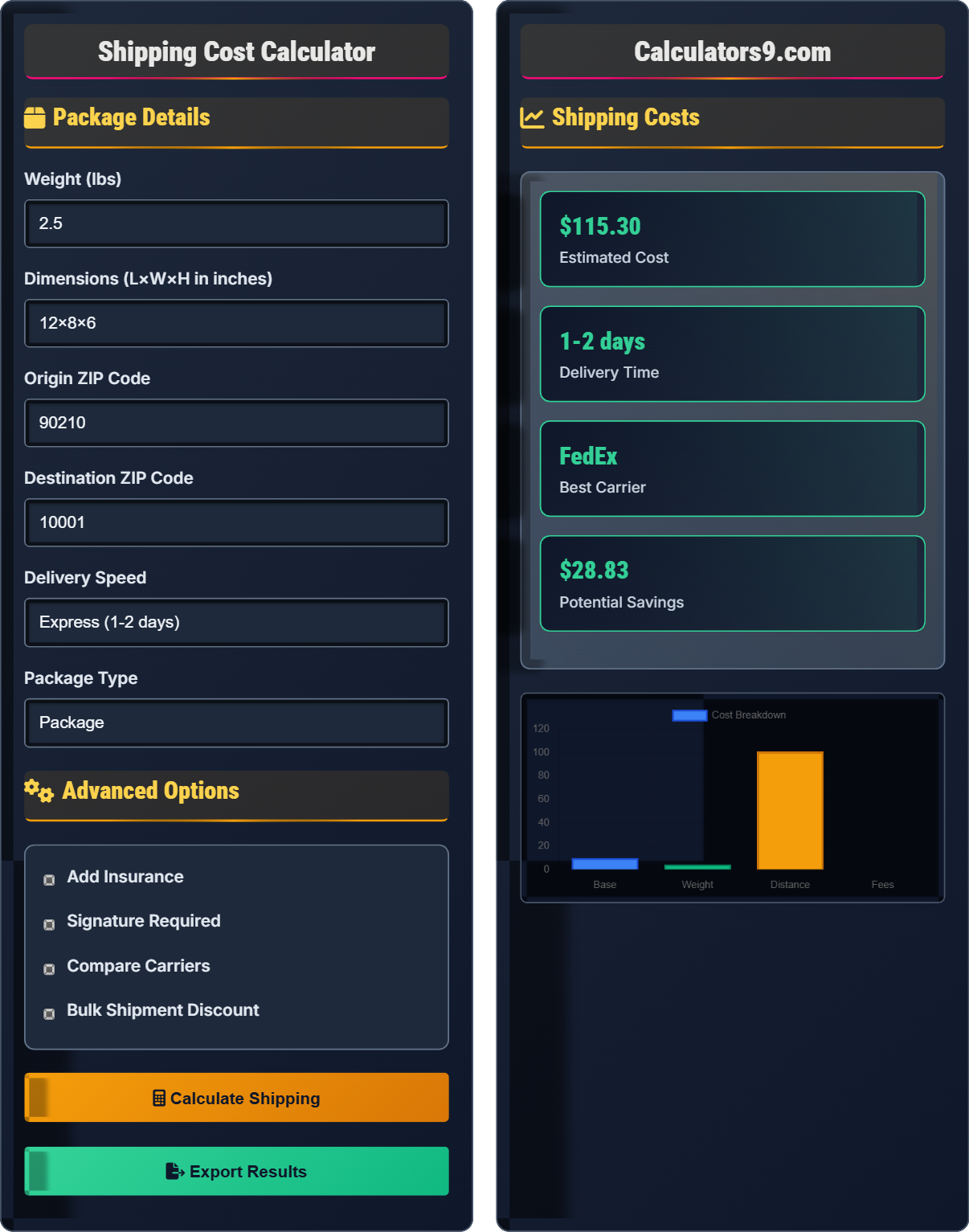
Shipping Cost Calculator
Rates & delivery optimization • 2026 e-commerce
Package Details
Advanced Options
Shipping Costs
| Service | Cost | Time | Details |
|---|
| Carrier | Cost | Tracking | Reliability |
|---|
Comprehensive Shipping Cost Guide
Shipping cost is the expense of transporting goods from seller to buyer. It's a critical component of e-commerce operations, affecting profit margins, customer satisfaction, and competitive positioning. Effective shipping cost management balances customer expectations with business profitability.
The fundamental shipping cost calculation uses this formula:
Where:
- \(Base\ Rate\) = Fixed handling fee
- \(Weight\) = Package weight in pounds
- \(Rate\ per\ lb\) = Cost per pound based on carrier
- \(Distance\ Surcharge\) = Zone-based distance fee
- \(Service\ Fees\) = Additional fees for special services
Shipping costs depend on multiple variables:
- Weight: Heavier packages cost more per pound
- Dimensions: Oversized packages incur dimensional weight charges
- Distance: Zone-based pricing affects long-distance shipping
- Speed: Express shipping costs 2-3x standard rates
- Package Type: Fragile items require special handling
- Volume: Bulk discounts available for frequent shippers
Most e-commerce businesses spend 8-12% of revenue on shipping costs.
- Free shipping threshold: Encourage larger orders with $35-75 minimum
- Hybrid approach: Pass through costs for express, subsidize standard
- Bulk shipping: Negotiate rates with carriers for high volume
- Regional fulfillment: Use multiple warehouses to reduce zones
- Smart packaging: Right-size packages to reduce dimensional weight
Shipping Cost Learning Quiz
Which factor has the greatest impact on shipping costs?
The answer is B) Weight and dimensions. Carriers charge based on actual weight or dimensional weight (length×width×height÷139). Heavy or oversized packages significantly increase shipping costs. Dimensional weight pricing became standard in 2015, making package efficiency crucial.
Dimensional weight pricing revolutionized shipping costs by accounting for space utilization in transport vehicles. A lightweight but large package takes up the same space as a heavy, compact package. Understanding this helps businesses optimize packaging to reduce costs while maintaining product safety.
Dimensional Weight: Space-based pricing (L×W×H÷139)
Actual Weight: Physical weight of package
Billable Weight: Higher of actual or dimensional weight
• Carriers charge for the greater of actual or dimensional weight
• Compact packaging reduces dimensional weight charges
• Oversized packages incur additional fees
• Use right-sized packaging to minimize dimensional weight
• Calculate both weights before shipping
• Consider flat-rate options for bulky items
• Using oversized boxes for small items
• Not calculating dimensional weight
• Ignoring zone-based pricing
If a package weighs 5 lbs and the carrier charges $2.50 base rate plus $1.20 per pound, what is the total shipping cost? Show your work.
Step 1: Calculate weight-based charge = Weight × Rate per pound
Weight charge = 5 lbs × $1.20/lb = $6.00
Step 2: Add base rate to weight charge
Total cost = Base rate + Weight charge
Total cost = $2.50 + $6.00 = $8.50
The total shipping cost is $8.50.
This demonstrates the basic structure of shipping cost calculations with a fixed base rate and variable weight-based charges. The base rate covers handling and processing, while the weight charge reflects transportation costs. Understanding this breakdown helps businesses analyze their shipping expenses.
Base Rate: Fixed handling fee regardless of weight
Variable Rate: Charge that changes with package attributes
Total Cost: Sum of all applicable charges
• Total cost = Base rate + Variable charges
• Weight charges scale linearly with package weight
• Always verify carrier-specific rate structures
• Remember: Base rate + (Weight × Rate per lb) = Total
• Factor in all applicable charges (distance, fuel, etc.)
• Compare rates across carriers for optimal pricing
• Forgetting to include base rate
• Misreading rate per pound
• Not accounting for additional surcharges
A company ships a 3lb package (12×10×8 inches) from New York (10001) to Los Angeles (90210). The carrier charges $3.00 base rate, $1.50 per lb, and $0.25 per mile. The distance is 2,450 miles. Calculate the total shipping cost. Does dimensional weight apply?
Step 1: Calculate dimensional weight
Dim weight = (12 × 10 × 8) ÷ 139 = 960 ÷ 139 = 6.9 lbs
Step 2: Use higher weight (dimensional weight)
Billable weight = 6.9 lbs (round to 7 lbs)
Step 3: Calculate weight-based charge
Weight charge = 7 lbs × $1.50/lb = $10.50
Step 4: Calculate distance charge
Distance charge = 2,450 miles × $0.25/mile = $612.50
Step 5: Calculate total
Total = Base + Weight + Distance = $3.00 + $10.50 + $612.50 = $626.00
Yes, dimensional weight applies since 6.9 lbs > 3 lbs actual weight.
This example demonstrates how multiple factors combine to create shipping costs. The distance charge makes this prohibitively expensive, showing why long-distance shipping requires special strategies. The dimensional weight calculation shows how package size affects costs beyond just weight.
Dimensional Weight: Space-based pricing calculation
Billable Weight: Weight used for charging (higher of actual/dimensional)
Zone Pricing: Distance-based shipping zones• Use higher of actual or dimensional weight
• Long-distance shipping can be very expensive
• Consider regional fulfillment centers for distant customers
• Calculate dimensional weight for all packages
• Consider flat-rate options for long distances
• Evaluate regional warehousing for national shipping
• Ignoring dimensional weight calculations
• Not considering distance-based pricing
• Using standard rates for long-distance shipping
A business ships 50 packages monthly with an average weight of 2 lbs each. Carrier A offers $8 base rate + $1.25/lb. Carrier B offers $5 base rate + $1.75/lb. Which carrier is more economical for this business? Calculate annual savings.
Step 1: Calculate monthly cost for Carrier A
Cost A = 50 × ($8 + (2 lbs × $1.25/lb)) = 50 × ($8 + $2.50) = 50 × $10.50 = $525
Step 2: Calculate monthly cost for Carrier B
Cost B = 50 × ($5 + (2 lbs × $1.75/lb)) = 50 × ($5 + $3.50) = 50 × $8.50 = $425
Step 3: Determine more economical option
Carrier B saves $525 - $425 = $100 per month
Step 4: Calculate annual savings
Annual savings = $100/month × 12 months = $1,200
Carrier B is more economical, saving $1,200 annually.
This example illustrates the importance of analyzing total cost structures rather than individual rates. Carrier B has a lower base rate but higher per-pound rate. For this business's volume and package weight, the lower base rate provides significant savings. Volume-based analysis is crucial for shipping cost optimization.
Volume Discount: Reduced rates for high shipment volumes
Cost Structure: Combination of base rates and variable charges
Economies of Scale: Reduced per-unit costs with increased volume
• Analyze total cost structure, not just individual rates
• Consider volume discounts for high shipment counts
• Factor in service levels and reliability
• Negotiate rates based on monthly volume
• Compare total monthly costs across carriers
• Consider service quality alongside cost
• Focusing only on base rate without considering weight charges
• Not analyzing total monthly costs
• Ignoring service quality in cost decisions
What is the most effective shipping strategy for e-commerce businesses?
The answer is B) Offer free shipping with minimum purchase. This strategy increases average order value, improves customer satisfaction, and is financially sustainable when properly calculated. Studies show 88% of consumers shop more when offered free shipping with a minimum purchase.
Free shipping thresholds are psychologically powerful because they eliminate shipping anxiety while encouraging larger orders. The strategy works because businesses can absorb shipping costs into product prices while customers perceive value. The threshold should cover the average shipping cost plus provide margin.
Free Shipping Threshold: Minimum purchase for free shipping
Psychological Pricing: Leveraging customer perception
Order Value Optimization: Increasing average basket size
• Set threshold at or above average shipping cost
• Communicate value clearly to customers
• Monitor impact on profit margins
• Use $35-75 as standard threshold
• Consider free standard shipping, paid express
• Test different thresholds for optimal results
• Setting threshold too low to cover shipping costs
• Not accounting for increased cart abandonment
• Ignoring impact on profit margins
Shipping Fundamentals
Dimensional weight, billable weight, zone pricing, and carrier selection.
\(Cost = Base\ Rate + (Weight \times Rate\ per\ lb) + Distance\ Surcharge\)
Dim\ Weight = (L × W × H) ÷ 139
Use higher of actual or dimensional weight.
- Calculate dimensional weight for all packages
- Compare total cost structures, not just base rates
- Consider volume discounts for high shipments
Optimization Strategies
Right-size packaging, negotiate rates, use shipping software, optimize routes.
- Free shipping threshold
- Hybrid pricing model
- Regional fulfillment
- Carrier diversification
- Balance cost with delivery speed
- Factor in customer expectations
- Monitor carrier performance
- Regular rate reviews
FAQ
Q: What's a good free shipping threshold?
A: $35-75 depending on average order value and shipping costs. Should cover average shipping cost plus provide margin. Higher threshold for premium products.
Q: How can I reduce shipping costs?
A: Right-size packaging, negotiate carrier rates, use shipping software, consolidate shipments, consider regional fulfillment centers.