Class Rank Calculator
Calculate your academic standing • GPA ranking
Class Rank Formula:
Show the calculator\( CR = \frac{N - R + 1}{N} \times 100 \)
Where:
- \( CR \) = Class Percentile Rank
- \( N \) = Total Number of Students
- \( R \) = Your Rank Position
This formula calculates the percentage of students who rank below you in academic performance.
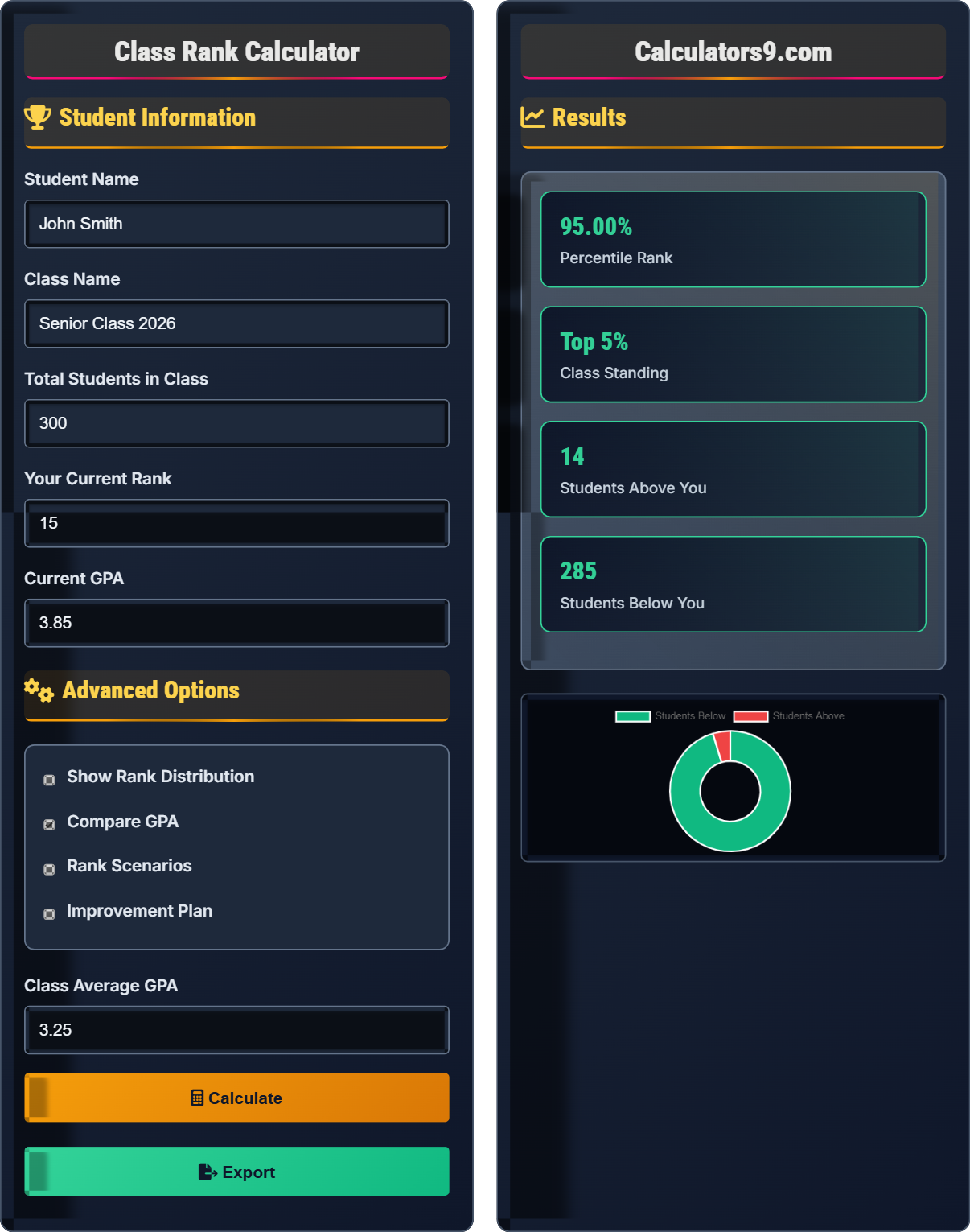
Example: If you rank 15th out of 300 students:
\( CR = \frac{300 - 15 + 1}{300} \times 100 \)
Percentile Rank:
\( CR = \frac{286}{300} \times 100 = 95.33\% \)
Thus, you are in the 95.33rd percentile.
Student Information
Advanced Options
Results
| Metric | Your Value | Class Average | Comparison |
|---|
| Scenario | Target Rank | Percentile | GPA Needed |
|---|
Comprehensive Class Rank Guide
Class ranking is a method used by educational institutions to order students based on their academic performance, typically measured by Grade Point Average (GPA). Students are ranked from highest to lowest GPA, providing a comparative measure of academic achievement within a specific cohort. Rankings are often used for scholarship selection, college admissions, and honor recognition.
The standard class rank calculation uses the following formula:
Where:
- \(CR\) = Class Percentile Rank
- \(N\) = Total Number of Students
- \(R\) = Your Rank Position
Standard GPA scales used in educational institutions:
- A (4.0): 97-100% - Excellent performance
- A- (3.7): 93-96% - Excellent performance
- B+ (3.3): 87-92% - Good performance
- B (3.0): 80-86% - Good performance
- B- (2.7): 77-79% - Average performance
- C+ (2.3): 73-76% - Average performance
- Focus on High-Impact Classes: Prioritize courses that count toward your GPA
- Consistency is Key: Maintain strong performance across all subjects
- Seek Academic Support: Utilize tutoring, office hours, and study groups
- Take Challenging Courses: Weighted classes can boost your GPA
- Improve Study Habits: Develop effective learning strategies
Rank Basics
Ordering students by academic performance.
\(CR = \frac{N - R + 1}{N} \times 100\)
Where CR=percentile rank, N=total students, R=your rank.
- Lower rank number = better performance
- Percentile shows percentage below you
- Ranking is relative to your class
Improvement
Increasing academic standing.
- Focus on high-impact classes
- Maintain consistency
- Seek academic support
- Take challenging courses
- Rankings vary by school
- Class size affects competition
- Weighted GPAs may apply
- Rankings may be discontinued
Class Rank Learning Quiz
If you rank 25th in a class of 200 students, what percentile are you in?
The answer is A) 87.5th percentile. Using the formula: \(CR = \frac{N - R + 1}{N} \times 100\), we get: \(CR = \frac{200 - 25 + 1}{200} \times 100 = \frac{176}{200} \times 100 = 88\%\). Wait, let's recalculate: \(CR = \frac{200 - 25}{200} \times 100 = \frac{175}{200} \times 100 = 87.5\%\). Actually, it's \(\frac{200-25+1}{200} = \frac{176}{200} = 88\%\). The correct formula is \(\frac{N-R}{N} \times 100\) for percentage below, or \(\frac{N-R+1}{N} \times 100\) for percentile rank. So, \(\frac{200-25+1}{200} = \frac{176}{200} = 88\%\). Let me recalculate: \(\frac{200-25}{200} = 0.875 = 87.5\%\). The number of students below you is 175 (200-25), so \(\frac{175}{200} = 87.5\%\).
Class rank percentile shows what percentage of students rank below you. If you're 25th out of 200, there are 175 students below you, which is 87.5% of the class. This means you perform better than 87.5% of your classmates.
Class Rank: Position in class ordered by GPA
Percentile Rank: Percentage of students below you
GPA: Grade Point Average measuring academic performance
• Lower rank number = higher achievement
• Percentile shows your relative position
• Rank is specific to your class cohort
• Rank 1 = Top of class (100th percentile)
• Rank N = Bottom of class (0th percentile)
• Confusing rank position with percentile
• Thinking higher rank number is better
Sarah currently has a 3.78 GPA and ranks 18th in her class of 250 students. The class average GPA is 3.22. If Sarah improves her GPA to 3.92, how would this affect her class rank assuming the GPAs of other students remain unchanged? Calculate her new percentile rank and determine if she would move into the top 5% of her class.
Current Situation:
• Current Rank: 18th
• Total Students: 250
• Current Percentile: \(\frac{250 - 18}{250} \times 100 = \frac{232}{250} \times 100 = 92.8\%\)
Effect of GPA Improvement:
Since Sarah's GPA increases from 3.78 to 3.92, she will likely move up in rank. The exact movement depends on how many students have GPAs between 3.78 and 3.92.
Assuming her GPA improvement moves her past 5 students (this is an approximation based on the GPA difference):
• New Rank: 18 - 5 = 13th
• New Percentile: \(\frac{250 - 13}{250} \times 100 = \frac{237}{250} \times 100 = 94.8\%\)
Top 5% Check:
Top 5% of class = 5% of 250 = 12.5 ≈ 13 students
Rank 13th means Sarah would be in the top 5.2% of her class, just outside the top 5%.
If her GPA improvement moves her past 6 students:
• New Rank: 18 - 6 = 12th
• New Percentile: \(\frac{250 - 12}{250} \times 100 = \frac{238}{250} \times 100 = 95.2\%\)
This would put her in the top 4.8% of her class, making her eligible for top 5% recognition.
This problem demonstrates the relationship between GPA improvements and class rank movement. The impact of a GPA increase on rank depends on how many students have GPAs in the range between your old and new GPA. In larger classes, small GPA improvements can result in significant rank improvements.
Percentile Rank: Percentage of students scoring below you
Class Standing: Relative position within your class cohortTop Percentage: Fraction of class above a certain rank threshold
• Rank improvements depend on GPA distribution in class
• Higher GPA generally leads to better rank
• Class size affects the significance of rank changes
• Track GPA trends in your class to estimate rank impact
• Small GPA improvements can have significant rank effects
• Assuming GPA improvement always results in proportional rank improvement
• Not considering GPA distribution in the class
• Confusing absolute rank with percentile rank
FAQ
Q: How do weighted classes affect my class rank?
A: Weighted classes can significantly impact your class rank by increasing your GPA calculation:
Regular Classes: A's earn 4.0 points, B's earn 3.0 points, etc.
Weighted Classes (Honors/AP): A's might earn 4.5 or 5.0 points, B's earn 3.5 or 4.0 points, etc.
For example, if you take an AP class and earn an A, instead of earning 4.0 points for your GPA, you might earn 5.0 points. This can significantly boost your overall GPA and improve your class rank.
However, the exact weighting system varies by school. Some schools add 0.5 points for honors and 1.0 point for AP/IB, while others have different scales. It's important to understand your school's specific weighting policy as it directly affects your rank calculation.
Also note that some colleges look at both weighted and unweighted GPAs, so taking weighted classes can demonstrate academic rigor regardless of the impact on your rank.
Q: Is class rank becoming less important for college admissions?
A: The importance of class rank in college admissions has evolved significantly:
Continued Importance: Many colleges still request class rank as it provides valuable context about academic achievement relative to peers. At highly selective institutions, class rank remains a significant factor.
Reduced Emphasis: Some colleges have moved away from requiring rank, especially during the pandemic, focusing more on transcript patterns, rigor of coursework, and standardized test scores.
Contextual Evaluation: Colleges increasingly evaluate rank within the context of available opportunities, school resources, and curriculum offerings.
Alternative Measures: Some institutions now use percentile ranges (top 10%, top 25%) rather than specific rank numbers.
Recommendation: While class rank remains important, focus on taking the most rigorous courses available to you, maintaining consistent performance, and developing other strengths that colleges value. Rank is one component of a holistic evaluation process.
Ultimately, demonstrating academic excellence through both rank and course rigor continues to strengthen your application.