Study Time Calculator
Calculate your academic study hours • Learning time planner
Study Time Formula:
Show the calculator\( ST = \frac{CT \times CI}{EF} \)
Where:
- \( ST \) = Study Time Required (hours)
- \( CT \) = Content Time (time needed to cover material)
- \( CI \) = Complexity Index (difficulty factor)
- \( EF \) = Efficiency Factor (learning effectiveness)
This formula calculates the recommended study time based on content complexity and individual learning efficiency.
Example: For 10 hours of content at medium complexity (CI=1.2) with high efficiency (EF=0.8):
\( ST = \frac{10 \times 1.2}{0.8} \)
Study Time:
\( ST = \frac{12}{0.8} = 15 \) hours
Thus, 15 hours of study time is recommended.
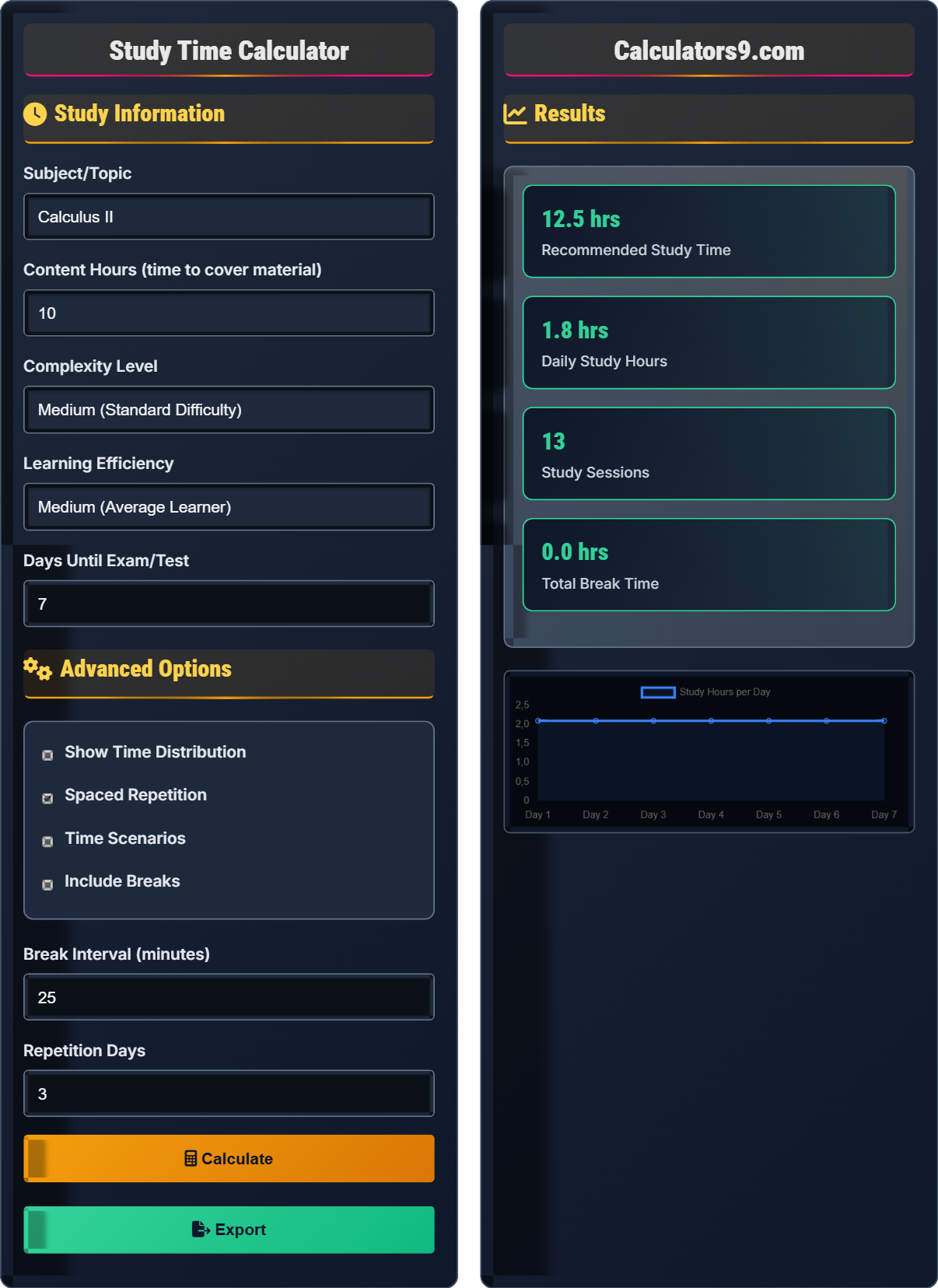
Study Information
Advanced Options
Results
| Component | Hours | Percentage | Recommendation |
|---|
| Scenario | Efficiency | Time Required | Daily Hours | Feasibility |
|---|
Comprehensive Study Time Guide
Study time planning is the process of estimating and scheduling the time required to master academic material effectively. It involves analyzing the complexity of content, assessing personal learning efficiency, and creating a realistic schedule that optimizes retention and performance. Proper study time planning prevents cramming and promotes consistent, effective learning.
The standard study time calculation uses the following formula:
Where:
- \(ST\) = Study Time Required (hours)
- \(CT\) = Content Time (time needed to cover material)
- \(CI\) = Complexity Index (difficulty factor)
- \(EF\) = Efficiency Factor (learning effectiveness)
Different content types require varying study approaches:
- Low Complexity (0.8): Basic facts, vocabulary, simple procedures
- Medium Complexity (1.0): Standard concepts, formulas, processes
- High Complexity (1.3): Abstract theories, multi-step problems
- Very High Complexity (1.6): Advanced theories, complex applications
- Assess Your Learning Style: Visual, auditory, or kinesthetic preferences
- Optimize Your Environment: Quiet, organized, distraction-free space
- Plan Breaks Strategically: Rest periods improve focus and retention
- Track Your Progress: Monitor effectiveness and adjust accordingly
- Review Regularly: Schedule periodic review sessions
Study Time Planning
Estimating and scheduling learning time effectively.
\(ST = \frac{CT \times CI}{EF}\)
Where ST=study time, CT=content time, CI=complexity, EF=efficiency.
- More complex material requires more time
- Higher efficiency reduces needed time
- Spaced repetition improves retention
Optimization
Improving learning efficiency and effectiveness.
- Assess your learning style
- Optimize your environment
- Plan breaks strategically
- Track your progress
- Individual learning efficiency varies
- Breaks are essential for focus
- Environment affects concentration
- Regular review improves retention
Study Time Learning Quiz
Which factor would most increase the recommended study time for a given subject?
The answer is C) Increasing content complexity. According to the formula \(ST = \frac{CT \times CI}{EF}\), complexity (CI) is in the numerator, so increasing it directly increases the required study time. Higher complexity means more difficult material that requires more time to master.
Understanding the components of the study time formula helps in planning. Complexity and content time increase required study time, while efficiency decreases it. Recognizing this relationship allows for better resource allocation and realistic goal-setting.
Study Time: Hours needed to master academic material
Complexity Index: Factor representing material difficulty
Learning Efficiency: Individual effectiveness in acquiring knowledge
• Complexity increases required time
• Higher efficiency reduces required time
• More content requires more time
• Assess complexity before planning study time
• Focus on improving learning efficiency
• Underestimating time needed for complex material
• Not accounting for individual learning differences
A student needs to prepare for a chemistry exam covering 15 hours of lecture content. The material is considered high complexity (factor of 1.3), and the student's learning efficiency is rated as medium (0.8). Calculate the recommended total study time. If the exam is 10 days away, how many hours should the student study each day? Additionally, if the student implements spaced repetition and needs to review the material 3 additional times, what is the total study commitment?
Part 1: Calculating initial study time
Using the formula: \(ST = \frac{CT \times CI}{EF}\)
Where:
- CT = 15 hours (content time)
- CI = 1.3 (high complexity)
- EF = 0.8 (medium efficiency)
Initial study time: \(ST = \frac{15 \times 1.3}{0.8} = \frac{19.5}{0.8} = 24.375\) hours
Part 2: Daily study hours
Days available: 10 days
Daily study hours: 24.375 ÷ 10 = 2.44 hours per day
Part 3: Including spaced repetition
Initial study: 24.375 hours
Additional reviews: 3 × 24.375 = 73.125 hours
Total study commitment: 24.375 + 73.125 = 97.5 hours
Daily with reviews: 97.5 ÷ 10 = 9.75 hours per day
Therefore, the student initially needs 24.38 hours of study time, or about 2.44 hours per day. With spaced repetition, the total commitment increases to 97.5 hours, or about 9.75 hours per day.
This problem demonstrates how spaced repetition significantly increases the total study commitment. While it may seem excessive to triple study time, research shows spaced repetition dramatically improves long-term retention. Students should plan accordingly and consider breaking up daily study into multiple shorter sessions to maintain focus.
Spaced Repetition: Learning technique involving reviewing material at increasing intervals
Study Commitment: Total time allocated to learning a subjectLearning Efficiency: Individual rate of knowledge acquisition
• Spaced repetition increases total time but improves retention
• Daily hours should be manageable and sustainable
• Break complex topics into smaller chunks
• Break long daily sessions into shorter focused blocks
• Use active recall techniques during study
• Not accounting for spaced repetition in planning
• Planning unrealistic daily study hours
• Ignoring the impact of complexity on time needed
FAQ
Q: How do I know if my learning efficiency rating is accurate?
A: You can assess your learning efficiency through several methods:
Self-Assessment: Compare how quickly you master concepts compared to peers. If you need significantly more time for the same material, your efficiency may be lower.
Retention Testing: After studying, test yourself after 24 hours, 1 week, and 1 month. High retention indicates efficient learning.
Practice Problems: Solve problems from memory without notes. Efficient learners can reproduce concepts quickly.
Feedback Analysis: Review your test corrections. Frequent conceptual errors suggest lower efficiency.
Starting Points:
• Low (0.5): Need to read material multiple times, struggle with recall
• Medium (0.8): Average learner, standard practice works well
• High (1.2): Learn quickly, retain well, connect concepts easily
• Very High (1.5): Exceptional learner with strong recall and understanding
Adjust your rating based on actual study outcomes and performance.
Q: How can I help my child develop better study time habits?
A: Here are strategies to help develop effective study time habits:
1. Create a Routine: Establish consistent study times and stick to them daily.
2. Designate a Space: Set up a quiet, organized study area free from distractions.
3. Use Planning Tools: Help your child use calendars, planners, or apps to schedule study time.
4. Break Down Tasks: Teach them to divide large tasks into smaller, manageable chunks.
5. Encourage Active Learning: Promote techniques like summarizing, questioning, and teaching concepts to others.
6. Monitor Progress: Regular check-ins to assess what's working and what needs adjustment.
7. Balance Work and Rest: Ensure they take breaks and maintain a healthy schedule.
8. Lead by Example: Model good time management and study habits in your own activities.
Remember that developing good study habits is a gradual process that requires patience and consistent support.