Test Score Calculator
Calculate your exam scores • Academic performance
Test Score Formula:
Show the calculator\( TS = \frac{CC}{TP} \times 100 \)
Where:
- \( TS \) = Test Score Percentage
- \( CC \) = Correctly Answered Questions
- \( TP \) = Total Points Possible
This formula calculates the percentage score based on the number of correct answers relative to the total possible points.
Example: If you answered 45 out of 50 questions correctly:
\( TS = \frac{45}{50} \times 100 \)
Test Score:
\( TS = 0.9 \times 100 = 90\% \)
Thus, your test score would be 90%.
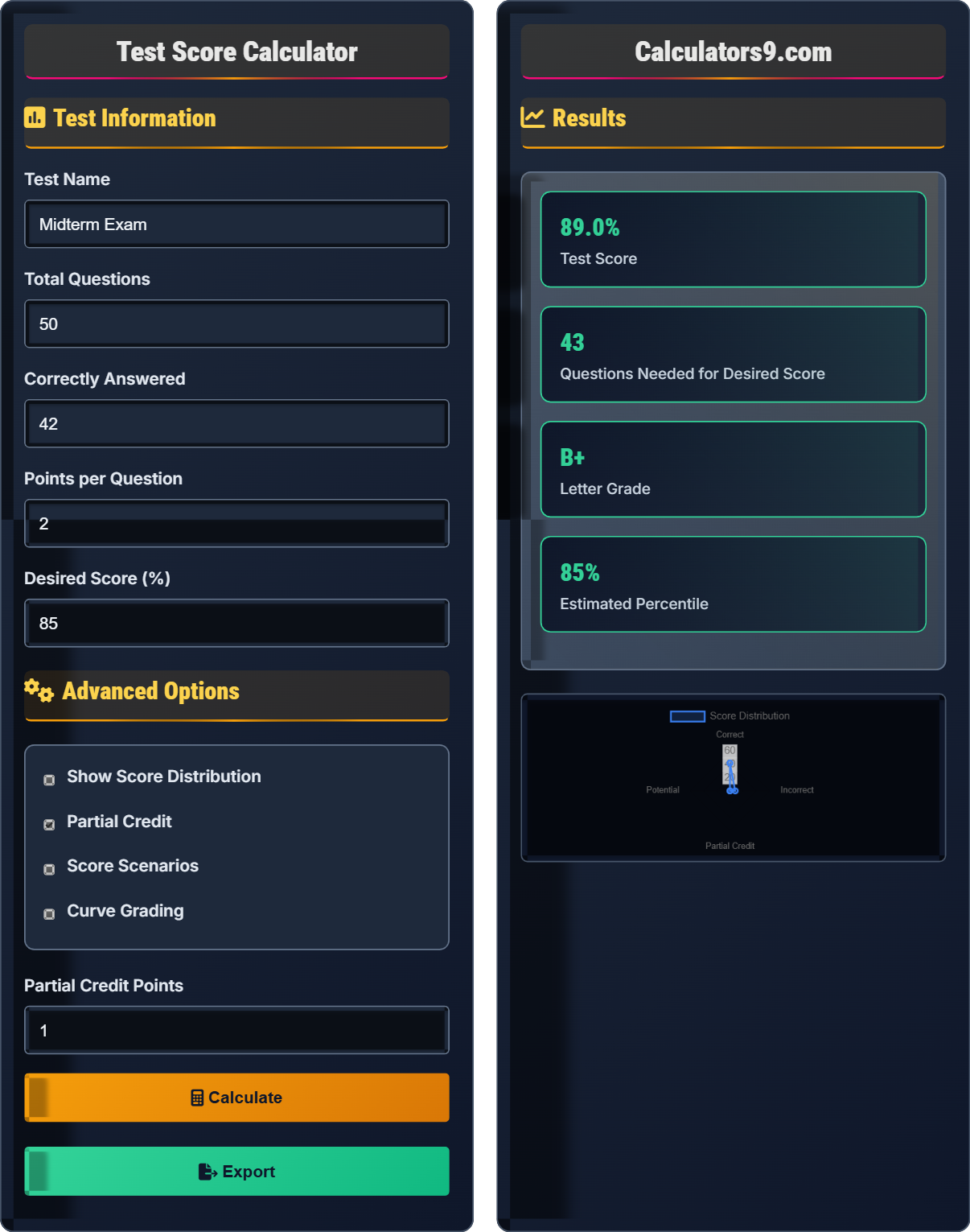
Test Information
Advanced Options
Results
| Category | Count | Percentage | Points |
|---|
| Scenario | Correct | Score | Letter | Status |
|---|
Comprehensive Test Score Guide
Test scoring is the process of evaluating and quantifying performance on an examination or assessment. It involves calculating the percentage of correct answers relative to the total possible points. Understanding test scoring helps students set realistic goals, identify areas for improvement, and track academic progress throughout the semester.
The standard test score calculation uses the following formula:
Where:
- \(TS\) = Test Score Percentage
- \(CC\) = Correctly Answered Questions
- \(TP\) = Total Points Possible
Common grading scales used in educational institutions:
- A (90-100%): Excellent performance
- B (80-89%): Good performance
- C (70-79%): Average performance
- D (60-69%): Below average performance
- F (0-59%): Failure
- Understand the Format: Know the types of questions and their point values
- Calculate Minimum Requirements: Determine how many questions you need to answer correctly
- Practice Time Management: Allocate time based on question difficulty and points
- Focus on High-Impact Areas: Prioritize topics that appear frequently
- Review Past Tests: Identify patterns and common question types
Score Basics
Quantifying exam performance as percentage.
\(TS = \frac{CC}{TP} \times 100\)
Where TS=test score, CC=correct answers, TP=total points.
- Score = (Correct / Total) × 100
- Each question contributes equally unless weighted
- Partial credit may apply to some questions
Preparation
Strategies for optimal performance.
- Understand test format
- Calculate minimum requirements
- Practice time management
- Focus on high-impact areas
- Question types may vary in difficulty
- Partial credit policies differ
- Curving may affect final scores
- Study habits impact performance
Test Score Learning Quiz
If a test has 40 questions and you answer 34 correctly, what is your percentage score?
The answer is B) 85%. Using the formula: \(TS = \frac{CC}{TP} \times 100\), we get: \(TS = \frac{34}{40} \times 100 = 0.85 \times 100 = 85\%\).
Test scoring is calculated by dividing the number of correct answers by the total number of questions and multiplying by 100. This gives you the percentage of the total possible points you earned. In this case, you earned 34 out of 40 possible points.
Test Score: Percentage of correct answers relative to total possible
Raw Score: Total number of correct answers
Percentage Score: Raw score converted to percentage
• Score = (Correct / Total) × 100
• Always convert to decimal before multiplying by 100
• Each question contributes equally unless weighted
• Use calculator for complex divisions
• Check your work by reversing the calculation
• Dividing total by correct instead of correct by total
• Forgetting to multiply by 100
A math test has 30 multiple-choice questions worth 2 points each and 5 short-answer questions worth 8 points each. You answered 25 multiple-choice questions correctly and 3 short-answer questions completely correct, plus earned partial credit on 1 short-answer question (4 out of 8 points). Calculate your total score and percentage. Also, determine how many multiple-choice questions you would need to answer correctly to achieve a 90% score if your short-answer performance remains the same.
Part 1: Calculating current score
Multiple-choice points: 25 correct × 2 points = 50 points
Short-answer points: 3 completely correct × 8 points = 24 points
Partial credit: 4 points
Total earned points: 50 + 24 + 4 = 78 points
Total possible points: (30 MC × 2) + (5 SA × 8) = 60 + 40 = 100 points
Current percentage: \(TS = \frac{78}{100} \times 100 = 78\%\)
Part 2: Calculating questions needed for 90%
For 90%: 90% of 100 points = 90 points needed
Points still needed: 90 - 78 = 12 points
Additional multiple-choice questions needed: 12 ÷ 2 = 6 questions
Total multiple-choice questions needed: 25 + 6 = 31
Wait, since there are only 30 multiple-choice questions, it's impossible to get 90% with current short-answer performance.
Let's recalculate: Maximum possible with current short-answer performance: 24 + 4 = 28 points
Maximum possible from multiple-choice: 30 × 2 = 60 points
Total maximum: 28 + 60 = 88 points
Maximum possible percentage: 88%
Therefore, achieving 90% is impossible with current short-answer performance.
This problem demonstrates how different question types contribute differently to the total score. Multiple-choice questions have lower point values but are easier to answer completely correctly. Short-answer questions offer more points but require more knowledge and skill. Partial credit allows for partial understanding to be recognized.
Partial Credit: Points awarded for partially correct answers
Weighted Questions: Questions worth different point valuesTotal Possible Points: Maximum points available on test
• Calculate points separately for each question type
• Sum all points earned and all possible points
• Check if target score is achievable with current performance
• Organize calculations by question type
• Always verify if target scores are achievable
• Not accounting for different point values per question
• Forgetting partial credit points
• Not verifying if target scores are achievable
FAQ
Q: How do I calculate my score when some questions are worth more points than others?
A: When questions have different point values, you need to calculate the total points earned and divide by the total possible points:
Step 1: Calculate points earned for each question type
Step 2: Sum all points earned
Step 3: Sum all possible points
Step 4: Calculate percentage: (Total Points Earned ÷ Total Possible Points) × 100
For example, if a test has:
• 10 multiple-choice questions worth 1 point each
• 5 short-answer questions worth 4 points each
And you answered 8 MC correctly and 3 SA completely correct:
Points earned: (8 × 1) + (3 × 4) = 8 + 12 = 20 points
Possible points: (10 × 1) + (5 × 4) = 10 + 20 = 30 points
Percentage: (20 ÷ 30) × 100 = 66.7%
Q: How can I help my child prepare for tests based on their previous scores?
A: Here are strategies to help based on previous test scores:
1. Analyze Patterns: Look for consistently low-scoring areas or question types to focus study efforts.
2. Set Realistic Goals: Use current performance as baseline to set achievable improvement targets.
3. Focus on High-Impact Areas: Prioritize topics that appear frequently or carry more weight.
4. Practice Weak Areas: Spend extra time on concepts where performance was poor.
5. Develop Test-Taking Skills: Work on time management, reading comprehension, and question analysis.
6. Review Mistakes: Go through incorrect answers to understand errors and learn from them.
7. Use Tools Like This Calculator: Set specific score targets and calculate how many questions need to be answered correctly.
Remember that improvement takes time, and consistent practice is more effective than cramming.