Weighted Grade Calculator
Calculate your course grade • Academic performance
Weighted Grade Formula:
Show the calculator\( WG = \sum_{i=1}^{n} (SC_i \times W_i) \)
Where:
- \( WG \) = Weighted Grade
- \( SC_i \) = Score Component i
- \( W_i \) = Weight of Component i
- \( n \) = Number of grade components
This formula calculates the weighted average of all grade components to determine the final course grade, where each component contributes proportionally to its assigned weight.
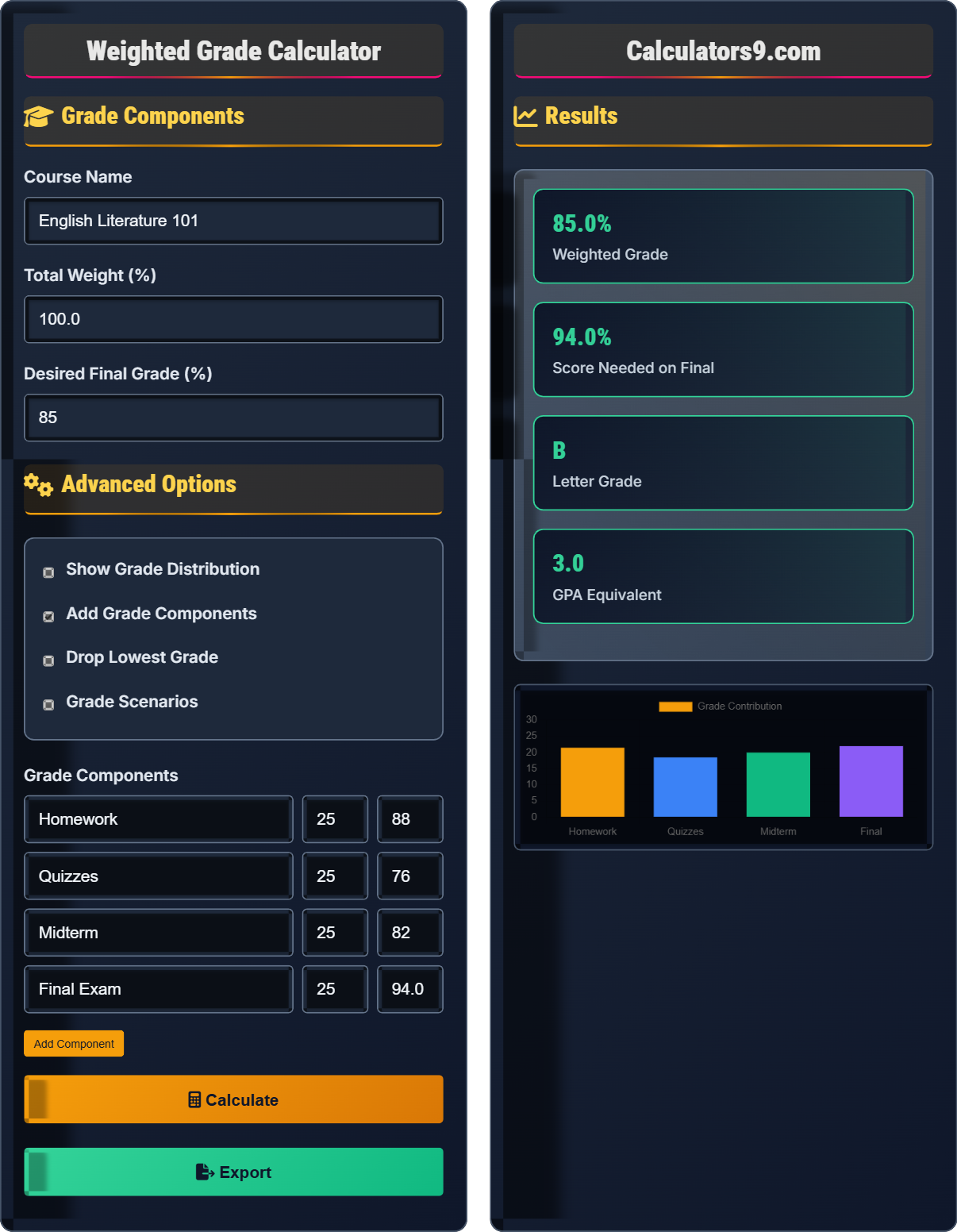
Example: Homework (25%): 88%, Quizzes (25%): 76%, Midterm (25%): 82%, Final (25%): 90%
\( WG = (88 \times 0.25) + (76 \times 0.25) + (82 \times 0.25) + (90 \times 0.25) \)
Weighted Grade:
\( WG = 22 + 19 + 20.5 + 22.5 = 84 \)
Thus, the weighted grade would be 84%.
Grade Components
Advanced Options
Results
| Component | Weight | Score | Contribution | Status |
|---|
| Scenario | Final Score | Final Grade | Letter | GPA |
|---|
Comprehensive Weighted Grade Guide
Weighted grading is a system where different components of a course contribute different percentages to the final grade. Rather than giving equal weight to all assignments, instructors assign specific percentages to categories like homework, quizzes, exams, and projects. This allows for a more nuanced assessment of student performance based on the relative importance of different types of work.
The standard weighted grade calculation uses the following formula:
Where:
- \(WG\) = Weighted Grade
- \(SC_i\) = Score Component i
- \(W_i\) = Weight of Component i
- \(n\) = Number of grade components
Common grading scales used in educational institutions:
- A (90-100%): Excellent performance
- B (80-89%): Good performance
- C (70-79%): Average performance
- D (60-69%): Below average performance
- F (0-59%): Failure
- Identify Weighted Components: Focus efforts on highest-weighted assessments
- Calculate Minimum Requirements: Determine what score is needed on remaining assignments
- Track Progress Regularly: Monitor grade changes throughout the semester
- Seek Help Early: Address weaknesses before they become problematic
- Maximize Easy Points: Don't lose points on participation or attendance
Weighted Grading
Assigning different percentages to grade components.
\(WG = \sum_{i=1}^{n} (SC_i \times W_i)\)
Where WG=weighted grade, SC=score, W=weight.
- All weights must sum to 100%
- Higher weighted components have more impact
- Calculate early to set realistic goals
Strategies
Increasing academic performance.
- Focus on high-weighted components
- Calculate minimum requirements
- Track progress regularly
- Seek help early
- Weighted averages are not simple averages
- Some components are harder to change
- Early intervention is most effective
- Drop lowest policies vary by instructor
Weighted Grade Learning Quiz
In a course with Homework (20%), Midterm (30%), and Final Exam (50%), which component has the greatest impact on the final grade?
The answer is C) Final Exam. In a weighted grading system, the component with the highest percentage weight has the greatest impact on the final grade. With 50% weight, the Final Exam contributes half of the final grade, making it the most influential component.
Understanding the weight of each component is crucial for effective study strategies. Students should allocate their time and effort proportionally to the weight of each assessment. A point gained on a 50% component is worth twice as much as a point gained on a 25% component.
Weighted Grade: Grade calculated by multiplying each component by its percentage weight
Grade Impact: How much a component affects the final grade
Weight: Percentage of final grade attributed to each component
• Higher weight = greater impact on final grade
• All weights must sum to 100%
• Focus effort on high-weighted components
• Allocate study time proportional to component weights
• Prioritize high-impact components for grade improvement
• Treating all components as equally important
• Not understanding how weights affect the final grade
A student has the following grades in a course: Homework Average (20% weight): 92%, Quizzes (25% weight): 78%, Midterm (25% weight): 85%, and wants to achieve an overall grade of 88%. Calculate the minimum score needed on the Final Exam (30% weight) to reach the desired grade. Also, determine how the grade would change if the instructor drops the lowest quiz score (72%) and recalculates the quiz average.
Part 1: Calculating needed final exam score
We need to find the Final Exam score (F) that will result in an 88% overall grade.
Using the weighted average formula: \(WG = (HW \times WH) + (Q \times WQ) + (MT \times WMT) + (F \times WF)\)
Where:
- WG = 88% (desired weighted grade)
- HW = 92% (homework average)
- WH = 0.20 (homework weight)
- Q = 78% (quiz average)
- WQ = 0.25 (quiz weight)
- MT = 85% (midterm score)
- WMT = 0.25 (midterm weight)
- F = ? (final exam score)
- WF = 0.30 (final exam weight)
Substituting known values: \(88 = (92 \times 0.20) + (78 \times 0.25) + (85 \times 0.25) + (F \times 0.30)\)
Calculating contributions: \(88 = 18.4 + 19.5 + 21.25 + (F \times 0.30)\)
Simplifying: \(88 = 59.15 + (F \times 0.30)\)
Solving for F: \(F \times 0.30 = 88 - 59.15 = 28.85\)
Therefore: \(F = 28.85 ÷ 0.30 = 96.17\)
Part 2: Effect of dropping lowest quiz score
Let's say the student had quiz scores of: 85%, 72%, 88%, 90%, 78%
Original quiz average: (85 + 72 + 88 + 90 + 78) ÷ 5 = 413 ÷ 5 = 82.6%
After dropping lowest (72%): (85 + 88 + 90 + 78) ÷ 4 = 341 ÷ 4 = 85.25%
New weighted grade: \(WG = (92 \times 0.20) + (85.25 \times 0.25) + (85 \times 0.25) + (F \times 0.30)\)
With final exam still at 96.17%: \(WG = 18.4 + 21.31 + 21.25 + 28.85 = 90.81\%\)
Therefore, the student needs to score at least 96.17% on the Final Exam to achieve an overall grade of 88%. Dropping the lowest quiz score would improve the final grade to approximately 90.81%.
This problem demonstrates how to work backwards from a desired outcome. By understanding the contribution of completed components (59.15% in this case), we can determine what's needed from remaining components. Additionally, it shows how policies like dropping lowest scores can significantly impact final grades.
Backward Calculation: Determining needed scores to achieve desired outcomes
Grade Contribution: Portion of final grade from each componentWeighted Average: Average where components have different importance
• Sum of all weights must equal 100%
• Completed components' contributions are fixed
• Remaining components must make up the difference
• Calculate current grade before determining needed scores
• Focus on components with highest potential impact
• Forgetting to convert percentages to decimals in calculations
• Not accounting for the weight of remaining components
• Assuming simple average instead of weighted average
FAQ
Q: How do I handle different point values when calculating weighted grades?
A: When assignments have different point values within a category, you need to calculate the percentage for each assignment first, then compute the average for that category:
Step 1: Calculate the percentage for each assignment: (Points Earned ÷ Total Points Possible) × 100
Step 2: Calculate the average percentage for the category
Step 3: Apply the category weight to the average percentage
For example, if you have 3 homework assignments worth 10, 20, and 15 points respectively, and you earned 8, 16, and 12 points:
Assignment 1: 8/10 = 80%
Assignment 2: 16/20 = 80%
Assignment 3: 12/15 = 80%
Homework average = (80% + 80% + 80%) ÷ 3 = 80%
If homework is worth 25% of your grade, its contribution is 80 × 0.25 = 20 points toward your final grade.
Q: How can I help my child maximize their weighted grade?
A: Here are strategies to help maximize weighted grades:
1. Identify High-Impact Components: Focus on categories with the highest weight percentages. A 5% improvement in a 40% component is worth more than a 10% improvement in a 10% component.
2. Track Progress Regularly: Monitor grades throughout the semester to identify trends and address weaknesses early.
3. **Prioritize Consistent Performance:** Aim for steady performance across all components rather than excelling in some and failing in others.
4. Understand the Syllabus: Know all policies regarding dropped scores, extra credit, and grade replacement opportunities.
5. Focus on Easy Wins: Don't lose points on participation, attendance, or completion assignments that have relatively high weight.
6. Prepare for Major Assessments: Invest more time in studying for exams and projects that carry significant weight.
7. Calculate Before Finals: Determine what score is needed on remaining assessments to reach grade goals.