Antonym Matcher
Fast Opposite Words Finder • 2026 Edition
Antonym Matching Formula:
Show the matcher\( \text{Oppositeness Score} = \frac{\text{Semantic Distance}}{\text{Contextual Relevance}} \)
Where:
- \( \text{Semantic Distance} \) = degree of meaning opposition
- \( \text{Contextual Relevance} \) = appropriateness in specific context
- \( \text{Oppositeness Score} \) = measure of antonym strength
This formula represents the conceptual relationship between words with opposing meanings. True antonyms exhibit high semantic distance while maintaining contextual relevance.
Example: For "hot" and "cold":
Semantic Distance: High (opposite temperature concepts)
Contextual Relevance: High (both describe temperature)
Oppositeness Score: Very Strong
Thus, "hot" and "cold" are considered strong antonyms in temperature contexts.
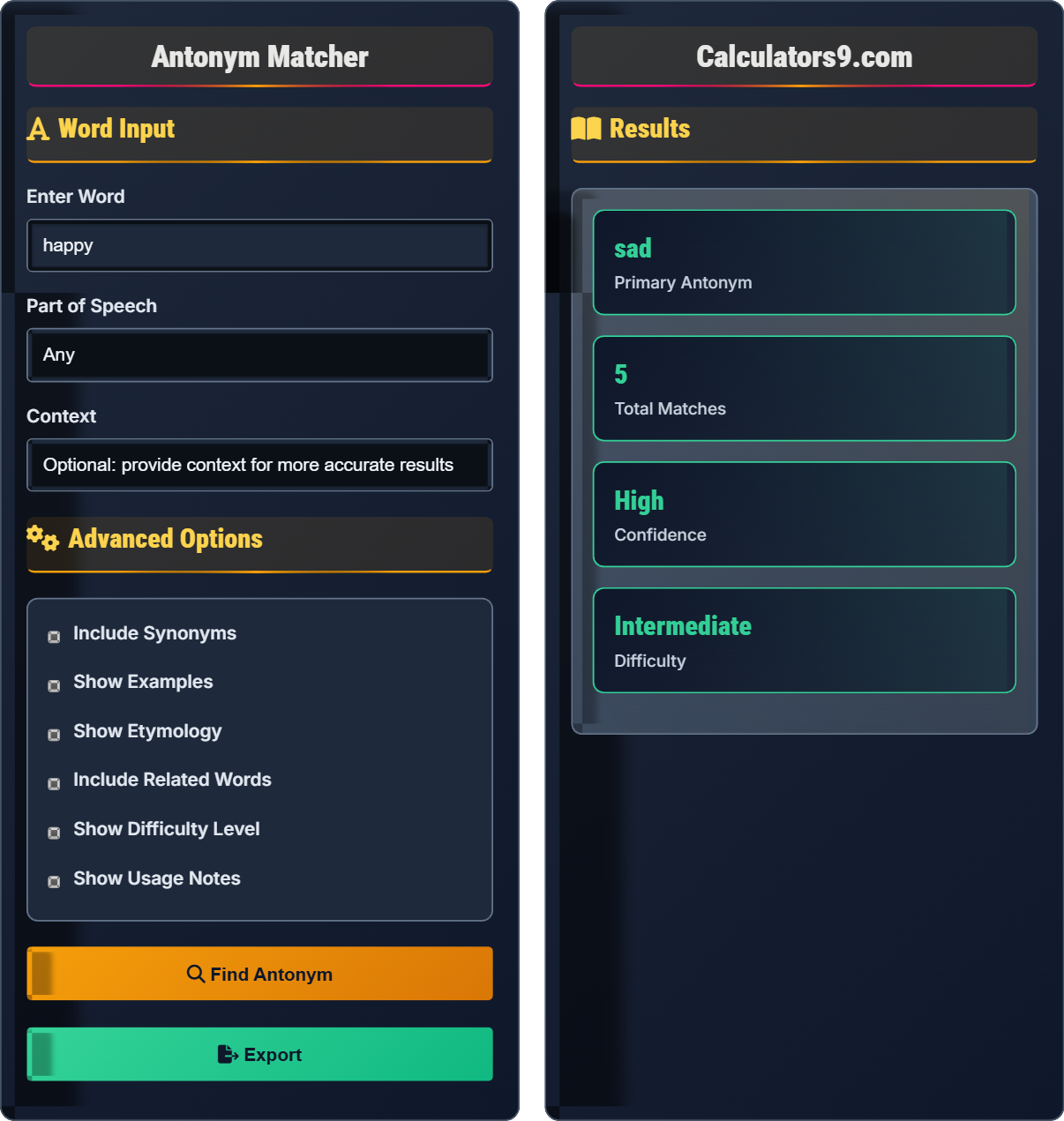
Word Input
Advanced Options
Results
Comprehensive Antonym Guide
An antonym is a word that has the opposite meaning of another word. Antonyms are pairs of words that express contrary qualities or concepts. They play a crucial role in language by providing contrast and clarity, helping to define and distinguish between different concepts. Common examples include "hot" and "cold", "big" and "small", "happy" and "sad".
Antonyms can be categorized into different types based on their relationship:
Where:
- Gradable: Words with degrees of opposition (hot/cold, happy/sad)
- Complementary: Absolute opposites (alive/dead, true/false)
- Relational: Opposite relationships (buy/sell, teacher/student)
Some frequently used antonym pairs include:
- Adjectives: hot/cold, big/small, happy/sad, light/dark
- Verbs: give/receive, buy/sell, come/go, open/close
- Nouns: day/night, beginning/end, success/failure, friend/enemy
- Adverbs: quickly/slowly, loudly/quietly, always/never
- Context Clues: Look for contrasting words in sentences to understand meaning
- Visual Associations: Create mental images of opposite concepts
- Word Families: Learn groups of related words and their opposites
- Practice Sentences: Use antonyms in sentences to reinforce understanding
- Memory Techniques: Use mnemonics or rhymes to remember antonym pairs
- Thematic Groups: Organize antonyms by theme (weather, emotions, size)
Antonym Basics
Word with opposite meaning of another word.
Look for contrasting meanings in context.
Recognize opposite concepts and qualities.
- Must have opposite meanings
- Same grammatical category
- Context-dependent relationships
- Can be absolute or relative
Learning
Expanding language through opposite word recognition.
- Group words by theme
- Create flashcards with pairs
- Use in sentences
- Practice regularly
- Context affects meaning
- Multiple antonyms possible
- Gradable vs absolute opposites
- Language evolution
Antonym Learning Quiz
Which type of antonym describes words that represent absolute opposites with no middle ground?
The answer is B) Complementary antonyms. Complementary antonyms are absolute opposites with no middle ground between them. Examples include: alive/dead, true/false, on/off, married/single. When one is true, the other must be false. There are no intermediate states between complementary antonyms.
This question tests understanding of antonym categories, which is fundamental to grasping how words relate to each other. Complementary antonyms are particularly important because they represent binary oppositions that are essential for logical thinking and clear communication. Understanding these distinctions helps learners use language more precisely.
Complementary Antonyms: Absolute opposites with no intermediate states
Binary Opposition: Two mutually exclusive states
Contrastive Meaning: Words expressing opposite concepts
• Complementary antonyms are mutually exclusive
• One state excludes the other completely
• No middle ground exists between them
• Think of binary states (on/off, yes/no)
• Look for absolute opposites
• Consider if both can be true simultaneously
• Confusing gradable with complementary antonyms
• Thinking that some opposites have intermediate states
• Misunderstanding mutual exclusivity
Identify the antonym of "generous" and explain why it's considered an antonym.
The antonym of "generous" is "stingy" or "miserly". "Generous" means willing to give freely and unselfishly, characterized by kindness and liberality in giving. Its antonym "stingy" means reluctant to spend or give money, characterized by unwillingness to share or give. These words represent opposite attitudes toward giving and sharing resources.
This question demonstrates how antonyms work by representing opposite character traits. "Generous" and "stingy" are gradable antonyms, meaning there's a spectrum between them (moderate, economical, thrifty, etc.). Understanding personality trait antonyms helps in describing people and character development in literature and everyday conversation.
Gradable Antonyms: Opposites with intermediate degrees
Personality Traits: Characteristic ways of behaving
Character Description: Words that describe personal qualities
• Antonyms must have opposite meanings
• Same grammatical category (adjectives with adjectives)
• Context can influence antonym selection
• Consider the core meaning of the word
• Think about opposite actions or characteristics
• Use context clues to verify
• Choosing words that are merely different rather than opposite
• Mixing grammatical categories
• Not considering the full meaning of the word
In the sentence "The teacher's approach was lenient, but the principal's was _______.", which word would best complete the sentence as an antonym of "lenient"?
The word "strict" would best complete the sentence. "Lenient" means permissive or tolerant, especially regarding punishment or rules. Its antonym "strict" means demanding adherence to rules or standards, not allowing deviation. In the educational context of the sentence, these words represent opposite approaches to discipline and rule enforcement.
This question emphasizes the importance of context in selecting appropriate antonyms. While "lenient" has multiple possible antonyms (strict, harsh, severe, rigid), "strict" is the most contextually appropriate in an educational setting. Understanding context helps choose the most precise antonym for effective communication.
Contextual Appropriateness: Suitability for specific situations
Educational Setting: School or academic environment
Discipline Approach: Method of enforcing rules
• Context influences antonym choice
• Multiple antonyms may exist for one word
• Consider the specific meaning in context
• Read the entire sentence before choosing
• Consider the subject matter
• Think about the specific meaning intended
• Choosing antonyms that don't fit the context
• Not considering the specific meaning in the sentence
• Selecting words that are too general or too specific
If "buy" is to "sell" as "hire" is to _______, what is the missing word? Explain the relationship.
The missing word is "fire" (or "terminate" or "dismiss"). This represents a relational antonym pair. "Buy" and "sell" are opposite sides of the same transaction - one person buys while another sells. Similarly, "hire" and "fire" are opposite sides of the employment relationship. These are not gradable antonyms but relational ones, where the roles are reversed in the relationship.
This question demonstrates relational antonyms, which are based on reciprocal relationships. Unlike gradable antonyms (hot/cold) or complementary antonyms (alive/dead), relational antonyms involve two participants in a relationship where each performs the opposite action relative to the other. Understanding these relationships helps recognize how language reflects social and business interactions.
Relational Antonyms: Opposites based on reciprocal relationships
Reciprocal Relationship: Two parties in opposite roles
Transaction Roles: Different sides of an exchange
• Both parties are involved in the relationship
• Roles are reversed between antonyms
• Neither antonym implies moral judgment
• Look for paired relationships
• Consider who is performing the action
• Think about opposite sides of transactions
• Confusing relational with gradable antonyms
• Not recognizing the two-party nature of the relationship
• Choosing synonyms instead of relational opposites
Which of the following pairs represents the most challenging antonym relationship to understand for language learners?
The answer is C) Humble/Proud. Abstract concepts like humility and pride are more challenging for language learners than concrete physical concepts like temperature (hot/cold), light (light/dark), or temporal sequences (begin/end). Abstract antonyms often have cultural nuances and subjective interpretations that make them harder to grasp.
This question highlights the difference in difficulty between concrete and abstract antonyms. Concrete antonyms (like temperature, size, color) are easier to learn because they can be experienced physically. Abstract antonyms (like personality traits, emotions, philosophical concepts) require deeper cultural and conceptual understanding, making them more challenging for language learners.
Concrete Concepts: Tangible, physically observable ideas
Abstract Concepts: Intangible, mentally conceived ideas
Cultural Nuances: Language variations based on culture
• Concrete antonyms are easier for beginners
• Abstract antonyms require cultural understanding
• Difficulty increases with concept abstraction
• Start with concrete antonyms for beginners
• Use visual aids for abstract concepts
• Provide cultural context for abstract terms
• Assuming all antonyms have equal difficulty
• Not considering cultural differences in abstract concepts
• Teaching abstract antonyms before concrete ones
FAQ
Q: Is "big" always the antonym of "small"?
A: "Big" and "small" are generally considered antonyms, but context matters. In size comparisons, they are opposite ends of the spectrum. However, the relationship can vary depending on context:
Size Context: "The elephant is big, but the mouse is small." (Clear antonym relationship)
Relative Context: "This house is big compared to the shed, but small compared to the mansion." (Both terms can be relative)
Dimension Context: Something can be "big" in one dimension but "small" in another (wide but thin).
Other potential antonyms for "big" might include "tiny," "little," or "minuscule" depending on the degree of opposition needed. "Big" and "small" are gradable antonyms, meaning there are degrees between them.
Q: How can I help students remember antonyms effectively?
A: Here are effective strategies for teaching antonyms:
Visual Associations: Use images showing opposite concepts (day/night, hot/cold thermometer, happy/sad faces).
Physical Activities: Have students demonstrate opposites (stand up/sit down, loud voice/quiet voice).
Contextual Sentences: Create meaningful sentences that show the contrast (e.g., "The door was open, but now it's closed").
Thematic Groups: Organize antonyms by themes (weather: sunny/rainy, emotions: happy/sad, size: big/small).
Games and Activities: Use matching games, antonym bingo, or "opposite day" exercises.
Mnemonic Devices: Create memorable phrases or rhymes (e.g., "up and down, go around and around").
Progressive Difficulty: Start with concrete, obvious antonyms and gradually introduce more abstract ones.
Consistent review and application in writing and speaking activities reinforces learning.