Flesch-Kincaid Score Calculator
Reading level analyzer • 2026 best practices
Flesch-Kincaid Formulas:
Show the calculator\( \text{Flesch Reading Ease} = 206.835 - (1.015 \times ASL) - (84.6 \times ASW) \)
\( \text{Flesch-Kincaid Grade Level} = (0.39 \times ASW) + (11.8 \times ASL) - 15.59 \)
Where:
- ASL: Average Sentence Length = Total Words ÷ Total Sentences
- ASW: Average Syllables per Word = Total Syllables ÷ Total Words
Score Interpretation:
- 90-100: Very Easy (5th grade)
- 60-70: Standard (8th-9th grade)
- 0-30: Very Difficult (College graduate)
Example: For text with 100 words, 5 sentences, and 120 syllables:
ASL = 100 ÷ 5 = 20 words per sentence
ASW = 120 ÷ 100 = 1.2 syllables per word
FRE = 206.835 - (1.015 × 20) - (84.6 × 1.2) = 92.9
This indicates very easy reading level.
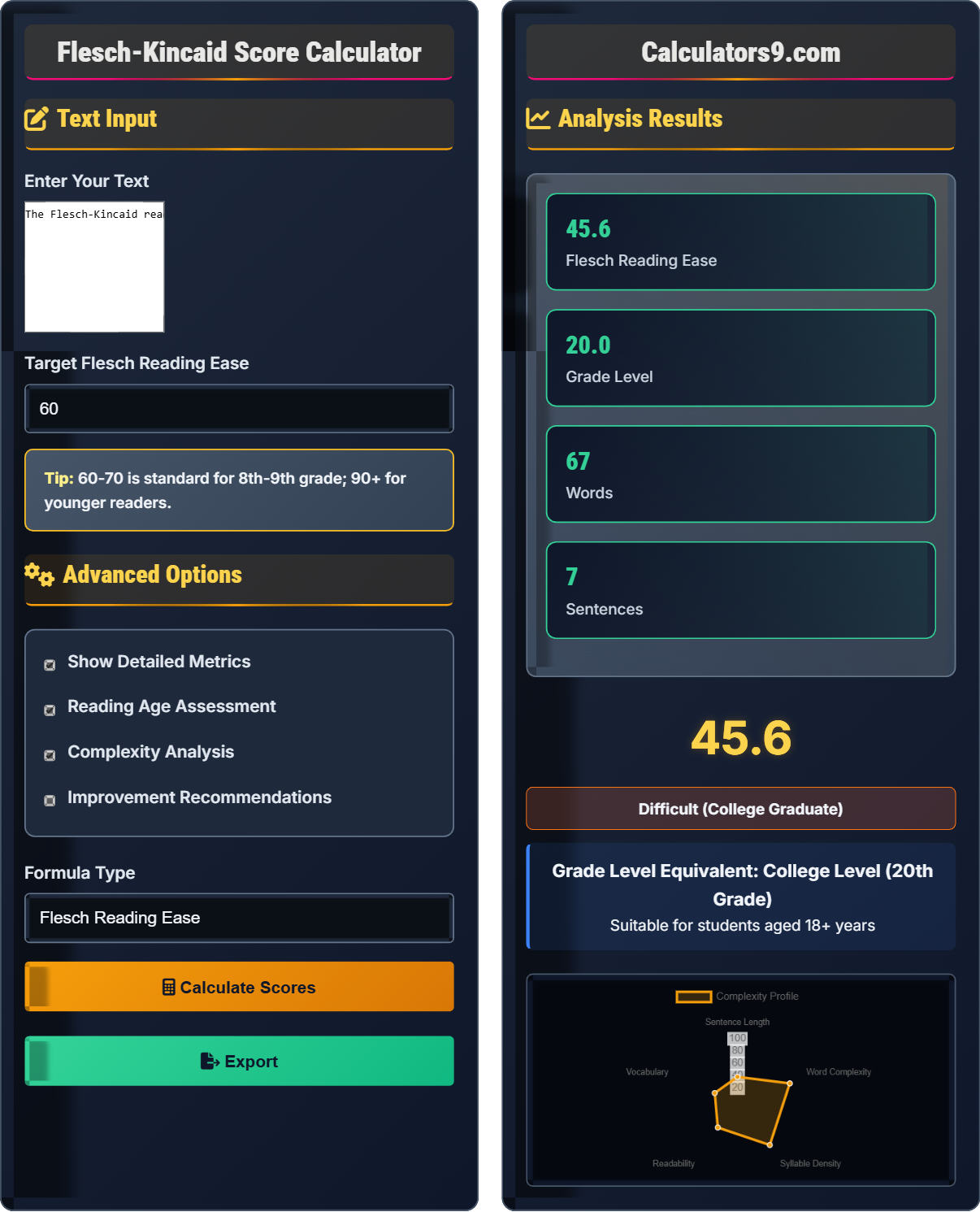
Text Input
Advanced Options
Analysis Results
Grade Level Equivalent: 8th-9th Grade
Suitable for students aged 13-15 years
Target Score: 60
Current Score: 65.4
Difference: +5.4 (Better than target)
- Consider using slightly longer sentences to increase complexity
- Introduce more complex vocabulary words strategically
- Vary sentence structures for enhanced readability
Comprehensive Flesch-Kincaid Guide
The Flesch-Kincaid readability tests are used to assess the reading difficulty of text. They provide objective measures of text complexity based on sentence length and word length (measured in syllables). These scores are widely used in education to match text difficulty with reader ability.
Two primary formulas exist:
Where ASL = Average Sentence Length, ASW = Average Syllables per Word
Flesch-Kincaid scores are invaluable in education:
- Curriculum Planning: Select appropriate reading materials
- Assessment: Evaluate student writing complexity
- Differentiation: Adapt materials for diverse learners
- Instruction: Guide writing development goals
- Placement: Determine appropriate reading levels
- Shorter Sentences: Reduce average sentence length
- Simpler Vocabulary: Use words with fewer syllables
- Active Voice: Generally creates shorter sentences
- Clear Transitions: Improve text flow
- Consistent Tone: Maintain appropriate complexity
Flesch-Kincaid Basics
Objective measures of text readability based on sentence and word length.
FRE = 206.835 - (1.015 × ASL) - (84.6 × ASW)
Essential calculation for readability assessment.
- Higher FRE scores = easier reading
- Lower FKGL scores = easier reading
- Match scores to target audience
Educational Applications
Aligning text complexity with reader ability.
- Assess current text difficulty
- Identify target audience
- Select appropriate materials
- Monitor comprehension outcomes
- Content affects readability
- Background knowledge matters
- Context influences comprehension
- Individual differences exist
Flesch-Kincaid Learning Quiz
What does a Flesch Reading Ease score of 85 indicate?
The answer is C) Very easy text. A Flesch Reading Ease score of 85 falls in the 80-90 range, which indicates "Easy" reading difficulty. This corresponds to approximately 6th-7th grade level. Higher scores indicate easier reading, with 90-100 being "Very Easy" (5th grade level). The Flesch Reading Ease scale is inverted, where higher numbers mean easier text.
Understanding the inverted nature of the Flesch Reading Ease scale is crucial. Unlike many measurement systems, higher scores indicate easier reading. This counterintuitive design means that 100 (very easy) is better than 0 (very difficult). Educators must be careful not to misinterpret the scale when selecting reading materials.
Flesch Reading Ease (FRE): Scale from 0-100 measuring text difficulty
Score Interpretation: Higher = Easier reading
Grade Level Equivalent: U.S. school grade required for comprehension
• Higher FRE scores = Easier reading
• 90-100 = Very Easy (5th grade)
• 60-70 = Standard (8th-9th grade)
• Remember: High score = Easy reading
• 60-70 is conversational level
• Confusing high scores with difficulty
• Misreading the inverted scale
If a text has 200 words, 10 sentences, and 250 syllables, what is the Flesch Reading Ease score?
Step 1: Calculate Average Sentence Length (ASL)
ASL = Total Words ÷ Total Sentences
ASL = 200 ÷ 10 = 20 words per sentence
Step 2: Calculate Average Syllables per Word (ASW)
ASW = Total Syllables ÷ Total Words
ASW = 250 ÷ 200 = 1.25 syllables per word
Step 3: Apply Flesch Reading Ease formula
FRE = 206.835 - (1.015 × ASL) - (84.6 × ASW)
FRE = 206.835 - (1.015 × 20) - (84.6 × 1.25)
FRE = 206.835 - 20.3 - 105.75 = 80.785
The Flesch Reading Ease score is approximately 80.8, indicating easy reading difficulty.
This calculation demonstrates the systematic approach to determining readability. The formula penalizes longer sentences (higher ASL) and more complex words (higher ASW). The constants in the formula (206.835, 1.015, 84.6) were derived empirically to correlate with human assessments of readability.
ASL: Average Sentence Length (words per sentence)
ASW: Average Syllables per Word
Empirical Formula: Based on observed data relationships
• ASL = Total Words ÷ Total Sentences
• ASW = Total Syllables ÷ Total Words
• FRE = 206.835 - (1.015 × ASL) - (84.6 × ASW)
• Calculate ASL and ASW first
• Substitute values carefully
• Dividing incorrectly
• Misapplying the formula
A 7th-grade teacher wants to select a text with a Flesch Reading Ease score between 60-70. She analyzes a passage that has 150 words, 8 sentences, and 180 syllables. Is this text appropriate for her students? What is the exact score?
Step 1: Calculate Average Sentence Length (ASL)
ASL = 150 ÷ 8 = 18.75 words per sentence
Step 2: Calculate Average Syllables per Word (ASW)
ASW = 180 ÷ 150 = 1.2 syllables per word
Step 3: Calculate Flesch Reading Ease
FRE = 206.835 - (1.015 × 18.75) - (84.6 × 1.2)
FRE = 206.835 - 19.031 - 101.52 = 86.284
The text has a Flesch Reading Ease score of 86.3, which is "Easy" reading (approximately 6th-7th grade level). This is below the target range of 60-70, making it easier than desired for 7th graders. The text is appropriate but may not provide sufficient challenge.
This example shows how educators can use Flesch-Kincaid scores for curriculum planning. The teacher's target of 60-70 corresponds to 8th-9th grade level, which would provide appropriate challenge for 7th graders. The calculated score of 86.3 indicates the text is too easy, suggesting she should select a more challenging passage.
Appropriate Challenge: Text slightly above current ability
Reading Level: Grade required for comprehension
Curriculum Planning: Systematic selection of materials
• Match scores to grade level targets
• Consider appropriate challenge level
• Use scores for systematic planning
• Set target ranges for grade levels
• Adjust for student abilities
• Not considering appropriate challenge level
• Misinterpreting score implications
A textbook editor wants to adjust a passage from a Flesch Reading Ease score of 55 to 75. The current text has 100 words and 5 sentences. How should they modify the text? Calculate the target values for average sentence length and syllables per word.
Step 1: Calculate current metrics
Current ASL = 100 ÷ 5 = 20 words per sentence
Current FRE = 55
Step 2: Set up equation for target FRE of 75
75 = 206.835 - (1.015 × ASL_new) - (84.6 × ASW_new)
(1.015 × ASL_new) + (84.6 × ASW_new) = 206.835 - 75 = 131.835
Step 3: To make text easier (higher FRE), reduce ASL and/or ASW
For example, if ASL_new = 15, then:
(1.015 × 15) + (84.6 × ASW_new) = 131.835
15.225 + (84.6 × ASW_new) = 131.835
84.6 × ASW_new = 116.61
ASW_new = 1.38
The editor should aim for shorter sentences (~15 words) and simpler words (~1.4 syllables per word).
This demonstrates how to reverse-engineer text modifications. To increase the FRE (make easier), both ASL and ASW must decrease. This requires either shorter sentences, simpler vocabulary, or both. Textbook editors use these calculations to adapt materials for different grade levels.
Text Modification: Adjusting content for readability
Reverse Engineering: Calculating requirements from desired outcome
Adaptation: Changing text for target audience
• Higher FRE requires lower ASL and ASW
• Modify sentence length and vocabulary
• Maintain content while adjusting complexity
• Shorter sentences improve readability
• Simpler words have fewer syllables
• Changing content instead of complexity
• Not maintaining educational value
What does a Flesch-Kincaid Grade Level of 10.0 indicate?
The answer is A) Text suitable for 10th graders. The Flesch-Kincaid Grade Level directly corresponds to U.S. school grade levels. A score of 10.0 indicates that the text requires the reading ability of a 10th-grade student (typically 15-16 years old). This system provides a straightforward interpretation compared to the Flesch Reading Ease scale.
The Flesch-Kincaid Grade Level is more intuitive than the Flesch Reading Ease scale because it directly indicates the grade level needed for comprehension. Unlike the FRE scale, higher numbers indicate greater difficulty. This makes it easier for educators to match text to grade-appropriate levels.
Flesch-Kincaid Grade Level (FKGL): Direct grade-level equivalent
U.S. School Grade: American educational system levels
Reading Ability: Skills needed for comprehension
• FKGL directly indicates grade level
• Higher numbers = More difficult
• 8.0 = 8th grade reading level
• FKGL is easier to interpret than FRE
• Match to appropriate grade level
• Confusing FKGL with FRE interpretation
• Not understanding grade-level equivalency
FAQ
Q: How do I interpret the relationship between Flesch Reading Ease and Flesch-Kincaid Grade Level?
A: The two scores are mathematically related but interpreted differently:
Flesch Reading Ease (FRE): Higher scores = easier reading (scale 0-100)
Flesch-Kincaid Grade Level (FKGL): Higher scores = harder reading (grade level equivalent)
Conversion approximation: \( \text{FKGL} \approx 12.5 - (0.11 \times \text{FRE}) \)
For example, FRE of 60 ≈ FKGL of 5.9. FRE is more intuitive for understanding difficulty direction, while FKGL directly indicates the grade level required for comprehension.
Q: What's the ideal Flesch Reading Ease score for different grade levels?
A: Recommended FRE scores by grade level:
- K-2: 90-100 (very easy)
- 3-5: 80-90 (easy)
- 6-8: 70-80 (fairly easy)
- 9-12: 60-70 (standard)
- College: 40-60 (difficult)
Mathematically: \( \text{Target FRE} = 105 - (2.3 \times \text{Grade Level}) \) for grades 1-12. For example, 8th grade (grade 8) would target FRE ≈ 86.6. This ensures appropriate challenge while maintaining comprehension.