Grammar Checker Simulator
Language analysis tool • 2026 best practices
Grammar Analysis Formulas:
Show the calculator\( \text{Error Density} = \frac{\text{Number of Errors}}{\text{Total Words}} \times 100 \)
\( \text{Accuracy Score} = \left(1 - \frac{\text{Number of Errors}}{\text{Total Opportunities}}\right) \times 100 \)
\( \text{Complexity Index} = \frac{\text{Total Grammar Rules Checked}}{\text{Text Length}} \)
Where:
- Error Density: Percentage of problematic words/phrases
- Accuracy Score: Overall correctness percentage
- Complexity Index: Depth of grammar analysis
Grammar checking algorithms evaluate:
- Syntax: Sentence structure and word order
- Morphology: Word formation and inflection
- Semantics: Meaning and context appropriateness
- Pragmatics: Contextual language use
Example: For text with 100 words and 5 errors:
Error Density = (5 ÷ 100) × 100 = 5%
Accuracy Score = (1 - 5/100) × 100 = 95%
This provides comprehensive language quality assessment.
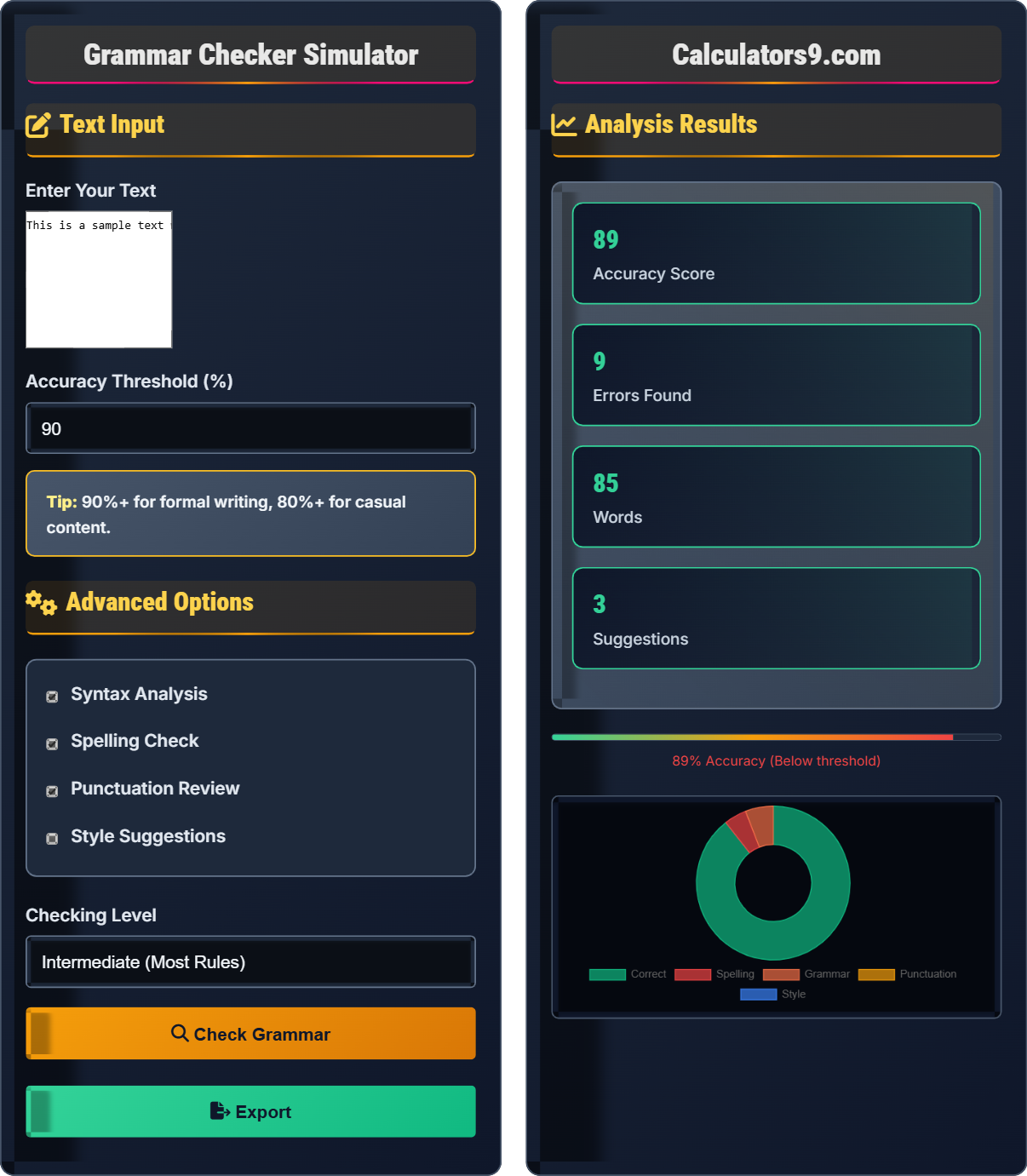
Text Input
Advanced Options
Analysis Results
Comprehensive Grammar Guide
Grammar checking involves analyzing text for adherence to linguistic rules and conventions. Modern grammar checkers evaluate syntax, morphology, semantics, and pragmatics to identify potential errors and suggest corrections.
Key metrics for evaluating text quality include:
Additional metrics:
- Syntax Adherence: Following sentence structure rules
- Morphological Accuracy: Correct word forms and inflections
- Semantic Coherence: Logical meaning and context
- Pragmatic Appropriateness: Context-sensitive usage
Common error types in writing:
- Spelling: Incorrect word spelling
- Grammar: Syntax and morphological errors
- Punctuation: Improper mark usage
- Style: Clarity and coherence issues
- Mechanics: Capitalization and formatting
- Read Aloud: Identifies awkward phrasing and errors
- Peer Review: Fresh eyes catch missed errors
- Consistent Practice: Regular writing improves skills
- Reference Materials: Use grammar guides and dictionaries
- Technology: Leverage grammar checking tools
Grammar Basics
Analysis of text for linguistic rule adherence and error identification.
Error density, accuracy score, complexity index
Essential measurements for language quality assessment.
- Subject-verb agreement
- Pronoun reference clarity
- Proper punctuation usage
Improvement Strategies
Systematic approach to finding and correcting language issues.
- Identify error type
- Apply relevant rule
- Verify correction
- Learn from mistake
- Context affects correctness
- Style varies by purpose
- Rules have exceptions
- Continuous learning needed
Grammar Analysis Learning Quiz
Which of the following represents a subject-verb disagreement error?
The answer is B) The students was excited. This is a subject-verb disagreement error because "students" is plural but "was" is singular. The correct form should be "were": "The students were excited." The subject "students" (plural) requires the plural verb "were," not the singular "was."
Subject-verb agreement is a fundamental grammar rule requiring that plural subjects take plural verbs and singular subjects take singular verbs. In the example, "students" is plural, so it must pair with a plural verb form. This rule applies regardless of intervening phrases or clauses.
Subject-Verb Agreement: Grammatical rule requiring matching number between subject and verb
Singular Subject: One person, place, thing, or idea
Plural Subject: More than one person, place, thing, or idea
• Plural subjects take plural verbs
• Singular subjects take singular verbs
• Intervening phrases don't affect agreement
• Find the true subject by removing modifiers
• Match number of subject to verb
• Being distracted by intervening phrases
• Confusing collective nouns
Identify the error in this sentence: "She don't like the way he writes." What is the grammatical rule being violated?
The error is "don't" which should be "doesn't." The grammatical rule being violated is subject-verb agreement in the third person singular. The correct sentence is: "She doesn't like the way he writes."
In English, third-person singular subjects (he, she, it) require the auxiliary verb "does" in negative constructions, not "do." The correct negative form is "doesn't" (does not), not "don't" (do not).
This error demonstrates the importance of understanding auxiliary verb patterns with different subjects. The auxiliary "do" is used with first and second person pronouns (I, you, we, they) in negatives, but "does" is used with third person singular (he, she, it). This is a common error among English learners.
Auxiliary Verb: Helper verb that adds functional or grammatical meaning
Third Person Singular: He, she, or it (referring to one person or thing)
Negative Construction: Forming sentences that express negation
• I/You/We/They + don't
• He/She/It + doesn't
• Third person singular requires special treatment
• Remember: He/She/It gets "doesn't"
• Practice with different subjects
• Using "don't" with third person singular
• Confusing auxiliary patterns
A student wrote an essay with 400 words that contains 12 grammar errors. If the target error density is less than 2%, is this essay acceptable? Calculate the actual error density and determine if it meets the requirement.
Step 1: Calculate error density
Error Density = (Number of Errors ÷ Total Words) × 100
Error Density = (12 ÷ 400) × 100 = 3%
Step 2: Compare to target
Target: Less than 2% error density
Actual: 3% error density
The essay has 3% error density, which is higher than the target of less than 2%. Therefore, the essay is not acceptable according to the error density requirement. The student needs to correct at least 4 more errors to meet the 2% threshold (at most 8 errors allowed).
This calculation demonstrates how to quantify text quality using error density metrics. Error density provides an objective measure of language proficiency that can be used to set benchmarks for writing assignments. Understanding this metric helps students target specific improvement goals.
Error Density: Percentage of errors relative to total words
Quality Benchmark: Standard for acceptable performance
Quantitative Assessment: Numerical evaluation method
• Error Density = (Errors ÷ Words) × 100
• Lower density = Higher quality
• Set benchmarks for improvement
• Calculate error density to track improvement
• Set specific targets for writing
• Not calculating percentages correctly
• Not setting appropriate benchmarks
A writer's text has an accuracy score of 75% with 500 words. They want to improve to 90% accuracy. How many errors must they eliminate? Calculate the current number of errors and the target number.
Step 1: Calculate current number of errors
Accuracy Score = (1 - Errors/Total Words) × 100
75 = (1 - Errors/500) × 100
0.75 = 1 - Errors/500
Errors/500 = 0.25
Current Errors = 0.25 × 500 = 125 errors
Step 2: Calculate target number of errors
90 = (1 - Errors/500) × 100
0.90 = 1 - Errors/500
Errors/500 = 0.10
Target Errors = 0.10 × 500 = 50 errors
Step 3: Calculate errors to eliminate
Errors to Eliminate = 125 - 50 = 75 errors
The writer must eliminate 75 errors to improve from 75% to 90% accuracy.
This demonstrates how to set measurable writing goals using accuracy metrics. The formula shows the relationship between errors and overall accuracy. Improving from 75% to 90% requires eliminating 75 errors, which is a significant improvement representing a 60% reduction in errors.
Accuracy Score: Percentage of text free from errors
Measurable Goals: Quantifiable improvement targetsPerformance Metrics: Standards for evaluation
• Accuracy = (1 - Errors/Words) × 100
• Set incremental improvement goals
• Track progress quantitatively
• Work backwards from target scores
• Set achievable milestones
• Not understanding the accuracy formula
• Setting unrealistic improvement goals
Which of the following sentences correctly applies the rule for possessive pronouns?
The answer is B) They're going to bring their books. This sentence correctly uses "they're" (contraction of "they are") and "their" (possessive pronoun). The rule for possessive pronouns states that "their" shows ownership without an apostrophe, unlike contractions which use apostrophes. "Their" indicates the books belong to them.
This question tests the distinction between contractions and possessive pronouns. Possessive pronouns (my, your, his, her, its, our, their) never use apostrophes, while contractions (they're, we're, you're) always use apostrophes. This is a common source of confusion in English grammar.
Contractions: Words formed by omitting letters and using apostrophes
Possessive Pronouns: Show ownership without apostrophes
Ownership: Relationship of belonging
• Possessive pronouns never use apostrophes
• Contractions always use apostrophes
• Their (possessive) vs They're (contraction)
• Remember: "Their" = belonging to them
• "They're" = they are
• Confusing possessive pronouns with contractions
• Adding unnecessary apostrophes
FAQ
Q: How do I know if my writing meets grammar standards?
A: Evaluate your writing using these metrics:
Error Density: \( \text{Density} = \frac{\text{Errors}}{\text{Words}} \times 100 \). For high school writing, aim for less than 3% error density.
Accuracy Score: \( \text{Score} = (1 - \frac{\text{Errors}}{\text{Opportunities}}) \times 100 \). Target 85-90% accuracy for formal writing.
Common checks include: subject-verb agreement, pronoun reference, punctuation, and capitalization. A good rule is that if you're unsure about a sentence, read it aloud to hear awkwardness.
Q: What's the difference between grammar and mechanics?
A: These are distinct but related concepts:
Grammar: Rules governing sentence structure, word forms, and meaning relationships. Example: "The students were excited" (subject-verb agreement).
Mechanics: Surface-level conventions like spelling, punctuation, and capitalization. Example: "Students' projects" (apostrophe for possession).
Mathematically: \( \text{Total Language Quality} = \text{Grammar} + \text{Mechanics} + \text{Style} \). Both contribute to overall writing effectiveness, but address different aspects of language use.