Pronunciation Guide
Fast IPA & Sound Pattern Tool • 2026 Edition
Pronunciation Formula:
Show the guide\( \text{Pronunciation Quality} = \frac{\text{Articulatory Accuracy} + \text{Prosodic Features}}{\text{Acoustic Similarity}} \)
Where:
- \( \text{Articulatory Accuracy} \) = Correct placement of tongue, lips, and jaw
- \( \text{Prosodic Features} \) = Stress, intonation, and rhythm patterns
- \( \text{Acoustic Similarity} \) = Sound resemblance to native speaker
This formula represents the multidimensional nature of pronunciation, combining physical articulation, prosodic elements, and acoustic quality. Effective pronunciation requires mastery of all three components.
Example: For the word "cat" /kæt/:
Articulatory: K sound at back of mouth, vowel fronted, T at tip of tongue
Prosodic: Single syllable with clear stress
Acoustic: Similar to native speaker production
Thus, the pronunciation quality depends on achieving accurate articulation, appropriate prosody, and acoustic similarity.
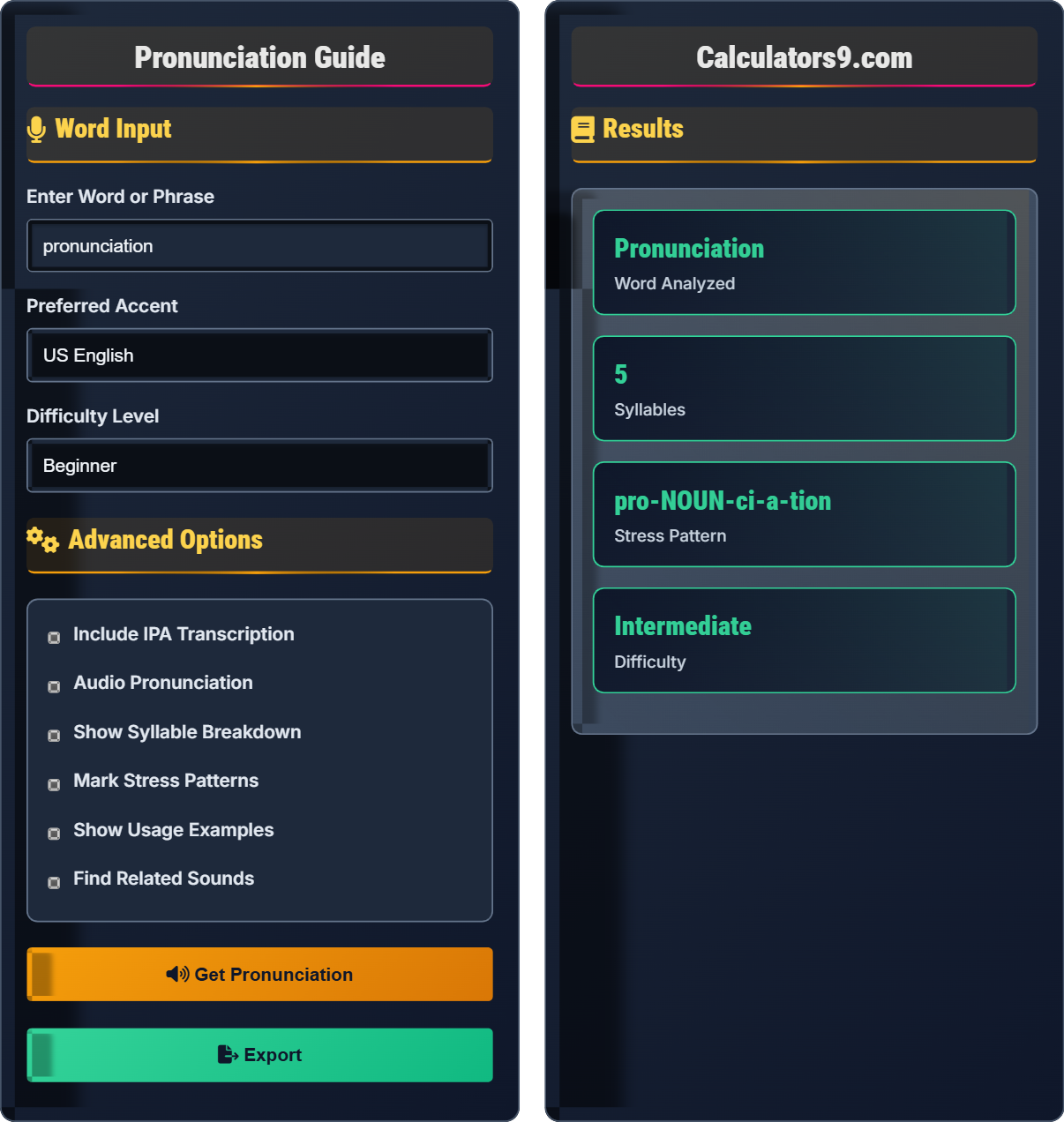
Word Input
Advanced Options
Results
Comprehensive Pronunciation Guide
The International Phonetic Alphabet (IPA) is a system of phonetic notation that represents the sounds of human speech. Each symbol corresponds to a specific sound, allowing for precise pronunciation guidance. IPA transcriptions appear between slashes / / for phonemic representation or square brackets [ ] for phonetic detail. Understanding IPA is essential for mastering pronunciation across different languages and dialects.
The IPA system organizes sounds by:
Where:
- Place: Where in the vocal tract the sound is made
- Manner: How the airflow is modified
- Voicing: Whether vocal cords vibrate
Key English phonemes include:
- Consonants: /θ/ (think), /ð/ (this), /ʃ/ (ship), /ʒ/ (measure)
- Vowels: /ɪ/ (sit), /i/ (seat), /ɛ/ (set), /æ/ (sat)
- Diphthongs: /aɪ/ (my), /aʊ/ (cow), /ɔɪ/ (boy)
- Rhythm: Stress-timed patterns with weak and strong syllables
- Listening Practice: Expose yourself to native speaker models
- Minimal Pairs: Practice sounds that are easily confused
- Mirror Work: Observe mouth positions while speaking
- Recording: Compare your pronunciation to models
- Slow Motion: Practice sounds slowly before increasing speed
- Consistent Practice: Daily practice for muscle memory development
Pronunciation Basics
International Phonetic Alphabet for precise sound representation.
By place, manner, and voicing.
Systematic organization of speech sounds.
- Each symbol represents one sound
- Context affects pronunciation
- Stress patterns matter
- Practice improves muscle memory
Improvement
Developing automatic pronunciation patterns.
- Listen and repeat
- Record yourself
- Use minimal pairs
- Focus on weak sounds
- Consistency is key
- Patience with progress
- Feedback from natives
- Contextual variations
Pronunciation Learning Quiz
Which IPA symbol represents the "th" sound in "think"?
The answer is B) /θ/. The IPA symbol /θ/ represents the voiceless dental fricative, which is the "th" sound in words like "think," "thank," and "thirty." This sound is produced by placing the tongue tip between the teeth and forcing air through the narrow opening.
This question tests knowledge of IPA symbols, which is fundamental to understanding pronunciation guides. The /θ/ symbol represents a sound that doesn't exist in many languages, making it particularly challenging for non-native speakers. Understanding IPA symbols helps learners accurately reproduce English sounds.
IPA: International Phonetic Alphabet
Dental Fricative: Sound made with tongue between teeth
Articulation: How speech sounds are produced
• Each IPA symbol represents one sound
• /θ/ is voiceless (no vocal cord vibration)
• Tongue placement is critical for this sound
• Place tongue tip between teeth
• Blow air gently through the opening
• Don't vibrate vocal cords
• Confusing /θ/ with /s/ or /f/ sounds
• Not placing tongue between teeth
• Adding vocal cord vibration
How would you transcribe the word "pronunciation" using IPA symbols?
The IPA transcription for "pronunciation" is /prəˌnʌn.siˈeɪ.ʃən/ (US) or /prəˌnʌn.siˈeɪ.tʃən/ (UK).
This transcription shows: • Primary stress on the 4th syllable: /siˈeɪ/ • Secondary stress on the 2nd syllable: /prəˌ/ • Weak vowels in unstressed syllables: /ə/, /ən/ • Final syllable: /ʃən/
This question demonstrates how IPA captures stress patterns and vowel reductions that are crucial for correct pronunciation. The stressed syllable (/siˈeɪ/) is pronounced more clearly, while unstressed syllables (/prə/, /ən/) use reduced vowels. Understanding stress patterns helps produce more natural-sounding speech.
Primary Stress: Most emphasized syllable
Secondary Stress: Moderately emphasized syllable
Weak Vowels: Reduced vowels in unstressed syllables
• Stress patterns affect vowel quality
• Unstressed syllables often have /ə/ sound
• IPA shows exact pronunciation details
• Focus on the stressed syllable
• Reduce unstressed syllables
• Practice with audio examples
• Stressing the wrong syllable
• Not reducing unstressed vowels
• Misidentifying the stressed syllable
Which of the following pairs represents a minimal pair that could help distinguish between /ɪ/ and /i/ sounds?
The answer is B) sit/seat. This is a minimal pair because the only difference is the vowel sound: "sit" contains /ɪ/ (short, high front vowel) while "seat" contains /i/ (long, high front vowel). Both words are identical except for this one sound, making them perfect for practicing the distinction.
Minimal pairs are essential tools for pronunciation practice because they isolate specific sound differences. In "sit" vs "seat," the /ɪ/ vs /i/ distinction is crucial - /ɪ/ is shorter and slightly more relaxed, while /i/ is longer and more tense. Practicing minimal pairs helps develop phonemic awareness and accurate sound production.
Minimal Pair: Words differing by one phoneme
Phonemic Awareness: Ability to recognize sound differences
Vowel Length: Duration difference between sounds
• Minimal pairs differ by only one sound
• They help distinguish similar sounds
• Practice improves sound discrimination
• Practice minimal pairs repeatedly
• Record yourself to compare
• Focus on the specific sound difference
• Not hearing the sound difference
• Producing the same sound for both words
• Confusing similar vowel sounds
Explain the difference in stress patterns between "photograph" and "photography" and how this affects their pronunciation.
"Photograph" /ˈfoʊ.tə.ɡræf/ has primary stress on the first syllable, while "photography" /fəˈtɑː.ɡrə.fi/ has primary stress on the second syllable.
This shift in stress affects: • First syllable: /ˈfoʊ/ vs /fə/ (full vowel vs schwa) • Second syllable: /tə/ vs /ˈtɑː/ (schwa vs stressed vowel) • Overall rhythm and sound of the words
Stress pattern changes are common when converting between different parts of speech (noun vs verb).
This question demonstrates how stress patterns change with word formation. The shift from noun "PHOtograph" to noun "phoTOGraphy" shows how adding suffixes can alter stress placement. Understanding these patterns helps produce more natural-sounding speech and improves listening comprehension.
Stress Shift: Change in emphasized syllable
Schwa /ə/: Reduced vowel sound
Word Formation: Creating new words from roots
• Stress patterns can change with word endings
• Vowel quality changes in stressed/unstressed syllables
• Part of speech affects stress placement
• Notice stress patterns in word families
• Practice with audio examples
• Focus on the stressed syllable
• Using same stress pattern for related words
• Not changing vowel quality in unstressed syllables
• Misplacing stress in derived forms
How would you classify the consonant /t/ in terms of place and manner of articulation?
The answer is C) Alveolar, stop, voiceless. The /t/ sound is produced by stopping the airflow at the alveolar ridge (just behind the upper teeth), making it an alveolar stop consonant. It's voiceless because the vocal cords don't vibrate during production. Examples: "top," "stop," "water."
This question tests understanding of consonant classification, which is fundamental to phonetics. Knowing place of articulation (where in the mouth), manner of articulation (how airflow is modified), and voicing (vocal cord vibration) helps understand how sounds are produced and can improve pronunciation accuracy.
Alveolar: Sound made at alveolar ridge
Stop: Complete airflow blockage
Voiced: Vocal cords vibrate
• Place: where sound is made
• Manner: how airflow is modified
• Voicing: vocal cord vibration
• Feel your mouth when producing sounds
• Notice tongue position
• Practice with mirror work
• Confusing place of articulation
• Mixing up manner of articulation
• Not distinguishing voiced/voiceless
FAQ
Q: Why is pronunciation so difficult for English learners?
A: English pronunciation presents unique challenges because:
Complex Sound System: English has 44 phonemes (sounds) compared to 20-30 in many other languages. Many sounds don't exist in other languages.
Inconsistent Spelling: The same letters can represent different sounds (e.g., "ough" in "tough," "through," "thought," "bough").
Stress-Timed Rhythm: English has a stress-timed rhythm where stressed syllables occur at regular intervals, with unstressed syllables compressed.
Weak Forms: Function words like "to," "for," "the" are often pronounced with weak vowels (/ə/, /ɪ/) in connected speech.
Connected Speech: Sounds change in context (assimilation, elision, liaison) making individual sounds blend together.
Regional Variations: Different English accents have different pronunciations for the same words.
Success requires focused practice on individual sounds, stress patterns, and rhythm.
Q: How can I help my students improve their pronunciation?
A: Effective pronunciation teaching strategies include:
Visual Aids: Use diagrams of the mouth, tongue position charts, and mirror work to show sound production.
Minimal Pairs: Practice words that differ by only one sound (e.g., "ship" vs "sheep") to develop discrimination.
Drill and Repeat: Systematic practice of individual sounds, then syllables, words, phrases, and sentences.
Contextual Practice: Use authentic materials like songs, poems, and dialogues to practice sounds in natural contexts.
Recording: Have students record themselves and compare to native speaker models.
Feedback: Provide immediate, specific feedback focusing on achievable improvements.
Phonemic Awareness: Teach students to recognize and distinguish between sounds before producing them.
Progressive Difficulty: Start with easier sounds and build to more complex patterns.
Consistent Practice: Regular, short practice sessions are more effective than infrequent intensive sessions.