Syllable Counter
Pronunciation analyzer • 2026 best practices
Syllable Counting Formulas:
Show the calculator\( \text{Syllables} = \text{Vowel Sounds in Word} \)
\( \text{Complexity Index} = \frac{\text{Total Syllables}}{\text{Total Words}} \)
\( \text{Reading Level} = 0.39 \times \frac{\text{Words}}{\text{Sentences}} + 11.8 \times \frac{\text{Syllables}}{\text{Words}} - 15.59 \)
Where:
- Syllables = Individual vowel sounds pronounced separately
- Complexity Index = Average syllables per word
- Reading Level = Grade level equivalent (Flesch-Kincaid)
Syllable counting follows these linguistic rules:
- Vowel Groups: Consecutive vowels often form one syllable (e.g., "boat" = 1 syllable)
- Silent 'e': Final 'e' is usually silent and doesn't create a new syllable
- R-Controlled Vowels: 'ar', 'er', 'ir', 'or', 'ur' often form single syllables
- Diphthongs: Two vowels forming one sound (e.g., "oi", "ou") = one syllable
Example: For the word "education" (edu-ca-tion):
Vowel sounds: e-du-ca-tion = 4 syllables
This helps determine pronunciation and reading difficulty.
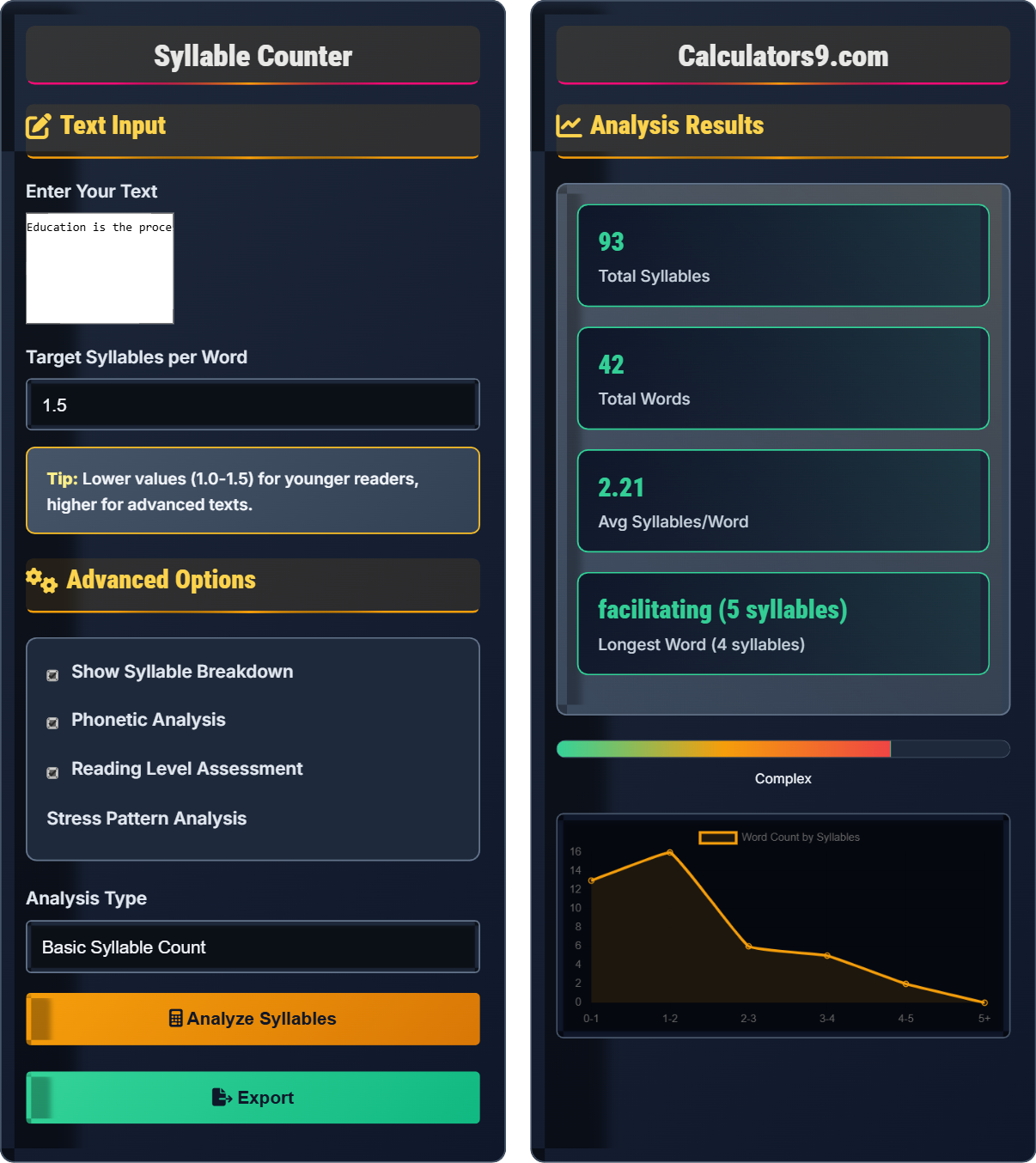
Text Input
Advanced Options
Analysis Results
Grade Level: 8-9
Suitable for middle school students
Comprehensive Syllable Guide
A syllable is a unit of pronunciation having one vowel sound, with or without surrounding consonants, forming the whole or part of a word. Syllables are the basic rhythmic units of speech and are essential for proper pronunciation and reading.
Follow these rules to count syllables accurately:
Core rules:
- Every vowel sound equals one syllable (not every vowel letter)
- Silent 'e' rule: Final 'e' is usually silent and doesn't create a syllable
- Vowel teams: Two vowels working together make one sound (ai, ea, ou)
- Consonant 'l' rule: 'l' after a vowel often creates a separate syllable (tunnel = tun-nel)
Syllable count correlates with reading difficulty:
- K-2: 1.0-1.3 syllables per word
- 3-5: 1.3-1.6 syllables per word
- 6-8: 1.6-1.9 syllables per word
- 9-12: 1.9-2.2 syllables per word
- College: 2.2+ syllables per word
- Clapping Method: Clap out each syllable while saying the word
- Chin Method: Place hand under chin, count movements for each syllable
- Hyphenation: Break words with hyphens at syllable boundaries
- Visual Aids: Use color coding for different syllables
- Practice Games: Syllable counting activities and challenges
Syllable Basics
One vowel sound with surrounding consonants.
Count individual vowel sounds, not letters.
Each vowel sound = one syllable unit.
- Count sounds, not letters
- Silent 'e' doesn't add syllables
- Vowel teams = one syllable
Learning Strategies
Breaking words into pronounceable chunks.
- Clap each syllable
- Use visual markers
- Practice with rhymes
- Read aloud regularly
- Language variations exist
- Context affects pronunciation
- Practice improves accuracy
- Audio feedback helps
Syllable Analysis Learning Quiz
How many syllables are in the word "education"?
The answer is B) 4 syllables. The word "education" breaks down as: ed-u-ca-tion. Each vowel sound represents one syllable. The vowel team "uca" forms one syllable, not three separate ones. Counting individual vowel sounds gives us 4 distinct syllables.
Understanding syllable division is crucial for pronunciation and reading. The word "education" demonstrates the vowel team concept where "uca" forms a single syllable despite containing multiple vowel letters. Students should focus on sounds rather than letters when counting syllables.
Syllable: One vowel sound with surrounding consonants
Vowel Team: Two or more vowels that produce one sound
Pronunciation: The way a word is spoken
• Count vowel sounds, not vowel letters
• Vowel teams form single syllables
• Silent 'e' doesn't add syllables
• Say the word slowly and listen for vowel sounds
• Try clapping out the rhythm
• Counting vowel letters instead of sounds
• Misidentifying vowel teams
Count the syllables in these words: "beautiful", "elephant", "computer". What is the average syllables per word?
Step 1: Count syllables in "beautiful"
beau-ti-ful = 3 syllables
Step 2: Count syllables in "elephant"
el-e-phant = 3 syllables
Step 3: Count syllables in "computer"
com-pu-ter = 3 syllables
Step 4: Calculate average
Average = (3 + 3 + 3) ÷ 3 = 3 syllables per word
All three words have 3 syllables, so the average is 3 syllables per word.
This exercise demonstrates how to systematically count syllables across multiple words. The silent 'e' in "computer" doesn't add a syllable, and vowel teams like "au" in "beautiful" form single syllables. Averaging syllable counts helps assess overall text complexity.
Average Syllables: Total syllables divided by total words
Text Complexity: Difficulty level based on linguistic features
Linguistic Features: Characteristics affecting readability
• Count each word individually
• Apply rules consistently
• Calculate averages for groups
• Break words into smaller parts
• Listen for vowel sounds
• Practice with familiar words first
• Inconsistent application of rules
• Miscounting vowel teams
A teacher analyzed a student's writing sample that contained 200 words and 320 syllables. If the target for the student's grade level is 1.4 syllables per word, how does this writing sample compare? Is it above or below the target complexity?
Step 1: Calculate actual average syllables per word
Average Syllables per Word = Total Syllables ÷ Total Words
Average = 320 ÷ 200 = 1.6 syllables per word
Step 2: Compare to target
Target: 1.4 syllables per word
Actual: 1.6 syllables per word
Difference: 1.6 - 1.4 = 0.2 syllables higher than target
The student's writing is 0.2 syllables per word more complex than the target, indicating slightly advanced vocabulary for their grade level.
This analysis shows how syllable counting can assess writing development. Students performing above their target syllable count may be ready for more advanced material, while those below may need additional support. The 0.2 difference suggests the student is slightly ahead of grade level expectations.
Grade Level Target: Expected complexity for age group
Writing Development: Progress in language and expressionAssessment Metric: Measurement for evaluation
• Calculate average syllables per word
• Compare to grade-level targets
• Consider individual differences
• Use multiple samples for accuracy
• Consider content area variations
• Not calculating averages properly
• Ignoring content-specific vocabulary
An author wants to simplify a text from 2.1 syllables per word to 1.5 syllables per word to reach a younger audience. If the current text is 1000 words, how many total syllables should the simplified version have? What percentage reduction is this?
Step 1: Calculate current total syllables
Current syllables = 1000 words × 2.1 syllables/word = 2,100 syllables
Step 2: Calculate target total syllables
Target syllables = 1000 words × 1.5 syllables/word = 1,500 syllables
Step 3: Calculate reduction
Reduction = 2,100 - 1,500 = 600 syllables
Percentage reduction = (600 ÷ 2,100) × 100 = 28.6%
The simplified version should have 1,500 total syllables, representing a 28.6% reduction in syllable count.
This demonstrates how authors can use syllable analysis to adapt texts for different audiences. The 28.6% reduction represents a significant simplification that would make the text more accessible to younger readers. This type of analysis is commonly used in educational publishing.
Text Simplification: Reducing complexity for accessibility
Audience Adaptation: Adjusting text for reader level
Accessibility: Ease of understanding
• Maintain core meaning during simplification
• Replace complex words with simpler synonyms
• Preserve essential information
• Use synonym dictionaries for alternatives
• Focus on replacing high-syllable words
• Oversimplifying to lose meaning
• Not considering context
Which of the following words follows the "vowel-consonant-e" syllable pattern?
The answer is B) hope. The "vowel-consonant-e" pattern occurs when a word ends with a vowel, followed by a consonant, and then a silent 'e'. In "hope", we have 'h' (consonant), 'o' (vowel), 'p' (consonant), and 'e' (silent). The silent 'e' makes the 'o' say its name, creating one syllable. This is different from "cat" (closed syllable), "boat" (vowel team), and "book" (closed syllable).
Recognizing syllable patterns helps with reading and spelling. The vowel-consonant-e pattern is one of the most common in English and affects pronunciation significantly. Understanding this pattern helps students decode unfamiliar words and spell them correctly.
Vowel-Consonant-e: Pattern where final 'e' is silent
Closed Syllable: Ends in a consonant
Vowel Team: Two vowels making one sound
• Silent 'e' makes preceding vowel long
• Creates one syllable despite multiple letters
• Common pattern in English words
• Look for vowel-consonant-'e' endings
• The 'e' is usually silent
• Counting silent 'e' as a syllable
• Not recognizing the vowel-consonant-e pattern
FAQ
Q: How can I teach syllable counting to young students?
A: Effective syllable teaching methods include:
Clapping Method: Have students clap along as they say each syllable: ba-na-na = clap-clap-clap
Chin Method: Place hand under chin, count jaw movements: each movement represents a syllable
Visual Markers: Use dots or circles under each syllable: beau-ti-ful
Mathematically, the syllable count formula is: \( \text{Syllables} = \text{Individual vowel sounds} \). For beginning readers, focus on simple CVC (consonant-vowel-consonant) words like "cat" (1 syllable) before progressing to multi-syllabic words.
Q: What's the difference between phonemes and syllables?
A: These are different linguistic units:
Syllables: Units of pronunciation containing one vowel sound (ba-na-na = 3 syllables)
Phonemes: Smallest units of sound that distinguish meaning (/b/ and /p/ in "bat" vs "pat")
In mathematical terms: \( \text{Syllables} \geq \text{Phonemes} \), since each syllable contains multiple phonemes. For example, "cat" has 1 syllable but 3 phonemes: /k/-/æ/-/t/. Syllables are larger rhythmic units, while phonemes are discrete sound segments.