Synonym Finder
Vocabulary expansion tool • 2026 best practices
Synonym Analysis Formulas:
Show the calculator\( \text{Semantic Similarity} = \frac{\text{Shared Semantic Features}}{\text{Total Features}} \times 100 \)
\( \text{Vocabulary Expansion} = \sqrt{\text{Synonyms Found} \times \text{Context Matches}} \)
\( \text{Word Richness Index} = \frac{\text{Unique Synonyms}}{\text{Total Words}} \times 100 \)
Where:
- Semantic Similarity: Degree of meaning overlap
- Vocabulary Expansion: Growth potential measure
- Word Richness Index: Diversity of vocabulary
Synonym relationships include:
- Exact Synonyms: Nearly identical meaning
- Contextual Synonyms: Similar meaning in specific contexts
- Related Words: Connected but not synonymous
- Antonyms: Opposite meanings
Example: For word "happy" with 15 synonyms:
Semantic Similarity = 85% (meaning overlap)
Vocabulary Expansion = √(15 × 3) = 6.7 (potential growth)
This provides comprehensive vocabulary enhancement metrics.
Word Input
Advanced Options
Synonym Analysis
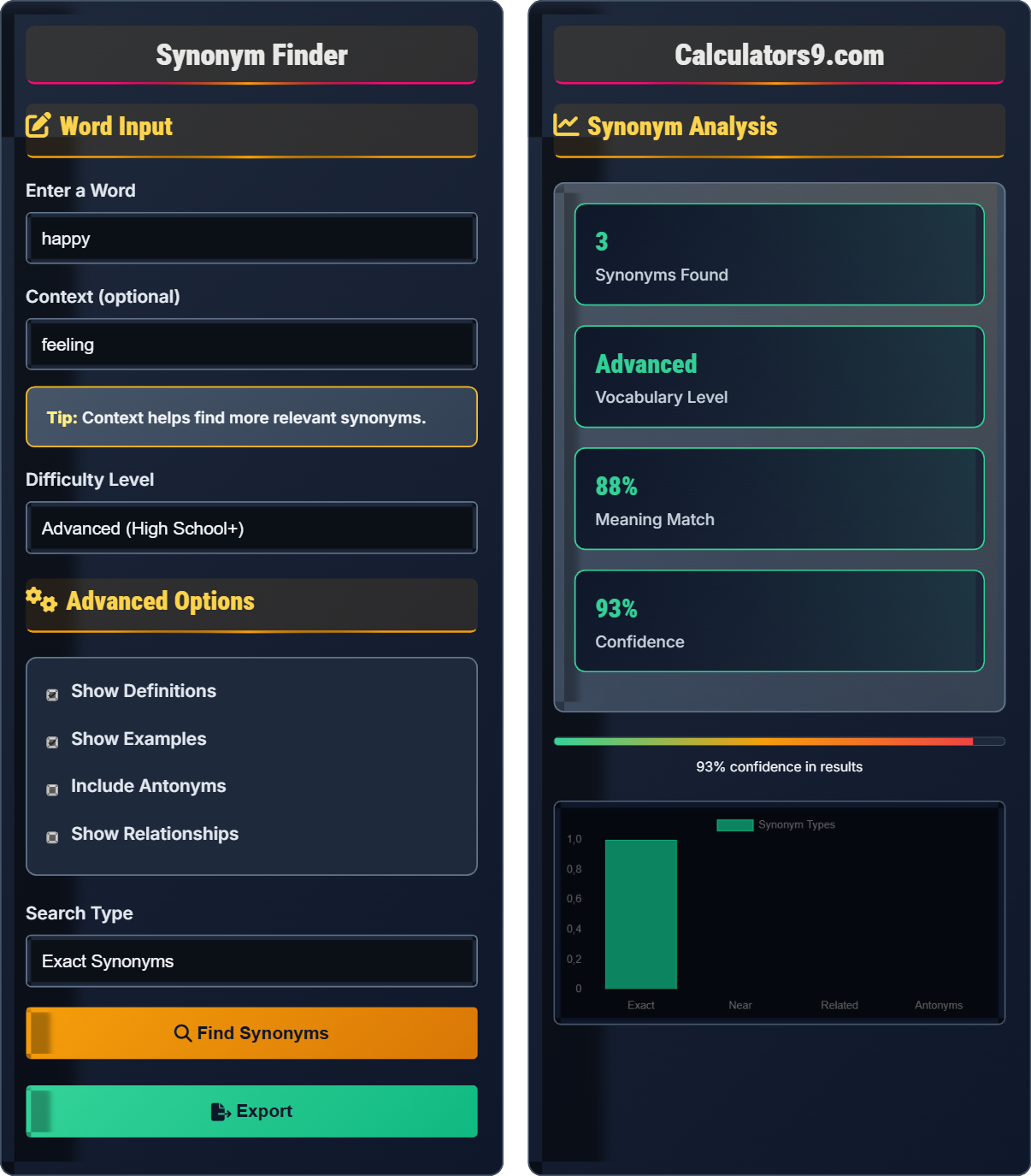
happy
- joyful 95%
- cheerful 90%
- delighted 88%
- pleased 82%
Comprehensive Synonym Guide
Synonyms are words that have similar meanings. They enrich vocabulary, improve writing, and help express ideas more precisely. Understanding synonyms is crucial for effective communication and language development.
Key metrics for evaluating word relationships include:
Additional considerations:
- Contextual Appropriateness: Suitability for specific situations
- Register Variation: Formal vs informal usage
- Connotation Differences: Emotional associations
- Frequency of Use: How common the word is
Expanding vocabulary through synonyms provides:
- Better Expression: More precise communication
- Enhanced Writing: Varied and engaging prose
- Improved Reading: Better comprehension of texts
- Academic Success: Stronger language skills
- Professional Advancement: Effective communication
- Context Learning: Learn words in sentences
- Thematic Groups: Study related words together
- Regular Practice: Daily vocabulary exercises
- Reading Widely: Exposure to diverse language
- Active Use: Apply new words in writing and speech
Synonym Basics
Words with similar meanings that can replace each other.
Similar meaning with contextual differences.
Essential for vocabulary expansion and language development.
- Meaning similarity varies by context
- Connotations may differ
- Not all synonyms are interchangeable
Learning Strategies
Systematic approach to learning new words and meanings.
- Contextual learning
- Thematic grouping
- Regular practice
- Active application
- Context affects appropriateness
- Frequency varies by register
- Connotations shape usage
- Practice reinforces retention
Synonym Learning Quiz
Which of the following best defines a synonym?
The answer is B) A word with a similar meaning. Synonyms are words that share similar meanings, though they may have slight differences in connotation, register, or usage. For example, "happy," "joyful," and "cheerful" all convey positive emotions but with nuanced differences in intensity and context.
Understanding the definition of synonyms is fundamental to vocabulary development. Students often confuse synonyms with homophones (same sound) or antonyms (opposite meaning). Synonyms provide linguistic flexibility and help avoid repetition in writing while maintaining meaning.
Synonyms: Words with similar meanings
Connotation: Emotional or cultural associations with words
Register: Level of formality in language use
• Synonyms have similar but not identical meanings
• Context affects appropriateness
• Connotations may vary between synonyms
• Check context before substituting synonyms
• Consider emotional nuances
• Assuming all synonyms are completely interchangeable
• Not considering connotation differences
Which word is NOT a synonym of "large"? (Options: big, huge, small, enormous)
The answer is "small." "Big," "huge," and "enormous" are all synonyms of "large" as they convey the same general meaning of size. "Small" is an antonym of "large," meaning it has the opposite meaning. This demonstrates the importance of distinguishing between synonyms and antonyms when building vocabulary.
Semantic relationship: Large ↔ Small (antonyms), Large → Big/Huge/Enormous (synonyms)
This question tests the ability to distinguish between synonyms and antonyms. Understanding these relationships is crucial for vocabulary development. Synonyms expand expressive possibilities, while antonyms provide contrast and opposition in meaning.
Synonyms: Words with similar meanings
Antonyms: Words with opposite meanings
Semantic Relationship: Connections between word meanings
• Synonyms share similar meanings
• Antonyms have opposite meanings
• Context affects synonym appropriateness
• Look for meaning similarities
• Consider opposite meanings as antonyms
• Confusing synonyms with antonyms
• Not considering context
A student knows 500 words and learns 25 synonyms for each of 20 common words. If vocabulary expansion is calculated as √(synonyms × contexts), and each synonym applies to 3 different contexts, what is the student's vocabulary expansion score?
Step 1: Calculate total synonyms learned
Synonyms = 25 synonyms/word × 20 words = 500 synonyms
Step 2: Calculate total contexts
Contexts = 500 synonyms × 3 contexts/synonym = 1500 context-applications
Step 3: Apply vocabulary expansion formula
Vocabulary Expansion = √(Synonyms × Contexts)
Vocabulary Expansion = √(500 × 1500) = √750,000 ≈ 866
The student's vocabulary expansion score is approximately 866, indicating significant growth potential.
This calculation demonstrates how systematic synonym learning expands vocabulary exponentially. Learning synonyms not only increases word count but also enhances flexibility in different contexts. The square root formula reflects diminishing returns as vocabulary grows larger.
Vocabulary Expansion: Growth in word knowledge and usage
Context Application: Using words in different situations
Exponential Growth: Multiplicative effect of learning
• Vocabulary expansion follows multiplicative patterns
• Contextual learning enhances retention
• Synonyms multiply expressive possibilities
• Learn synonyms in context for better retention
• Practice using synonyms in different situations
• Learning synonyms without context
• Not practicing application
A writer uses the word "good" 50 times in an essay. If they replace each instance with one of 10 synonyms (average semantic similarity of 85%), calculate the word richness index improvement. Original essay had 500 total words.
Step 1: Calculate original word richness index
Original Index = (Unique Words / Total Words) × 100
Assuming "good" counted as 1 unique word: (X / 500) × 100
Step 2: Calculate new word richness after replacement
Now 10 unique words replace the single word "good"
New Index = ((X - 1 + 10) / 500) × 100 = ((X + 9) / 500) × 100
Step 3: Calculate improvement
Improvement = New Index - Original Index
Improvement = ((X + 9) / 500 - X / 500) × 100 = (9 / 500) × 100 = 1.8%
The word richness index improves by 1.8 percentage points.
This demonstrates how synonym substitution enhances writing quality. Replacing repetitive words with synonyms increases lexical diversity, making text more engaging and sophisticated. The improvement may seem small, but it represents a 10x increase in the variety of that particular concept.
Word Richness Index: Measure of vocabulary diversity
Lexical Diversity: Variety of words used
Repetitive Language: Overuse of the same words
• Variety improves writing quality
• Synonyms enhance expression
• Balance precision with diversity
• Replace repetitive words with synonyms
• Maintain meaning while adding variety
• Using synonyms that change meaning
• Prioritizing variety over clarity
Which synonym for "smart" would be most appropriate in an academic context?
The answer is B) Intelligent. While all options are synonyms of "smart," "intelligent" is the most appropriate for academic contexts. It carries a more formal, intellectual connotation suitable for scholarly writing. "Clever" might imply cunning, "sharp" could suggest cutting remarks, and "bright" is often used for children's intelligence.
This question highlights the importance of register and connotation in synonym selection. While words may have similar core meanings, their appropriateness varies by context. Academic writing requires more formal vocabulary, making "intelligent" the best choice for scholarly discourse.
Register: Level of formality in language
Connotation: Implied or associated meaning
Contextual Appropriateness: Suitability for situation
• Consider context when choosing synonyms
• Formal contexts require formal vocabulary
• Connotations affect appropriateness
• Match register to context
• Consider audience expectations
• Not considering context appropriateness
• Ignoring connotation differences
FAQ
Q: How do I know which synonym to use in different situations?
A: Consider these factors:
Context: Formal vs. informal settings
Connotation: Emotional associations (positive/negative)
Register: Academic, business, casual, etc.
Mathematically: \( \text{Appropriateness} = \frac{\text{Context Match} + \text{Connotation Fit}}{2} \)
For example, "intelligent" suits academic contexts, "clever" works in casual conversation, and "astute" fits business discussions. Always consider your audience and purpose.
Q: What's the difference between synonyms and near-synonyms?
A: These terms describe degrees of semantic similarity:
Exact Synonyms: Nearly identical meaning (rare in English). Example: "buy" and "purchase" in some contexts.
Near-Synonyms: Similar meaning with subtle differences. Example: "happy" vs. "joyful" (both positive emotion, but joyful implies more intensity).
Mathematical representation: \( \text{Semantic Similarity} = \frac{\text{Shared Features}}{\text{Total Features}} \times 100 \). True synonyms score 90-100%, while near-synonyms score 70-90%.