Word Counter
Text analysis tool • 2026 best practices
Text Analysis Formulas:
Show the calculator\( \text{Words} = \text{Count of separated terms} \)
\( \text{Characters} = \text{Total characters including spaces} \)
\( \text{Sentences} = \text{Count of sentence-ending punctuation} \)
\( \text{Average Sentence Length} = \frac{\text{Total Words}}{\text{Total Sentences}} \)
Where:
- Words = Individual terms separated by spaces/punctuation
- Characters = Total letters, numbers, spaces, and symbols
- Sentences = Phrases ending with ., !, ?
- Readability = Measure of text complexity
Text analysis evaluates writing quality using metrics like:
- Flesch Reading Ease: Higher scores indicate easier reading
- Average Sentence Length: Longer sentences may indicate complexity
- Vocabulary Density: Word variety affects comprehension
- Character Distribution: Spacing and punctuation patterns
Example: For a 300-word text with 10 sentences:
Average sentence length = 300 ÷ 10 = 30 words per sentence
This provides insights into text complexity and readability.
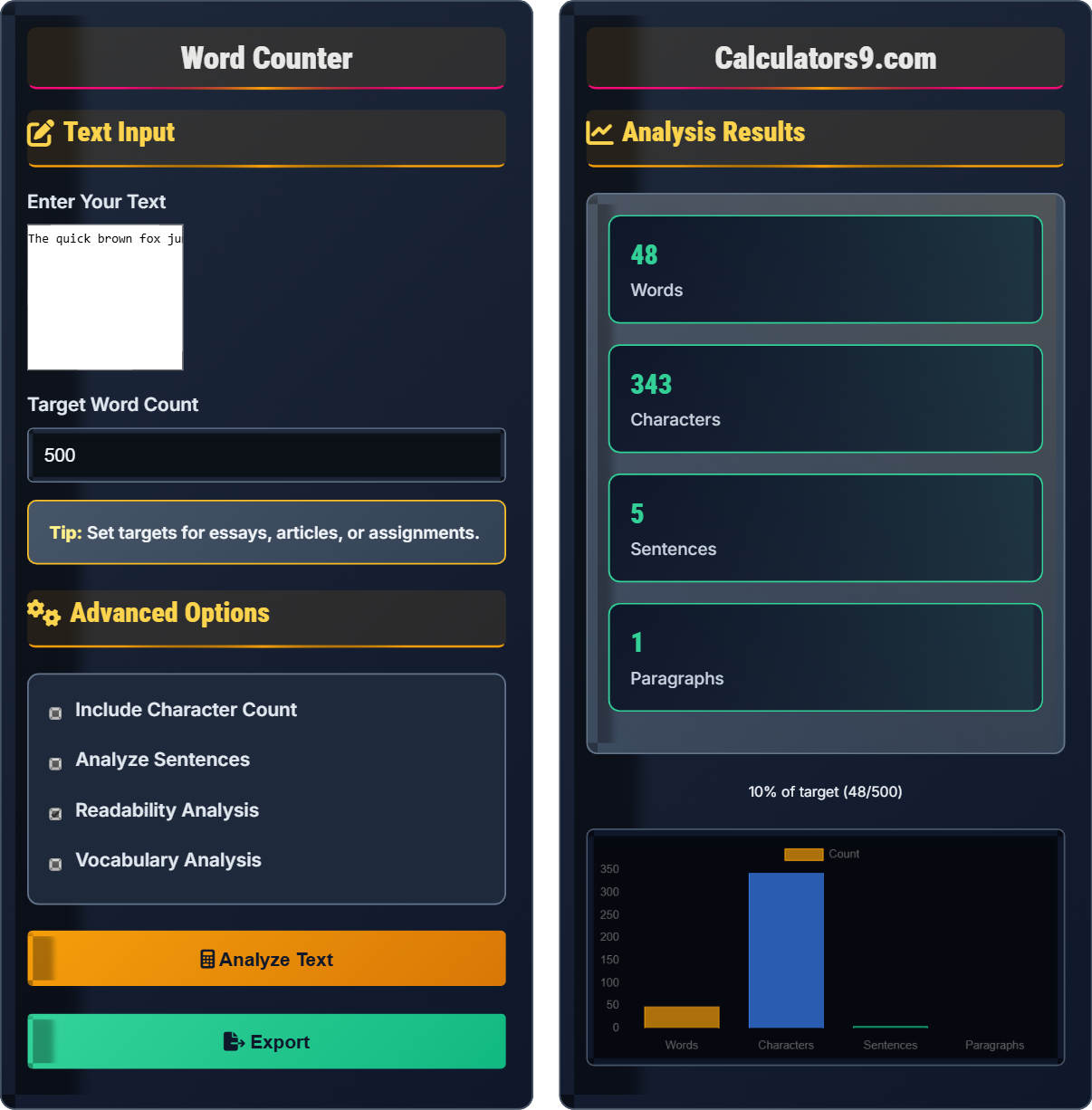
Text Input
Advanced Options
Analysis Results
Writing Suggestions:
- Use shorter sentences for better readability
- Vary sentence beginnings to improve flow
- Consider using more active voice constructions
Comprehensive Writing Guide
Text analysis is the process of examining written content to extract meaningful information about its structure, complexity, and readability. It helps writers understand how their text will be perceived by readers and identify areas for improvement.
Key metrics for evaluating text quality include:
Where ASL = Average Sentence Length, ASW = Average Syllables per Word
Additional metrics:
- Word Count: Total number of words in the text
- Character Count: Total number of characters including spaces
- Sentence Count: Number of sentences based on punctuation
- Paragraph Count: Number of paragraph breaks
Enhance your writing with these techniques:
- Vary sentence length: Mix short and long sentences for rhythm
- Use active voice: Makes writing more direct and clear
- Eliminate unnecessary words: Concise writing is more impactful
- Check for repetition: Vary vocabulary to maintain interest
- Read aloud: Helps identify awkward phrasing
- Essay Length: High school: 500-1000 words, College: 1000-2500 words
- Paragraph Structure: Topic sentence, supporting details, conclusion
- Citation Style: Follow APA, MLA, or Chicago formatting guidelines
- Readability Target: Aim for 60-70 for general audiences
- Revision Process: Multiple drafts with peer review
Text Analysis Basics
Examines text structure, complexity, and readability metrics.
Words, Characters, Sentences, Readability Score
Essential measurements for evaluating text quality.
- Count words by space separation
- Measure readability for audience
- Check sentence variety
Improvement Strategies
Measures how easily text can be understood by readers.
- Reduce sentence length
- Use simpler vocabulary
- Add subheadings
- Include examples
- Target audience knowledge
- Subject matter complexity
- Document purpose
- Format requirements
Writing Analysis Learning Quiz
What does the Flesch Reading Ease score measure in text analysis?
The answer is B) How easy the text is to read. The Flesch Reading Ease score is a readability test designed to indicate how difficult a passage in English is to understand. Higher scores (90-100) indicate easier reading, while lower scores (0-30) indicate more difficult text. The formula considers average sentence length and average syllables per word.
Understanding readability metrics is crucial for effective communication. The Flesch Reading Ease score helps writers adjust their language complexity to match their target audience. For example, educational materials for children should aim for higher scores, while academic papers may appropriately have lower scores.
Flesch Reading Ease: A readability test measuring text difficulty (0-100 scale)
Average Sentence Length: Total words divided by number of sentences
Text Complexity: How difficult text is to comprehend
• Higher scores indicate easier reading
• Scores between 60-70 are suitable for 13-15 year olds
• Match readability to your target audience
• Remember: Higher = Easier to read
• Use shorter sentences to improve scores
• Confusing readability with spelling accuracy
• Not considering target audience needs
If a text contains 450 words and 15 sentences, what is the average sentence length? If the target is 25 words per sentence, how does this compare?
Step 1: Calculate average sentence length
Average Sentence Length = Total Words ÷ Total Sentences
Average Sentence Length = 450 ÷ 15 = 30 words per sentence
Step 2: Compare to target
Target: 25 words per sentence
Actual: 30 words per sentence
Difference: 30 - 25 = 5 words longer than target
The text has sentences that are 5 words longer than the target, which may make it more difficult to read.
This calculation demonstrates how sentence length affects readability. Longer sentences require readers to hold more information in their working memory, potentially making comprehension more difficult. Writers aiming for clarity often target shorter sentences, especially for general audiences.
Average Sentence Length: Mean number of words per sentence
Working Memory: Cognitive capacity for holding information temporarily
Readability: How easily text can be understood
• Average Sentence Length = Total Words ÷ Total Sentences
• Shorter sentences improve readability
• Target varies by audience and purpose
• Divide total words by sentence count for average
• Aim for 15-20 words for general audiences
• Forgetting to divide by number of sentences
• Not considering the impact on readability
A student wrote an essay that is 850 words long with 42 sentences. The assignment required a minimum of 800 words. If the ideal average sentence length for this assignment is 18 words per sentence, how does the student's essay compare? Is it within the target parameters?
Step 1: Check if the word count meets requirements
Required: 800 words minimum
Submitted: 850 words
Result: Meets requirement (850 > 800)
Step 2: Calculate actual average sentence length
Average Sentence Length = 850 ÷ 42 = 20.24 words per sentence
Step 3: Compare to ideal length
Ideal: 18 words per sentence
Actual: 20.24 words per sentence
Difference: 2.24 words longer than ideal
The essay meets the word count requirement but has sentences that are slightly longer than the ideal length, which may affect readability.
This problem demonstrates how to evaluate multiple aspects of writing quality simultaneously. Meeting word count requirements is just one aspect; sentence structure also impacts the effectiveness of communication. Students should consider both quantity and quality metrics when revising their work.
Assignment Requirements: Minimum standards for submission
Quality Metrics: Measures of writing effectiveness beyond quantity
Academic Writing: Formal writing for educational purposes
• Meet minimum word count requirements
• Maintain appropriate sentence lengths
• Balance quantity with quality metrics
• Check both word count and sentence length
• Revise for clarity and conciseness
• Focusing only on word count requirements
• Not considering sentence structure impact
A writer has a document with a Flesch Reading Ease score of 45, which is considered "Difficult." The text has 500 words and 25 sentences. To improve the score to "Fairly Easy" (60-70), what changes could they make? Calculate the target average sentence length for a score of 65.
Step 1: Calculate current average sentence length
Current Average = 500 ÷ 25 = 20 words per sentence
Step 2: Understand the relationship between sentence length and readability
Shorter sentences generally improve readability scores
Step 3: To achieve a score of 65 (Fairly Easy), the writer should reduce average sentence length
Target average sentence length: 15-16 words per sentence
Step 4: Calculate target sentence count
Target sentences = 500 ÷ 15 = 33.3 sentences (round to 33-34)
The writer should increase sentence count from 25 to 33-34 sentences to achieve the target readability score.
This demonstrates how writers can use quantitative metrics to improve their text. By understanding the relationship between sentence length and readability, writers can make targeted revisions. Breaking longer sentences into shorter ones often improves clarity and comprehension.
Readability Score: Quantitative measure of text difficulty
Text Revision: Process of improving written content
Quantitative Metrics: Numerical measures of text characteristics
• Shorter sentences improve readability scores
• Target scores based on intended audience
• Use metrics to guide revision decisions
• Break long sentences at logical pauses
• Use active voice to create shorter sentences
• Not using metrics to guide improvements
• Creating too many very short sentences
Which of the following is the BEST indicator of good writing quality based on text analysis metrics?
The answer is B) High readability score with appropriate complexity. Good writing balances accessibility with appropriate complexity for the target audience. A high readability score indicates the text is easy to understand, but it must also be appropriately complex for the subject matter and audience. Simply having high counts (A, D) or uniform sentence length (C) doesn't indicate quality.
This question emphasizes that writing quality isn't just about quantity but about appropriateness. Effective writing matches the complexity to the audience while maintaining clarity. A research paper for academics will have different readability expectations than a children's story, but both should be appropriately complex for their audiences.
Writing Quality: Effectiveness of communication in written form
Appropriate Complexity: Level of difficulty matching audience needs
Accessibility: How easily content can be understood
• Match complexity to audience capability
• Prioritize clarity and understanding
• Consider purpose and context
• Know your audience before writing
• Test readability with sample readers
• Equating length with quality
• Not considering audience needs
FAQ
Q: How do I know if my essay meets the required word count and readability standards?
A: To evaluate your essay, calculate these key metrics:
Word Count Verification: Total words should meet assignment requirements. For example, if required 800 words and you have 750, you need 50 more words.
Readability Assessment: Use the Flesch Reading Ease formula: \( \text{Score} = 206.835 - (1.015 \times ASL) - (84.6 \times ASW) \)
Where ASL (Average Sentence Length) = Total Words ÷ Total Sentences, and ASW (Average Syllables per Word) = Total Syllables ÷ Total Words.
For college-level writing, aim for a score between 50-60 (Fairly Difficult) to ensure adequate complexity while maintaining comprehension.
Q: What's the difference between character count with and without spaces?
A: The distinction matters for different applications:
Characters With Spaces: Counts every character including spaces, punctuation, and special characters. For example, "Hello world" has 11 characters with spaces.
Characters Without Spaces: Excludes space characters but includes all letters, numbers, punctuation, and special characters. The same "Hello world" has 10 characters without spaces.
In mathematical terms: \( \text{Chars Without Spaces} = \text{Total Chars} - \text{Space Count} \)
Social media platforms like Twitter often use character count without spaces for certain limits, while some academic submissions may specify total character count including spaces.