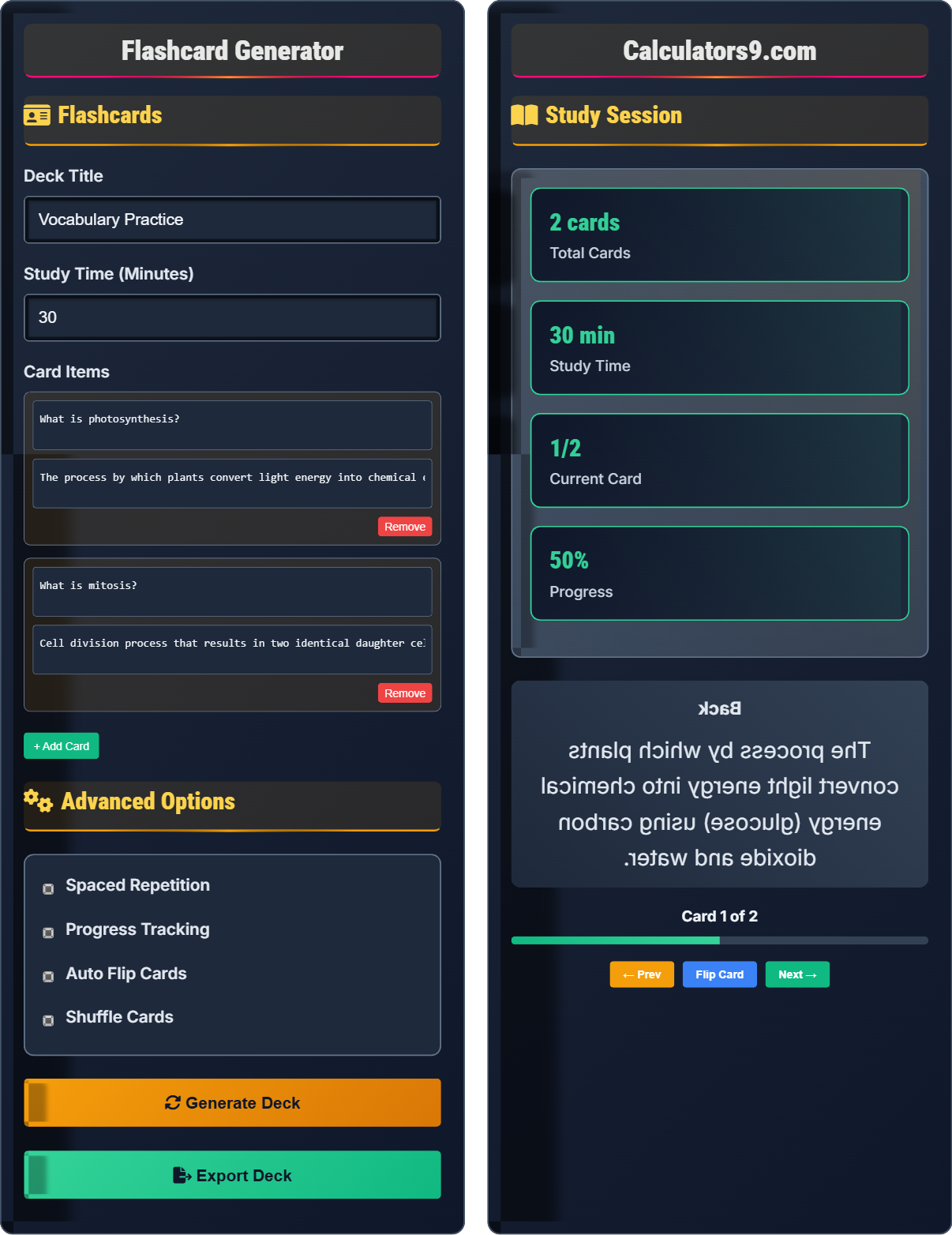
Flashcard Generator
Interactive study aid • 2026 edition
Spaced Repetition Formula:
Show the generator\( I(n) = I(0) \times e^{(k \times n)} \)
Where:
- \( I(n) \) = Interval for nth review
- \( I(0) \) = Initial interval (e.g., 1 day)
- \( k \) = Growth factor (typically 1.0-2.5)
- \( n \) = Review number
This formula calculates the optimal time intervals between reviews based on spaced repetition principles. It ensures that items are reviewed just before they are likely to be forgotten, maximizing retention efficiency.
Example: With \( I(0) = 1 \) day and \( k = 1.5 \):
Review 1: Day 1
Review 2: Day 2.7 (1 × e^(1.5×1))
Review 3: Day 9.5 (1 × e^(1.5×2))
Thus, intervals grow exponentially based on successful recalls.
Flashcards
Advanced Options
Study Session
Comprehensive Flashcard Guide
Flashcards are learning tools consisting of cards with information on both sides, used to test memory and recall. They typically feature a question, term, or concept on one side and the answer, definition, or explanation on the other. Flashcards leverage the psychological principle of active recall, where learners actively retrieve information from memory rather than passively reviewing material.
The fundamental spaced repetition calculation uses the following formula:
Where:
- \(I(n)\) = Interval for nth review
- \(I(0)\) = Initial interval (typically 1 day)
- \(k\) = Growth factor (1.0-2.5)
- \(n\) = Review number
Well-designed flashcards follow these principles:
- One Concept: Each card should focus on a single idea or fact
- Clear Questions: Front side should have unambiguous questions
- Concise Answers: Back side should provide clear, brief responses
- Examples: Include relevant examples when helpful
- Visual Elements: Use diagrams or images when appropriate
- Chunking: Break complex information into smaller, manageable pieces
- Mnemonic Devices: Use acronyms, rhymes, or associations
- Self-Explanation: Explain concepts in your own words
- Retrieval Practice: Actively recall information without looking
- Testing Effect: Practice recalling information under test conditions
Flashcard Basics
Actively retrieving information from memory without cues.
\( I(n) = I(0) \times e^{(k \times n)} \)
Where I=interval, n=review number, k=growth factor.
- Focus on one concept per card
- Use active recall over passive review
- Space reviews at increasing intervals
Strategies
Review material at increasing intervals to optimize long-term retention.
- Review immediately after learning
- Review after 1 day
- Review after 3 days
- Review after 1 week
- Review after 2 weeks
- Adjust intervals based on difficulty
- Review missed cards more frequently
- Combine with other study methods
- Track performance over time
Flashcard Learning Quiz
What is the primary cognitive benefit of using active recall (testing yourself) compared to passive review (reading notes) when using flashcards?
The answer is B) It strengthens memory pathways through retrieval practice. Active recall requires you to retrieve information from memory, which strengthens the neural pathways associated with that information. This retrieval process is more demanding than simply recognizing information during passive review, but it results in significantly better long-term retention. Research consistently shows that testing oneself produces superior learning outcomes compared to passive review methods.
The testing effect, also known as retrieval practice, is one of the most robust findings in cognitive psychology. When you actively retrieve information from memory, you strengthen the memory trace and make future retrieval easier. This is different from recognition, which is what happens during passive review. The effort required to retrieve information appears to be crucial for long-term retention. This explains why flashcards, which inherently involve active recall, are more effective than simply re-reading material.
Active Recall: Retrieving information from memory without cues
Passive Review: Recognizing information when presented
Memory Pathways: Neural connections formed during learning
• Test yourself before looking at the answer
• Focus on retrieval rather than recognition
• The difficulty of retrieval predicts learning strength
• Say the answer out loud before flipping the card
• Write down the answer before checking
• Explain the concept in your own words
• Looking at the answer immediately without trying to recall
• Reading through cards without testing yourself
• Confusing familiarity with actual knowledge
Using the spaced repetition formula \( I(n) = I(0) \times e^{(k \times n)} \) with \( I(0) = 1 \) day and \( k = 1.5 \), calculate when you should review a card for the third time. Show your work.
Using the formula: \( I(n) = I(0) \times e^{(k \times n)} \)
Given:
- \( I(0) = 1 \) day (initial interval)
- \( k = 1.5 \) (growth factor)
- \( n = 2 \) (for the third review, since n starts at 0)
Step 1: Calculate the exponent
\( k \times n = 1.5 \times 2 = 3 \)
Step 2: Calculate \( e^3 \)
\( e^3 \approx 20.09 \)
Step 3: Calculate the interval
\( I(2) = 1 \times 20.09 = 20.09 \) days
Therefore, you should review the card for the third time in approximately 20 days.
This exponential formula demonstrates how spaced repetition algorithms work. As you successfully recall information, the intervals between reviews increase exponentially. This optimizes study time by focusing on items you're having trouble remembering while reducing review frequency for items you know well. The algorithm ensures you review material just before you're likely to forget it, maximizing retention efficiency.
Spaced Repetition: Reviewing material at increasing intervals
Exponential Growth: Intervals increase by a constant factor
Optimal Timing: Reviewing just before forgetting
• Review intervals grow exponentially with successful recalls
• Failed recalls reset or shorten intervals
• The algorithm adapts to individual performance
• Use apps that implement spaced repetition algorithms
• Adjust intervals based on difficulty
• Track your performance to refine timing
• Reviewing at fixed intervals instead of adaptive timing
• Not adjusting intervals based on performance
• Confusing massed practice with distributed practice
Research shows that students using active recall (flashcards) retain 80% of information after one week, while those using passive review retain only 20%. If a student has 50 terms to learn, how many more terms will they remember after one week using flashcards compared to passive review?
Step 1: Calculate terms retained with active recall
Flashcards: 50 × 0.80 = 40 terms
Step 2: Calculate terms retained with passive review
Passive: 50 × 0.20 = 10 terms
Step 3: Calculate the difference
Difference: 40 - 10 = 30 terms
Therefore, the student will remember 30 more terms using flashcards compared to passive review after one week.
This dramatic difference in retention rates highlights the effectiveness of active recall. The 4x improvement in retention demonstrates why flashcards are considered one of the most effective study techniques. This is based on extensive research in cognitive psychology showing that the act of retrieving information strengthens memory more than simply re-exposing yourself to it. The effort required to recall information appears to be crucial for long-term learning.
Retention Rate: Percentage of information remembered after a time period
Active Recall: Retrieving information without cues
Passive Review: Recognizing information when presented
• Active recall produces significantly better retention than passive review
• The effort required for retrieval enhances memory formation
• Retention differences become more pronounced over time
• Combine flashcards with other active learning techniques
• Use spaced repetition to maintain high retention
• Focus on terms you struggle to recall
• Assuming passive review is as effective as active recall
• Not implementing spaced repetition with flashcards
• Using too much information per card
A student is creating flashcards for organic chemistry reactions. Which of the following is the best way to format a card about the SN1 reaction mechanism? Explain why this format is more effective than alternatives.
The answer is B) Front: "What is the mechanism of an SN1 reaction?" | Back: "Carbocation intermediate forms, then nucleophile attacks from either side causing racemization". This format is most effective because:
1. It asks a specific question that requires understanding of the mechanism
2. The answer is concise but complete
3. It focuses on a single concept (the mechanism)
4. It requires the learner to mentally organize the information to answer
Option A is too brief on the front, Option C tries to cover too much on one card, and Option D is too specific to a single example rather than the general mechanism.
Effective flashcard design follows the principle of "minimum information principle" - each card should focus on a single concept or piece of information. This prevents cognitive overload and allows for focused practice. The question on the front should be specific enough to require a clear answer but general enough to promote understanding. Good flashcard questions engage higher-order thinking skills rather than simple memorization.
Minimum Information Principle: Each card should focus on a single concept
Cognitive Load: The amount of mental effort required to process information
Active Processing: Mentally engaging with information rather than passively receiving it
• One concept per card
• Formulate clear questions on the front
• Keep answers concise but complete
• Focus on understanding rather than rote memorization
• Use questions that require explanation, not just definitions
• Include examples when helpful for understanding
• Break complex topics into multiple simpler cards
• Including too much information on a single card
• Using vague questions that don't require specific answers
• Creating cards that only test recognition rather than recall
Which combination of techniques will most effectively enhance long-term retention when using flashcards?
The answer is B) Distributed practice with active recall and spaced repetition. This combination leverages three evidence-based learning strategies: 1) Distributed practice spreads study sessions over time, improving retention compared to massed practice (cramming). 2) Active recall strengthens memory pathways through retrieval practice. 3) Spaced repetition optimizes review timing based on forgetting curves. Together, these techniques create optimal conditions for long-term retention.
These three techniques work synergistically. Distributed practice prevents interference between learning sessions, active recall strengthens memory traces, and spaced repetition ensures optimal timing of reviews. Research consistently shows that combining these methods produces superior learning outcomes compared to any single technique. This is why modern flashcard applications incorporate all three principles.
Distributed Practice: Spreading study sessions over time
Massed Practice: Concentrating study in a single session (cramming)
Forgetting Curve: Graph showing how quickly information is forgotten over time
• Distribute study sessions over multiple days
• Actively retrieve information rather than recognize it
• Space reviews at increasing intervals
• Combine multiple evidence-based techniques
• Use spaced repetition algorithms when possible
• Mix different types of material in each session
• Review difficult cards more frequently
• Cramming all flashcards in one session
• Simply recognizing information instead of recalling it
• Reviewing all cards at the same frequency
FAQ
Q: How many flashcards should I review in one session for optimal learning?
A: The optimal number depends on your attention span and the difficulty of the material, but research suggests 15-25 cards per session is ideal for most learners.
The cognitive load formula for flashcard sessions:
\( CL = \frac{N \times D}{T} \)
Where:
- \( CL \) = Cognitive Load
- \( N \) = Number of cards
- \( D \) = Difficulty level (1-5 scale)
- \( T \) = Time spent per session
Keep cognitive load below 3.0 for optimal learning. For example, with 20 cards of moderate difficulty (3.0) in 30 minutes: \( CL = \frac{20 \times 3}{30} = 2.0 \) (optimal).
Q: Should I create my own flashcards or use pre-made decks?
A: Both approaches have merit, but creating your own flashcards is generally more effective due to the Generation Effect.
Creating cards involves deeper processing:
- Encoding: You process information more deeply when creating questions
- Personalization: You can tailor cards to your specific needs
- Ownership: You understand the material better when you've processed it
However, pre-made decks are efficient when time is limited. The optimal approach is to start with pre-made decks for broad coverage, then create custom cards for areas of weakness. Research shows that the process of creating cards contributes to learning even before you begin studying them.