Scholarship ROI Calculator
Calculate your educational investment returns • 2026 edition
Scholarship ROI Formula:
Show the calculator\( ROI = \frac{Net\_Benefits - Total\_Costs}{Total\_Costs} \times 100 \)
Where:
- \( Net\_Benefits \) = (Average Salary Difference × Years Worked) - Opportunity Costs
- \( Total\_Costs \) = (College Costs - Scholarship Amount) + Interest + Other Expenses
- \( Years\_Worked \) = Expected Career Duration Post-Graduation
This formula calculates the percentage return on your educational investment, accounting for scholarships received and opportunity costs of attending college.
Example: For a student receiving $20,000 in scholarships for a degree that increases salary by $15,000 annually over 30 years:
Net Benefits: ($15,000 × 30) - $0 = $450,000
Total Costs: ($80,000 - $20,000) + $10,000 = $70,000
ROI: ($450,000 - $70,000) / $70,000 × 100 = 542.86%
Thus, the scholarship investment yields a 542.86% return over the career.
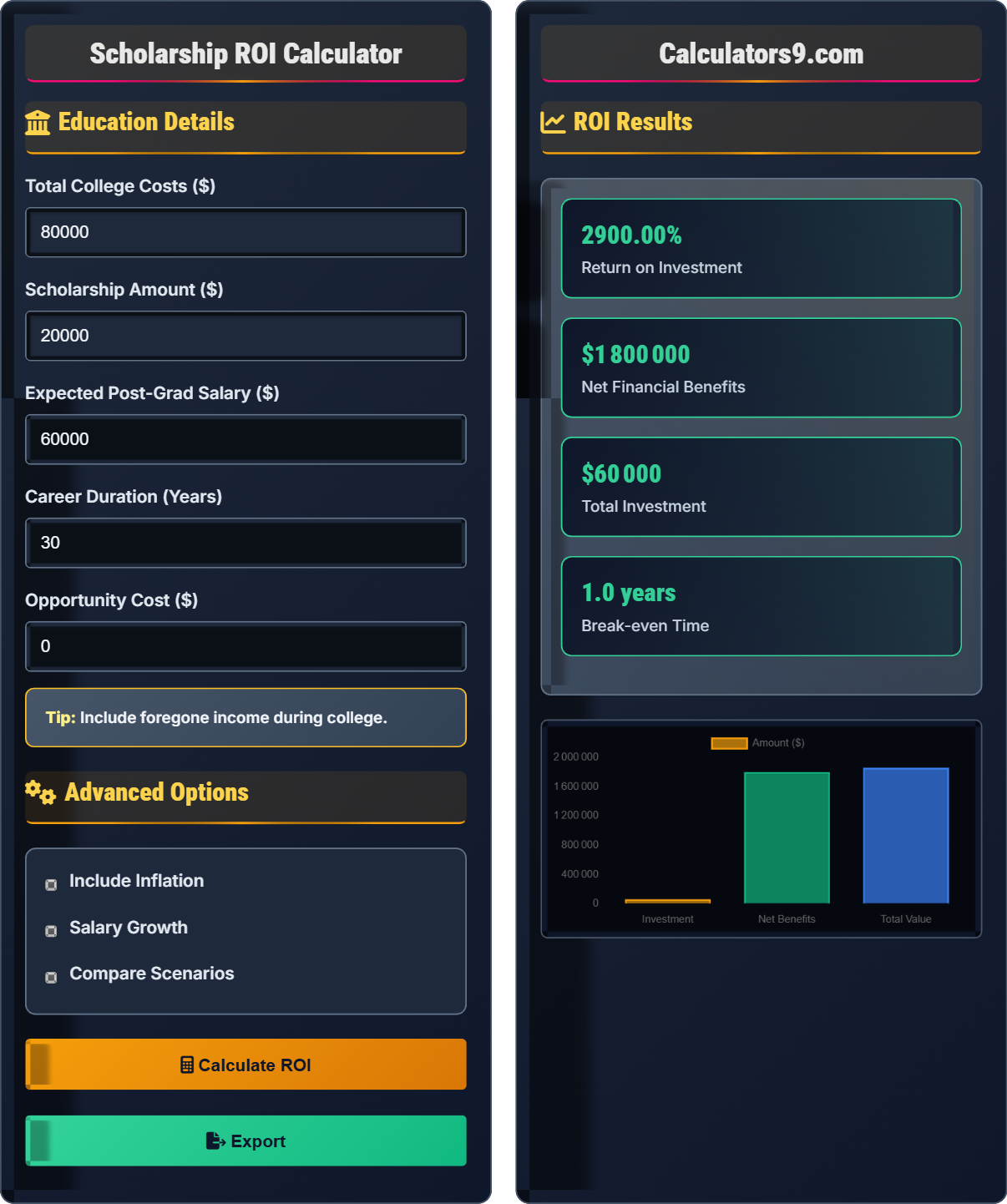
Education Details
Advanced Options
ROI Results
| Component | Amount |
|---|---|
| Total College Costs | $80,000 |
| Scholarship Received | -$20,000 |
| Net Investment | $60,000 |
| Opportunity Cost | $0 |
| Total Investment | $60,000 |
| Total Earnings Increase | $450,000 |
| Net Financial Benefit | $390,000 |
| ROI | 542.86% |
| Year | Salary | Cumulative Earnings | Net Benefit |
|---|
Comprehensive Scholarship ROI Guide
Educational Return on Investment (ROI) measures the financial value of your education relative to its cost. It compares the total cost of education (including opportunity costs) to the increased earnings potential over your career. Scholarships dramatically improve ROI by reducing the total investment required.
The standard scholarship ROI calculation uses the following formula:
Where:
- \(Net\_Benefits\) = Total increased earnings over career
- \(Total\_Costs\) = (College costs - Scholarships) + Opportunity costs
ROI benchmarks for education investments:
- Excellent: 400%+ ROI
- Good: 200-400% ROI
- Average: 100-200% ROI
- Poor: Below 100% ROI
- Apply for multiple scholarships: Every dollar reduces your investment
- Choose high-demand majors: STEM and business fields typically offer better returns
- Consider community college: Transfer credits can reduce costs significantly
- Minimize opportunity costs: Work part-time or during breaks
- Focus on completion: Incomplete degrees offer minimal returns
ROI Fundamentals
Financial return on educational investment.
\(ROI = \frac{Net\_Benefits - Total\_Costs}{Total\_Costs} \times 100\)
Where ROI=return on investment, Net_Benefits=increased earnings, Total_Costs=investment.
- Higher scholarships = Better ROI
- Longer careers = Greater returns
- Higher salaries = Exponential gains
Strategies
Focus on high-demand fields with good salary prospects.
- Secure maximum scholarships
- Choose profitable majors
- Minimize opportunity costs
- Complete your degree
- Graduation rates matter
- Debt burden impacts ROI
- Non-financial benefits
- Market changes affect outcomes
Educational ROI Learning Quiz
Which of the following is NOT a component of educational ROI calculation?
The answer is D) Personal hobbies. Educational ROI calculation includes total college costs, scholarships received, expected salary increase, and career duration. Personal hobbies are unrelated to the financial return on education investment.
Understanding the components of educational ROI is crucial for making informed decisions about higher education. The calculation focuses on quantifiable financial factors: costs (tuition, fees, opportunity costs) and benefits (salary increases over time). Only elements that directly impact financial outcomes are included in the calculation.
ROI: Return on Investment - measure of profitability
Opportunity Cost: Income foregone while studying
Net Benefits: Total increased earnings minus investment
• Only include quantifiable financial factors in ROI
• Scholarships reduce the investment component
• Salary increases represent the return component
• Remember: ROI = (Benefits - Costs) / Costs × 100
• Higher scholarships always improve ROI
• Longer careers amplify returns exponentially
• Including non-financial benefits in ROI calculations
• Forgetting to subtract scholarships from costs
• Underestimating the impact of career duration
Calculate the ROI for a student who receives $15,000 in scholarships for a degree that costs $75,000 total. The degree increases their salary by $20,000 annually over a 30-year career. Assume no opportunity costs. Show your work.
Step 1: Calculate Total Investment
Total Investment = Total Costs - Scholarships
Total Investment = $75,000 - $15,000 = $60,000
Step 2: Calculate Total Benefits
Total Benefits = Annual Salary Increase × Career Duration
Total Benefits = $20,000 × 30 = $600,000
Step 3: Calculate ROI
ROI = (Total Benefits - Total Investment) / Total Investment × 100
ROI = ($600,000 - $60,000) / $60,000 × 100
ROI = $540,000 / $60,000 × 100 = 900%
Therefore, the educational ROI is 900%.
This calculation demonstrates how scholarships dramatically improve ROI. Without the $15,000 scholarship, the investment would have been $75,000, resulting in an ROI of 700% (a 200% difference). This shows the exponential impact of reducing educational costs through scholarships.
Total Investment: Actual cost after scholarships
Total Benefits: Cumulative salary increase over career
Exponential Returns: Longer careers amplify ROI significantly
• Always subtract scholarships from total costs
• Multiply annual benefits by career duration
• ROI is expressed as a percentage
• Use the formula: (Benefits - Costs) / Costs × 100
• Remember to subtract scholarships from costs
• Career duration multiplies benefits significantly
• Forgetting to subtract scholarships from total costs
• Calculating annual ROI instead of lifetime ROI
• Not multiplying annual benefits by career duration
Two students graduate with identical degrees that increase their salary by $18,000 annually. Both expect 35-year careers. Student A pays full tuition of $80,000, while Student B receives a $25,000 scholarship. What is the difference in their ROIs?
Step 1: Calculate total benefits for both students
Total Benefits = $18,000 × 35 = $630,000
Step 2: Calculate investment for Student A
Student A Investment = $80,000 - $0 = $80,000
Step 3: Calculate investment for Student B
Student B Investment = $80,000 - $25,000 = $55,000
Step 4: Calculate ROI for Student A
Student A ROI = ($630,000 - $80,000) / $80,000 × 100 = 687.5%
Step 5: Calculate ROI for Student B
Student B ROI = ($630,000 - $55,000) / $55,000 × 100 = 1,045.5%
Step 6: Calculate difference in ROIs
Difference = 1,045.5% - 687.5% = 358%
Therefore, Student B's ROI is 358% higher than Student A's.
This example shows how scholarships create disproportionate benefits. The $25,000 scholarship represents 31.25% of the total cost, but it increases the ROI by 358 percentage points - a massive improvement relative to the scholarship's size. This demonstrates the leveraged effect of scholarships on ROI.
Leveraged Effect: Small reductions in investment yield disproportionately large ROI improvements
Disproportionate Benefits: ROI improvements exceed cost reductions
Investment Leverage: How much returns are amplified by reducing costs
• Smaller investments lead to higher ROIs
• The same benefits divided by smaller costs = higher ROI
• Scholarships have leveraged impact on ROI
• Even small scholarships significantly improve ROI
• Apply for multiple small scholarships
• The leverage effect works in your favor
• Underestimating the leveraged effect of scholarships
• Thinking small scholarships don't matter
• Not appreciating how reduced costs amplify ROI
A student receives a $10,000 scholarship for a degree that costs $60,000 total. The degree increases their salary by $15,000 annually. Calculate the ROI for three different career durations: 20 years, 30 years, and 40 years. What pattern do you observe?
Step 1: Calculate investment (same for all scenarios)
Investment = $60,000 - $10,000 = $50,000
Step 2: Calculate ROI for 20-year career
Total Benefits = $15,000 × 20 = $300,000
ROI = ($300,000 - $50,000) / $50,000 × 100 = 500%
Step 3: Calculate ROI for 30-year career
Total Benefits = $15,000 × 30 = $450,000
ROI = ($450,000 - $50,000) / $50,000 × 100 = 800%
Step 4: Calculate ROI for 40-year career
Total Benefits = $15,000 × 40 = $600,000
ROI = ($600,000 - $50,000) / $50,000 × 100 = 1,100%
Pattern observed: ROI increases exponentially with career duration. Each additional 10 years adds 300 percentage points to the ROI.
This demonstrates the exponential nature of educational ROI. The same annual salary increase becomes more valuable over longer careers. The investment remains fixed, but benefits accumulate over time. This is why education is often called a "long-term investment" - the returns compound over decades.
Exponential Returns: Benefits that grow disproportionately over time
Compounding Effect: Fixed investment yielding increasing returns
Long-term Investment: Education's value increases with time
• ROI increases exponentially with career length
• Fixed investment yields growing returns
• Education's value compounds over time
• Longer careers maximize educational ROI
• Consider career stability when evaluating ROI
• Education pays dividends for decades
• Underestimating the impact of career duration
• Thinking of education as short-term investment
• Ignoring the compounding effect of time
Which of the following statements about educational ROI is TRUE?
The answer is C) A 200% ROI means you earned twice your investment back. A 200% ROI indicates that the net benefits are twice the investment. For example, if you invested $50,000 and achieved a 200% ROI, your net benefits would be $100,000 (2 times your investment).
ROI is a ratio of net benefits to investment. A 200% ROI means net benefits equal twice the investment. This is different from saying total returns are twice the investment - the 200% refers to the profit being twice the original investment. Understanding this distinction is crucial for interpreting ROI values correctly.
ROI: Return on Investment - net benefits relative to investment
Net Benefits: Total returns minus original investment
Investment: Total amount spent to generate returns
• ROI = (Net Benefits / Investment) × 100
• 200% ROI = Net benefits are 2× the investment
• Higher ROIs indicate better investment efficiency
• Remember: ROI measures efficiency, not absolute returns
• Compare ROIs across different investments
• Use ROI to evaluate scholarship effectiveness
• Confusing total returns with ROI
• Thinking ROI below 100% always means loss
• Not understanding the ratio nature of ROI
FAQ
Q: How do scholarships improve my educational ROI?
A: Scholarships directly improve your educational ROI by reducing your total investment while keeping the benefits constant. Since ROI is calculated as:
\( ROI = \frac{Net\_Benefits - Total\_Costs}{Total\_Costs} \times 100 \)
Reducing Total_Costs through scholarships creates a leveraged effect. For example, if your degree costs $80,000 and you receive $20,000 in scholarships, your investment drops from $80,000 to $60,000. If the degree increases your earnings by $400,000 over your career:
Without scholarship: ROI = ($400,000 - $80,000) / $80,000 × 100 = 400%
With scholarship: ROI = ($400,000 - $60,000) / $60,000 × 100 = 567%
This shows the $20,000 scholarship improved your ROI by 167 percentage points!
Q: Is a high ROI guarantee of career success?
A: While a high projected ROI suggests strong financial returns, it doesn't guarantee career success. ROI calculations rely on assumptions about:
- Consistent salary increases over the full career duration
- Job market stability in the chosen field
- Successful degree completion
- Full utilization of the degree in employment
For example, a degree with a projected 500% ROI assumes a 35-year career with consistent salary growth. However, economic downturns, industry changes, or personal circumstances could alter these outcomes. ROI should be one factor among many (passion, aptitude, job satisfaction) when choosing a field of study.