Study Planner
Academic success tracker • 2026 edition
Study Planning Formula:
Show the planner\( T = \sum(S_i \times H_i) \)
Where:
- \( T \) = Total study time required
- \( S_i \) = Study sessions needed for subject i
- \( H_i \) = Hours per session for subject i
This formula calculates the total time required to cover all subjects based on individual study needs. It helps prioritize subjects based on difficulty and importance.
Example: For Math requiring 10 sessions of 2 hours each and Science requiring 8 sessions of 1.5 hours each:
\( T = (10 \times 2) + (8 \times 1.5) = 20 + 12 = 32 \) hours
Thus, you need 32 hours of total study time.
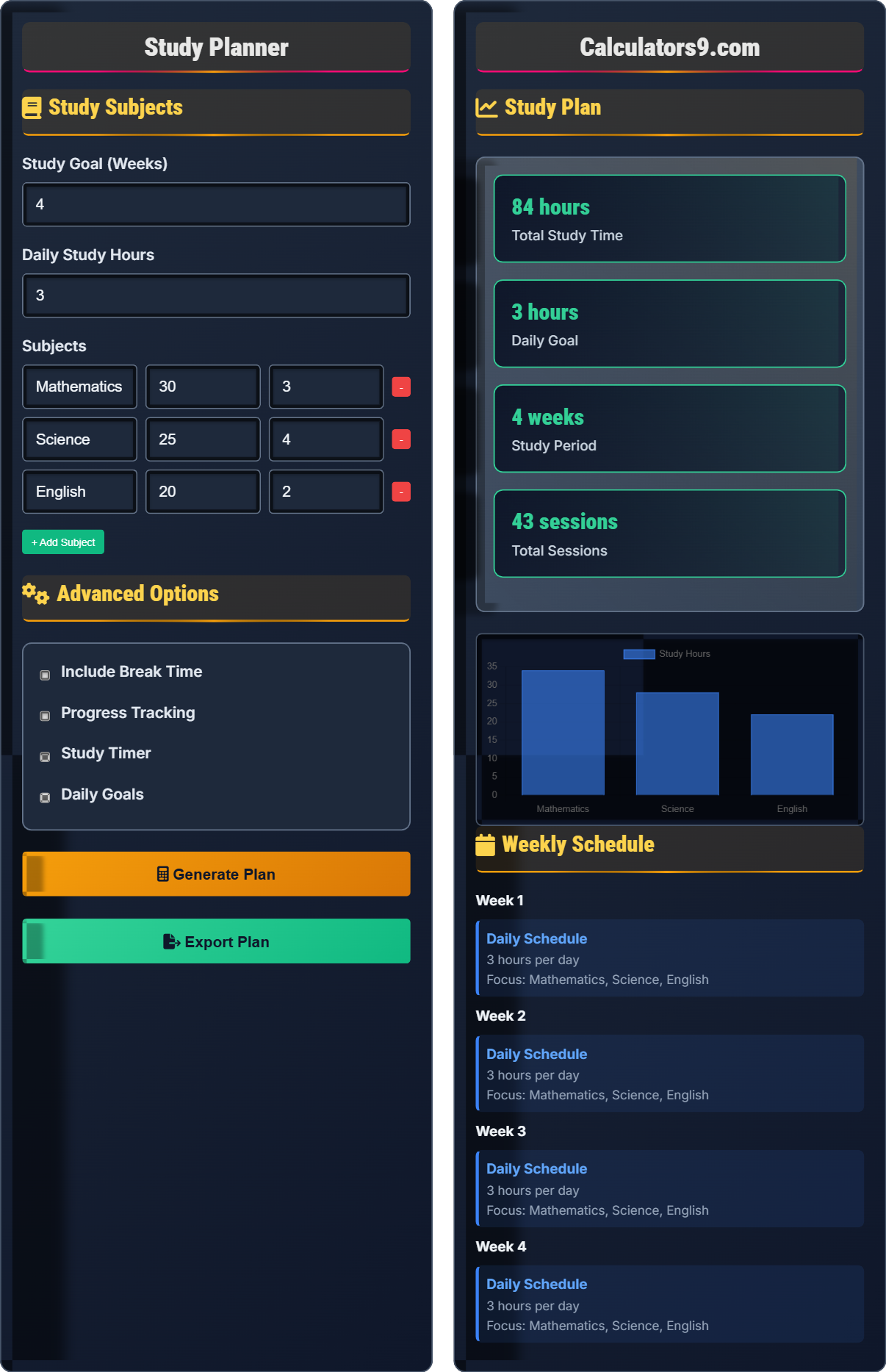
Study Subjects
Advanced Options
Study Plan
Weekly Schedule
Comprehensive Study Planning Guide
Study planning is the systematic organization of your academic activities to maximize efficiency and effectiveness. It involves setting specific goals, allocating time appropriately, and tracking progress to ensure successful completion of learning objectives. Effective study planning helps reduce stress, improve retention, and optimize performance across all subjects.
The fundamental study planning calculation uses the following formula:
Where:
- \(T\) = Total study time required
- \(S_i\) = Study sessions needed for subject i
- \(H_i\) = Hours per session for subject i
Effective study time allocation typically follows these principles:
- Priority Subjects: Assign 40-50% of time to most challenging subjects
- Review Sessions: Dedicate 20-30% to reviewing previously learned material
- New Material: Spend 30-40% on learning new concepts
- Practice Tests: Reserve 10-15% for assessment and practice
- Pomodoro Technique: Work for 25 minutes, then take a 5-minute break
- Active Recall: Test yourself regularly instead of passive reading
- Spaced Repetition: Review material at increasing intervals
- Mind Mapping: Create visual representations of concepts and relationships
- Teach Others: Explain concepts to reinforce understanding
Study Planning Basics
Systematic organization of academic activities to maximize efficiency.
\(T = \sum(S_i \times H_i)\)
Where T=total time, S=sessions, H=hours per session.
- Allocate more time to difficult subjects
- Distribute sessions evenly across days
- Include regular breaks for optimal focus
Strategies
Spread study sessions across multiple days rather than cramming.
- Pomodoro Technique
- Active Recall
- Spaced Repetition
- Mind Mapping
- Set realistic daily goals
- Track progress consistently
- Adjust plans based on performance
- Balance study with rest
Study Planning Learning Quiz
According to effective study planning principles, what percentage of study time should be allocated to the most challenging subjects?
The answer is C) 40-50%. According to effective study planning principles, you should allocate 40-50% of your study time to the most challenging subjects. This ensures that you dedicate sufficient time to mastering difficult concepts while still covering other subjects adequately. The rationale is that difficult subjects require more effort and repetition to achieve the same level of mastery as easier subjects.
Research in educational psychology shows that students learn most effectively when they spend more time on challenging material. The principle of "desirable difficulties" suggests that struggling with complex concepts initially leads to stronger long-term retention. By allocating more time to difficult subjects, you're implementing this research-based approach to optimize learning outcomes.
Study Time Allocation: The distribution of available study hours across different subjects or topics
Desirable Difficulties: Learning challenges that require effort but ultimately improve retention
Challenge Level: The degree of difficulty a student experiences with particular material
• More challenging subjects require proportionally more study time
• Time allocation should reflect both difficulty and importance
• Regular review of all subjects is essential for retention
• Use the 40-50% rule as a starting point, then adjust based on performance
• Reassess allocation weekly based on progress
• Combine challenging subjects with easier ones to prevent burnout
• Spending equal time on all subjects regardless of difficulty
• Over-focusing on easy subjects for quick wins
• Not adjusting allocation based on actual learning progress
You have three subjects: Math (15 sessions × 2 hours), Science (10 sessions × 1.5 hours), and History (8 sessions × 1 hour). Calculate the total study time required using the study planning formula. Show your work.
Using the study planning formula: \(T = \sum(S_i \times H_i)\)
Given:
- Math: 15 sessions × 2 hours = 30 hours
- Science: 10 sessions × 1.5 hours = 15 hours
- History: 8 sessions × 1 hour = 8 hours
Step 1: Calculate individual subject totals
Math = 15 × 2 = 30 hours
Science = 10 × 1.5 = 15 hours
History = 8 × 1 = 8 hours
Step 2: Sum all subject totals
Total = 30 + 15 + 8 = 53 hours
Therefore, you need 53 hours of total study time.
This calculation demonstrates how to systematically determine total study requirements across multiple subjects. The formula allows you to plan your study schedule efficiently by knowing exactly how much time you need to allocate. This approach prevents underestimating requirements for complex subjects and helps create realistic study timelines.
Total Study Time (T): The sum of all time allocated to studying across all subjects
Sessions (S): Individual study periods dedicated to a subject
Hours per Session (H): Duration of each study session
• Multiply sessions by hours for each subject individually
• Sum all subject totals to get overall requirement
• Use this calculation to create realistic study schedules
• Add 10-15% buffer time for unexpected challenges
• Round up to nearest whole hour for practical scheduling
• Recalculate periodically as requirements change
• Forgetting to multiply sessions by hours for each subject
• Adding session counts without considering duration
• Not accounting for review sessions in total time
Alice needs to study 60 hours over the next 3 weeks. She wants to study 4 hours per day but also take weekends off. How many days per week should she study, and how many hours per day will she need to meet her goal?
Step 1: Calculate total available days (excluding weekends)
3 weeks × 5 weekdays = 15 days available for studying
Step 2: Calculate required hours per day
60 hours ÷ 15 days = 4 hours per day
Step 3: Verify calculation
15 days × 4 hours/day = 60 hours ✓
Therefore, Alice should study 5 days per week (weekdays only) for 4 hours each day to meet her 60-hour goal over 3 weeks.
This problem illustrates the importance of realistic scheduling that considers personal preferences (like weekend breaks) while maintaining study goals. The calculation shows how to distribute total study time across available days, ensuring consistent progress without overwhelming the student. This approach promotes sustainable study habits that can be maintained over extended periods.
Study Schedule: The planned distribution of study time across days and sessions
Available Study Days: Days when a student can realistically dedicate time to studying
Consistent Practice: Regular study sessions that promote long-term retention
• Account for days when studying won't occur (weekends, holidays)
• Distribute study time evenly to avoid cramming
• Balance intensity with sustainability
• Include rest days in your schedule for mental recovery
• Adjust daily hours based on subject difficulty
• Build flexibility into your schedule for unexpected events
• Assuming you'll study every day without accounting for breaks
• Creating schedules that don't match your actual availability
• Not accounting for fatigue accumulation over time
David initially planned to spend 30% of his study time on Math, 25% on Science, and 20% on English. After a diagnostic test, he realizes he's struggling with Math and needs to increase that allocation to 45%. If his total study time remains 80 hours, how should he redistribute his time to accommodate the new priority while maintaining his schedule?
Step 1: Calculate new Math allocation
Math: 45% of 80 hours = 0.45 × 80 = 36 hours
Step 2: Calculate remaining time for other subjects
Remaining time = 80 - 36 = 44 hours
Step 3: Redistribute remaining time proportionally
Original ratio for Science:English = 25:20 = 5:4
Science gets (5/9) × 44 = 24.44 hours ≈ 24 hours
English gets (4/9) × 44 = 19.56 hours ≈ 20 hours
Verification: 36 + 24 + 20 = 80 hours ✓
Therefore, David should allocate 36 hours to Math, 24 hours to Science, and 20 hours to English.
This demonstrates the importance of adaptability in study planning. Effective students reassess their plans based on performance data and adjust priorities accordingly. The redistribution maintains the proportional relationship between non-priority subjects while increasing time for the area of greatest need. This flexible approach ensures resources are directed where they're most needed.
Priority Adjustment: Modifying study allocations based on changing needs or performance
Performance-Based Planning: Adapting study schedules based on assessment results
Resource Allocation: Distributing limited study time to maximize learning outcomes
• Adjust allocations based on actual performance, not assumptions
• Maintain proportional relationships when redistributing time
• Reassess plans regularly based on learning outcomes
• Take diagnostic tests early to identify weak areas
• Keep some flexibility in your schedule for adjustments
• Track performance weekly to make timely corrections
• Sticking rigidly to original plans despite poor performance
• Redistributing time without considering proportional relationships
• Not reassessing priorities regularly enough
Which of the following study techniques is most effective for long-term retention according to cognitive science research?
The answer is B) Active recall and testing. Cognitive science research consistently shows that actively retrieving information from memory (testing yourself) is far more effective for long-term retention than passive activities like reading or highlighting. This technique strengthens neural pathways and identifies knowledge gaps that need attention. Studies show active recall can improve retention by 50% or more compared to passive study methods.
Research in cognitive psychology, particularly the "testing effect," demonstrates that retrieval practice strengthens memory more than repeated exposure to information. When you actively recall information, you strengthen the neural pathways associated with that memory, making it easier to retrieve in the future. This is why practice tests and self-quizzing are so effective for learning.
Active Recall: Retrieving information from memory without cues
Testing Effect: Improved retention from retrieval practiceCognitive Load: Mental resources required for processing information
• Active techniques are more effective than passive ones
• Spacing study sessions improves retention
• Testing yourself regularly enhances learning
• Use flashcards for active recall practice
• Teach concepts to others to test your understanding
• Space out review sessions over time
• Believing that highlighting makes you learn material
• Thinking that rereading is as effective as testing
• Underestimating the power of spaced repetition
FAQ
Q: How do I know if I'm spending the right amount of time on each subject?
A: The right amount of time depends on several factors: subject difficulty, importance for your goals, and your current proficiency level.
Use this formula to calculate allocation:
\( T_i = T_{total} \times \frac{W_i \times D_i}{\sum(W_j \times D_j)} \)
Where:
- \( T_i \) = Time for subject i
- \( W_i \) = Weight/importance of subject i (1-10 scale)
- \( D_i \) = Difficulty of subject i (1-10 scale)
- \( T_{total} \) = Total available study time
For example, if Math has weight 8 and difficulty 7, while English has weight 6 and difficulty 3, Math should receive more time: \( \frac{8 \times 7}{(8 \times 7) + (6 \times 3)} = \frac{56}{74} = 76\% \) of time for Math.
Q: Should I study the same subject every day or alternate between subjects?
Which approach is more effective for learning and retention?
A: Alternating between subjects (interleaving) is generally more effective than studying the same subject every day (blocking).
Research shows interleaving improves:
- Retention: 20-30% improvement in long-term recall
- Transfer: Better application of concepts to new problems
- Discrimination: Ability to distinguish between similar concepts
Instead of studying Math for 3 consecutive days, try: Math-Day 1, Science-Day 1, English-Day 1, Math-Day 2, Science-Day 2, etc. This creates spacing and forces your brain to reconstruct concepts each time, strengthening memory formation.