Communication Plan Checker
Emergency communication planning • 2026 edition
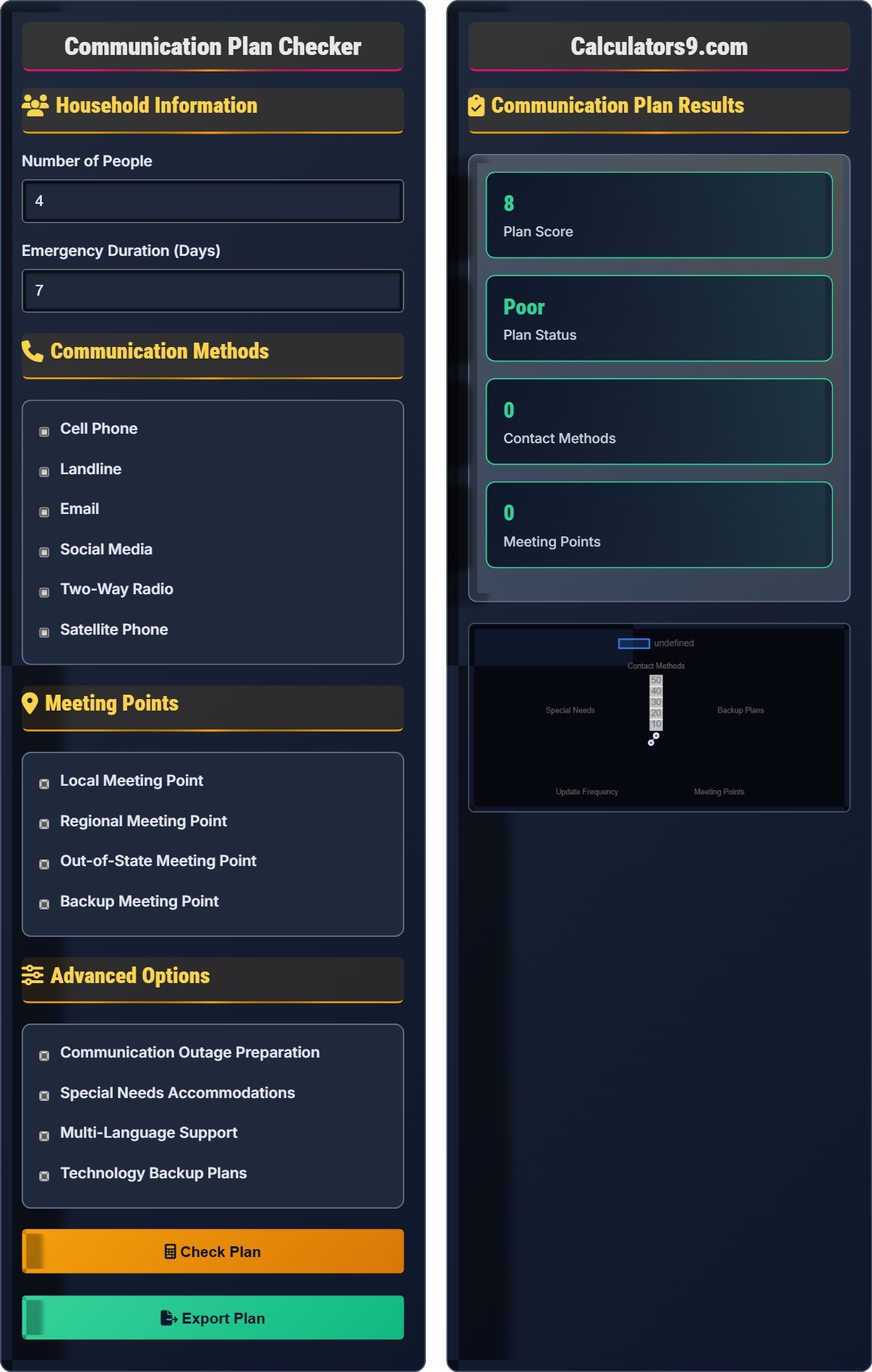
Communication Plan Formula:
Show the calculatorPlan Score = (Contact Methods × 10) + (Backup Plans × 15) + (Meeting Points × 5) + (Update Frequency × 8) + (Special Needs × 12)
Where:
- Contact Methods: Number of communication channels (phone, email, social media, etc.)
- Backup Plans: Number of alternative communication strategies
- Meeting Points: Number of designated reunion locations
- Update Frequency: How often to check in (daily, weekly, etc.)
- Special Needs: Accommodations for disabilities, language barriers, etc.
This formula evaluates the completeness and effectiveness of an emergency communication plan.
Example: For a plan with 3 contact methods, 2 backup plans, 1 meeting point, weekly updates, and 1 special need accommodation:
Score: (3 × 10) + (2 × 15) + (1 × 5) + (1 × 8) + (1 × 12) = 30 + 30 + 5 + 8 + 12 = 85 points
Household Information
Communication Methods
Meeting Points
Advanced Options
Communication Plan Results
| Category | Items | Score | Status |
|---|
| Improvement | Priority | Actions |
|---|
Communication Plan Guide
Emergency communication planning involves establishing reliable methods for staying in contact with family members during and after disasters. A comprehensive plan includes multiple communication channels, designated meeting points, and backup strategies when primary methods fail. Effective communication planning helps reunite families and coordinate safety measures during emergencies.
The standard communication plan evaluation uses the following formula:
Where:
- Contact Methods: Number of communication channels (phone, email, social media, etc.)
- Backup Plans: Number of alternative communication strategies
- Meeting Points: Number of designated reunion locations
- Update Frequency: How often to check in (daily, weekly, etc.)
- Special Needs: Accommodations for disabilities, language barriers, etc.
Recommended communication channels for emergency planning:
- Primary: Cell phones, landlines, internet messaging
- Secondary: Two-way radios, satellite phones
- Public: Social media, community bulletin boards
- Out-of-Area: Contact person outside affected region
- Text Messages: Often more reliable than voice calls during emergencies
- Out-of-Area Contact: Designate someone outside the region as information hub
- Written Instructions: Provide written emergency contact information
- Practice Drills: Regularly test communication plans with family
- Technology Backup: Have battery-powered or hand-crank communication devices
Communication Basics
Establishing reliable contact methods during disasters.
Plan Score = (Contact Methods × 10) + (Backup Plans × 15) + (Meeting Points × 5) + (Update Frequency × 8) + (Special Needs × 12)
Where higher scores indicate more comprehensive plans.
- Have at least 3 contact methods
- Designate out-of-area contact
- Plan for technology failures
Strategies
Often more reliable than voice calls during network congestion.
- Write down all contact information
- Share with all family members
- Store in multiple locations
- Update regularly
- Network outages
- Power failures
- Special needs
- Language barriers
Communication Plan Learning Quiz
According to emergency management guidelines, what is the recommended minimum number of communication methods for an effective emergency communication plan?
The answer is C) 3 methods. Emergency management guidelines recommend having at least 3 different communication methods to ensure reliable contact during emergencies. This provides redundancy in case primary methods fail due to network outages, power failures, or other emergency-related disruptions.
Emergency communication planning follows the principle of redundancy to ensure reliability. Having multiple communication methods increases the probability of successful contact during emergencies when individual channels may become unavailable. The 3-method minimum provides sufficient backup options while remaining manageable for most households.
Redundancy: Having backup systems to ensure reliability
Communication Channels: Different methods of contacting people
Network Outage: Failure of communication infrastructure
• Have at least 3 communication methods
• Include out-of-area contact options
• Test methods regularly
• Include landline as backup to cell phones
• Use social media as secondary option
• Consider two-way radios for local communication
• Relying solely on cell phones
• Not considering network congestion
• Forgetting to plan for power outages
Calculate the communication plan score for a family with: 3 contact methods, 2 backup plans, 1 meeting point, weekly updates, and 1 special need accommodation. Show your work.
Using the formula: Plan Score = (Contact Methods × 10) + (Backup Plans × 15) + (Meeting Points × 5) + (Update Frequency × 8) + (Special Needs × 12)
Given:
- Contact Methods = 3
- Backup Plans = 2
- Meeting Points = 1
- Update Frequency = 1 (weekly)
- Special Needs = 1
Step 1: Calculate contact method score = 3 × 10 = 30 points
Step 2: Calculate backup plan score = 2 × 15 = 30 points
Step 3: Calculate meeting point score = 1 × 5 = 5 points
Step 4: Calculate update frequency score = 1 × 8 = 8 points
Step 5: Calculate special needs score = 1 × 12 = 12 points
Step 6: Calculate total score = 30 + 30 + 5 + 8 + 12 = 85 points
Therefore, the communication plan score is 85 points.
This problem demonstrates the weighted scoring system used to evaluate communication plans. Different elements receive different weights based on their importance to overall plan effectiveness. Backup plans receive the highest weight (15 points each) because they are critical when primary methods fail. This quantitative approach helps identify strengths and weaknesses in communication planning.
Plan Score: Quantitative measure of communication plan completeness
Weighted Scoring: Different elements receive different point valuesEffectiveness: How well the plan achieves its objectives
• Calculate each category separately
• Apply correct weights to each element
• Sum all components for total score
• Backup plans have highest weight (15 points)
• Special needs receive high weight (12 points)
• Meeting points have lowest weight (5 points)
• Forgetting to apply different weights to categories
• Miscounting number of elements in each category
• Not summing all components for total score
Sarah is planning communication for her family of 4. She has 2 contact methods, 1 backup plan, 2 meeting points, and plans for daily updates. Her family includes 1 person with hearing impairment requiring text-based communication. Calculate her plan score and explain how the special need affects the score.
Step 1: Calculate contact method score = 2 × 10 = 20 points
Step 2: Calculate backup plan score = 1 × 15 = 15 points
Step 3: Calculate meeting point score = 2 × 5 = 10 points
Step 4: Calculate update frequency score = 1 × 8 = 8 points (daily = 1)
Step 5: Calculate special needs score = 1 × 12 = 12 points
Step 6: Calculate total score = 20 + 15 + 10 + 8 + 12 = 65 points
The special need accommodation adds 12 points to the score, demonstrating that planning for accessibility needs significantly improves the plan's comprehensiveness.
This example shows how special needs planning contributes to overall plan effectiveness. The high weight assigned to special needs (12 points) reflects the importance of ensuring that all family members can participate in the communication plan. This inclusive approach ensures that the plan works for everyone, regardless of disabilities or special requirements.
Special Needs: Accommodations for disabilities or unique requirements
Accessibility: Ensuring plan works for all family members
Inclusive Planning: Considering all family member needs
• Plan for all family members' communication needs
• Include accessibility accommodations
• Consider language barriers
• Consider text-based options for hearing impairments
• Plan for visual impairments with audio alternatives
• Include medication or medical equipment needs
• Not considering special communication needs
• Assuming standard plans work for all family members
• Forgetting to plan for medical requirements
John's communication plan includes 4 contact methods (2 cellular, 1 landline, 1 email) and 1 backup plan (satellite phone). During a major storm, cellular networks are down but landline works. How does this affect his communication strategy? What should his family do? (Hint: Consider redundancy and alternative methods)
Step 1: Identify working methods: Landline and email (if internet available)
Step 2: Activate backup plan: Satellite phone
Step 3: Implement alternative strategy: Use landline for local calls, satellite phone for long-distance
Step 4: Notify family: Inform everyone of the change in communication method
John's redundancy planning pays off - despite losing cellular service, he still has 2 working methods. His family should use the landline for local communication and the satellite phone for contacting out-of-area relatives.
This demonstrates the importance of having diverse communication methods that don't rely on the same infrastructure. Cellular networks can fail simultaneously due to tower damage or congestion, but landlines often remain operational during disasters. Satellite phones operate independently of terrestrial networks, providing crucial backup communication during major emergencies.
Infrastructure Independence: Communication methods that don't rely on same systems
Network Congestion: Overloaded communication systems during emergencies
Redundancy: Multiple systems to ensure reliability
• Diversify communication methods
• Choose methods with different infrastructure
• Test all methods regularly
• Satellite phones work during network outages
• Landlines often survive when cells fail
• Two-way radios for local communication
• Relying on methods with same infrastructure
• Not testing backup methods regularly
• Assuming all networks will work during disasters
Which of the following is the BEST practice for selecting emergency meeting points?
The answer is B) Select multiple points at different distances. Effective emergency planning includes multiple meeting points: a local point near home, a regional point outside the immediate area, and an out-of-area point for major disasters. This provides options depending on the severity and extent of the emergency.
Meeting point planning must account for different emergency scenarios. Local points work for minor incidents, regional points for area-wide emergencies, and out-of-area points for major disasters affecting the entire region. This tiered approach ensures that families have reunion options regardless of the emergency's scope.
Local Meeting Point: Near home for minor emergencies
Regional Meeting Point: Outside immediate area for area-wide emergencies
Out-of-Area Meeting Point: Far from disaster zone for major emergencies
• Have multiple meeting points at different distances
• Choose accessible locations
• Share locations with all family members
• Choose landmarks that won't be destroyed
• Have backup meeting times
• Practice getting to meeting points
• Only having one meeting point
• Choosing locations that might be affected by same disaster
• Not sharing meeting point information with all family members
FAQ
Q: How many communication methods should I have for my emergency plan?
A: Emergency management experts recommend having at least 3 different communication methods for your emergency plan. This typically includes:
- Primary: Cell phone (most common)
- Secondary: Landline or internet messaging
- Backup: Two-way radio or satellite phone
For example, a family of 4 might have: 4 cell phones, 1 landline, email/social media accounts, and 1 satellite phone for a robust communication strategy. The key is diversification - different methods rely on different infrastructure so if one fails, others may still work.
Q: Do I need special meeting points for my family?
A: Yes, emergency planning experts recommend having multiple meeting points:
- Local: Near your home for minor emergencies (e.g., house fire)
- Regional: Outside your neighborhood for area-wide emergencies
- Out-of-Area: Far from the disaster zone for major emergencies
For example, you might choose: your neighbor's house as local, a school 5 miles away as regional, and a relative's home 100 miles away as out-of-area. This tiered approach ensures you have reunion options regardless of the emergency's scope.