Emergency Supply Calculator
Essential survival planning • 2026 edition
Emergency Supply Formula:
Show the calculatorTotal Supplies Needed = (Days × People × Daily Requirements) + Buffer
Where:
- Water: 1 gallon per person per day (minimum 3 days recommended)
- Food: 2,000 calories per person per day (minimum 3 days recommended)
- Buffer: 20-25% extra for safety and special circumstances
This formula calculates the essential supplies needed to sustain individuals during emergency situations for the specified duration.
Example: For 4 people during a 7-day emergency:
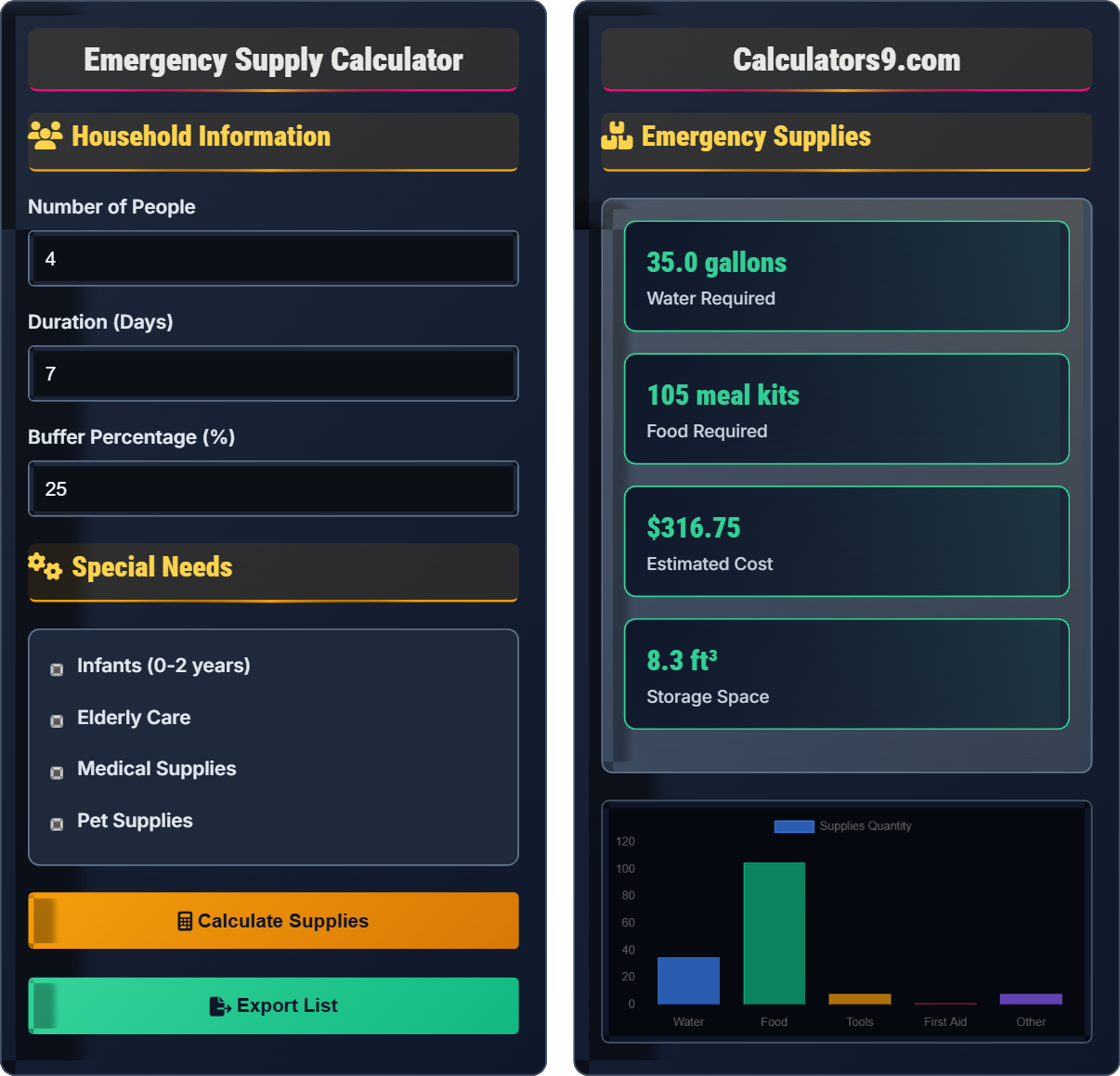
Water: 4 people × 7 days × 1 gallon/day × 1.25 buffer = 35 gallons
Food: 4 people × 7 days × 2,000 calories/day ÷ 2,000 cal/meal × 3 meals/day × 1.25 buffer = 105 meal kits
Thus, the household would need 35 gallons of water and 105 meal kits for 7 days.
Household Information
Special Needs
Emergency Supplies
| Item | Quantity | Unit | Cost |
|---|
| Category | Item | Quantity | Notes |
|---|
Emergency Preparedness Guide
Emergency preparedness involves taking proactive steps to ensure safety and survival during unexpected disasters or emergencies. It encompasses planning, gathering supplies, and developing skills to handle various crisis situations including natural disasters, power outages, medical emergencies, or supply chain disruptions. The goal is to maintain self-sufficiency for at least 72 hours without external assistance.
The standard emergency supply calculation uses the following formula:
Where:
- Water: 1 gallon per person per day (minimum 3 days recommended)
- Food: 2,000 calories per person per day (minimum 3 days recommended)
- Buffer: 20-25% extra for safety and special circumstances
- Special Needs: Additional items for infants, elderly, pets, or medical conditions
Your emergency supplies should include these categories:
- Hydration: Water, electrolyte packets, purification tablets
- Nutrition: Canned goods, energy bars, MREs, baby food if needed
- Shelter: Blankets, sleeping bags, tent, tarp, rope
- Communication: Battery-powered radio, cell phone chargers, whistles
- Sanitation: Toilet paper, soap, hand sanitizer, garbage bags
- Rotate supplies: Replace items before expiration dates
- Diversify storage: Keep supplies in multiple locations
- Practice drills: Regularly test your emergency plan
- Stay informed: Monitor weather alerts and emergency notifications
- Community resources: Know local emergency shelters and routes
Emergency Basics
Planning for self-sufficiency during disasters.
Total Supplies = (Days × People × Daily Requirements) + Buffer
Where water=1 gal/person/day, food=2000 cal/person/day.
- Plan for 72 hours minimum
- Add 20-25% buffer
- Consider special needs
Strategies
Replace items before expiration dates to maintain effectiveness.
- Use waterproof containers
- Label everything clearly
- Create inventory lists
- Store in accessible locations
- Medical needs
- Infant supplies
- Pet requirements
- Seasonal adjustments
Emergency Preparedness Learning Quiz
According to FEMA guidelines, what is the minimum recommended amount of water per person per day during an emergency?
The answer is B) 1 gallon. FEMA recommends storing at least 1 gallon of water per person per day for drinking and sanitation purposes during emergencies. This accounts for drinking water (half a gallon) and water for hygiene and cooking (half a gallon).
Water is the most critical resource during emergencies. The 1-gallon recommendation is based on scientific understanding of human hydration needs. This amount ensures that individuals can maintain basic health and hygiene during extended periods without access to public water systems. It's important to note that this is a minimum requirement and additional water may be needed in hot climates or for individuals with specific medical needs.
FEMA: Federal Emergency Management Agency - coordinates federal response to disasters
Hydration: Maintaining adequate fluid levels in the body
Sanitation: Measures to maintain cleanliness and prevent disease spread
• Store at least 1 gallon of water per person per day
• Plan for 3 days minimum (recommended 7 days)
• Consider additional water for pets and special needs
• Use BPA-free containers for water storage
• Rotate stored water every 6 months
• Store water in multiple locations to prevent total loss
• Underestimating water needs (assuming only drinking water is needed)
• Storing insufficient quantities for the planned duration
• Forgetting to account for water needed for pets and babies
Calculate the total water needed for a family of 5 people during a 10-day emergency, including a 25% buffer. Show your work.
Using the formula: Total Water = (Days × People × Daily Requirement) + Buffer
Given:
- Days = 10
- People = 5
- Daily Requirement = 1 gallon per person
- Buffer = 25%
Step 1: Calculate base water requirement = 10 days × 5 people × 1 gallon/day = 50 gallons
Step 2: Calculate buffer amount = 50 gallons × 0.25 = 12.5 gallons
Step 3: Calculate total water needed = 50 gallons + 12.5 gallons = 62.5 gallons
Therefore, the family needs 62.5 gallons of water for the 10-day emergency.
This problem demonstrates the importance of proper calculation in emergency planning. The buffer percentage accounts for unexpected needs, waste, or extended emergency duration. The calculation shows how quickly supplies can multiply with multiple people and extended timeframes. This is why emergency planning requires careful mathematical consideration to ensure adequate supplies without excessive storage burdens.
Buffer: Extra supplies added to account for uncertainties and safety margins
Base Requirement: The fundamental amount needed without any additional safety factors
Emergency Duration: The planned time period for which supplies are gathered
• Always calculate base requirements first
• Apply buffer percentage to the base amount
• Verify calculations to prevent shortages
• Remember: Total = Base × (1 + Buffer percentage)
• Use 25% as a standard buffer (can range from 20-30%)
• Double-check calculations for accuracy
• Adding buffer before multiplying by people and days
• Forgetting to include the buffer in final calculation
• Using incorrect daily requirement values
Sarah is preparing emergency supplies for her family of 4 for a 7-day period. Each person needs 2,000 calories per day. If she plans to store 3 meals per day using meal kits that provide 667 calories each, how many meal kits does she need with a 20% buffer?
Step 1: Calculate total calories needed = 4 people × 7 days × 2,000 cal/day = 56,000 calories
Step 2: Calculate number of meal kits needed = 56,000 calories ÷ 667 cal/kit = 84 kits
Step 3: Calculate buffer amount = 84 kits × 0.20 = 16.8 kits (round up to 17)
Step 4: Calculate total meal kits needed = 84 + 17 = 101 kits
Therefore, Sarah needs 101 meal kits for her 7-day emergency supply.
This example shows the complexity of food planning for emergencies. Unlike water which has simple daily requirements, food calculations involve calories, meal portions, and nutritional adequacy. The conversion from daily caloric needs to actual meal kits demonstrates how real-world applications of mathematical concepts work in practical scenarios. The buffer ensures adequate nutrition even if some food is lost or damaged.
Calories: Units of energy provided by food
Meal Kit: Pre-packaged food designed to provide a complete meal
Nutritional Adequacy: Meeting basic dietary requirements
• Plan for 2,000 calories per person per day minimum
• Ensure balanced nutrition across all meals
• Include variety to maintain morale during stress
• Calculate calories per meal kit before determining quantity
• Consider dietary restrictions and preferences
• Include comfort foods to help maintain mental health
• Not accounting for calories per meal kit in calculations
• Forgetting to include buffer for food spoilage
• Ignoring dietary restrictions or special needs
John has a family of 3 adults and 2 children (ages 8 and 5). He wants to prepare for a 5-day emergency. Adults need 1 gallon of water per day, but children need 0.75 gallons per day. How much total water does he need with a 25% buffer? (Hint: Calculate adult and child water needs separately)
Step 1: Calculate adult water needs = 3 adults × 5 days × 1 gallon/day = 15 gallons
Step 2: Calculate child water needs = 2 children × 5 days × 0.75 gallons/day = 7.5 gallons
Step 3: Calculate total base water = 15 + 7.5 = 22.5 gallons
Step 4: Calculate buffer amount = 22.5 gallons × 0.25 = 5.625 gallons
Step 5: Calculate total water needed = 22.5 + 5.625 = 28.125 gallons (round to 28.1 gallons)
Therefore, John needs approximately 28.1 gallons of water for his 5-day emergency supply.
This demonstrates the importance of accounting for special needs in emergency planning. Children have different hydration requirements than adults, and these differences must be considered when calculating supplies. The problem also illustrates how to handle fractional quantities in real-world scenarios. This level of detail is crucial for effective emergency preparedness, showing how mathematical planning applies to practical safety considerations.
Special Needs: Additional requirements for vulnerable populations
Vulnerable Populations: Groups requiring extra consideration (children, elderly, disabled)
Hydration Requirements: Vary by age, weight, activity level, and health
• Children need 0.5-0.75 gallons of water per day
• Elderly and sick individuals may need more water
• Pets require separate water calculations
• Calculate needs for each group separately
• Consider age-specific requirements
• Account for increased needs during illness
• Applying the same requirements to all family members
• Not accounting for special needs of children
• Forgetting to adjust for pets and elderly care
Which of the following is the BEST practice for maintaining emergency supplies?
The answer is B) Rotate supplies annually to prevent expiration. Regular rotation ensures that emergency supplies remain fresh and usable when needed. This includes checking expiration dates, replacing expired items, and maintaining the quality of stored goods. Proper rotation prevents the accumulation of unusable supplies during actual emergencies.
Emergency preparedness is not a one-time event but an ongoing process. The rotation principle demonstrates how planning extends beyond initial acquisition to include maintenance and quality assurance. Regular rotation prevents the common failure mode of having supplies that have expired or degraded when an emergency occurs. This principle applies to food, water, medications, and other perishable emergency items.
Rotation: The systematic replacement of stored items before expiration
Quality Assurance: Maintaining the usability and effectiveness of supplies
Perishables: Items with limited shelf life that require monitoring
• Check expiration dates quarterly
• Rotate water every 6 months
• Replace food before expiration dates
• Create a calendar system for tracking expiration dates
• Use the "first in, first out" principle
• Store supplies in climate-controlled environments
• Forgetting to check expiration dates regularly
• Not having a systematic approach to supply maintenance
FAQ
Q: How much water should I store per person during an emergency?
A: FEMA recommends storing at least 1 gallon of water per person per day for drinking and sanitation during emergencies. This accounts for drinking water (about half a gallon) and water for hygiene and cooking (about half a gallon).
For example, if you're preparing for a family of 4 during a 7-day emergency:
Base water: 4 people × 7 days × 1 gallon/day = 28 gallons
With a 25% buffer: 28 gallons × 1.25 = 35 gallons total
Mathematically: If \( W \) is total water needed, then:
\( W = P \times D \times R \times (1 + B) \)
Where \( P \) = People, \( D \) = Days, \( R \) = Rate (1 gallon), \( B \) = Buffer (0.25)
Q: Do children need the same amount of water as adults during emergencies?
A: No, children typically need less water than adults. For emergency planning, children aged 1-3 years need about 0.5 gallons per day, while children aged 4-8 years need about 0.75 gallons per day.
For example, if you're preparing for 2 adults and 2 children (ages 8 and 5) for a 5-day emergency:
- Adults: 2 × 5 × 1 = 10 gallons
- Children: 2 × 5 × 0.75 = 7.5 gallons
- Total base: 17.5 gallons
- With 25% buffer: 17.5 × 1.25 = 21.875 gallons
This calculation ensures adequate hydration while avoiding unnecessary storage burden.