Evacuation Route Planner
Safe exit strategy • 2026 edition
Evacuation Route Formula:
Show the calculatorEvacuation Time = (Distance ÷ Speed) + Preparation Time + Buffer
Where:
- Distance: Shortest safe path to destination
- Speed: Average walking speed (3 mph) or driving speed (varies)
- Preparation Time: Time to gather supplies and organize group
- Buffer: 25-50% extra time for obstacles and delays
This formula calculates the time needed to safely evacuate from a starting point to a designated destination, accounting for various factors that affect evacuation efficiency.
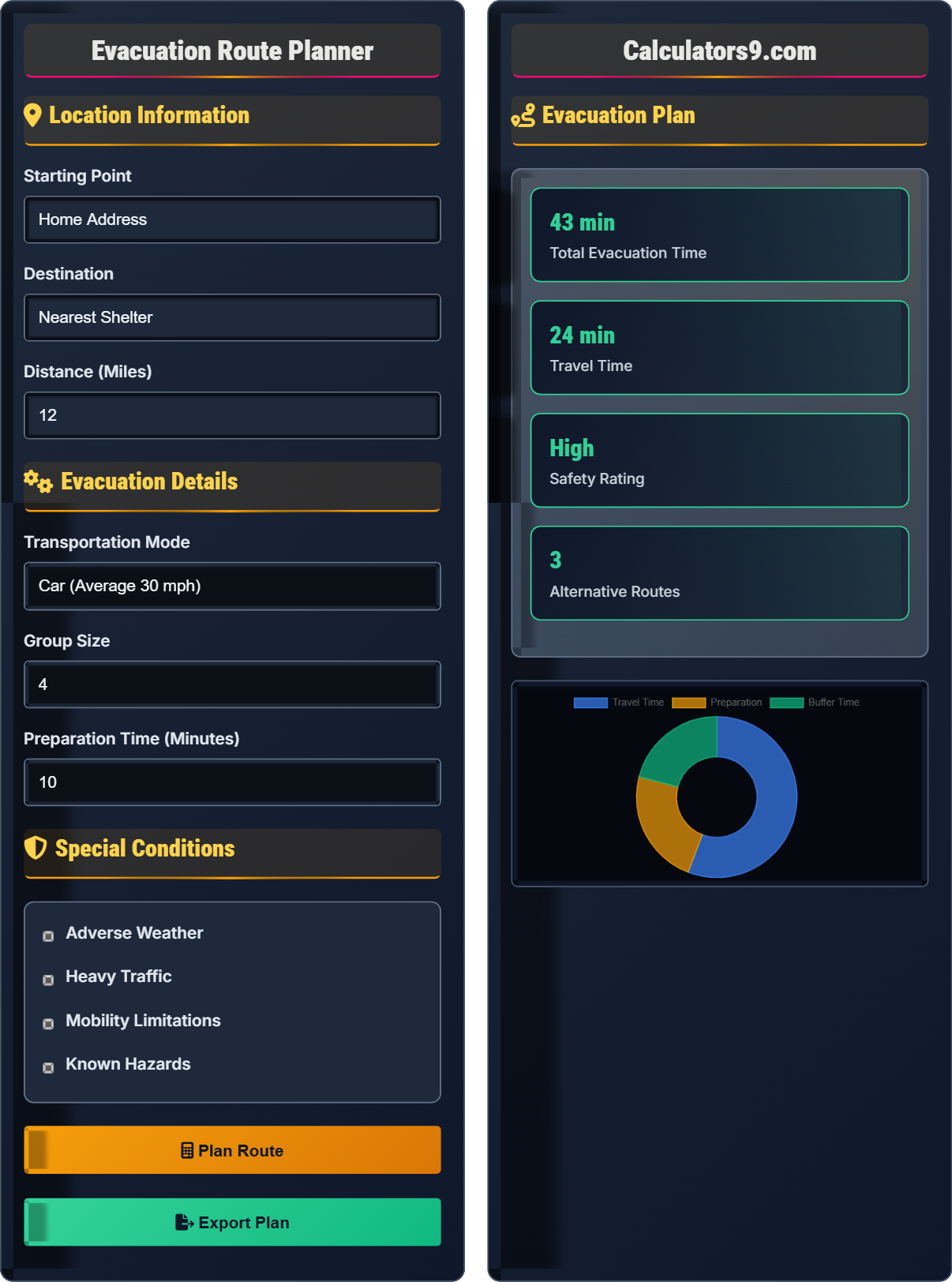
Example: For a 12-mile evacuation route with average driving speed of 30 mph:
Travel time: 12 miles ÷ 30 mph = 0.4 hours (24 minutes)
Preparation time: 10 minutes
With 25% buffer: (24 + 10) × 1.25 = 42.5 minutes total
Thus, the evacuation should be completed in 42.5 minutes.
Location Information
Evacuation Details
Special Conditions
Evacuation Plan
| Aspect | Details | Time |
|---|
| Step | Action | Duration | Notes |
|---|
Evacuation Planning Guide
Evacuation planning involves developing organized, efficient procedures to move people from dangerous locations to safe destinations during emergencies. Effective evacuation planning considers multiple factors including transportation methods, timing, special needs, and alternative routes to ensure the safety of all evacuees. The goal is to minimize exposure to hazards and maximize survival rates during emergency situations.
The standard evacuation time calculation uses the following formula:
Where:
- Distance: Shortest safe path to destination (in miles)
- Speed: Average travel speed based on mode of transport
- Preparation Time: Time needed to gather supplies and organize group
- Buffer: 25-50% extra time for obstacles and delays
Different modes of transportation have varying speeds and considerations:
- Car: Average 30 mph, fastest for longer distances, requires fuel and road access
- Walking: Average 3 mph, safest for short distances, physically demanding
- Bicycle: Average 10 mph, good middle option, requires physical fitness
- Public Transport: Average 20 mph, requires schedule coordination
- Phased Evacuation: Move people in groups based on vulnerability
- Multiple Routes: Use several paths to avoid bottlenecks
- Timing Coordination: Stagger departures to reduce traffic
- Checkpoints: Establish meeting points along the route
- Backup Plans: Prepare alternatives for when primary routes fail
Evacuation Basics
Organized movement from danger to safety.
Evacuation Time = (Distance ÷ Speed) + Preparation Time + Buffer
Where distance is in miles and speed is mph.
- Always plan multiple routes
- Add 25-50% buffer time
- Consider special needs
Strategies
Move people in priority groups based on vulnerability.
- Identify primary route
- Select 2-3 alternates
- Verify route accessibility
- Mark checkpoints
- Transportation capacity
- Physical limitations
- Weather conditions
- Time constraints
Evacuation Planning Learning Quiz
According to standard evacuation planning, what is the average walking speed used in calculations?
The answer is B) 3 mph. Standard evacuation planning assumes an average walking speed of 3 miles per hour. This conservative estimate accounts for fatigue, obstacles, carrying supplies, and the need to assist others during emergency situations.
Evacuation planning relies on conservative estimates to ensure safety. The 3 mph walking speed is based on research of average human performance under stress conditions. This standard allows planners to calculate realistic evacuation times that account for the challenges of moving during emergencies, including carrying supplies, helping others, and navigating potentially hazardous conditions.
Evacuation Speed: The rate at which people can safely move during an emergency
Conservative Estimate: A cautious calculation that accounts for worst-case scenarios
Under Stress: Conditions where normal performance may be reduced
• Use 3 mph as standard walking speed in calculations
• Adjust for special needs or conditions
• Always add buffer time for unforeseen delays
• Remember: 3 mph = 1 mile every 20 minutes
• Consider terrain difficulty when adjusting speed
• Account for group size in walking speed calculations
• Using normal walking speed instead of emergency speed
• Not accounting for carrying supplies or assisting others
• Assuming everyone walks at the same pace
Calculate the total evacuation time for a 15-mile route by car (average speed 30 mph) with 12 minutes preparation time and a 30% buffer. Show your work.
Using the formula: Evacuation Time = (Distance ÷ Speed) + Preparation Time + Buffer
Given:
- Distance = 15 miles
- Speed = 30 mph
- Preparation Time = 12 minutes
- Buffer = 30%
Step 1: Calculate travel time = 15 miles ÷ 30 mph = 0.5 hours = 30 minutes
Step 2: Calculate base time = 30 minutes + 12 minutes = 42 minutes
Step 3: Calculate buffer = 42 minutes × 0.30 = 12.6 minutes
Step 4: Calculate total time = 42 minutes + 12.6 minutes = 54.6 minutes
Therefore, the total evacuation time is 54.6 minutes.
This problem demonstrates the importance of unit conversion in evacuation planning. The calculation requires converting hours to minutes to maintain consistent units. The buffer calculation shows how additional time accounts for unpredictable factors during emergencies. This mathematical approach ensures realistic planning that accounts for real-world conditions.
Travel Time: The duration spent moving from origin to destination
Buffer Time: Extra time added to account for unexpected delays
Preparation Time: Time needed to get ready for evacuation
• Convert all time units to the same measurement
• Apply buffer to the total base time
• Verify calculations for accuracy
• Remember: Time = Distance ÷ Speed
• Buffer = Base Time × (Buffer percentage)
• Total Time = Base Time + Buffer
• Forgetting to convert units consistently
• Adding buffer before calculating base time
• Not accounting for preparation time in calculations
Sarah needs to evacuate her family of 4 from their home to a shelter 20 miles away. They will walk the first 3 miles (at 3 mph) to reach their car, then drive the remaining 17 miles (at 25 mph). If preparation time is 15 minutes and they want a 40% buffer, how long will the total evacuation take?
Step 1: Calculate walking time = 3 miles ÷ 3 mph = 1 hour = 60 minutes
Step 2: Calculate driving time = 17 miles ÷ 25 mph = 0.68 hours = 40.8 minutes
Step 3: Calculate base time = 60 + 40.8 + 15 = 115.8 minutes
Step 4: Calculate buffer = 115.8 × 0.40 = 46.32 minutes
Step 5: Calculate total time = 115.8 + 46.32 = 162.12 minutes (2 hours 42 minutes)
Therefore, the total evacuation will take approximately 2 hours and 42 minutes.
This example shows the complexity of real-world evacuation planning. Many evacuations involve multiple transportation modes due to accessibility constraints. The calculation demonstrates how to handle different speeds for different segments of the journey. This type of multi-modal planning is common in urban areas where vehicles may not be immediately accessible or where different terrains require different transportation methods.
Multi-Modal: Using multiple forms of transportation during evacuation
Accessibility: Whether transportation is available when needed
Segmented Journey: Travel involving different legs with different characteristics
• Calculate time for each segment separately
• Sum all segments before adding buffer
• Consider transition time between modes
• Calculate each leg of the journey separately
• Add transition times between modes
• Consider the slowest mode as the bottleneck
• Averaging speeds across different segments
• Not accounting for transition times between modes
• Forgetting to include preparation time in total
John's family includes 2 adults and 1 elderly person who walks at 2 mph instead of the standard 3 mph. Their evacuation route is 2 miles to their car, followed by a 10-mile drive at 30 mph. If preparation time is 10 minutes and they want a 50% buffer, how long will their evacuation take? (Hint: The slowest member determines the walking time)
Step 1: Calculate walking time (determined by slowest person) = 2 miles ÷ 2 mph = 1 hour = 60 minutes
Step 2: Calculate driving time = 10 miles ÷ 30 mph = 0.33 hours = 20 minutes
Step 3: Calculate base time = 60 + 20 + 10 = 90 minutes
Step 4: Calculate buffer = 90 × 0.50 = 45 minutes
Step 5: Calculate total time = 90 + 45 = 135 minutes (2 hours 15 minutes)
Therefore, John's family evacuation will take 2 hours and 15 minutes.
This demonstrates the critical principle that evacuation time is determined by the slowest participant. In group evacuations, the entire group moves at the pace of the most vulnerable member. This principle applies to both walking and other activities during evacuation. Planning must accommodate the needs of all group members, particularly those with mobility limitations, to ensure no one is left behind during an emergency.
Slowest Member Rule: Group moves at pace of slowest participant
Vulnerable Populations: Groups requiring special consideration
Mobility Limitations: Physical constraints affecting movement speed
• Plan for the slowest member of the group
• Adjust speeds based on individual capabilities
• Consider assistive devices in time calculations
• Identify the slowest member before planning
• Consider assistance options for mobility-impaired individuals
• Plan shorter walking distances for vulnerable members
• Using average speeds instead of the slowest person's speed
• Not accounting for mobility limitations in calculations
• Assuming all family members move at the same pace
Which of the following is the MOST important factor to consider when selecting an evacuation route?
The answer is B) Safest path with multiple alternatives. Effective evacuation planning prioritizes safety over convenience. Having multiple routes ensures that if the primary route becomes blocked or unsafe, alternatives are available. Safety considerations include avoiding flood zones, unstable structures, and other hazards that could impede evacuation or cause additional harm.
Evacuation planning follows the principle of redundancy to ensure success under various conditions. The "safest path" concept incorporates hazard assessment, while "multiple alternatives" provides resilience against route failures. This approach reflects the reality that emergency conditions can change rapidly, making pre-planned alternatives crucial for successful evacuation. The focus on safety over convenience distinguishes emergency planning from normal travel planning.
Redundancy: Having backup options to ensure system reliability
Hazard Assessment: Evaluating risks along potential routes
Resilience: Ability to adapt to changing conditions
• Always plan primary and alternate routes
• Prioritize safety over speed or convenience
• Consider hazard-specific route modifications
• Map at least 2-3 alternative routes
• Practice all planned routes in advance
• Verify route accessibility regularly
• Relying on only one evacuation route
• Choosing fastest instead of safest route
• Not verifying route accessibility during emergencies
FAQ
Q: How do I calculate the time needed for evacuation?
A: Use the formula: Evacuation Time = (Distance ÷ Speed) + Preparation Time + Buffer
For example, if you're evacuating 15 miles by car at 30 mph:
Travel time: 15 miles ÷ 30 mph = 0.5 hours = 30 minutes
Preparation time: 12 minutes
Buffer (30%): (30 + 12) × 0.30 = 12.6 minutes
Total time: 30 + 12 + 12.6 = 54.6 minutes
Mathematically: If \( T \) is total time, then:
\( T = \frac{D}{S} + P + B \)
Where \( D \) = Distance, \( S \) = Speed, \( P \) = Preparation, \( B \) = Buffer
Q: How many evacuation routes should I plan?
A: Emergency management experts recommend planning at least 3 evacuation routes:
- Primary route: Your main path to safety
- Secondary route: Alternative path if primary is blocked
- Tertiary route: Backup if both others are unavailable
For example, if your primary route is 12 miles and takes 25 minutes, your secondary route might be 15 miles but still safe. Planning multiple routes ensures you can adapt to changing conditions during an emergency. The key is that all routes lead to the same safe destination and have been verified for accessibility.