First Aid Kit Builder
Essential medical supplies • 2026 edition
First Aid Kit Formula:
Show the calculatorKit Size = (People × Severity Factor) + Special Needs + Durability Factor
Where:
- People: Number of individuals in household/group
- Severity Factor: High (3.0), Medium (2.0), Low (1.0)
- Special Needs: Additional items for medical conditions
- Durability: Long-term (2.0), Short-term (1.0)
This formula calculates the optimal first aid kit size and contents based on the number of people, expected use severity, special medical needs, and duration requirements.
Example: For a family of 4 with medium severity needs:
Base kit: 4 people × 2.0 (medium) = 8 person-units
With special needs: +2 items
Long-term durability: × 2.0 = 18 person-units
Thus, the kit should contain supplies for 18 person-units.
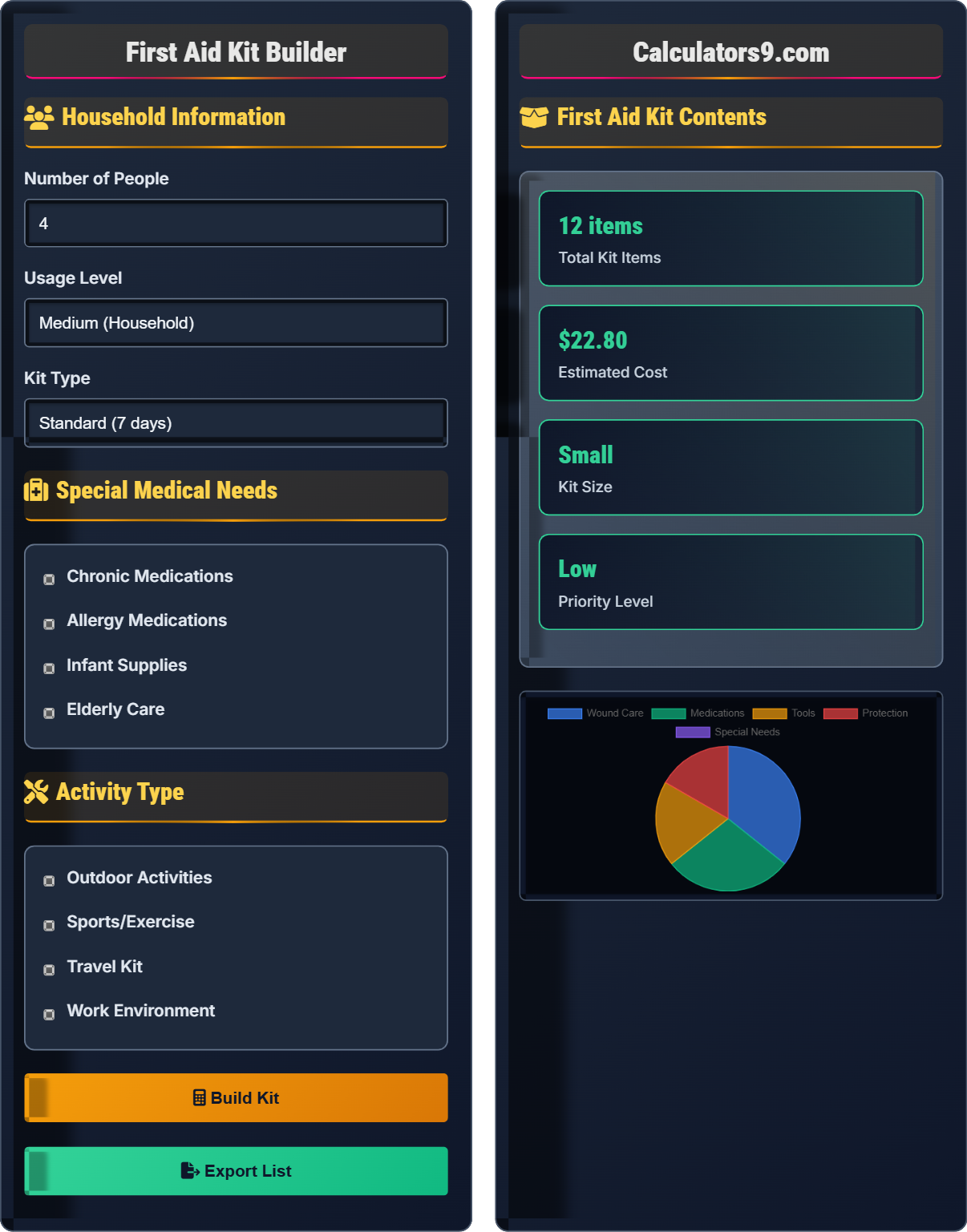
Household Information
Special Medical Needs
Activity Type
First Aid Kit Contents
| Item | Quantity | Unit | Priority |
|---|
| Category | Items Count | Essential Items | Notes |
|---|
First Aid Kit Planning Guide
A first aid kit is a collection of supplies and equipment for providing immediate care to injured or ill individuals. Properly equipped first aid kits can mean the difference between minor and major injuries, or even life and death in emergency situations. The contents should be tailored to the specific needs of the users, environment, and potential hazards.
The standard first aid kit calculation uses the following formula:
Where:
- People: Number of individuals in household/group
- Severity Factor: High (3.0), Medium (2.0), Low (1.0)
- Special Needs: Additional items for medical conditions
- Durability: Long-term (2.0), Short-term (1.0)
Your first aid kit should include these categories:
- Wound Care: Bandages, gauze, wound dressings, butterfly closures
- Medications: Over-the-counter pain relievers, antihistamines, antacids
- Tools: Scissors, tweezers, thermometers, flashlights
- Protection: Latex/nitrile gloves, masks, CPR barriers
- Documentation: Emergency contacts, medical information
- Regular checks: Inspect kit monthly for expired items
- Accessible placement: Keep kit in easily reachable location
- Training: Learn proper use of kit contents
- Customization: Adapt contents to specific needs
- Replacement: Restock used items immediately
First Aid Basics
Emergency medical supplies for immediate care.
Kit Size = (People × Severity Factor) + Special Needs + Durability Factor
Where severity ranges from low (1.0) to high (3.0).
- Check monthly for expired items
- Keep in accessible location
- Customize for specific needs
Strategies
Regular inspection and restocking to maintain effectiveness.
- Use clear containers
- Label everything clearly
- Create inventory lists
- Store in dry, cool location
- Medical conditions
- Age considerations
- Activity level
- Environmental factors
First Aid Kit Planning Learning Quiz
According to American Red Cross guidelines, which of the following is NOT considered an essential first aid kit item?
The answer is C) Prescription medications. While prescription medications are important, they are not considered standard essential first aid kit items since they are personalized and require a doctor's prescription. Essential items are non-prescription supplies for immediate care of common injuries and illnesses.
First aid kit planning distinguishes between universal essential items and personalized medical needs. Universal items treat common injuries and conditions for anyone, while prescription medications are individual-specific and cannot be stocked universally. However, if someone in the household requires specific medications, they should be included as special needs in the kit planning process.
Universal Items: Supplies suitable for treating anyone regardless of personal medical history
Personalized Items: Specific supplies for individual medical needs
Non-Prescription: Over-the-counter items available without doctor's prescription
• Include universal items for general use
• Add personalized items for specific needs
• Maintain separate prescriptions if needed
• Focus on common injuries first
• Add special needs second
• Keep prescriptions separate but accessible
• Including prescription medications as standard items
• Forgetting to customize for specific needs
• Not distinguishing between universal and personal items
Calculate the recommended kit size for a family of 5 with medium severity needs (factor 2.0) and long-term durability (factor 2.0), plus 3 special needs items. Show your work.
Using the formula: Kit Size = (People × Severity Factor) + Special Needs + Durability Factor
Wait, let me correct the formula based on the context: Kit Size = (People × Severity Factor) × Durability Factor + Special Needs
Given:
- People = 5
- Severity Factor = 2.0
- Durability Factor = 2.0
- Special Needs = 3 items
Step 1: Calculate base size = 5 people × 2.0 severity = 10 person-units
Step 2: Apply durability factor = 10 × 2.0 = 20 person-units
Step 3: Add special needs = 20 + 3 = 23 items
Therefore, the kit should contain 23 items.
This problem demonstrates how different factors scale first aid kit requirements. The multiplication by durability factor significantly increases the kit size, reflecting the need for more supplies when planning for extended use. The addition of special needs items shows how individual requirements are incorporated into the general calculation. This mathematical approach ensures comprehensive planning that accounts for all relevant factors.
Person-Units: Standard measure of kit capacity based on number of people
Severity Factor: Multiplier based on expected intensity of use
Durability Factor: Multiplier based on intended duration of use
• Apply durability factor after base calculation
• Add special needs last
• Verify calculations for accuracy
• Remember: Base × Durability + Special Needs
• Check units of measurement
• Round up to ensure adequate supplies
• Adding factors instead of multiplying when appropriate
• Applying special needs factor incorrectly
• Not accounting for all relevant factors
Sarah is preparing a first aid kit for a hiking trip with 3 friends. She expects high usage (severity factor 3.0) for a week-long trip (durability factor 1.5). One friend has allergies requiring special medication. How many items should her outdoor first aid kit contain?
Step 1: Calculate base size = 4 people × 3.0 severity = 12 person-units
Step 2: Apply durability factor = 12 × 1.5 = 18 person-units
Step 3: Add special needs = 18 + 1 = 19 items
Therefore, Sarah's outdoor first aid kit should contain 19 items.
This example shows how environmental factors affect kit planning. Outdoor activities require enhanced supplies due to increased risk of injuries and limited access to medical facilities. The higher severity factor reflects the greater likelihood of needing medical supplies during outdoor activities. The calculation demonstrates how activity-specific factors influence the overall kit requirements.
Outdoor Activities: Increased risk activities requiring enhanced medical supplies
Limited Access: Reduced availability of professional medical care
Enhanced Supplies: Additional items for challenging environments
• Increase severity factor for outdoor activities
• Consider access to medical facilities
• Include activity-specific supplies
• Pack extra supplies for remote locations
• Include environmental hazard protections
• Consider longer healing times outdoors
• Underestimating outdoor risk factors
• Not considering remote location challenges
• Forgetting environmental protection supplies
John's family includes 2 adults and 1 elderly person with diabetes. They need a 30-day comprehensive kit (durability factor 2.0) with medium severity needs (factor 2.0). The diabetic supplies count as 5 special needs items. How many total items should their first aid kit contain? (Hint: Include glucose monitoring supplies)
Step 1: Calculate base size = 3 people × 2.0 severity = 6 person-units
Step 2: Apply durability factor = 6 × 2.0 = 12 person-units
Step 3: Add special needs = 12 + 5 = 17 items
Therefore, John's family first aid kit should contain 17 items.
This demonstrates the importance of considering chronic medical conditions in first aid planning. Diabetes requires specific supplies like glucose monitors, testing strips, and emergency glucose treatments. The calculation shows how chronic conditions significantly impact kit composition, requiring specialized items that standard kits don't include. Proper planning ensures that individuals with chronic conditions have access to necessary supplies during emergencies.
Chronic Conditions: Ongoing medical conditions requiring continuous management
Specialized Supplies: Items specific to particular medical conditions
Emergency Preparedness: Planning for medical needs during crises
• Assess all chronic conditions in the household
• Include specialized supplies for each condition
• Plan for medication storage requirements
• Consult healthcare providers for specific needs
• Include medication storage solutions
• Plan for 2x normal supply for emergencies
• Forgetting to include chronic condition supplies
• Not accounting for medication storage requirements
• Assuming standard kits cover all medical needs
According to best practices, how often should you inspect and update your first aid kit?
The answer is C) Monthly. Best practices recommend inspecting first aid kits monthly to check for expired items, replenish used supplies, and ensure everything is in working order. Additionally, kits should be checked after each use to replace consumed items immediately.
Regular maintenance is crucial for first aid kit effectiveness. Monthly inspections catch expired medications and supplies before they're needed in emergencies. The frequency reflects the reality that many items have expiration dates ranging from 1-3 years, making monthly checks appropriate for maintaining readiness. This practice ensures that when an emergency occurs, all supplies are viable and effective.
Inspection: Systematic review of kit contents and condition
Expiration Dates: Safety limits for medication and supply effectiveness
Readiness: State of being prepared for immediate use
• Inspect monthly for expired items
• Replace used items immediately
• Check functionality of tools
• Set calendar reminders for monthly checks
• Keep an inventory list handy
• Replace items before expiration
• Waiting until items are needed to check expiration
• Not replacing items after use
• Forgetting to check functionality of tools
FAQ
Q: How do I determine the right size first aid kit for my family?
A: Use the formula: Kit Size = (People × Severity Factor) × Durability Factor + Special Needs
For example, for a family of 4 with medium severity needs:
Base size: 4 people × 2.0 (medium) = 8 person-units
Durability (standard): 8 × 1.5 = 12 person-units
With special needs: 12 + 2 = 14 items
Mathematically: If \( K \) is kit size, then:
\( K = (P \times S) \times D + N \)
Where \( P \) = People, \( S \) = Severity, \( D \) = Durability, \( N \) = Needs
Q: What special items should I include for children?
A: For families with children, add these specialized items to your first aid kit:
- Child-safe medications: Pediatric fever reducers (acetaminophen/ibuprofen)
- Smaller supplies: Child-sized bandages, smaller gauze pads
- Thermometer: Digital thermometer suitable for children
- Oral syringe: For accurate medication dosing
- Child-friendly tools: Fun-shaped bandages to encourage cooperation
Remember to calculate dosages based on the child's weight, not age. Keep emergency numbers readily available, including poison control (1-800-222-1222). The key is ensuring all supplies are appropriately sized and safe for pediatric use.