Generator Sizing Calculator
Emergency power planning • 2026 edition
Generator Sizing Formula:
Show the calculatorTotal Power = (Running Watts × Simultaneous Factor) × (1 + Buffer) + Starting Watts
Where:
- Running Watts: Continuous power draw of all devices
- Simultaneous Factor: 0.7-0.9 (percentage of devices running simultaneously)
- Buffer: 20-25% extra for safety and future expansion
- Starting Watts: Additional power needed for motor startup (typically 2-3x running watts)
This formula calculates the total generator capacity needed for emergency power, accounting for continuous operation and startup loads.
Example: For a home with 5000 running watts:
Base load: 5000 × 0.8 (simultaneous) = 4000 watts
With 25% buffer: 4000 × 1.25 = 5000 watts
With starting load: +2000 watts = 7000 watts total
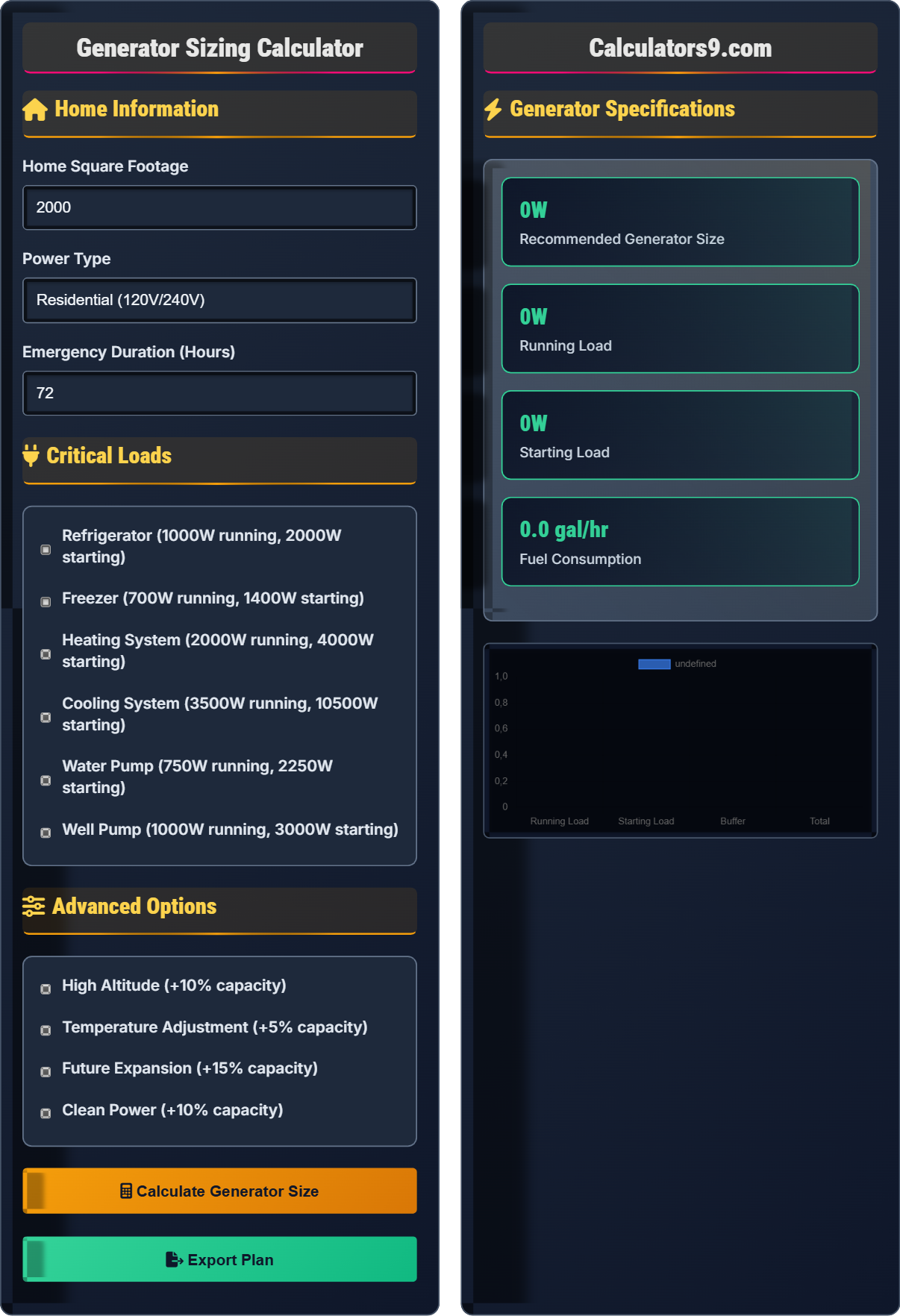
Home Information
Critical Loads
Advanced Options
Generator Specifications
| Device | Running Watts | Starting Watts | Priority |
|---|
| Specification | Value | Notes |
|---|
Generator Sizing Guide
Generator sizing involves calculating the appropriate generator capacity needed to power critical electrical loads during emergency situations. Proper sizing ensures that the generator can handle both continuous running loads and startup surges without being overloaded, while providing adequate power for essential needs during outages.
The standard generator sizing calculation uses the following formula:
Where:
- Running Watts: Continuous power draw of all devices
- Simultaneous Factor: 0.7-0.9 (percentage of devices running simultaneously)
- Buffer: 20-25% extra for safety and future expansion
- Starting Watts: Additional power needed for motor startup (typically 2-3x running watts)
Common household appliances and their power requirements:
- Refrigerator: 1000W running, 2000W starting
- Freezer: 700W running, 1400W starting
- Water Pump: 750W running, 2250W starting
- Well Pump: 1000W running, 3000W starting
- Central AC: 3500W running, 10500W starting
- Heating System: 2000W running, 4000W starting
- Conservative Approach: Size for all critical loads simultaneously
- Phased Operation: Run high-power loads sequentially to reduce peak demand
- Load Priority: Rank devices by importance and shed non-critical loads
- Smart Switching: Use transfer switches to manage load distribution
- Backup Planning: Have alternative power sources for extended outages
Generator Basics
Calculating appropriate generator capacity for emergency power.
Total Power = (Running Watts × Simultaneous Factor) × (1 + Buffer) + Starting Watts
Where simultaneous factor is 0.7-0.9.
- Account for starting loads
- Add 20-25% safety margin
- Consider duty cycle
Strategies
Controlling power consumption to match generator capacity.
- Life safety systems first
- Health and comfort systems
- Convenience systems
- Non-essential systems
- Motor starting requirements
- Altitude adjustments
- Temperature effects
- Future expansion needs
Generator Sizing Learning Quiz
Why is it important to account for starting watts when sizing a generator?
The answer is B) Motors require 2-3x their running wattage to start. Motors need significantly more power during startup due to overcoming inertia and magnetic field buildup. This surge can last several seconds and must be accounted for in generator sizing to prevent overload.
Motor starting loads represent a critical consideration in generator sizing. When motors start, they draw high inrush currents to overcome mechanical resistance and establish magnetic fields. This creates a temporary load that can be 2-3 times the normal operating load. Failing to account for this can result in generator overload, causing it to shut down or sustain damage during startup events.
Inrush Current: High current drawn by motors during startup
Starting Load: Initial power requirement when equipment begins operation
Surge: Temporary increase in electrical demand
• Motors need 2-3x running watts to start
• Account for all motor loads in sizing
• Consider duty cycle of motor operation
• Start high-power motors individually
• Use soft-start devices to reduce inrush
• Sequence motor startups to avoid simultaneous starting
• Only considering running watts without starting loads
• Assuming all loads start simultaneously
• Not accounting for inrush current
Calculate the recommended generator size for a home with a refrigerator (1000W running, 2000W starting), freezer (700W running, 1400W starting), and water pump (750W running, 2250W starting), assuming 80% simultaneous operation and 25% buffer. Show your work.
Using the formula: Total Power = (Running Watts × Simultaneous Factor) × (1 + Buffer) + Starting Watts
Given:
- Running Watts = 1000 + 700 + 750 = 2450W
- Simultaneous Factor = 0.8
- Buffer = 25% = 0.25
- Starting Watts = 2000 + 1400 + 2250 = 5650W
Step 1: Calculate base load = 2450W × 0.8 = 1960W
Step 2: Apply buffer = 1960W × 1.25 = 2450W
Step 3: Add starting load = 2450W + 5650W = 8100W
Therefore, the recommended generator size is 8100W or 8.1kW.
This problem demonstrates the layered approach to generator sizing. The calculation accounts for the fact that not all devices run simultaneously (simultaneous factor), adds a safety margin for unexpected loads (buffer), and includes the higher starting requirements for motor-driven appliances. This comprehensive approach ensures the generator can handle both steady-state operation and startup surges.
Simultaneous Factor: Percentage of loads that operate at the same time
Buffer: Extra capacity for safety margins and future expansion
Starting Load: Peak power required when equipment begins operation
• Calculate base load first
• Apply buffer to running load
• Add starting loads separately
• Consider staggering motor startups
• Use 70-90% for simultaneous factor
• Add 20-25% for safety buffer
• Adding starting watts to running watts before applying buffer
• Not accounting for simultaneous operation
• Forgetting to include safety margin
Sarah is sizing a generator for her mountain cabin at 6000 feet elevation. She has a central AC (3500W running, 10500W starting) and heating system (2000W running, 4000W starting). Calculate the recommended generator size with 85% simultaneous operation, 30% buffer, and high altitude adjustment (+10% capacity). Assume only one system runs at a time.
Step 1: Calculate base load = 3500W × 0.85 = 2975W (highest running load)
Step 2: Apply buffer = 2975W × 1.30 = 3867.5W
Step 3: Add starting load = 3867.5W + 10500W = 14367.5W
Step 4: Apply high altitude adjustment = 14367.5W × 1.10 = 15,804.25W
Therefore, Sarah needs approximately a 16kW generator for her mountain cabin.
This example shows how environmental factors affect generator sizing. At high altitudes, air density decreases, reducing engine efficiency and cooling effectiveness. This requires larger generators to deliver the same power output. The problem demonstrates multiple adjustment factors applied sequentially: simultaneous operation, safety buffer, and environmental compensation.
High Altitude: Locations above 3000 feet elevation
Air Density: Mass of air per unit volume, affects engine performance
Engine Efficiency: Power output relative to fuel consumption
• Apply altitude adjustments after base calculation
• Consider cooling effectiveness at elevation
• Add 10% capacity for altitudes above 5000 feet
• Consider derated performance specifications
• Account for temperature variations at elevation
• Forgetting altitude adjustments
• Not considering cooling effectiveness
• Assuming sea-level performance at elevation
John has a 10kW generator but wants to run a central AC (3500W running, 10500W starting) and electric oven (2000W running, 2000W starting) simultaneously. Is this possible? If not, what's the maximum AC size he can run with the oven? (Hint: Consider starting loads)
Step 1: Calculate total running load = 3500W + 2000W = 5500W
Step 2: Calculate total starting load = 10500W + 2000W = 12500W
Step 3: Compare to generator capacity: 12500W > 10000W (not possible)
Step 4: Maximum AC starting load = 10000W - 2000W = 8000W
Step 5: Maximum AC running load = 8000W ÷ 3 = 2667W (assuming 3:1 starting ratio)
Therefore, John cannot run both appliances simultaneously. With the oven, he can run an AC with up to 2667W running capacity.
This demonstrates the critical importance of managing startup loads. Even though the running loads of both appliances combined (5500W) are well within the generator's capacity, the combined starting loads (12500W) exceed the generator's 10kW rating. This example shows why load sequencing and management are crucial for generator operation.
Load Sequencing: Managing when devices start to avoid peak demand
Peak Demand: Highest instantaneous power requirement
Capacity Management: Ensuring loads don't exceed generator limits
• Starting loads are critical for motor equipment
• Sequence high-starting-load devices separately
• Never exceed generator's starting capacity
• Start high-power motors individually
• Use soft-start devices for large motors
• Consider load priority and shedding
• Only considering running loads
• Not accounting for simultaneous starting
• Assuming all devices can start together
Which of the following is the BEST practice for selecting a generator?
The answer is B) Size for total running load plus 20-25% buffer. Proper generator sizing accounts for continuous running loads with an appropriate safety margin, while separately considering starting loads and ensuring the generator can handle peak demands without being oversized for continuous operation.
Effective generator sizing balances operational efficiency with safety margins. Oversizing leads to poor fuel economy and wet stacking in diesel engines, while undersizing causes overload and potential damage. The optimal approach considers both steady-state operation and peak demands, with appropriate margins for safety and future expansion.
Wet Stacking: Fuel accumulation in exhaust due to light loading
Operational Efficiency: Power output relative to fuel consumption
Peak Demand: Highest instantaneous power requirement
• Size for running loads with safety margin
• Account for starting loads separately
• Consider 70-80% loading for optimal operation
• Aim for 70-80% loading for optimal efficiency
• Consider load management strategies
• Plan for future expansion needs
• Only sizing for running loads without buffer
• Not considering starting loads
• Oversizing for peak loads
FAQ
Q: How do I calculate the right generator size for my home?
A: Use the formula: Total Power = (Running Watts × Simultaneous Factor) × (1 + Buffer) + Starting Watts
For example, if your critical loads total 5000W running with 80% simultaneous operation:
Base load: 5000W × 0.8 = 4000W
With 25% buffer: 4000W × 1.25 = 5000W
Adding starting loads: 5000W + 2000W = 7000W total
Mathematically: If \( P \) is total power needed, then:
\( P = (R \times S) \times (1 + B) + ST \)
Where \( R \) = Running watts, \( S \) = Simultaneous factor, \( B \) = Buffer, \( ST \) = Starting watts
Q: Why do I need to account for starting watts?
A: Motors require significantly more power during startup due to:
- Inrush Current: 2-3x normal running current to overcome inertia
- Magnetic Field Building: Requires extra energy to establish magnetic fields
- Compression Loading: In engines, compression must be overcome
For example, a refrigerator rated at 1000W running may require 2000-3000W during startup. This brief surge can last several seconds and must be accommodated by the generator to prevent shutdown or damage.