Water Storage Calculator
Emergency water planning • 2026 edition
Water Storage Formula:
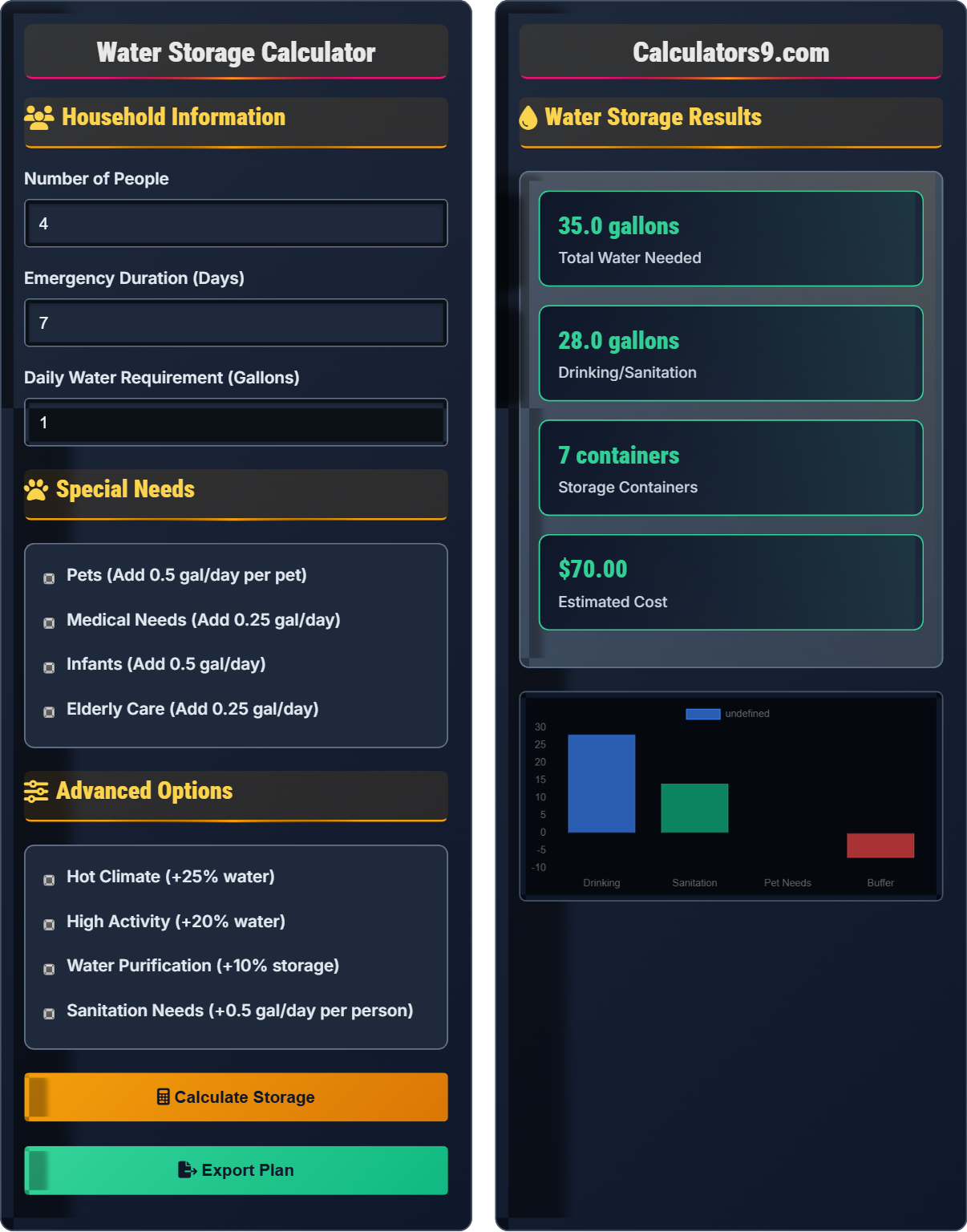
Show the calculatorTotal Water = (People × Days × Daily Requirement) × (1 + Buffer) + Special Needs
Where:
- People: Number of individuals in household/group
- Days: Emergency duration (typically 3-14 days)
- Daily Requirement: 1 gallon per person per day
- Buffer: 20-25% extra for safety
- Special Needs: Additional water for pets, medical, or sanitation
This formula calculates the total water needed for emergency preparedness, accounting for drinking, cooking, and basic hygiene needs.
Example: For a family of 4 during a 7-day emergency:
Base water: 4 people × 7 days × 1 gallon/day = 28 gallons
With 25% buffer: 28 × 1.25 = 35 gallons
With pet needs: +2 gallons = 37 gallons total
Household Information
Special Needs
Advanced Options
Water Storage Results
| Category | Requirement | Calculation | Amount |
|---|
| Container Type | Capacity | Quantity Needed | Notes |
|---|
Water Storage Planning Guide
Water storage planning involves calculating and preparing adequate water supplies for emergency situations when regular water service may be disrupted. The general rule is to store at least 1 gallon of water per person per day for drinking and basic hygiene, with a minimum 3-day supply recommended for emergencies. Proper planning considers household size, emergency duration, and special needs.
The standard water storage calculation uses the following formula:
Where:
- People: Number of individuals in household/group
- Days: Emergency duration (typically 3-14 days)
- Daily Requirement: 1 gallon per person per day
- Buffer: 20-25% extra for safety
- Special Needs: Additional water for pets, medical, or sanitation
Your emergency water should be allocated as follows:
- Drinking: 50-60% of total water supply
- Cooking: 10-15% of total water supply
- Hygiene: 20-30% of total water supply
- Sanitation: 10-15% of total water supply
- Rotation Method: Use oldest water first, replace every 6 months
- Multiple Locations: Store water in different areas to prevent total loss
- Container Diversity: Mix large and small containers for flexibility
- Freezing Strategy: Freeze water bottles as ice packs during emergencies
- Backup Sources: Identify alternative water sources if primary storage is compromised
Water Storage Basics
Preparing adequate water supplies for emergencies.
Total Water = (People × Days × Daily Requirement) × (1 + Buffer) + Special Needs
Where daily requirement is 1 gallon per person.
- Store 1 gallon per person per day
- Plan for 3-14 days minimum
- Add 20-25% buffer
Strategies
Systematic replacement to maintain freshness and safety.
- Use food-grade containers
- Label with date filled
- Store in cool, dark places
- Replace every 6 months
- Pet water needs
- Climate adjustments
- Medical requirements
- Sanitation needs
Water Storage Planning Learning Quiz
According to FEMA guidelines, what is the minimum recommended amount of water per person per day during an emergency?
The answer is B) 1 gallon. FEMA recommends storing at least 1 gallon of water per person per day during emergencies. This amount accounts for both drinking water and basic hygiene needs such as washing hands and brushing teeth.
Water storage planning follows evidence-based recommendations from emergency management agencies. The 1-gallon standard is based on scientific understanding of human hydration needs and basic sanitation requirements. This amount ensures that individuals can maintain basic health and hygiene during extended periods without access to public water systems.
FEMA: Federal Emergency Management Agency - coordinates federal response to disasters
Hydration: Maintaining adequate fluid levels in the body
Sanitation: Measures to maintain cleanliness and prevent disease spread
• Store at least 1 gallon of water per person per day
• Plan for 3 days minimum (recommended 7 days)
• Consider additional water for pets and special needs
• Use BPA-free containers for water storage
• Rotate stored water every 6 months
• Store water in multiple locations to prevent total loss
• Underestimating water needs (assuming only drinking water is needed)
• Storing insufficient quantities for the planned duration
• Forgetting to account for water needed for pets and babies
Calculate the total water needed for a family of 5 people during a 10-day emergency, including a 25% buffer. Show your work.
Using the formula: Total Water = (People × Days × Daily Requirement) × (1 + Buffer)
Given:
- People = 5
- Days = 10
- Daily Requirement = 1 gallon per person
- Buffer = 25% = 0.25
Step 1: Calculate base water requirement = 5 people × 10 days × 1 gallon/day = 50 gallons
Step 2: Calculate buffer amount = 50 gallons × 0.25 = 12.5 gallons
Step 3: Calculate total water needed = 50 gallons + 12.5 gallons = 62.5 gallons
Alternatively: 50 gallons × (1 + 0.25) = 50 × 1.25 = 62.5 gallons
Therefore, the family needs 62.5 gallons of water for the 10-day emergency.
This problem demonstrates the importance of proper calculation in emergency planning. The buffer percentage accounts for unexpected needs, waste, or extended emergency duration. The calculation shows how quickly supplies can multiply with multiple people and extended timeframes. This is why emergency planning requires careful mathematical consideration to ensure adequate supplies without excessive storage burdens.
Buffer: Extra supplies added to account for uncertainties and safety margins
Base Requirement: The fundamental amount needed without any additional safety factors
Emergency Duration: The planned time period for which supplies are gathered
• Always calculate base requirements first
• Apply buffer percentage to the base amount
• Verify calculations to prevent shortages
• Remember: Total = Base × (1 + Buffer percentage)
• Use 25% as a standard buffer (can range from 20-30%)
• Double-check calculations for accuracy
• Adding buffer before multiplying by people and days
• Forgetting to include the buffer in final calculation
• Using incorrect daily requirement values
Sarah is preparing water for her family of 4 during a 7-day emergency. She has 2 pets that need 0.5 gallons per day each. How much total water does she need with a 20% buffer?
Step 1: Calculate human water needs = 4 people × 7 days × 1 gallon/day = 28 gallons
Step 2: Calculate pet water needs = 2 pets × 7 days × 0.5 gallons/day = 7 gallons
Step 3: Calculate base total = 28 + 7 = 35 gallons
Step 4: Calculate buffer = 35 × 0.20 = 7 gallons
Step 5: Calculate total water needed = 35 + 7 = 42 gallons
Alternatively: 35 × (1 + 0.20) = 35 × 1.20 = 42 gallons
Therefore, Sarah needs 42 gallons of water for her 7-day emergency supply.
This example shows how special needs affect water storage calculations. Pets require significant additional water, especially during emergencies when regular water access may be limited. The calculation demonstrates how to incorporate special needs into the standard formula, ensuring that all family members (including pets) have adequate water supplies during emergencies.
Special Needs: Additional requirements for vulnerable populations
Vulnerable Populations: Groups requiring extra consideration (pets, elderly, disabled)
Hydration Requirements: Vary by species, weight, activity level, and health
• Pets need 0.5-1 gallon per day depending on size
• Include all household members in calculations
• Calculate needs for each group separately
• Consider size-specific requirements for pets
• Account for increased needs during illness
• Forgetting to account for pet water needs
• Not including special needs in buffer calculations
• Assuming pets can share human water supplies efficiently
John lives in a hot climate where water needs increase by 25%. He has a family of 3 adults and 1 infant. The infant needs an additional 0.5 gallons per day. Calculate his water needs for a 5-day emergency with a 30% buffer. (Hint: Add infant needs to base calculation before climate adjustment)
Step 1: Calculate base water needs = 3 adults × 5 days × 1 gallon/day = 15 gallons
Step 2: Add infant needs = 1 infant × 5 days × 0.5 gallons/day = 2.5 gallons
Step 3: Calculate pre-climate total = 15 + 2.5 = 17.5 gallons
Step 4: Apply climate adjustment = 17.5 × 1.25 = 21.875 gallons
Step 5: Apply buffer = 21.875 × 1.30 = 28.4375 gallons
Therefore, John needs approximately 28.4 gallons of water for his 5-day emergency supply.
This demonstrates how multiple factors affect water storage calculations. Climate adjustments significantly increase water needs, especially in hot weather when dehydration occurs more rapidly. The problem shows the correct order of operations: calculate base needs, add special needs, apply climate adjustment, then apply buffer. This layered approach ensures all factors are properly accounted for in the final calculation.
Climate Adjustment: Increased requirements due to environmental conditions
Dehydration: Loss of body fluids leading to health complications
Layered Calculations: Applying multiple factors in correct sequence
• Apply climate adjustments after base calculation
• Include special needs before climate adjustments
• Apply buffer after all other adjustments
• Order matters: Base → Special → Climate → Buffer
• Hot climates may require 25-50% more water
• Consider activity level in hot climates
• Applying climate adjustment too early in calculation
• Forgetting to account for special needs before climate adjustment
• Using incorrect order of operations for multiple factors
Which of the following is the BEST practice for maintaining stored water?
The answer is B) Use food-grade containers and rotate every 6 months. Proper water storage requires food-grade containers to prevent chemical contamination and regular rotation to maintain water quality. This ensures that stored water remains safe for consumption during emergencies.
Water storage planning extends beyond initial calculations to include maintenance and quality preservation. The rotation principle demonstrates how planning extends beyond initial acquisition to include ongoing maintenance. Food-grade containers prevent harmful chemicals from leaching into the water, while regular rotation prevents stagnation and maintains palatability. These practices ensure that stored water remains safe and usable when needed most.
Food-Grade: Materials safe for contact with food and beverages
Chemical Contamination: Harmful substances entering water supply
Stagnation: Water becoming stale due to lack of circulation
• Use only food-grade containers
• Store in cool, dark places
• Rotate water every 6 months
• Label containers with fill date
• Store in multiple locations
• Use oldest water first (first in, first out)
• Using non-food-grade containers
• Storing in areas with temperature fluctuations
• Not rotating water regularly
FAQ
Q: How much water should I store per person during an emergency?
A: FEMA recommends storing at least 1 gallon of water per person per day during emergencies. This accounts for both drinking water and basic hygiene needs such as washing hands and brushing teeth.
For example, if you're preparing for a family of 4 during a 7-day emergency:
Base water: 4 people × 7 days × 1 gallon/day = 28 gallons
With 25% buffer: 28 × 1.25 = 35 gallons total
Mathematically: If \( W \) is total water needed, then:
\( W = P \times D \times R \times (1 + B) \)
Where \( P \) = People, \( D \) = Days, \( R \) = Rate (1 gallon), \( B \) = Buffer (0.25)
Q: Do I need extra water for pets during emergencies?
A: Yes, pets require significant additional water during emergencies. The general recommendation is:
- Small pets (cats, small dogs): 0.5 gallons per day
- Medium pets (dogs 20-50 lbs): 1 gallon per day
- Large pets (dogs over 50 lbs): 1.5-2 gallons per day
For example, if you have 2 small pets during a 7-day emergency:
Pet water: 2 pets × 7 days × 0.5 gallons/day = 7 gallons additional
Don't forget that pets also need water for hydration during stress, which may increase their requirements.