Appliance Cost Calculator
Energy efficiency calculator • 2026 rates
Appliance Details
Advanced Options
Energy Cost Analysis
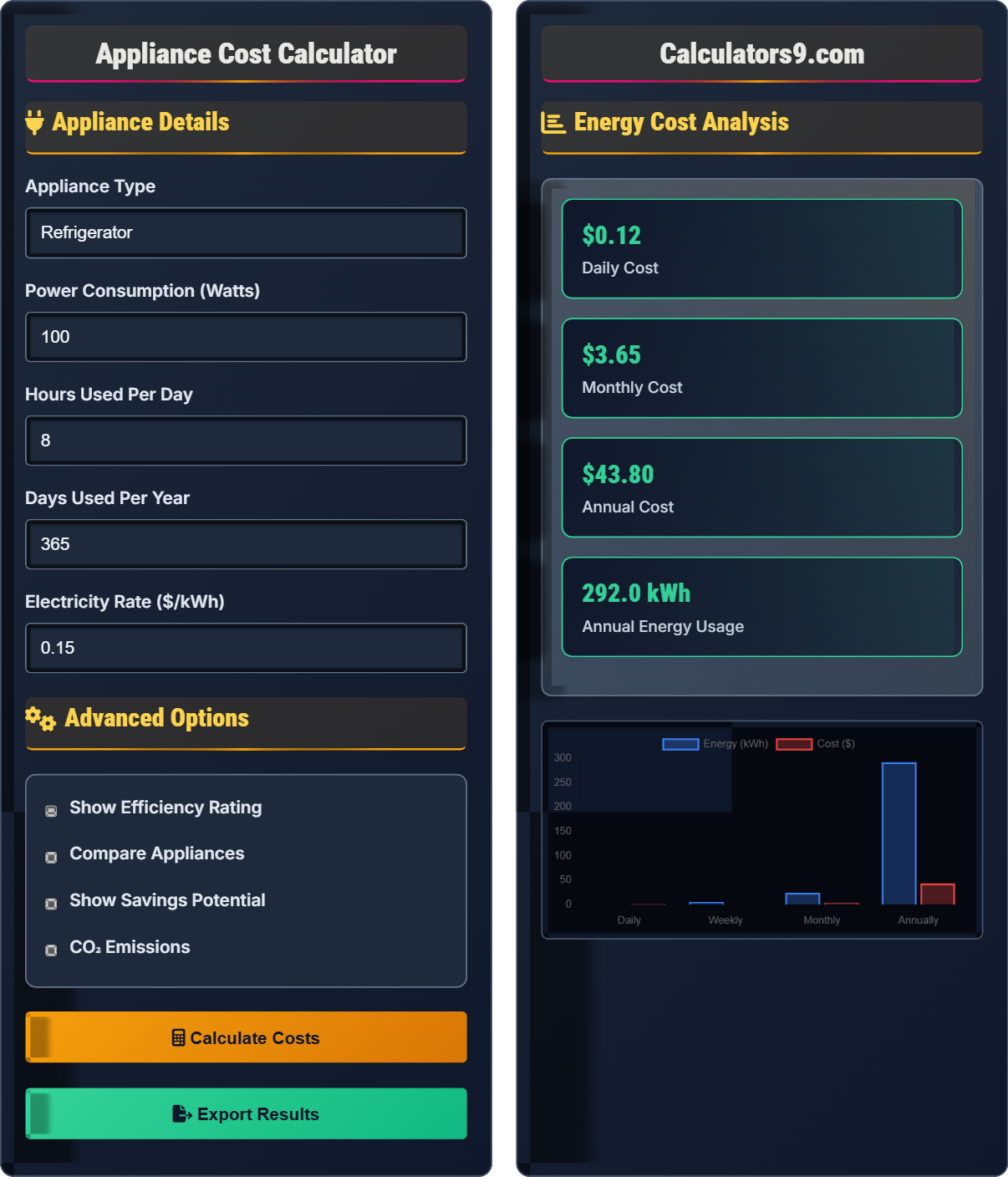
| Period | Energy (kWh) | Cost ($) | Savings ($) |
|---|---|---|---|
| Daily | 0.8 | 0.12 | 0.00 |
| Weekly | 5.6 | 0.84 | 0.00 |
| Monthly | 24 | 3.60 | 0.00 |
| Annually | 292 | 43.80 | 0.00 |
| Metric | Current | Upgrade | Improvement |
|---|---|---|---|
| Efficiency | 85% | 95% | 10% |
| Energy Saved | - | 29.2 kWh | 10% |
| Money Saved | - | $4.38 | 10% |
| CO₂ Reduced | - | 20.4 kg | 10% |
Comprehensive Energy Efficiency Guide
Energy efficiency refers to using less energy to perform the same task or deliver the same service. For appliances, this means achieving the desired function while consuming minimal electrical power. Energy-efficient appliances use advanced technologies like improved insulation, efficient motors, smart controls, and LED lighting to reduce energy consumption while maintaining performance.
The basic formula for calculating appliance energy costs is:
Where:
- Power = Appliance power consumption in watts
- Hours = Average hours used per day
- Days = Number of days used per year
- Rate = Electricity rate per kilowatt-hour (kWh)
Energy Star certified appliances offer significant advantages:
- 20-30% Energy Savings: Compared to standard models
- Lower Operating Costs: Reduced monthly electricity bills
- Environmental Impact: Lower greenhouse gas emissions
- Rebate Opportunities: Many utilities offer incentives
- Performance Quality: Maintains functionality while saving energy
- Replace old appliances: Upgrade to Energy Star models
- Smart scheduling: Run high-energy appliances during off-peak hours
- Regular maintenance: Keep appliances running efficiently
- Unplug idle devices: Eliminate phantom loads
- Use LED lighting: Replace incandescent bulbs with LEDs
Energy Efficiency Learning Quiz
How much does it cost to run a 1000W microwave for 30 minutes daily at $0.15/kWh for a year?
Using the formula: Annual Cost = (Power × Hours × Days × Rate) / 1000
Given:
- Power = 1000W
- Hours = 0.5 hours/day
- Days = 365
- Rate = $0.15/kWh
Calculation: (1000 × 0.5 × 365 × 0.15) / 1000 = $27.38
This problem demonstrates how to calculate energy costs for appliances with intermittent usage. The key is converting all units to consistent measurements: power in watts, time in hours, and energy in kilowatt-hours. Notice how even a high-power appliance like a microwave has relatively low annual costs due to limited daily usage.
Kilowatt-hour (kWh): Unit of energy equal to 1000 watts used for 1 hour
Power (W): Rate of energy consumption
Energy (kWh): Total amount of power consumed over time
• Divide by 1000 to convert watt-hours to kilowatt-hours
• Always convert time to consistent units (hours)
• Multiply power × time × rate to get total cost
• Remember: 1 kWh = 1000 Wh
• Convert daily usage to annual by multiplying by 365
• Use the formula: (W × h × d × rate) / 1000
• Forgetting to divide by 1000 to convert to kWh
• Mixing up hours and minutes in calculations
• Not accounting for partial hours of usage
A household replaces a 60W incandescent bulb with a 10W LED bulb, both used 5 hours daily. Calculate the annual energy and cost savings at $0.15/kWh.
Incandescent bulb annual energy: (60 × 5 × 365) / 1000 = 109.5 kWh
LED bulb annual energy: (10 × 5 × 365) / 1000 = 18.25 kWh
Energy savings: 109.5 - 18.25 = 91.25 kWh
Cost savings: 91.25 × $0.15 = $13.69
The LED bulb saves 91.25 kWh and $13.69 annually.
This example illustrates the dramatic impact of switching to energy-efficient lighting. The LED bulb uses only 1/6th the energy of the incandescent while providing equivalent light output. This represents a 83% reduction in energy consumption for the same function, demonstrating how simple upgrades can yield significant savings.
Phantom Load: Energy consumed by devices when turned off but still plugged in
Energy Efficiency: Performing the same function with less energy
Luminous Efficacy: Light output per unit of energy consumed
• Compare identical functions when calculating savings
• Calculate energy usage for both options separately
• Multiply energy savings by rate to get cost savings
• Calculate individual savings for each replacement
• Consider the total number of bulbs replaced
• Account for the longer lifespan of LEDs
• Forgetting to account for the same usage time for both bulbs
• Not considering the full annual usage period
• Confusing power ratings with actual energy consumption
Sarah's old refrigerator uses 150W and runs 24/7. She replaces it with an Energy Star model that uses 80W. Calculate her annual energy and cost savings at $0.15/kWh, and determine how long it will take to recover a $400 upgrade cost.
Old refrigerator annual energy: (150 × 24 × 365) / 1000 = 1,314 kWh
New refrigerator annual energy: (80 × 24 × 365) / 1000 = 700.8 kWh
Energy savings: 1,314 - 700.8 = 613.2 kWh
Annual cost savings: 613.2 × $0.15 = $91.98
Payback period: $400 ÷ $91.98 = 4.35 years
Sarah saves 613.2 kWh annually and recovers her investment in 4.35 years.
This problem demonstrates the long-term value of energy-efficient appliances. Refrigerators run continuously, making them significant energy consumers. The Energy Star model uses 47% less energy while providing the same cooling function. The payback period calculation shows when the energy savings offset the initial investment, making it a financially sound decision.
Payback Period: Time required for savings to equal the initial investment
Continuous Load: Appliances that operate 24/7
Energy Factor: Measure of appliance efficiency
• Continuous appliances have the highest potential savings
• Calculate payback period to assess investment value
• Consider the appliance's expected lifespan
• Focus on continuous-use appliances for maximum savings
• Calculate payback period to justify upgrade costs
• Consider rebates and incentives that reduce payback time
• Forgetting that refrigerators run continuously
• Not accounting for the full year in calculations
• Ignoring the payback period when evaluating investments
John installs a smart thermostat that reduces his heating and cooling energy usage by 15%. His annual HVAC energy bill is $1,200. Calculate his annual savings and the CO₂ reduction if his electricity comes from a grid with 0.7 kg CO₂/kWh. Also, determine how long it takes to recover a $250 smart thermostat cost.
Annual energy savings: $1,200 × 0.15 = $180
Energy usage before: $1,200 ÷ $0.15/kWh = 8,000 kWh
Energy savings: 8,000 × 0.15 = 1,200 kWh
CO₂ reduction: 1,200 kWh × 0.7 kg/kWh = 840 kg CO₂
Payback period: $250 ÷ $180 = 1.39 years
John saves $180 annually, reduces CO₂ by 840 kg, and recovers investment in 1.39 years.
This example shows how smart technology can optimize energy usage beyond just appliance efficiency. Smart thermostats use algorithms to optimize temperature settings, reducing unnecessary heating and cooling. The environmental impact calculation connects energy savings to CO₂ reduction, demonstrating the broader benefits of energy efficiency improvements.
Smart Controls: Automated systems that optimize energy usage
Carbon Intensity: CO₂ emissions per unit of electricity generated
Load Shifting: Moving energy usage to off-peak times
• Smart devices can optimize usage patterns for savings
• Connect energy savings to environmental impact
• Calculate payback for technology investments
• Look for ENERGY STAR certified smart devices
• Consider time-of-use rates for additional savings
• Track actual savings to verify performance claims
• Assuming all smart devices provide equal savings
• Not verifying actual performance against claims
• Overlooking installation and setup costs
Which of the following statements about Energy Star appliances is TRUE?
The answer is B) Energy Star appliances use 10-50% less energy than standard models. Energy Star is a certification program that identifies products meeting strict energy efficiency guidelines set by the EPA. The program covers over 75 product categories including refrigerators, washing machines, dishwashers, TVs, and lighting fixtures. While some Energy Star models may cost more upfront, they typically pay for themselves through energy savings within 2-3 years.
Energy Star is a widely recognized symbol of energy efficiency excellence. The program sets rigorous standards that products must meet to earn certification. These standards are updated periodically to reflect technological advances. Energy Star certified products undergo testing to verify they meet performance requirements while delivering energy savings. The program has helped consumers save billions of dollars in energy costs since its inception.
Energy Star: EPA certification for energy-efficient products
EPA: Environmental Protection Agency
Energy Efficiency Ratio (EER): Cooling capacity divided by power input
• Energy Star applies to 75+ product categories
• Certified products meet performance and efficiency standards
• Savings vary by product type and usage patterns
• Look for Energy Star when replacing appliances
• Check the Energy Guide label for estimated annual costs
• Consider rebates available for Energy Star purchases
• Assuming all energy-efficient appliances are Energy Star certified
• Not considering the total cost of ownership
• Ignoring available rebates and incentives
Energy Efficiency Basics
Using less energy to perform the same function.
Annual Cost = (Power × Hours × Days × Rate) / 1000
Where Power=Watts, Hours=usage time, Rate=$/kWh.
- Convert watts to kilowatts for kWh calculation
- Continuous appliances have highest savings potential
- Small efficiency improvements = big savings
Strategies
Identify highest energy-consuming appliances first.
- Replace continuous-use appliances
- Switch to LED lighting
- Optimize heating/cooling
- Eliminate phantom loads
- Payback period calculations
- Available rebates/incentives
- Appliance lifespan
- Performance requirements
FAQ
Q: How much can I save by upgrading appliances?
A: Energy Star appliances save 10-50% depending on type. Refrigerators: ~$100-200/year. Dryers: ~$50-100/year. LED bulbs: ~$5-15/year per bulb.
Q: Are Energy Star appliances worth it?
A: Yes! Energy Star appliances typically pay for themselves within 2-3 years through energy savings. They also last longer and often perform better.