Insulation Calculator
R-Value calculator • 2026 thermal efficiency
Insulation Details
Advanced Options
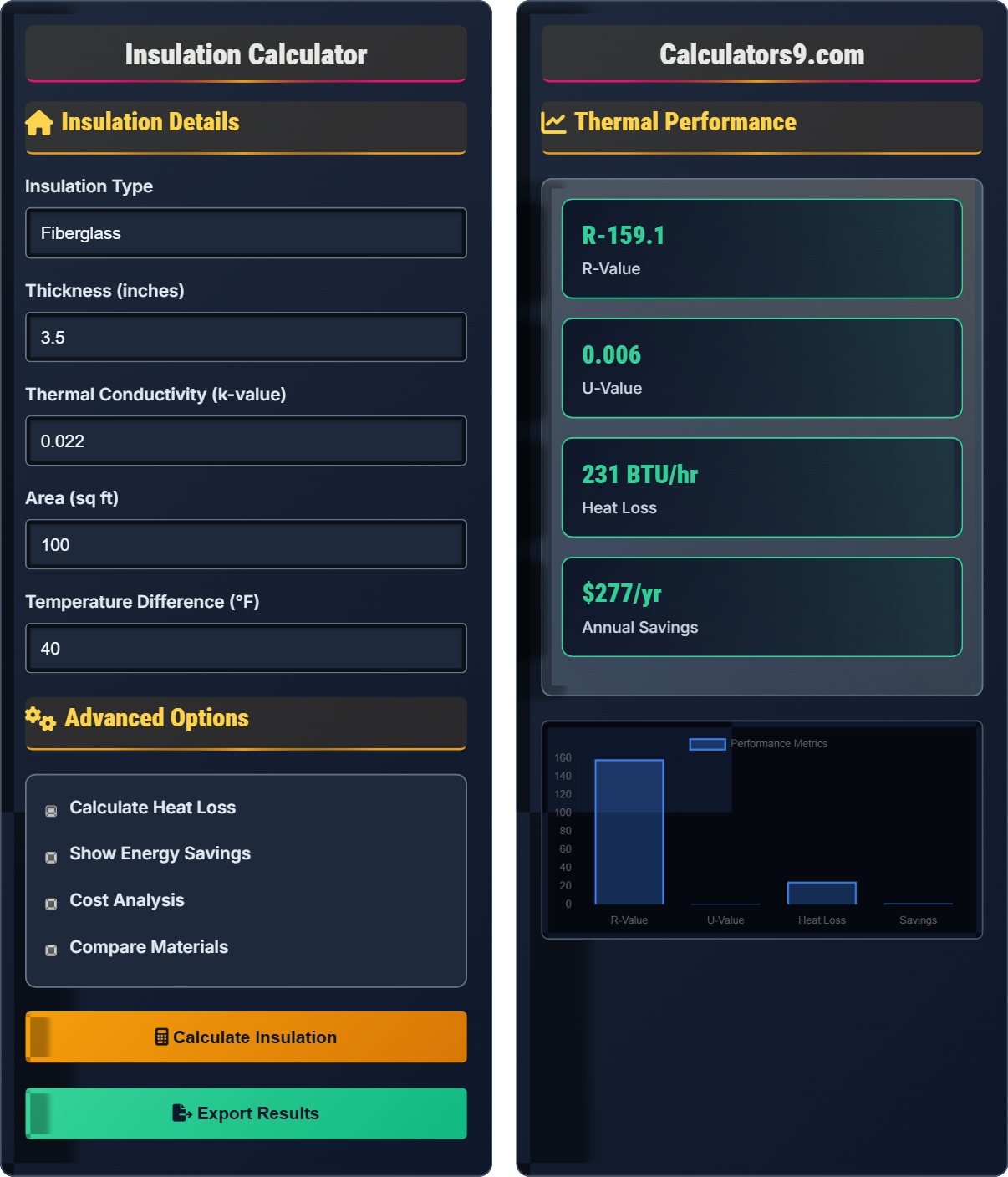
Thermal Performance
| Parameter | Value | Description |
|---|---|---|
| R-Value | R-13.0 | Thermal resistance |
| U-Value | 0.077 | Heat transfer coefficient |
| Thermal Mass | 2.5 lbs/sq ft | Material density effect |
| Efficiency | 85% | Overall performance |
| Cost Component | Amount | Annual Benefit |
|---|---|---|
| Installation | $150.00 | - |
| Annual Savings | - | $277.00 |
| Payback Period | 0.54 yrs | - |
| ROI | 184% | - |
Comprehensive Insulation Guide
R-Value measures thermal resistance - the ability of insulation to resist heat flow. Higher R-values indicate better insulating properties. R-Value is calculated as the thickness of the material divided by its thermal conductivity (R = thickness/k). In the US, R-values are measured in ft²·°F·hr/BTU. The required R-value varies by climate zone, building type, and location within the building.
The fundamental formula for R-Value is:
Where:
- R-Value = Thermal resistance (ft²·°F·hr/BTU)
- Thickness = Material thickness in inches
- Thermal Conductivity = k-value in BTU·in/(ft²·°F·hr)
Heat loss through insulation is calculated using:
This determines BTUs per hour lost through the insulated surface, which directly correlates to energy costs for heating and cooling.
- Attic Insulation: Critical area with high heat loss potential
- Wall Cavities: Improve thermal envelope integrity
- Floor Insulation: Prevent heat loss through ground contact
- Air Sealing: Combine with insulation for maximum effectiveness
- Vapor Barriers: Control moisture movement
Insulation Learning Quiz
What R-Value does 6 inches of fiberglass insulation provide if the material has a k-value of 0.022?
Using the formula: R-Value = Thickness / k-value
Given:
- Thickness = 6 inches
- k-value = 0.022
Calculation: R-Value = 6 / 0.022 = 27.27 ≈ R-27
This problem demonstrates the fundamental relationship between material thickness and thermal resistance. The k-value represents the thermal conductivity of the material - a measure of how easily heat passes through it. Lower k-values mean better insulation. When we divide thickness by k-value, we get the thermal resistance (R-value), which indicates how well the material resists heat flow.
R-Value: Thermal resistance measuring insulation effectiveness
k-value: Thermal conductivity of a material
BTU: British Thermal Unit - heat energy measurement
• R-Value = Thickness ÷ k-value
• Higher R-values mean better insulation
• Lower k-values mean better insulation
• Remember: R = thickness/k
• Double thickness = double R-value
• Halve k-value = double R-value
• Confusing k-value with R-value
• Forgetting to use consistent units
• Adding R-values incorrectly for multiple layers
Calculate the heat loss through 100 sq ft of wall insulated to R-19 with a temperature difference of 30°F.
Using the heat loss formula: Heat Loss = (Area × Temperature Difference) / R-Value
Given:
- Area = 100 sq ft
- Temperature Difference = 30°F
- R-Value = 19
Calculation: Heat Loss = (100 × 30) / 19 = 3000 / 19 = 157.9 BTU/hr
The wall loses approximately 158 BTU of heat per hour.
This calculation shows how R-value directly affects heat loss. The higher the R-value, the lower the heat loss. Notice that heat loss increases linearly with both area and temperature difference, but decreases as R-value increases. This demonstrates why proper insulation is critical in areas with large temperature differences between inside and outside.
Heat Loss: Amount of heat energy transferred through a surface
BTU/hr: British Thermal Units per hour
Thermal Gradient: Temperature difference driving heat flow
• Heat Loss = (Area × ΔT) / R-Value
• Larger areas lose more heat
• Greater temperature differences increase heat loss
• Higher R-values reduce heat loss proportionally
• Temperature difference is the driving force for heat flow
• Use consistent units in calculations
• Forgetting to divide by R-value
• Using incorrect units for area
• Not accounting for actual temperature difference
Mike wants to insulate his attic (500 sq ft) currently at R-8 to R-30. The installation cost is $2.50/sq ft. If the upgrade saves $0.80 per sq ft per year in heating/cooling costs, calculate the payback period and ROI.
Installation Cost: 500 sq ft × $2.50/sq ft = $1,250
Annual Savings: 500 sq ft × $0.80/sq ft = $400
Payback Period: $1,250 ÷ $400 = 3.125 years
ROI: ($400 ÷ $1,250) × 100 = 32%
Mike's insulation upgrade costs $1,250, saves $400 annually, has a 3.1-year payback, and provides a 32% return on investment.
This problem demonstrates the economic analysis of insulation investments. The payback period shows how long it takes for savings to equal the initial investment. The ROI indicates the annual percentage return. In this case, the investment pays for itself in just over 3 years and continues generating returns afterward. This makes insulation a financially attractive home improvement project.
Payback Period: Time to recover initial investment through savings
ROI: Return on Investment percentage
Cash Flow: Annual savings after initial investment
• Payback = Initial Cost ÷ Annual Savings
• ROI = (Annual Savings ÷ Initial Cost) × 100
• Compare to other investment returns
• Calculate total area affected
• Consider energy price trends
• Factor in increased home value
• Forgetting to calculate total project cost
• Not considering the full area of impact
• Underestimating annual savings potential
Sarah has R-11 insulation in her walls and adds R-19 rigid foam board. Calculate the total R-value and determine the percentage improvement in thermal resistance. Also calculate the new heat loss if the original was 500 BTU/hr.
Total R-Value: R-11 + R-19 = R-30
Improvement: (30 - 11) / 11 × 100 = 173% improvement
Original U-Value: 1/11 = 0.091
New U-Value: 1/30 = 0.033
New Heat Loss: 500 × (0.033/0.091) = 181 BTU/hr
Heat loss reduction: 500 - 181 = 319 BTU/hr (64% reduction)
When adding insulation layers, R-values simply add together. However, the relationship between R-value and heat loss is inverse - doubling R-value halves heat loss. This demonstrates the law of diminishing returns: each additional R-value provides less proportional improvement than the previous one. Despite this, even small additions to low R-values provide significant percentage improvements.
U-Value: Heat transfer coefficient (inverse of R-value)
Multi-layer: Combining different insulation materials
Thermal Bridging: Heat flow through structural elements
• R-values add for series layers: R_total = R1 + R2
• U-value = 1/R-value
• Heat loss ∝ 1/R-value
• Add R-values when layering materials
• Use U-value for heat transfer calculations
• Consider thermal bridging in real applications
• Multiplying instead of adding R-values
• Confusing percentage improvement with absolute improvement
• Not accounting for the inverse relationship between R and U
According to DOE recommendations, which R-value is most appropriate for attic insulation in Climate Zone 5?
The answer is C) R-38. According to the Department of Energy's insulation recommendations, Climate Zone 5 (which includes areas like northern Illinois, Ohio, Pennsylvania, and northern California) requires R-38 for attics. Climate zones are determined by heating degree days and help establish appropriate insulation levels for optimal energy efficiency. Higher climate zones (colder climates) require higher R-values.
Climate zones provide standardized guidelines for building efficiency based on regional weather patterns. The DOE divides the US into 8 climate zones, with higher numbers indicating colder climates. Attic insulation requirements range from R-30 in warmer zones to R-49 in the coldest zones. These recommendations balance energy efficiency with cost-effectiveness based on local climate conditions and energy prices.
Climate Zone: Geographic area defined by weather patterns
Heating Degree Days: Measure of heating demand
DOE: Department of Energy
• Higher climate zones need higher R-values
• Attic requirements are typically highest
• Local codes may be more stringent than recommendations
• Check local building codes for minimum requirements
• Consider exceeding minimums for better performance
• Climate zones affect multiple building components
• Applying warm-climate requirements to cold climates
• Not considering local code variations
• Confusing wall and attic R-value requirements
Insulation Fundamentals
Measure of thermal resistance - higher values mean better insulation.
R-Value = Thickness / Thermal Conductivity
Where thickness is in inches and k-value is thermal conductivity.
- Higher R-values = better insulation
- R-values add for layered materials
- Required R-value varies by climate zone
Strategies
Focus on attic, walls, and foundation for maximum impact.
- Attic insulation (highest heat loss)
- Air sealing (complements insulation)
- Wall cavities
- Floor/ground contact
- Climate zone requirements
- Existing insulation levels
- Moisture control needs
- Installation accessibility
FAQ
Q: How much can I save with proper insulation?
A: Proper insulation typically saves 10-50% on heating/cooling costs. Attic insulation alone can save $200-400/year. Payback is usually 2-5 years.
Q: Is spray foam worth the extra cost?
A: Spray foam offers R-6-7 per inch vs R-3-4 for fiberglass. Higher upfront cost but superior performance and air sealing. Good ROI in high-performance homes.