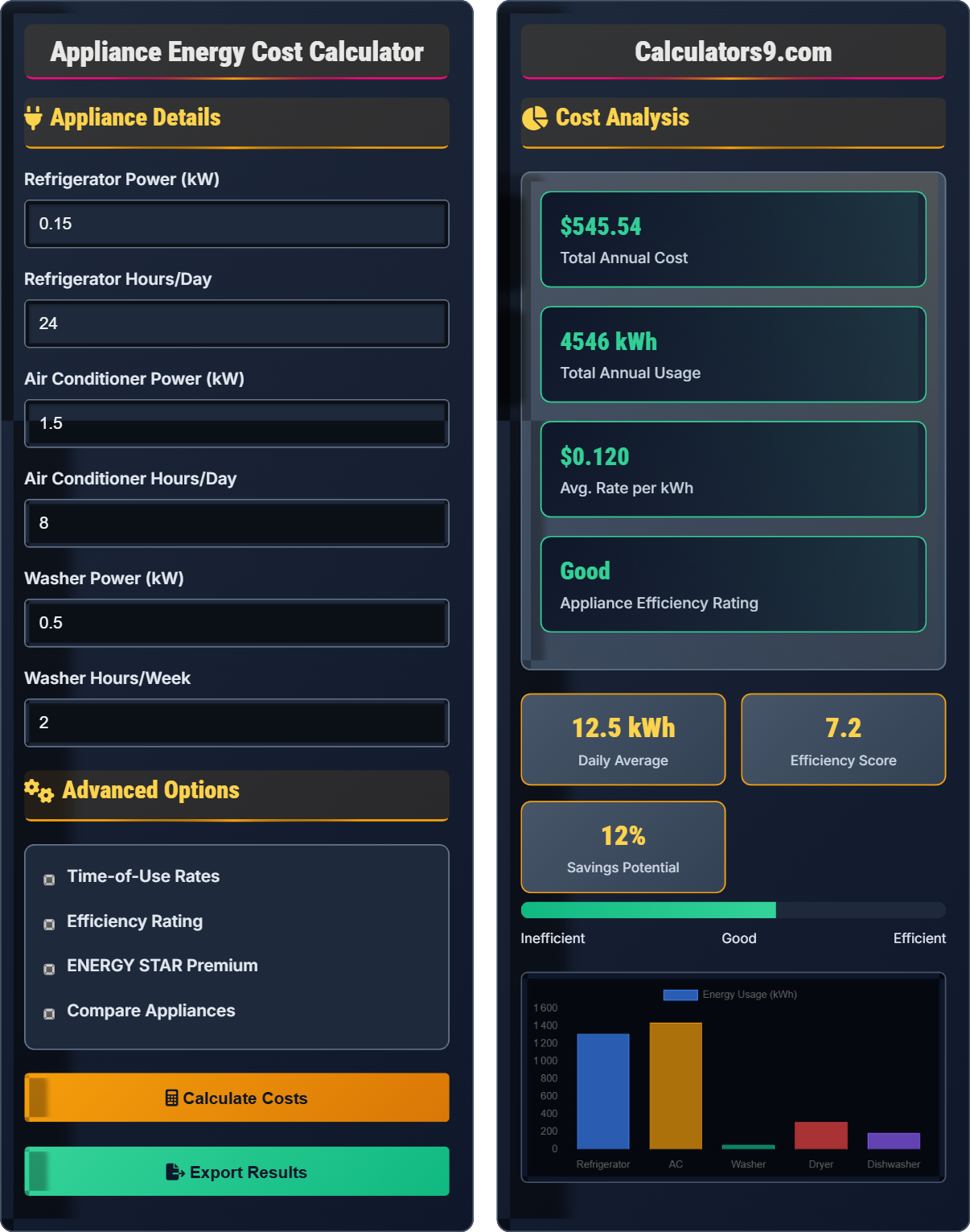
Appliance Energy Cost Calculator
Home appliance efficiency tracker • 2026 rates
Appliance Energy Cost Formula:
Show the calculator\( EC = \sum (P_i \times H_i \times D_i \times R) \)
Where:
- \( EC \) = Total energy cost ($)
- \( P_i \) = Power rating of appliance i (kilowatts)
- \( H_i \) = Hours used per day for appliance i
- \( D_i \) = Days used per year for appliance i
- \( R \) = Rate per kWh ($)
This formula calculates the annual energy cost for each appliance based on power consumption, usage patterns, and electricity rates. It helps identify the most expensive appliances to operate.
Example: For a refrigerator (0.15 kW) running 24 hours/day (365 days), at $0.12/kWh:
Energy = 0.15 kW × 24 hrs/day × 365 days = 1,314 kWh
Cost = 1,314 kWh × $0.12/kWh = $157.68 annually
Appliance Details
Advanced Options
Cost Analysis
| Appliance | Power (kW) | Usage (kWh/yr) | Annual Cost ($) |
|---|
| Upgrade | Current Cost | New Cost | Annual Savings |
|---|
Appliance Efficiency Tips & Savings
Here are average power ratings for common appliances:
- Refrigerator: 100-400W (varies by size and age)
- Air Conditioner: 1,000-3,500W (window units)
- Washing Machine: 350-500W
- Dryer: 1,800-5,000W (electric)
- Dishwasher: 1,200-2,400W
- Microwave: 600-1,200W
- TV: 50-400W (depending on size/type)
Follow these guidelines to reduce appliance energy costs:
- Replace old appliances with ENERGY STAR models
- Use appliances during off-peak hours if on TOU rates
- Unplug devices when not in use (phantom loads)
- Clean refrigerator coils monthly
- Use cold water for washing clothes when possible
- Run dishwashers and washing machines with full loads
Understanding the long-term benefits of efficient appliances:
- ENERGY STAR appliances use 10-50% less energy than standard models
- Replacing old refrigerators can save $100-200 annually
- Efficient washing machines use 25% less energy and 40% less water
- LED bulbs last 25 times longer than incandescent bulbs
- Programmable thermostats pay for themselves in 2-3 years
ENERGY STAR Certified Appliances
Appliance Energy Usage & Efficiency Quiz
Which appliance typically consumes the most electricity in a household?
The answer is B) Air Conditioner. During hot months, air conditioning typically accounts for 40-70% of residential electricity usage. In cooler climates, water heaters may be the largest consumer, but in most regions, air conditioning is the biggest energy drain due to its high power draw and frequent operation during peak summer months.
Understanding which appliances consume the most energy helps prioritize efficiency improvements. Air conditioners require significant power because they move large volumes of air and often operate for many hours during hot weather. The seasonal nature of AC usage also means its impact on monthly bills can vary dramatically throughout the year.
Power Draw: Amount of electrical energy consumed by an appliance
Seasonal Usage: Energy consumption that varies significantly by season
Peak Load: Maximum energy consumption during a period
• Air conditioning typically has the highest energy consumption
• Consumption varies by climate and season
• Running time affects total energy usage
• Remember: AC is usually the biggest energy user
• Use programmable thermostats to reduce cooling costs
• Consider ceiling fans to reduce AC dependency
• Assuming refrigerators are the largest consumers (they run constantly but use less power)
• Not considering regional climate differences
• Forgetting that seasonal usage affects total consumption
If you use a 1,500W space heater for 4 hours each day for a month (30 days), and electricity costs $0.12 per kWh, what is the monthly cost? Show your work.
Step 1: Convert watts to kilowatts = 1,500W ÷ 1,000 = 1.5 kW
Step 2: Calculate daily energy usage = 1.5 kW × 4 hours = 6 kWh/day
Step 3: Calculate monthly energy usage = 6 kWh/day × 30 days = 180 kWh
Step 4: Calculate monthly cost = 180 kWh × $0.12/kWh = $21.60
Therefore, using the space heater for 4 hours daily costs $21.60 per month.
This calculation demonstrates how to convert between different units of power and energy. Understanding the relationship between watts, kilowatts, and kilowatt-hours is crucial for accurate energy cost calculations. The conversion factor of 1,000 is consistent: 1,000 watts = 1 kilowatt, and 1,000 watt-hours = 1 kilowatt-hour.
Watt (W): Unit of power measuring energy consumption rate
Kilowatt (kW): 1,000 watts
Kilowatt-hour (kWh): Energy consumed over one hour
• Watts ÷ 1,000 = Kilowatts
• Power × Time = Energy (kW × hours = kWh)
• Energy × Rate = Cost (kWh × $/kWh = $)
• Always convert watts to kilowatts before calculating costs
• Remember: kWh = kW × hours
• Check your electricity bill for actual rates
• Forgetting to convert watts to kilowatts
• Multiplying power by time incorrectly
• Confusing power (watts) with energy (watt-hours)
You currently have an old refrigerator that uses 1.2 kW and runs 24 hours daily. You're considering replacing it with an ENERGY STAR model that uses 0.5 kW. If electricity costs $0.12 per kWh, how much would you save annually? Show your calculations.
Step 1: Current annual usage = 1.2 kW × 24 hours/day × 365 days = 10,512 kWh
Step 2: New annual usage = 0.5 kW × 24 hours/day × 365 days = 4,380 kWh
Step 3: Annual energy savings = 10,512 kWh - 4,380 kWh = 6,132 kWh
Step 4: Annual cost savings = 6,132 kWh × $0.12/kWh = $735.84
Therefore, switching to the efficient refrigerator would save approximately $735.84 per year.
This calculation demonstrates the significant savings possible through appliance upgrades. ENERGY STAR refrigerators use about 40% less energy than standard models. The example shows how replacing an old, inefficient appliance with a new, efficient one can result in substantial annual savings that often pay for the new appliance in just a few years.
ENERGY STAR: Certification program for energy-efficient products
Energy Efficiency: Using less energy to perform the same function
Appliance Replacement: Upgrading to more efficient equipment
• Energy savings = (old usage - new usage) × rate
• Efficient appliances provide same function with less energy
• Annual savings = daily savings × 365
• Replace oldest appliances first for maximum savings
• Look for ENERGY STAR certified products
• Consider rebates and tax incentives for efficient appliances
• Not accounting for the full lifetime of energy savings
• Forgetting to convert watts to kilowatts
• Assuming all appliances provide equal energy efficiency
You currently use a standard washing machine that consumes 0.5 kW for 1 hour per load, 4 times per week. An efficient model uses 0.35 kW for the same load. If electricity costs $0.12 per kWh, what would be your annual savings? If the efficient washer costs $800 and the old one costs $300, what is the payback period?
Step 1: Current annual usage = 0.5 kW × 1 hour/load × 4 loads/week × 52 weeks = 104 kWh
Step 2: New annual usage = 0.35 kW × 1 hour/load × 4 loads/week × 52 weeks = 72.8 kWh
Step 3: Annual energy savings = 104 kWh - 72.8 kWh = 31.2 kWh
Step 4: Annual cost savings = 31.2 kWh × $0.12/kWh = $3.74
Step 5: Additional investment = $800 - $300 = $500
Step 6: Payback period = $500 ÷ $3.74/year = 133.7 years
This example shows that the energy savings alone may not justify the purchase. However, efficient washers also save water and have better features.
This example demonstrates how to evaluate appliance investments considering both energy costs and other benefits. While the energy savings alone may not justify the investment in this case, efficient appliances often provide additional benefits like water savings, better performance, and longer lifespans. The example also shows that some appliances have relatively low energy costs compared to their purchase price.
Payback Period: Time required for savings to equal investment cost
Energy Investment: Upfront cost for energy-efficient equipment
Multiple Benefits: Savings from energy, water, and other factors
• Payback period = Investment ÷ Annual savings
• Consider all benefits when evaluating appliances
• Some appliances have low energy costs relative to purchase price
• Look for payback periods under 5-10 years for major appliances
• Consider water savings for washers and dishwashers
• Factor in rebates and tax incentives in calculations
• Only considering energy savings without other benefits
• Not accounting for installation and maintenance costs
• Assuming all appliances have similar energy cost impacts
Which of the following statements about residential appliance energy consumption is TRUE?
The answer is B) Heating and cooling account for 48% of home energy. According to the U.S. Department of Energy, heating and cooling represent approximately 48% of residential energy consumption. Water heating comes second at about 14%, followed by appliances and lighting. This makes HVAC systems the primary target for energy efficiency improvements.
This statistic helps prioritize energy efficiency efforts. Since heating and cooling account for nearly half of home energy use, improvements in this area yield the greatest savings. This includes upgrading insulation, sealing air leaks, using programmable thermostats, and upgrading to efficient HVAC systems. Understanding energy distribution helps focus efforts where they'll have the most impact.
HVAC: Heating, Ventilation, and Air Conditioning systems
Energy Distribution: How energy is allocated among different uses
Priority Areas: Uses with highest energy consumption
• Focus efficiency efforts on highest consumption areas
• HVAC systems account for nearly half of home energy
• Small improvements in high-consumption areas yield large savings
• Remember: HVAC = 48% of energy use
• Prioritize improvements in high-consumption areas
• Use energy audit to identify consumption patterns
• Focusing on low-impact areas while ignoring major consumers
• Assuming all appliances use equal amounts of energy
• Not understanding the seasonal variation in HVAC use
FAQ
Q: How can I identify which appliances are consuming the most energy?
A: The easiest ways to identify high-energy appliances include:
- Check labels: Look for EnergyGuide labels showing annual energy use
- Use a wattmeter: Measure actual power consumption of appliances
- Review your bill: Compare usage during different seasons
- Appliance age: Older appliances (pre-2000s) typically use more energy
Mathematically, for an appliance with power rating \( P \) (kW) running \( H \) hours daily:
\( \text{Annual Usage} = P \times H \times 365 \)
Focus on appliances with high power ratings that run frequently.
Q: What's the most effective way to reduce appliance energy costs?
A: The most effective approach targets the largest energy consumers:
- HVAC: Account for 48% of home energy - upgrade to efficient systems
- Water Heater: 14% of energy - insulate and lower temperature
- Refrigerator: Replace old models with ENERGY STAR units
- Behavioral: Unplug electronics, use cold water for laundry
- Phantom Loads: Eliminate standby power with smart power strips
Research shows that targeting HVAC and refrigeration can reduce bills by 20-30% with proper implementation.