Battery Backup Calculator
Power backup tracker • 2026 rates
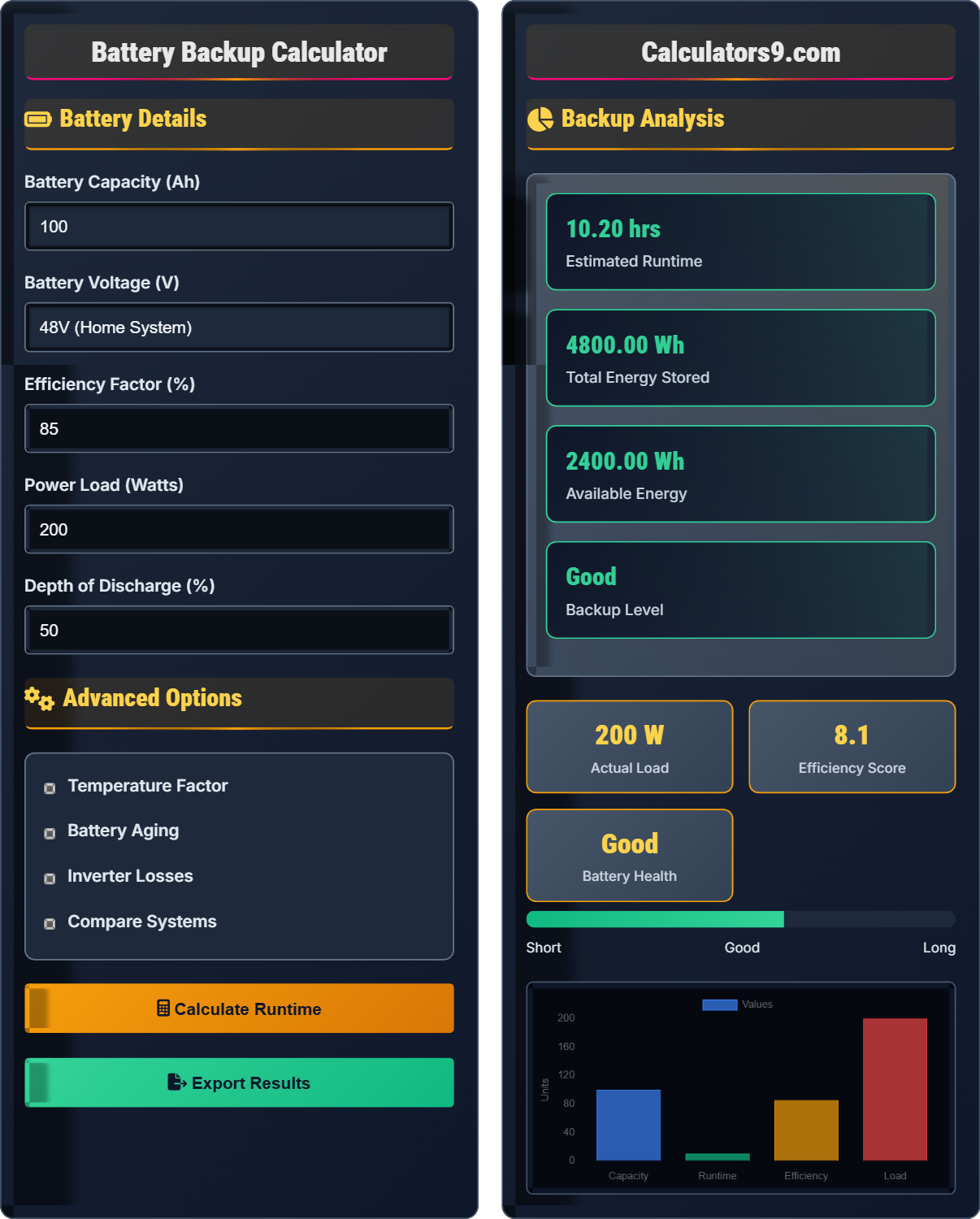
Battery Backup Formula:
Show the calculator\( R = \frac{C \times V \times E}{P \times D} \)
Where:
- \( R \) = Runtime (hours)
- \( C \) = Battery capacity (Ah)
- \( V \) = Voltage (Volts)
- \( E \) = Efficiency factor
- \( P \) = Power load (Watts)
- \( D \) = Depth of discharge factor
This formula calculates the estimated runtime of a battery backup system based on capacity, voltage, efficiency, and power draw. It helps plan for emergency power needs and system sizing.
Example: For a 100Ah battery at 12V, 85% efficiency, 200W load, 50% DoD:
Runtime = (100 × 12 × 0.85) ÷ (200 × 0.5) = 1020 ÷ 100 = 10.2 hours
Battery Details
Advanced Options
Backup Analysis
| Parameter | Value | Description |
|---|
| Device | Power (W) | Runtime (hrs) | Energy (Wh) |
|---|
Battery Backup Tips & Efficiency
Key factors for battery backup systems:
- Capacity: Higher Ah rating = longer runtime
- Voltage: Higher voltage = more efficient
- Chemistry: Lithium-ion vs Lead-acid
- Efficiency: 80-95% depending on type
- Depth of Discharge: Limit to 50-80% for longevity
Best practices for maximum battery life:
- Keep batteries at room temperature
- Charge regularly to prevent sulfation
- Monitor water levels in flooded cells
- Equalize charging monthly
- Replace when capacity drops below 80%
Understanding the long-term benefits of proper battery backup:
- Properly sized systems provide 4-8 hours of backup
- Lead-acid batteries last 3-5 years, Li-ion 8-10 years
- Regular maintenance extends life by 50-100%
- Backup power prevents data loss and equipment damage
- Proper sizing reduces replacement costs
Battery Type Options
Battery Backup & Runtime Quiz
Which battery chemistry provides the highest efficiency?
The answer is B) Lithium-Ion. Lithium-ion batteries typically achieve 95-98% efficiency, significantly higher than lead-acid (80-85%), AGM (85-90%), and gel cell (80-85%). This higher efficiency means less energy is lost as heat during charging and discharging, resulting in longer runtime and better performance.
Understanding battery efficiency helps optimize system performance and runtime. Higher efficiency batteries waste less energy as heat, providing more usable power for the same capacity. This is particularly important for backup systems where every bit of stored energy matters during outages.
Battery Efficiency: Percentage of energy input that can be retrieved as output
Energy Loss: Energy converted to heat during charge/discharge cycles
Round-Trip Efficiency: Combined charge and discharge efficiency
• Lithium-ion has highest efficiency (95-98%)
• Higher efficiency = longer runtime for same capacity
• Efficiency affects both charging and discharging
• Remember: Li-ion = 95% efficiency (highest)
• Lead-acid = 80-85% efficiency (lowest)
• Higher efficiency = less heat generation
• Assuming all battery types have similar efficiency
• Not considering efficiency in runtime calculations
• Ignoring heat generation from inefficiency
If you have a 200Ah battery at 12V with 85% efficiency and a load of 150W, what is the theoretical runtime? Show your work.
Step 1: Calculate total energy stored = 200Ah × 12V = 2,400 Wh
Step 2: Apply efficiency factor = 2,400 Wh × 0.85 = 2,040 Wh
Step 3: Calculate runtime = 2,040 Wh ÷ 150W = 13.6 hours
Therefore, the theoretical runtime is 13.6 hours.
This calculation demonstrates the basic principle of battery runtime: total energy divided by power load. The calculation shows that a 200Ah battery at 12V contains 2,400 watt-hours of energy. After accounting for efficiency losses, 2,040 watt-hours are available to power the load. Dividing available energy by load gives the theoretical runtime.
Amp-Hour (Ah): Unit of battery capacity
Watt-Hour (Wh): Unit of energy (power × time)
Theoretical Runtime: Runtime without considering additional factors
• Energy = Capacity × Voltage
• Runtime = Available Energy ÷ Load
• Always account for efficiency losses
• Remember: Energy (Wh) = Capacity (Ah) × Voltage (V)
• Always apply efficiency factor to available energy
• Consider depth of discharge limits
• Forgetting to convert capacity to energy units
• Not accounting for efficiency losses
• Assuming 100% of capacity is available
You need to power a 300W load for 8 hours during outages. Your battery system has 85% efficiency. What minimum battery capacity (Ah) at 24V do you need? Show your calculations.
Step 1: Calculate required energy = 300W × 8hrs = 2,400 Wh
Step 2: Account for efficiency = 2,400 Wh ÷ 0.85 = 2,824 Wh needed
Step 3: Calculate battery capacity = 2,824 Wh ÷ 24V = 117.7 Ah
Step 4: Account for depth of discharge (use 50%) = 117.7 ÷ 0.5 = 235.4 Ah
You need a minimum 236Ah battery at 24V.
This example demonstrates how to size a battery system for specific requirements. The calculation accounts for efficiency losses and depth of discharge limits. It's important to not discharge batteries completely to extend their life, typically limiting discharge to 50-80% of capacity.
Depth of Discharge (DoD): Percentage of capacity that can be safely used
Battery Sizing: Selecting capacity to meet power requirements
System Efficiency: Overall efficiency of battery and inverter
• Size for efficiency losses (divide by efficiency)
• Account for depth of discharge limits
• Add safety margin for extended outages
• Always size for efficiency losses
• Limit discharge to 50-80% for battery life
• Add 20-25% safety margin to calculations
• Not accounting for efficiency losses in sizing
• Assuming 100% of capacity is available
• Forgetting to consider depth of discharge limits
You have a 100Ah battery at 12V with 80% efficiency. Your critical loads total 100W, but you could reduce this to 70W by shutting off non-essential items. How much longer will your battery last with load reduction? What percentage improvement does this represent?
Step 1: Calculate total available energy = 100Ah × 12V × 0.80 = 960 Wh
Step 2: Runtime at 100W = 960 Wh ÷ 100W = 9.6 hours
Step 3: Runtime at 70W = 960 Wh ÷ 70W = 13.7 hours
Step 4: Time difference = 13.7 - 9.6 = 4.1 hours
Step 5: Percentage improvement = (4.1 ÷ 9.6) × 100 = 42.7%
Reducing load from 100W to 70W extends runtime by 4.1 hours (42.7%).
This example demonstrates the significant impact of load management on battery backup time. Reducing power consumption by 30% (from 100W to 70W) increases runtime by 42.7%. This non-linear relationship occurs because runtime is inversely proportional to load, making load reduction one of the most effective ways to extend backup time.
Load Management: Controlling power consumption to extend runtime
Critical Loads: Essential equipment during outages
Non-Essential Loads: Equipment that can be shut off
• Runtime is inversely proportional to load
• Small load reductions = Large time increases
• Prioritize critical loads during outages
• Calculate runtime for different load scenarios
• Identify non-essential loads to shut off
• Use power strips to easily disconnect loads
• Assuming linear relationship between load and runtime
• Not identifying non-essential loads
• Connecting too many devices simultaneously
Which battery chemistry provides the longest service life?
The answer is C) Lithium-Ion. Lithium-ion batteries typically provide 8-10 years of service life, significantly longer than flooded lead-acid (3-5 years), AGM (5-7 years), and gel cell (5-8 years). This longer life, combined with higher efficiency and lighter weight, makes lithium-ion increasingly popular despite higher initial costs.
Understanding battery service life helps with long-term planning and cost analysis. While lithium-ion batteries have higher upfront costs, their longer service life often results in lower total cost of ownership over time. The longer life also means fewer replacements and less maintenance.
Service Life: Duration a battery can operate effectively
Total Cost of Ownership: Initial cost plus replacement and maintenance
Cycle Life: Number of charge-discharge cycles
• Lithium-ion has longest service life (8-10 years)
• Higher upfront cost = Lower long-term cost
• Service life affects replacement planning
• Li-ion = 8-10 years (longest life)
• Lead-acid = 3-5 years (shortest life)
• Consider long-term costs, not just initial price
• Focusing only on initial cost, not total cost of ownership
• Not considering replacement intervals
• Assuming all batteries have similar lifespans
FAQ
Q: How long will my battery backup system run during an outage?
A: Runtime depends on several factors:
- Battery capacity: Higher Ah rating = longer runtime
- Load: Lower power consumption = longer runtime
- Efficiency: 80-95% depending on battery type
- Depth of discharge: Limit to 50-80% for longevity
Mathematically, if \( C \) is capacity in Ah, \( V \) is voltage, and \( P \) is load in watts:
\( \text{Runtime} = \frac{C \times V \times E}{P} \)
Where \( E \) is efficiency factor (0.8-0.95).
Q: What's the best strategy for maximizing battery backup time?
A: The most effective approach includes:
- Load Management: Power only essential equipment
- Efficiency: Use lithium-ion for highest efficiency
- Sizing: Properly size for your needs
- Maintenance: Regular upkeep extends life
- Monitoring: Track state of charge
Load management alone can extend runtime by 30-50% compared to full loading.