Gas Bill Calculator
Natural gas usage & cost tracker • 2026 rates
Gas Bill Formula:
Show the calculator\( GB = (U \times R) + F + D + T \)
Where:
- \( GB \) = Total gas bill ($)
- \( U \) = Total gas usage (therms)
- \( R \) = Rate per therm ($)
- \( F \) = Fixed monthly fee ($)
- \( D \) = Delivery charges ($)
- \( T \) = Taxes and surcharges ($)
This formula calculates your total gas bill based on consumption, rate structure, and additional fees. It helps users understand billing components and identify potential savings.
Example: For 150 therms usage (\( R = 1.20 \) $/therm, \( F = 15 \) $, \( T = 0.08 \) of subtotal):
Subtotal = (150 × 1.20) + 15 = $195
Taxes = $195 × 0.08 = $15.60
Total bill = $195 + $15.60 = $210.60
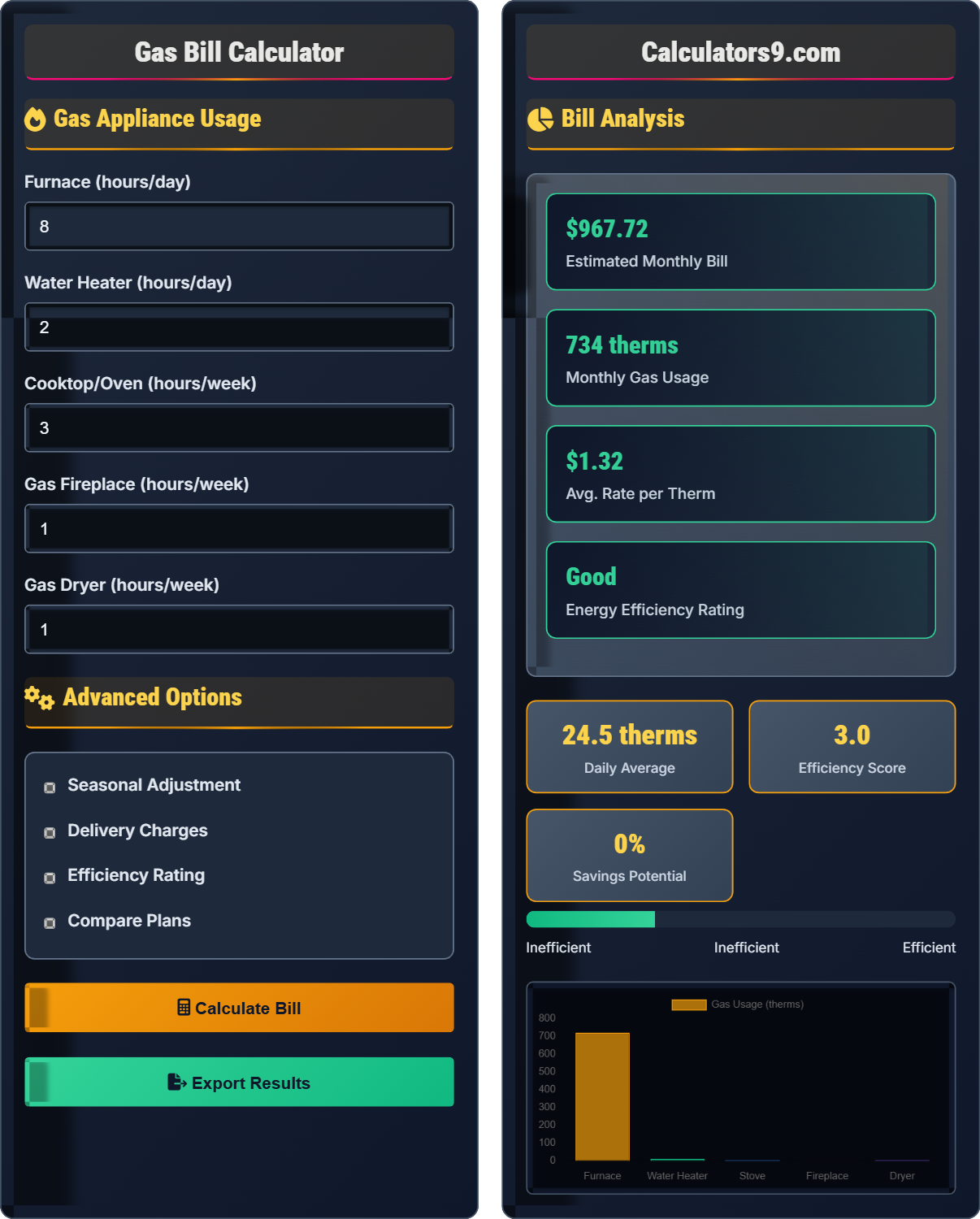
Gas Appliance Usage
Advanced Options
Bill Analysis
| Appliance | Usage (therms) | Cost ($) | % of Total |
|---|
| Improvement | Monthly Savings | Annual Savings | Payback Period |
|---|
Gas Efficiency Tips & Savings
Here are average gas consumption rates for common appliances:
- Furnace: 2-4 therms/hour (varies by efficiency)
- Water Heater: 0.1-0.2 therms/hour
- Gas Range: 0.1-0.3 therms/hour per burner
- Gas Fireplace: 1-2 therms/hour
- Gas Dryer: 0.2-0.3 therms/hour
Follow these guidelines to reduce your gas bill:
- Set thermostat to 68°F in winter, 78°F in summer
- Seal air leaks around windows and doors
- Insulate attic and walls
- Service furnace annually
- Lower water heater temperature to 120°F
Understanding the long-term benefits of gas efficiency:
- Well-insulated homes use 20-30% less gas for heating
- High-efficiency furnaces can save 15-20% on heating costs
- Programmable thermostats can save $180/year on heating
- Properly sealed homes reduce drafts and improve comfort
- Regular maintenance extends appliance life and efficiency
Energy-Efficient Gas Appliances
Natural Gas Usage & Efficiency Quiz
Which appliance typically consumes the most natural gas in a household?
The answer is B) Furnace/Heating System. Space heating typically accounts for 50-70% of residential natural gas consumption. During winter months, the furnace operates for many hours daily, making it the largest gas consumer in most homes. Water heaters come second at about 18-20% of total gas usage.
Understanding which appliances consume the most gas helps prioritize efficiency improvements. Heating systems require significant energy because they must maintain comfortable indoor temperatures despite outdoor temperature differences. The seasonal nature of heating means its impact on monthly bills varies dramatically throughout the year.
AFUE: Annual Fuel Utilization Efficiency rating for furnaces
Therms: Unit of natural gas measurement (100,000 BTUs)
Space Heating: Providing warmth to living areas of a building
• Heating systems typically consume the most gas
• Consumption varies by climate and season
• Efficiency ratings affect consumption
• Remember: Heating is usually the biggest gas user
• Use programmable thermostats to reduce heating costs
• Maintain furnace for optimal efficiency
• Assuming water heaters are the largest consumers
• Not considering regional climate differences
• Forgetting that seasonal usage affects total consumption
If you use a gas furnace that consumes 3 therms per hour for 8 hours each day for a month (30 days), and gas costs $1.20 per therm, what is the monthly cost? Show your work.
Step 1: Calculate daily usage = 3 therms/hour × 8 hours = 24 therms/day
Step 2: Calculate monthly usage = 24 therms/day × 30 days = 720 therms
Step 3: Calculate monthly cost = 720 therms × $1.20/therm = $864.00
Therefore, running the furnace for 8 hours daily costs $864.00 per month.
This calculation demonstrates how to determine gas costs based on appliance consumption rates. Understanding the relationship between hourly usage, daily operation time, and monthly duration helps predict energy costs. The calculation shows how continuous heating during cold months can result in significant gas expenses.
Therm: Unit of heat energy equal to 100,000 BTUs
BTU: British Thermal Unit measuring heat content
Consumption Rate: Amount of gas used per unit of time
• Consumption × Time = Total Usage
• Usage × Rate = Cost
• Higher efficiency appliances use less gas
• Check your gas bill for actual therm rates
• Monitor daily usage patterns
• Consider seasonal rate variations
• Confusing therms with cubic feet of gas
• Not accounting for efficiency factors
• Forgetting to multiply by time period
You currently have a furnace with 70% efficiency that uses 800 therms monthly for heating. You're considering upgrading to a 95% efficient furnace. If gas costs $1.20 per therm, how much would you save annually? Show your calculations.
Step 1: Current furnace energy output = 800 therms × 0.70 = 560 useful therms
Step 2: New furnace gas needed = 560 useful therms ÷ 0.95 = 589.5 therms
Step 3: Monthly gas savings = 800 - 589.5 = 210.5 therms
Step 4: Annual gas savings = 210.5 therms × 12 months = 2,526 therms
Step 5: Annual cost savings = 2,526 therms × $1.20/therm = $3,031.20
Therefore, upgrading to the efficient furnace would save approximately $3,031.20 per year.
This calculation demonstrates the significant savings possible through efficiency upgrades. Higher efficiency furnaces extract more heat from the same amount of gas, reducing consumption while maintaining the same heating output. The example shows how efficiency improvements can yield substantial annual savings that quickly offset the initial investment.
Efficiency: Ratio of useful output to energy input
AFUE: Annual Fuel Utilization Efficiency (furnace rating)
Energy Output: Useful heat delivered to home
• Higher efficiency = less gas for same output
• Savings = (old usage - new usage) × rate
• Efficiency upgrades often have short payback periods
• Look for AFUE rating above 90% for furnaces
• Consider financing options for efficiency upgrades
• Factor in rebates and tax incentives
• Not accounting for actual heating needs in calculations
• Assuming all savings occur immediately
• Forgetting to consider installation costs
You currently keep your thermostat at 72°F all day. A programmable thermostat can reduce heating costs by 10-15% by lowering temperature when you're away. If your annual heating bill is $1,200, what would be your annual savings with a programmable thermostat? If the thermostat costs $150, what is the payback period?
Step 1: Calculate minimum savings = $1,200 × 10% = $120
Step 2: Calculate maximum savings = $1,200 × 15% = $180
Step 3: Average expected savings = ($120 + $180) ÷ 2 = $150
Step 4: Calculate payback period = $150 ÷ $150/year = 1.0 year
With a programmable thermostat, you could save $120-$180 annually, with a payback period of about 1 year.
This example demonstrates how to evaluate energy efficiency investments using payback period calculations. The payback period measures how long it takes for savings to equal the initial investment. In this case, the programmable thermostat pays for itself in just 1 year while continuing to provide savings afterward. This makes it a financially sound investment with quick returns.
Payback Period: Time required for savings to equal investment cost
Energy Investment: Upfront cost for energy-efficient equipment
Return on Investment: Financial benefit relative to cost
• Payback period = Investment ÷ Annual savings
• Shorter payback periods are generally preferred
• Consider ongoing savings after payback period
• Look for payback periods under 2 years
• Consider maintenance and replacement costs
• Factor in increased home comfort from efficiency upgrades
• Not considering the full lifetime of energy savings
• Assuming all savings occur immediately
• Forgetting to account for installation costs
Which of the following statements about residential natural gas consumption is TRUE?
The answer is B) Space heating accounts for 50-70% of gas usage. According to the U.S. Energy Information Administration, space heating represents approximately 50-70% of residential natural gas consumption. Water heating comes second at about 18-20%, followed by cooking and other uses. This makes heating systems the primary target for gas efficiency improvements.
This statistic helps prioritize gas efficiency efforts. Since space heating accounts for the majority of residential gas consumption, improvements in this area yield the greatest savings. This includes upgrading to efficient furnaces, improving insulation, sealing air leaks, and using programmable thermostats. Understanding consumption patterns helps focus efforts where they'll have the most impact.
Space Heating: Providing warmth to living areas of a building
Energy Distribution: How energy is allocated among different uses
Priority Areas: Uses with highest energy consumption
• Focus efficiency efforts on highest consumption areas
• Heating systems account for majority of gas use
• Small improvements in high-consumption areas yield large savings
• Remember: Heating = 50-70% of gas use
• Prioritize improvements in high-consumption areas
• Use energy audit to identify consumption patterns
• Focusing on low-impact areas while ignoring major consumers
• Assuming all appliances use equal amounts of gas
• Not understanding the seasonal variation in heating use
FAQ
Q: How does natural gas pricing work and what are the main components of my bill?
A: Natural gas bills typically consist of several components:
- Commodity Charge: Based on actual therms consumed at a rate per therm
- Delivery Charge: Costs for transporting gas through pipelines
- Fixed Charge: Monthly service fee regardless of usage
- Taxes/Surcharges: Government fees and environmental programs
Mathematically, if \( U \) is usage in therms and \( R \) is rate per therm:
\( \text{Bill} = (U \times R) + \text{Delivery} + \text{Fixed Fee} + \text{Taxes} \)
Understanding these components helps identify opportunities for savings.
Q: What's the most effective way to reduce my gas bill?
A: The most effective approach targets the largest gas consumers:
- Heating: Accounts for 50-70% of gas use - upgrade to efficient furnaces
- Thermostat: Programmable units save 10-15% on heating costs
- Insulation: Proper insulation reduces heating/cooling needs by 20-30%
- Water Heating: Lower temperature to 120°F, insulate tank and pipes
- Maintenance: Annual furnace servicing maintains efficiency
Research shows that targeting heating and insulation can reduce gas bills by 20-30% with proper implementation.