Generator Runtime Calculator
Power supply tracker • 2026 rates
Generator Runtime Formula:
Show the calculator\( R = \frac{F \times E}{P \times C} \)
Where:
- \( R \) = Runtime (hours)
- \( F \) = Fuel capacity (gallons)
- \( E \) = Energy density of fuel (kWh/gallon)
- \( P \) = Power output (kW)
- \( C \) = Efficiency factor
This formula calculates the estimated runtime of a generator based on fuel capacity, energy content, and power draw. It helps plan for emergency power needs and fuel requirements.
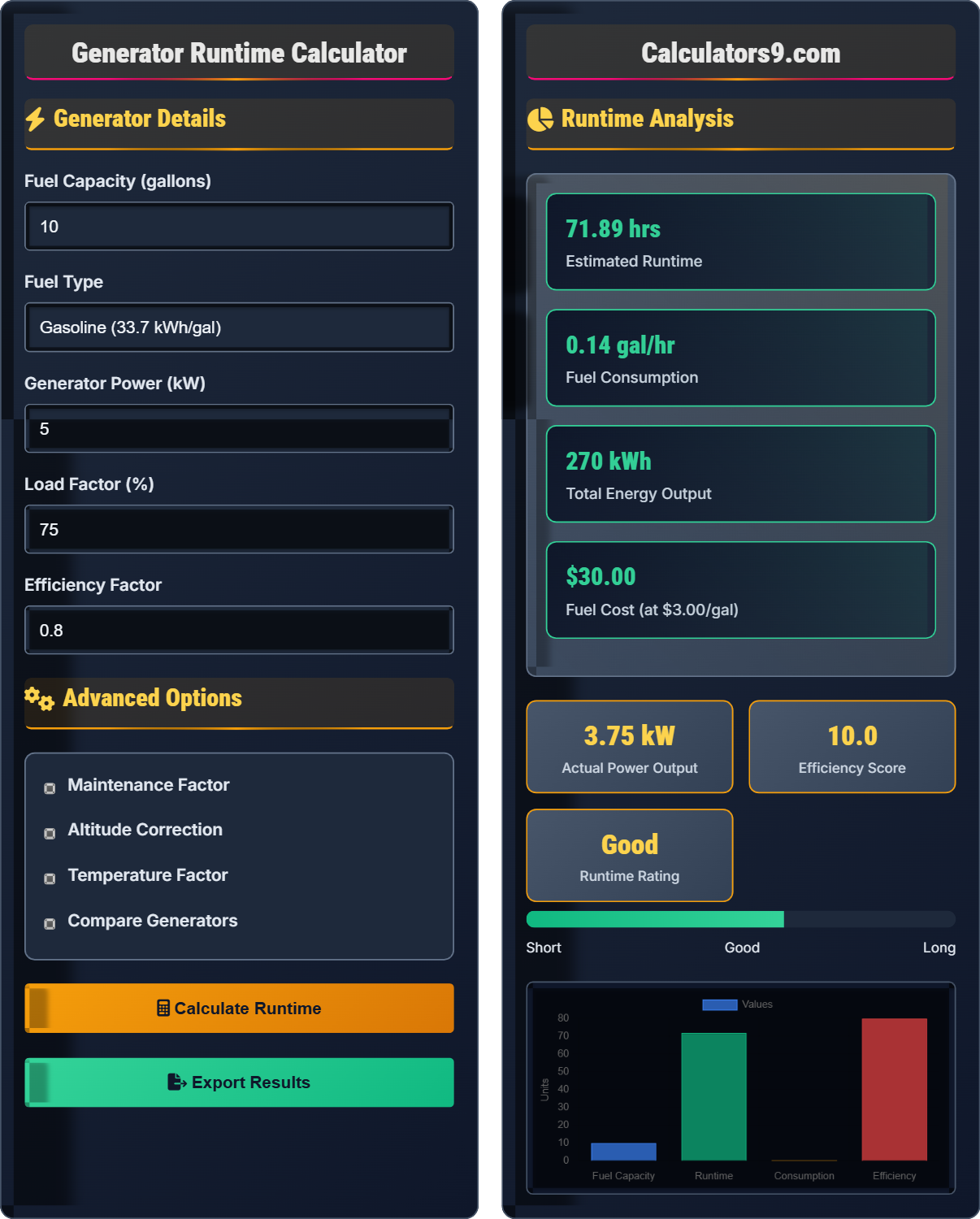
Example: For a 10-gallon fuel tank (gasoline = 33.7 kWh/gal), 5kW load, 0.8 efficiency:
Runtime = (10 × 33.7) ÷ (5 × 0.8) = 337 ÷ 4 = 84.25 hours
Generator Details
Advanced Options
Runtime Analysis
| Parameter | Value | Description |
|---|
| Scenario | Runtime | Power Load | Fuel Usage |
|---|
Generator Efficiency Tips & Runtime
Key factors affecting generator runtime:
- Load Factor: 75% of rated capacity is optimal
- Fuel Type: Diesel provides longest runtime
- Efficiency: Modern generators 80-90% efficient
- Maintenance: Regular service maintains performance
- Temperature: Cold weather reduces efficiency
Best practices for maximum runtime:
- Operate at 75-80% of rated capacity
- Use fresh fuel stored properly
- Perform regular maintenance
- Store in dry, cool locations
- Use fuel stabilizers for long-term storage
Understanding the long-term implications of generator use:
- Proper maintenance extends generator life by 50-100%
- Correct sizing reduces fuel costs by 20-40%
- Regular exercise prevents engine problems
- Proper ventilation ensures safety and efficiency
- Backup power reduces outage-related losses
Generator Type Options
Generator Runtime & Efficiency Quiz
Which fuel type provides the highest energy content per gallon?
The answer is B) Diesel. Diesel fuel provides approximately 38.6 kWh per gallon, which is higher than gasoline (33.7 kWh/gal) and propane (25.3 kWh/gal). This makes diesel generators more efficient in terms of fuel consumption per unit of power generated. Natural gas has lower energy density per unit volume but is often more economical for stationary applications.
Understanding fuel energy content helps optimize generator runtime and fuel costs. Diesel's higher energy density means more power can be generated per gallon of fuel, resulting in longer runtime for the same fuel capacity. However, diesel generators are typically more expensive to purchase and maintain.
Energy Density: Amount of energy stored in a given system per unit volume
Energy Content: Total energy available from a fuel source
Fuel Efficiency: Energy output per unit of fuel consumed
• Diesel has highest energy density among liquid fuels
• Higher energy density = longer runtime per gallon
• Consider fuel availability when selecting generator type
• Remember: Diesel = 38.6 kWh/gal (highest)
• Gasoline = 33.7 kWh/gal
• Propane = 25.3 kWh/gal
• Assuming all fuels have similar energy content
• Not considering fuel availability in emergencies
• Ignoring storage requirements for different fuels
If a generator has a 15-gallon fuel tank and operates at 60% of its rated capacity, consuming 0.15 gallons per hour, how long will it run? Show your work.
Step 1: Total fuel available = 15 gallons
Step 2: Fuel consumption rate = 0.15 gallons per hour
Step 3: Runtime = Total fuel ÷ Consumption rate
Step 4: Runtime = 15 ÷ 0.15 = 100 hours
Therefore, the generator will run for 100 hours.
This calculation demonstrates the basic principle of generator runtime: total fuel divided by consumption rate. The load factor affects consumption rate - higher loads consume more fuel per hour. Understanding this relationship helps in planning for emergency situations and estimating fuel requirements.
Runtime: Duration a generator can operate continuously
Fuel Consumption Rate: Amount of fuel used per hour
Load Factor: Percentage of rated capacity being used
• Runtime = Total Fuel ÷ Consumption Rate
• Higher loads = Higher consumption rate
• Optimal efficiency at 75-80% capacity
• Operate at 75-80% capacity for best efficiency
• Calculate fuel requirements before emergencies
• Consider fuel storage limitations
• Forgetting to account for load factor in calculations
• Assuming constant consumption rate regardless of load
• Not considering fuel storage capacity
You need to power your home for 72 hours during an outage. Your generator consumes 0.2 gallons per hour at the required load. How much fuel should you have available? If fuel costs $3.25 per gallon, what is the total fuel cost? Show your calculations.
Step 1: Calculate fuel needed = 0.2 gal/hr × 72 hrs = 14.4 gallons
Step 2: Calculate fuel cost = 14.4 gal × $3.25/gal = $46.80
Step 3: Add 20% safety margin = 14.4 × 1.2 = 17.28 gallons
Step 4: Cost with safety margin = 17.28 × $3.25 = $56.16
You should have 17.3 gallons available at a cost of $56.16.
This example demonstrates how to plan for emergency power needs. It's important to include a safety margin for unexpected extensions of outages. The calculation shows the relationship between required runtime, consumption rate, and fuel costs. Planning ahead helps ensure adequate fuel is available when needed.
Safety Margin: Extra capacity planned for unexpected needs
Emergency Planning: Preparation for power outages
Fuel Budgeting: Estimating fuel costs for planned use
• Always include safety margin (20-25%)
• Plan fuel storage before emergencies
• Consider fuel shelf life and storage requirements
• Add 20-25% to calculated fuel requirements
• Store fuel in approved containers
• Rotate fuel every 6-12 months
• Not including safety margins in calculations
• Forgetting to account for fuel degradation
• Underestimating fuel requirements during extended outages
Your generator has a 20-gallon fuel tank and runs at 0.18 gallons per hour at 50% load. If you increase the load to 80%, fuel consumption increases to 0.28 gallons per hour. How much longer will the generator run at 50% load compared to 80% load? What are the advantages of managing loads?
Step 1: Runtime at 50% load = 20 gal ÷ 0.18 gal/hr = 111.1 hours
Step 2: Runtime at 80% load = 20 gal ÷ 0.28 gal/hr = 71.4 hours
Step 3: Difference = 111.1 - 71.4 = 39.7 hours
Step 4: Percentage difference = (39.7 ÷ 71.4) × 100 = 55.6%
The generator runs 55.6% longer at 50% load. Advantages include extended runtime, reduced fuel costs, and lower maintenance requirements.
This example demonstrates the significant impact of load management on generator runtime. Operating at lower loads dramatically extends runtime, allowing for longer emergency power availability. Load management involves selectively powering only essential appliances to extend generator operation during outages.
Load Management: Controlling power consumption to extend runtime
Essential Loads: Critical appliances during outages
Power Prioritization: Ranking appliances by importance
• Lower loads = Much longer runtime
• Load management can double or triple runtime
• Prioritize essential loads during outages
• Calculate load requirements before emergencies
• Prioritize essential appliances (refrigerator, heating)
• Use power strips to easily disconnect non-essential loads
• Connecting too many appliances simultaneously
• Not planning load priorities before outages
• Ignoring the exponential relationship between load and consumption
At what load percentage do generators typically achieve peak efficiency?
The answer is B) 75-80%. Generators typically achieve peak efficiency at 75-80% of their rated capacity. At this load level, they provide the best fuel economy and longest runtime per unit of fuel. Running below 30% or above 90% of rated capacity reduces efficiency and increases fuel consumption per kWh generated.
This knowledge is crucial for optimal generator operation. Running too lightly loaded wastes fuel and can cause engine problems, while running at maximum capacity reduces efficiency and stresses the engine. The 75-80% range provides the best balance of efficiency and reliability for sustained operation.
Rated Capacity: Maximum power output a generator can sustain
Peak Efficiency: Load level with best fuel economyOptimal Load: Ideal operating range for efficiency
• Peak efficiency at 75-80% of rated capacity
• Avoid prolonged operation below 30% load
• Do not exceed 90% of rated capacity
• Size generator to operate at 75-80% capacity
• Calculate total load requirements before purchasing
• Monitor load levels during operation
• Oversizing generators leading to inefficient operation
• Running at maximum capacity for extended periods
• Not monitoring load levels during operation
FAQ
Q: How long will my generator run on a full tank?
A: Runtime depends on several factors:
- Fuel capacity: Larger tanks = longer runtime
- Load factor: 75% of rated capacity is optimal
- Fuel type: Diesel provides longest runtime
- Generator size: Larger units use fuel more efficiently
Mathematically, if \( F \) is fuel capacity and \( C \) is consumption rate:
\( \text{Runtime} = \frac{F}{C} \)
For a 10-gallon tank with 0.15 gal/hr consumption: 10 ÷ 0.15 = 66.7 hours.
Q: What's the best strategy for maximizing generator runtime?
A: The most effective approach includes:
- Load Management: Operate at 75-80% capacity
- Fuel Planning: Store adequate fuel with stabilizers
- Maintenance: Regular service for optimal performance
- Efficiency: Use newer models with better fuel economy
- Prioritization: Power only essential loads
Load management alone can extend runtime by 50-100% compared to full loading.