Insulation ROI Calculator
Building efficiency tracker • 2026 rates
Insulation ROI Formula:
Show the calculator\( ROI = \frac{(S_y \times L) - C}{C} \times 100 \)
Where:
- \( ROI \) = Return on Investment (%)
- \( S_y \) = Annual energy savings ($)
- \( L \) = Lifespan of insulation (years)
- \( C \) = Total cost of insulation ($)
This formula calculates the return on investment for insulation based on energy savings over the insulation's lifespan. It helps quantify the financial benefits of insulation upgrades.
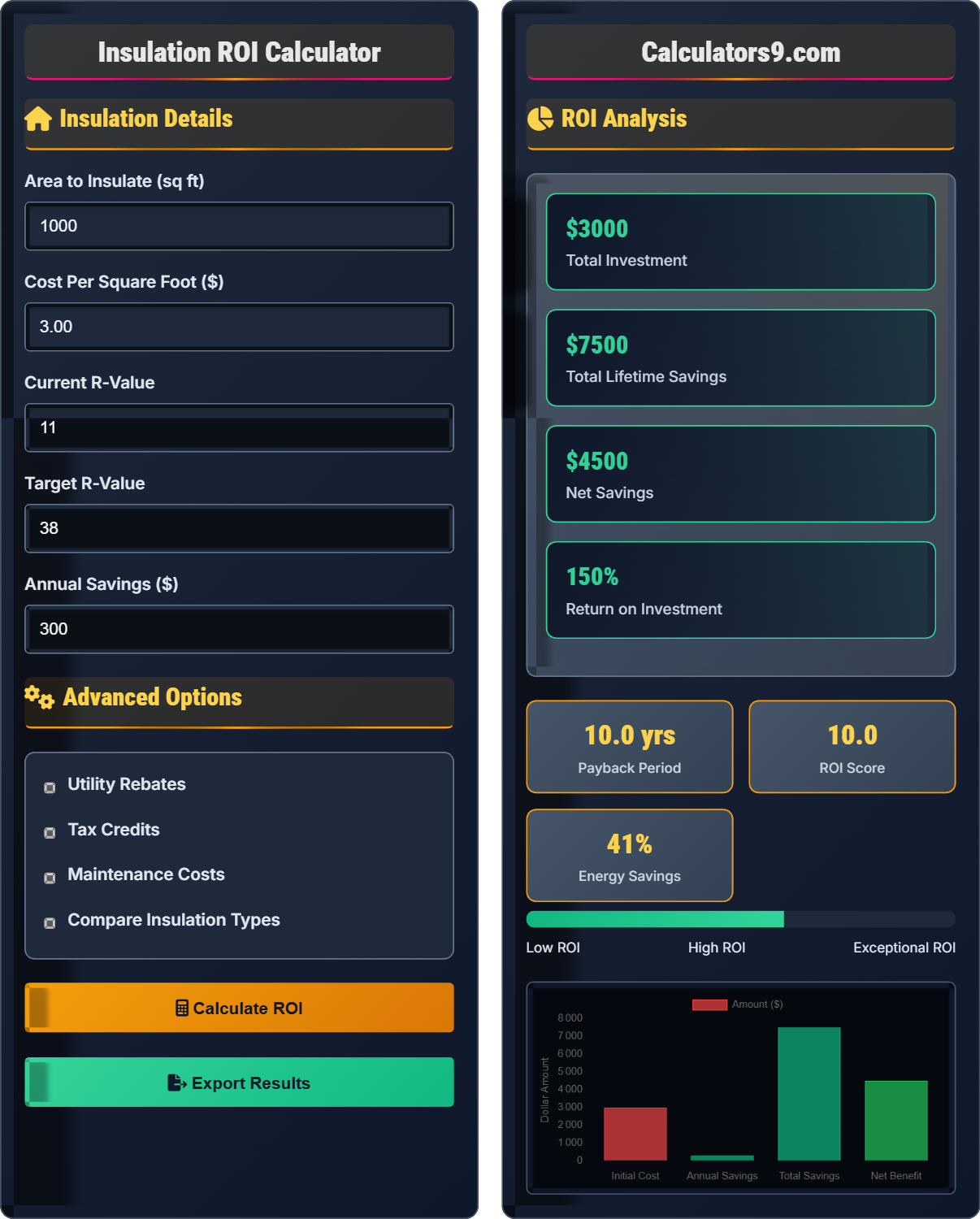
Example: For $3,000 insulation that saves $300 annually over 25 years:
Total savings = $300 × 25 = $7,500
Net savings = $7,500 - $3,000 = $4,500
ROI = ($4,500 ÷ $3,000) × 100 = 150%
Insulation Details
Advanced Options
ROI Analysis
| Component | Amount | Description |
|---|
| Year | Cumulative Savings | Net Value |
|---|
Insulation Efficiency Tips & Savings
Recommended R-values for different areas of the home:
- Attic: R-38 to R-60 (highest priority)
- Walls: R-13 to R-21 (depending on climate)
- Floors: R-25 to R-30 (over unheated spaces)
- Crawl Spaces: R-19 to R-25
- Basements: R-11 to R-15 (interior walls)
Best practices for maximum insulation effectiveness:
- Seal air leaks before installing insulation
- Ensure complete coverage with no gaps
- Don't compress insulation in tight spaces
- Use appropriate R-value for your climate zone
- Consider professional installation for best results
Understanding the long-term benefits of proper insulation:
- Insulation can save 10-50% on heating and cooling costs
- Typical payback period is 3-7 years
- Increases home value by 1-3%
- Reduces carbon footprint by 1,000+ lbs CO₂ per year
- Improves comfort with consistent temperatures
Insulation Material Options
Insulation ROI & Efficiency Quiz
According to studies, what percentage of energy can proper insulation save on heating and cooling?
The answer is B) 10-50%. Proper insulation can save 10-50% on heating and cooling costs, depending on the current state of insulation, climate, and home construction. The savings are typically higher in homes with little or no existing insulation and in extreme climates. This makes insulation one of the most cost-effective energy efficiency improvements.
Understanding the potential energy savings from insulation helps set realistic expectations for investment returns. The wide range (10-50%) reflects different factors: climate, existing insulation levels, and the specific area being insulated. Homes with poor existing insulation in extreme climates typically see the highest percentage savings.
R-Value: Measure of thermal resistance (higher = better insulation)
Thermal Resistance: Ability to resist heat flow
Energy Efficiency: Using less energy to maintain comfort• Proper insulation saves 10-50% on heating and cooling
• Savings depend on climate and existing insulation
• Higher R-values provide better insulation
• Remember: 10-50% savings on HVAC costs
• Attic insulation provides highest returns
• Seal air leaks before adding insulation
• Expecting savings that are too high or too low
• Not considering climate differences
• Installing insulation without sealing air leaks
If insulation costs $4,000 and saves $400 annually, what is the return on investment over a 20-year lifespan? Show your work.
Step 1: Calculate total savings = $400 × 20 years = $8,000
Step 2: Calculate net savings = $8,000 - $4,000 = $4,000
Step 3: Calculate ROI = ($4,000 ÷ $4,000) × 100 = 100%
Therefore, the return on investment is 100%.
This calculation demonstrates how to determine ROI for insulation investments. The ROI formula compares the net savings (total savings minus initial cost) to the initial investment. A 100% ROI means you double your money over the investment period. The longer the lifespan, the higher the potential ROI for energy efficiency improvements.
Return on Investment (ROI): Net profit as percentage of investment
Net Savings: Total savings minus initial investment
Lifespan: Expected useful life of the improvement
• ROI = (Net Savings ÷ Investment) × 100
• Net Savings = Total Savings - Investment
• Longer lifespan increases potential ROI
• Remember: ROI = (Net Savings ÷ Investment) × 100
• Calculate total savings over entire lifespan
• Consider non-financial benefits like comfort
• Forgetting to subtract initial investment from total savings
• Not considering the full lifespan of savings
• Confusing ROI with annual savings percentage
You're considering insulation that costs $3,500 and will save $350 annually on energy bills. What is the payback period for this investment? If the insulation lasts 25 years, what is the total ROI? Show your calculations.
Step 1: Calculate payback period = $3,500 ÷ $350/year = 10 years
Step 2: Calculate total savings over 25 years = $350 × 25 = $8,750
Step 3: Calculate net savings = $8,750 - $3,500 = $5,250
Step 4: Calculate ROI = ($5,250 ÷ $3,500) × 100 = 150%
The payback period is 10 years, and the total ROI over 25 years is 150%.
This example demonstrates how to calculate both payback period and total ROI for insulation investments. The payback period is the time required for savings to equal the initial investment. After the payback period, all additional savings represent pure profit. The ROI calculation shows the total return over the investment's entire lifespan.
Payback Period: Time required for savings to equal investment cost
Total ROI: Return over the entire investment lifespan
Investment Recovery: Process of earning back initial expenditure
• Payback Period = Investment ÷ Annual Savings
• Total ROI = (Net Savings ÷ Investment) × 100
• Consider entire lifespan for accurate ROI
• Look for payback periods under 10 years
• Consider the full lifespan of savings
• Factor in non-financial benefits like comfort
• Not considering the full lifespan of savings
• Forgetting to subtract initial investment from total savings
• Assuming savings stop after payback period
You're comparing two insulation options: Option A costs $2.50/sq ft with R-30 value, Option B costs $4.00/sq ft with R-40 value. You need to insulate 800 sq ft. If the R-40 option saves 15% more energy annually than R-30, and R-30 saves $250 annually, which option provides better ROI over 20 years? Assume both have the same installation cost.
Step 1: Calculate Option A cost = $2.50 × 800 = $2,000
Step 2: Calculate Option B cost = $4.00 × 800 = $3,200
Step 3: Calculate Option A savings = $250 × 20 = $5,000
Step 4: Calculate Option B savings = $250 × 1.15 × 20 = $5,750
Step 5: Calculate Option A ROI = ($5,000 - $2,000) ÷ $2,000 × 100 = 150%
Step 6: Calculate Option B ROI = ($5,750 - $3,200) ÷ $3,200 × 100 = 79.7%
Option A provides better ROI (150% vs 79.7%), despite lower R-value.
This example demonstrates that higher R-values don't always provide better ROI. The calculation shows that the more expensive, higher R-value option has a lower ROI despite saving more energy. This is because the cost difference outweighs the additional energy savings. When evaluating insulation options, consider both performance and cost-effectiveness.
Cost-Effectiveness: Achieving goals at lowest possible cost
R-Value: Measure of thermal resistance
Performance vs Cost: Balancing effectiveness with expense
• Higher R-value doesn't always mean better ROI
• Consider cost per unit of performance
• Evaluate total cost vs total benefits
• Calculate cost per R-value point
• Consider diminishing returns on high R-values
• Focus on areas with highest heat loss first
• Assuming higher R-value always provides better ROI
• Not considering cost differences
• Forgetting to calculate total project costs
Which of the following statements about home insulation is TRUE?
The answer is B) Insulation typically pays for itself in 3-7 years. Studies show that proper insulation typically has a payback period of 3-7 years, depending on the climate, existing insulation levels, and type of insulation. This makes insulation one of the fastest-paying energy efficiency improvements available for homes.
This statistic highlights the relatively quick payback period for insulation investments. The 3-7 year range reflects different factors like climate, existing insulation, and the specific area being insulated. This short payback period makes insulation an attractive investment for both financial and environmental reasons. The savings continue for decades after the investment is recovered.
Payback Period: Time required for savings to equal investment
Energy Efficiency: Using less energy to achieve same results
Cost Recovery: Process of recovering investment through savings
• Insulation typically pays for itself in 3-7 years
• Savings continue for decades after payback
• Works in all climates (heating and cooling)
• Remember: 3-7 year payback period
• Insulation works in both hot and cold climates
• Attic insulation typically has shortest payback
• Assuming insulation takes too long to pay back
• Thinking insulation only works in cold climates
• Not considering long-term savings after payback
FAQ
Q: How much money can I really save with proper insulation?
A: The savings depend on your current insulation level, but here's what to expect:
- Average savings: 10-50% on heating and cooling costs
- Typical annual savings: $200-600 for most homes
- Payback period: 3-7 years for most installations
Mathematically, if \( E \) is your annual HVAC cost:
\( \text{Annual Savings} = E \times 0.10 \text{ to } 0.50 \)
Higher savings occur with poor existing insulation or extreme climates.
Q: What's the best strategy for insulating my home?
A: The most effective approach prioritizes high-impact areas:
- Priority 1: Attic/roof (R-38 to R-60)
- Priority 2: Walls and foundation
- Priority 3: Floors and crawl spaces
- Always: Seal air leaks before insulation
Focus on areas with the highest heat loss for maximum return on investment.