LED Savings Calculator
Light bulb efficiency tracker • 2026 rates
LED Savings Formula:
Show the calculator\( S = (P_o - P_n) \times H \times D \times R \)
Where:
- \( S \) = Annual savings ($)
- \( P_o \) = Old bulb power rating (kilowatts)
- \( P_n \) = New LED power rating (kilowatts)
- \( H \) = Hours used per day
- \( D \) = Days used per year
- \( R \) = Rate per kWh ($)
This formula calculates the annual savings from switching to LED bulbs based on power consumption differences, usage patterns, and electricity rates. It helps quantify the financial benefits of LED adoption.
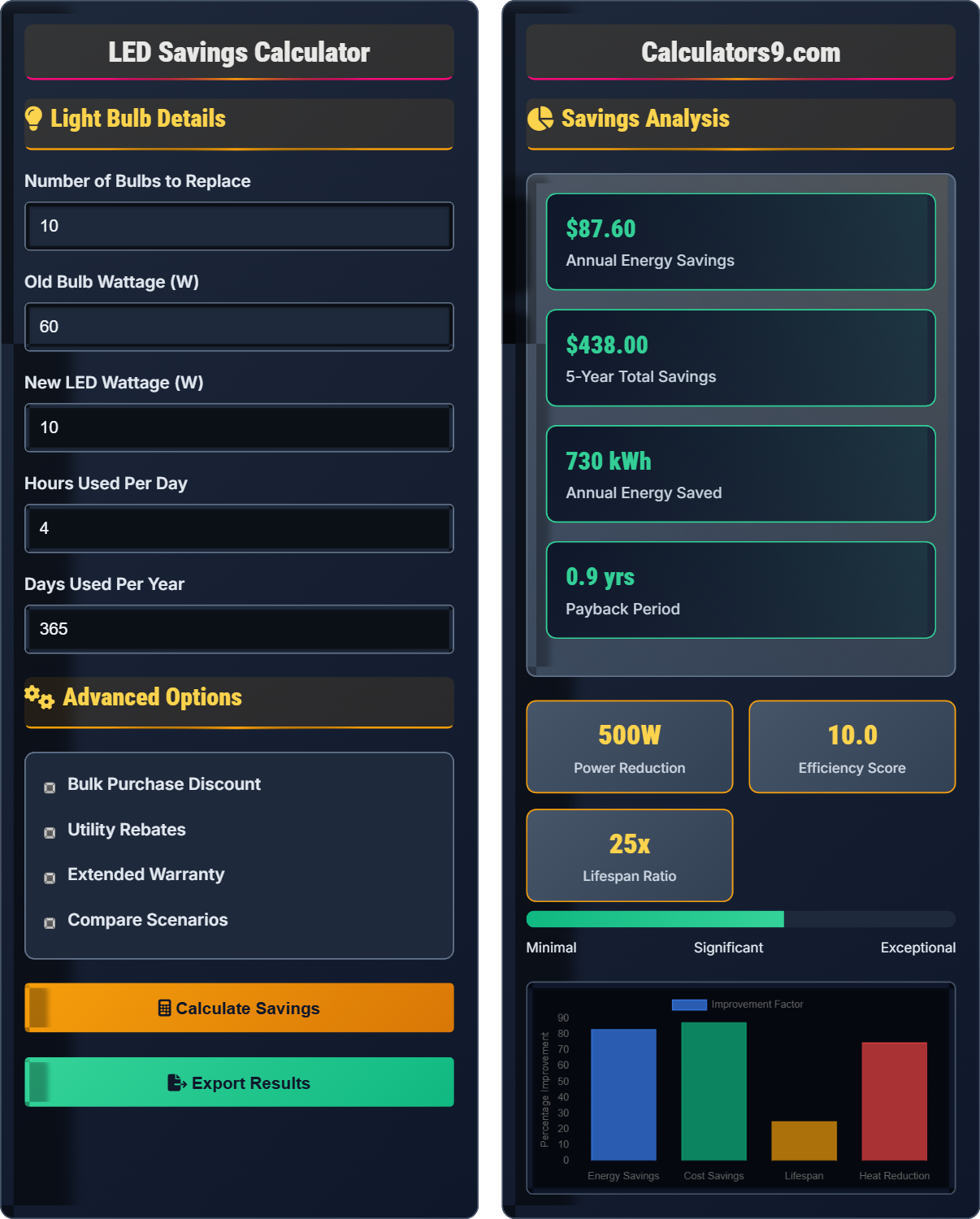
Example: For 10 bulbs switching from 60W incandescent to 10W LED (4 hours/day, 365 days, $0.12/kWh):
Power difference = (0.060 - 0.010) kW = 0.050 kW
Annual savings = 0.050 kW × 4 hrs/day × 365 days × $0.12/kWh = $87.60
Light Bulb Details
Advanced Options
Savings Analysis
| Category | Amount | Description |
|---|
| Metric | Before LED | After LED | Difference |
|---|
LED Efficiency Tips & Savings
Here are the key differences between LED and traditional bulbs:
- Incandescent: 10% efficiency, 1,000 hour lifespan
- CFL: 25% efficiency, 8,000 hour lifespan
- LED: 80% efficiency, 25,000+ hour lifespan
- Energy Savings: LED uses 75-80% less energy than incandescent
- Heat Production: LED produces 75% less heat than incandescent
Follow these guidelines for maximum LED benefits:
- Replace bulbs in frequently used areas first
- Look for ENERGY STAR certified LEDs
- Match color temperature to your preference (2700K-6500K)
- Consider dimmable LEDs for versatility
- Properly dispose of old bulbs (especially CFLs)
Understanding the long-term benefits of LED adoption:
- LED bulbs last 25 times longer than incandescent bulbs
- Replacing 10 bulbs can save $800+ over 5 years
- LED adoption reduces carbon footprint by 75%
- LEDs contain no mercury (unlike CFLs)
- Reduced heat production lowers cooling costs
LED Bulb Specifications
LED Efficiency & Savings Quiz
What percentage of energy does an LED bulb convert to light compared to an incandescent bulb?
The answer is B) LED: 80%, Incandescent: 10%. LED bulbs convert approximately 80% of energy to light, while incandescent bulbs only convert about 10% to light, with the rest lost as heat. This fundamental difference in efficiency explains why LEDs use 75-80% less energy than incandescent bulbs for the same light output.
Understanding the efficiency differences between lighting technologies helps explain the significant energy savings possible with LED adoption. The high efficiency of LEDs means that for every 100 units of energy consumed, 80 units become light, while with incandescent bulbs, only 10 units become light and 90 units are wasted as heat.
Energy Efficiency: Percentage of energy converted to useful output
Luminous Efficacy: Light output per unit of power input (lumens per watt)
Heat Loss: Energy converted to thermal output instead of light
• LEDs are 8x more efficient than incandescent bulbs
• Efficiency determines energy consumption for same light output
• Higher efficiency means more savings
• Remember: LED = 80% efficiency, Incandescent = 10%
• Look for lumens per watt rating when shopping
• Higher efficiency means lower electricity bills
• Assuming all bulbs have similar efficiency
• Confusing wattage with brightness
• Not considering efficiency when calculating savings
If you replace 10 incandescent bulbs (60W each) with LED bulbs (10W each) that are used 4 hours per day, and electricity costs $0.12 per kWh, what are your annual energy savings? Show your work.
Step 1: Calculate power difference per bulb = 60W - 10W = 50W = 0.050 kW
Step 2: Calculate total power difference = 0.050 kW × 10 bulbs = 0.50 kW
Step 3: Calculate annual energy usage difference = 0.50 kW × 4 hrs/day × 365 days = 730 kWh
Step 4: Calculate annual cost savings = 730 kWh × $0.12/kWh = $87.60
Therefore, replacing 10 incandescent bulbs with LEDs saves $87.60 annually.
This calculation demonstrates how to determine energy savings from LED adoption. The key is finding the power difference between old and new bulbs, then multiplying by usage time and electricity rate. The calculation shows how small changes in individual bulbs can lead to significant annual savings when multiplied across multiple fixtures.
Power Difference: Reduction in energy consumption from efficiency upgrade
Annual Energy Savings: Total energy saved over one year
Energy Payback: Time required to recover investment through savings
• Savings = (old power - new power) × hours × days × rate
• Convert watts to kilowatts for kWh calculations
• Multiply by number of bulbs for total savings
• Always convert watts to kilowatts for electricity calculations
• Multiply individual bulb savings by number of bulbs
• Check your electricity bill for accurate rates
• Forgetting to convert watts to kilowatts
• Not accounting for number of bulbs in calculations
• Confusing energy (kWh) with power (kW)
You're considering replacing 15 old 60W incandescent bulbs with 10W LED bulbs. Each LED bulb costs $8, and your electricity costs $0.12 per kWh. If the bulbs are used 5 hours per day, what is the payback period for this investment? Show your calculations.
Step 1: Calculate total investment = 15 bulbs × $8 = $120
Step 2: Calculate power difference per bulb = 60W - 10W = 50W = 0.050 kW
Step 3: Calculate annual energy savings = 0.050 kW × 15 bulbs × 5 hrs/day × 365 days = 1,368.75 kWh
Step 4: Calculate annual cost savings = 1,368.75 kWh × $0.12/kWh = $164.25
Step 5: Calculate payback period = $120 ÷ $164.25/year = 0.73 years (about 8.8 months)
The payback period for this LED investment is approximately 8.8 months.
This example demonstrates how to calculate the payback period for LED investments. The payback period is the time required for savings to equal the initial investment. In this case, the investment pays for itself in less than a year, making it a financially sound decision. The quick payback period is due to the significant energy savings from LED technology.
Payback Period: Time required for savings to equal investment cost
Return on Investment: Financial benefit relative to cost
Investment Recovery: Process of earning back initial expenditure
• Payback Period = Investment ÷ Annual Savings
• Shorter payback periods are generally preferred
• Consider ongoing savings after payback period
• Look for payback periods under 2 years
• Consider the full lifetime of LED savings
• Factor in rebates and incentives when calculating
• Not considering the full lifetime of savings
• Forgetting to account for all bulbs in calculations
• Assuming savings stop after payback period
An incandescent bulb lasts 1,000 hours and costs $1. A LED bulb costs $8 and lasts 25,000 hours. If a bulb is used 4 hours per day, how much would you save over 5 years by using LED instead of replacing incandescent bulbs? Include both purchase and electricity costs. Assume electricity costs $0.12 per kWh.
Step 1: Calculate total hours in 5 years = 4 hrs/day × 365 days/year × 5 years = 7,300 hours
Step 2: Incandescent bulbs needed = 7,300 hours ÷ 1,000 hours/bulb = 7.3 ≈ 8 bulbs
Step 3: Incandescent purchase cost = 8 bulbs × $1 = $8
Step 4: LED electricity cost = 0.010 kW × 7,300 hours × $0.12/kWh = $8.76
Step 5: Incandescent electricity cost = 0.060 kW × 7,300 hours × $0.12/kWh = $52.56
Step 6: LED total cost = $8 (purchase) + $8.76 (electricity) = $16.76
Step 7: Incandescent total cost = $8 (purchase) + $52.56 (electricity) = $60.56
Step 8: Total savings = $60.56 - $16.76 = $43.80
You would save $43.80 over 5 years by using LED instead of incandescent bulbs.
This example demonstrates the comprehensive benefits of LED technology, including both purchase and operational costs. The calculation shows that while LED bulbs have higher upfront costs, their longer lifespan and lower electricity consumption result in significant savings over time. The longer lifespan also means fewer replacements and associated labor costs.
Total Cost of Ownership: All costs associated with owning and operating a product
Lifespan Cost Analysis: Evaluating costs over the entire product life
Replacement Frequency: How often items need to be replaced
• Total Cost = Purchase Cost + Operating Cost
• Longer lifespan reduces replacement costs
• Consider both purchase and operational costs
• Evaluate total cost of ownership, not just purchase price
• Consider maintenance and replacement costs
• Factor in convenience of longer-lasting products
• Only comparing purchase prices without considering operational costs
• Forgetting to account for multiple replacements
• Not considering the time value of money
Which of the following statements about LED bulbs is TRUE?
The answer is B) LED bulbs last 25 times longer than incandescent. Standard LED bulbs typically last 25,000+ hours compared to 1,000 hours for incandescent bulbs. Additionally, LED bulbs use 75-80% less energy than incandescent bulbs and contain no mercury, making them safer and more environmentally friendly than CFLs.
This statistic highlights the durability advantage of LED technology. The 25x longer lifespan means that for every LED bulb purchased, you would need to buy 25 incandescent bulbs to provide the same duration of use. This translates to significant savings in purchase costs and time spent replacing bulbs over the life of a single LED bulb.
Bulb Lifespan: Operational time before failure
Operational Hours: Total time a bulb functions before needing replacement
Reliability Factor: Consistency of performance over time
• LED lifespan = 25,000+ hours vs 1,000 hours for incandescent
• LED uses 75-80% less energy than incandescent
• LED contains no mercury (unlike CFLs)
• Remember: LED = 25x longer lifespan than incandescent
• Look for 25,000+ hour rated life when shopping
• Factor in replacement convenience when calculating benefits
• Assuming all bulbs have similar lifespans
• Not considering replacement frequency in cost calculations
• Confusing LED benefits with CFL characteristics
FAQ
Q: How much money can I really save by switching to LED bulbs?
A: The savings depend on your usage and number of bulbs, but here's a typical example:
- Per bulb: $8-15 annual savings (for 4 hours/day usage)
- 10 bulbs: $80-150 annual savings
- 20 bulbs: $160-300 annual savings
Mathematically, if \( W_o \) is old wattage and \( W_n \) is new LED wattage:
\( \text{Annual Savings} = (W_o - W_n) \times H \times 365 \times R \)
Where \( H \) is hours per day and \( R \) is rate per kWh.
Q: What's the best strategy for implementing LED lighting?
A: The most effective approach prioritizes high-usage areas:
- Priority 1: Kitchen, living room, bathroom (used daily)
- Priority 2: Hallways, closets (frequently accessed)
- Priority 3: Guest rooms, storage areas (less frequent use)
- Special considerations: Dimming capabilities, color temperature matching
Focus on bulbs used 4+ hours daily for maximum return on investment.