Thermostat Savings Calculator
HVAC efficiency tracker • 2026 rates
Thermostat Savings Formula:
Show the calculator\( S = (T_d \times H_r \times D_h \times C_f) \times (E_s - E_b) \)
Where:
- \( S \) = Annual savings ($)
- \( T_d \) = Temperature difference (degrees)
- \( H_r \) = Heating rate per degree ($)
- \( D_h \) = Degree hours per year
- \( C_f \) = Cooling factor
- \( E_s \) = Efficiency of smart thermostat
- \( E_b \) = Baseline efficiency
This formula calculates the annual savings from installing a smart thermostat based on temperature adjustments, usage patterns, and efficiency improvements. It helps quantify the financial benefits of thermostat automation.
Example: For a 2°F setback during 8 hours of absence daily (365 days), at $0.05 per degree-hour:
Savings = 2°F × 8 hrs/day × 365 days × $0.05 × 0.15 efficiency gain
= $43.80 annual savings
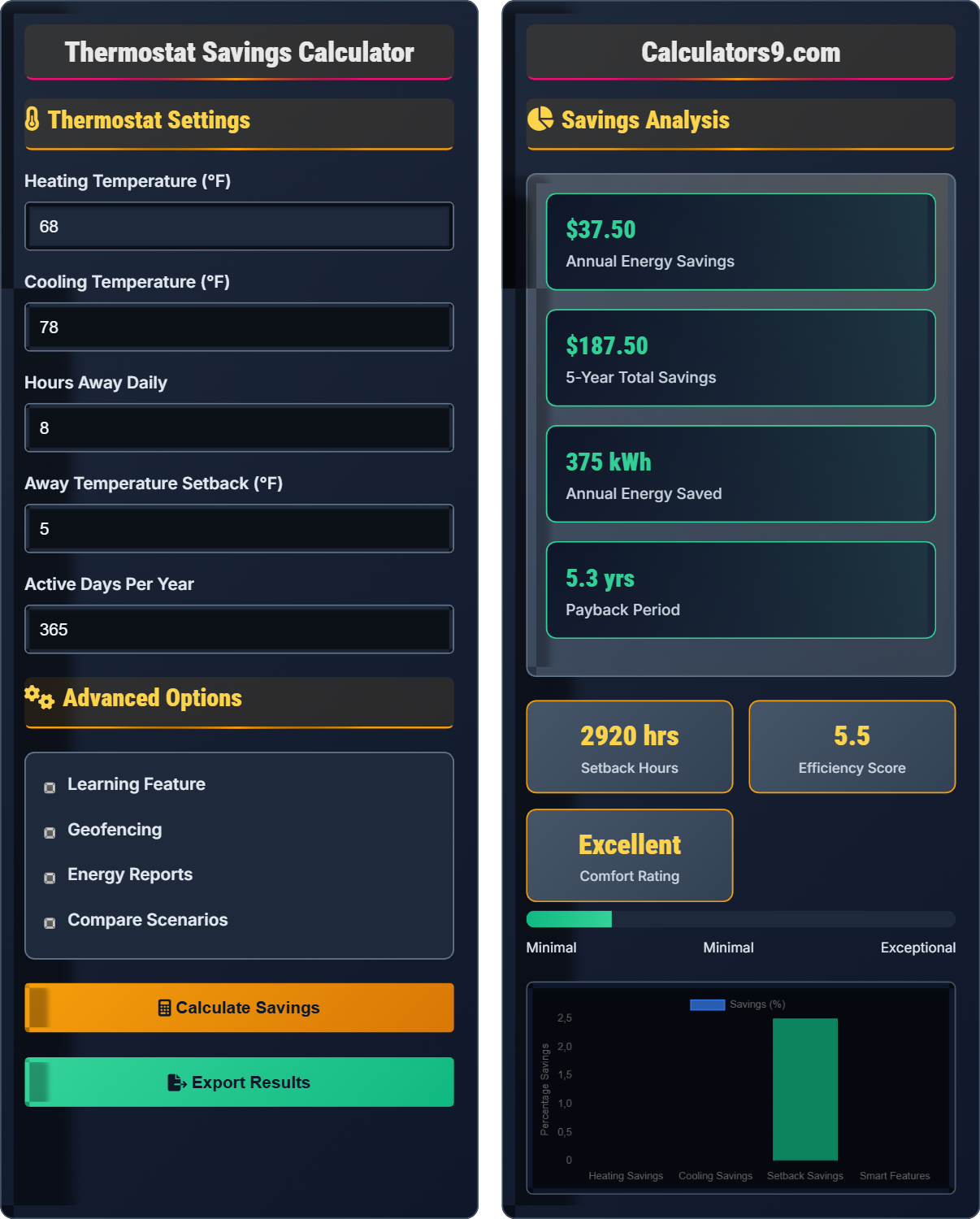
Thermostat Settings
Advanced Options
Savings Analysis
| Feature | Efficiency Gain | Annual Savings |
|---|
| Scenario | Temperature | Setback | Annual Savings |
|---|
Thermostat Efficiency Tips & Savings
Here are recommended temperature settings for maximum efficiency:
- Winter: 68°F when home, 62°F when away
- Summer: 78°F when home, 82°F when away
- Energy Savings: 1°F adjustment saves 1-3% on energy costs
- Humidity: Keep at 30-50% for comfort and efficiency
- Program: Use 7-day scheduling for maximum savings
Key advantages of smart thermostats:
- Learning: Adapts to your schedule automatically
- Remote Control: Adjust from anywhere via smartphone
- Geofencing: Detects when you're coming home
- Reports: Track energy usage and savings
- Integration: Works with smart home systems
Understanding the long-term benefits of smart thermostats:
- Smart thermostats save 10-15% on heating and cooling costs
- Average payback period is 1-3 years
- Can save $180+ annually on heating and cooling
- Reduce carbon footprint by 1,000+ lbs CO₂ per year
- Improve home comfort with consistent temperatures
Smart Thermostat Features
Thermostat Efficiency & Savings Quiz
According to studies, what percentage of energy can a smart thermostat save on heating and cooling?
The answer is B) 10-15%. Studies by the U.S. Department of Energy and other organizations show that smart thermostats can save 10-15% on heating and cooling costs. This is achieved through features like automatic setback when away, learning algorithms, and optimized scheduling. The savings can be even higher in homes with irregular schedules or poor manual thermostat management.
Understanding the typical savings from smart thermostats helps set realistic expectations for investment returns. The 10-15% savings figure is based on average usage patterns and assumes proper programming. Homes with irregular schedules or those that frequently leave the thermostat set to a constant temperature tend to see higher savings.
Setback: Reducing temperature when building is unoccupied
Energy Efficiency: Using less energy to maintain comfort
Smart Technology: Automated systems that learn and adapt
• Smart thermostats typically save 10-15% on HVAC costs
• Savings depend on usage patterns and climate
• Proper installation and programming are essential
• Remember: 10-15% savings on HVAC costs
• Homes with irregular schedules see higher savings
• Use full feature set for maximum benefits
• Expecting savings that are too high or too low
• Not programming the thermostat properly
• Assuming all thermostats provide equal savings
If your annual heating and cooling bill is $1,200, and a smart thermostat saves 12% annually, what are your annual savings? Show your work.
Step 1: Calculate annual savings = $1,200 × 12%
Step 2: Annual savings = $1,200 × 0.12 = $144
Therefore, the smart thermostat would save $144 annually.
This calculation demonstrates how to determine potential savings based on current HVAC costs and expected efficiency gains. The percentage savings apply to the total HVAC bill, so homes with higher bills see greater dollar savings. This makes smart thermostats particularly attractive for homes with high heating and cooling costs.
Percentage Savings: Efficiency gain expressed as a percentage
Dollar Savings: Actual monetary savings achieved
HVAC Bill: Total cost of heating and cooling
• Savings = Total cost × Percentage savings
• Higher bills mean higher dollar savings
• Percentage savings remain constant regardless of bill amount
• Convert percentage to decimal for calculations (12% = 0.12)
• Higher HVAC bills mean more dollar savings
• Check your actual bill for accurate calculations
• Forgetting to convert percentage to decimal
• Applying savings to total utility bill instead of HVAC portion
• Not considering seasonal variations in savings
You're considering buying a smart thermostat for $200. Your annual heating and cooling bill is $1,500, and the thermostat is expected to save 10% annually. What is the payback period for this investment? Show your calculations.
Step 1: Calculate annual savings = $1,500 × 10% = $1,500 × 0.10 = $150
Step 2: Calculate payback period = $200 ÷ $150/year = 1.33 years
The payback period for the smart thermostat is approximately 1.33 years (about 16 months).
This example demonstrates how to calculate the payback period for energy efficiency investments. The payback period is the time required for savings to equal the initial investment. In this case, the investment pays for itself in just over a year, making it a financially sound decision. The quick payback period is due to the significant annual savings relative to the investment cost.
Payback Period: Time required for savings to equal investment cost
Return on Investment: Financial benefit relative to cost
Investment Recovery: Process of earning back initial expenditure
• Payback Period = Investment ÷ Annual Savings
• Shorter payback periods are generally preferred
• Consider ongoing savings after payback period
• Look for payback periods under 3 years
• Consider the full lifetime of savings
• Factor in non-financial benefits like comfort
• Not considering the full lifetime of savings
• Forgetting to account for all savings factors
• Assuming savings stop after payback period
You currently keep your thermostat at 72°F year-round. You're considering using setback settings: 68°F when home in winter, 78°F when home in summer, with 5°F setbacks when away. If each degree of adjustment saves 1% on energy costs, and your annual HVAC bill is $1,800, how much could you save annually? Assume you're away 8 hours daily.
Step 1: Calculate winter savings = 4°F difference × 1% per degree = 4% savings
Step 2: Calculate summer savings = 6°F difference × 1% per degree = 6% savings
Step 3: Average annual savings = (4% + 6%) ÷ 2 = 5%
Step 4: Annual savings = $1,800 × 5% = $90
Step 5: Additional savings from setback = 5°F × 1% × (8/24) × 5% = 0.83%
Step 6: Total annual savings = $1,800 × 5.83% = $105
Therefore, you could save approximately $105 annually with optimized thermostat settings.
This example demonstrates how to calculate savings from optimal temperature settings and setback programming. The calculation shows that even simple temperature adjustments can yield meaningful savings. The setback feature adds additional savings by reducing energy use during unoccupied hours. The example illustrates how combining multiple strategies maximizes energy efficiency.
Setback Programming: Automatically adjusting temperature when away
Optimal Settings: Temperature that balances comfort and efficiency
Occupancy Patterns: Times when building is occupied/unoccupied
• Each degree of adjustment typically saves 1% on energy costs
• Setbacks during unoccupied hours provide additional savings
• Combine temperature settings with scheduling for maximum benefits
• Winter: 68°F when home, 62°F when away
• Summer: 78°F when home, 82°F when away
• Use programmable features for automatic adjustments
• Not accounting for setback hours in calculations
• Assuming all degrees provide equal savings
• Forgetting to consider seasonal variations
Which of the following statements about smart thermostats is TRUE?
The answer is B) Smart thermostats save 10-15% on heating and cooling. Studies by the U.S. Department of Energy and other organizations confirm that properly installed and programmed smart thermostats can reduce heating and cooling costs by 10-15%. They work with most existing HVAC systems and provide additional benefits like remote control, energy reports, and automated scheduling.
This statistic highlights the proven energy-saving benefits of smart thermostats. The 10-15% savings figure is based on extensive research and real-world installations. Smart thermostats work with most existing HVAC systems, making them a viable upgrade option for many homeowners. The savings come from features like automated setback, learning algorithms, and optimized scheduling.
Smart Thermostat: Programmable device that learns and adapts to preferences
Energy Savings: Reduction in energy consumption from efficiency measures
Compatibility: Ability to work with existing HVAC systems
• Smart thermostats save 10-15% on HVAC costs
• Work with most existing HVAC systems
• Require proper installation and programming
• Remember: 10-15% savings on HVAC costs
• Most work with existing HVAC systems
• Proper programming is essential for maximum savings
• Assuming smart thermostats don't work with older systems
• Expecting savings that are too high or too low
• Not considering installation requirements
FAQ
Q: How much money can I really save with a smart thermostat?
A: The savings depend on your usage patterns, but here's what to expect:
- Average savings: 10-15% on heating and cooling costs
- Typical annual savings: $100-200 for most homes
- Payback period: 1-3 years for most installations
Mathematically, if \( C \) is your annual HVAC cost:
\( \text{Annual Savings} = C \times 0.10 \text{ to } 0.15 \)
Higher savings occur with irregular schedules or poor manual thermostat management.
Q: What's the best strategy for setting thermostat temperatures?
A: The most effective approach uses setback programming:
- Winter: 68°F when home, 62°F when away
- Summer: 78°F when home, 82°F when away
- Each degree: Saves approximately 1% on energy costs
- Use schedule: 7-day programming for maximum savings
Combine this with a smart thermostat for automatic adjustments based on occupancy and weather.