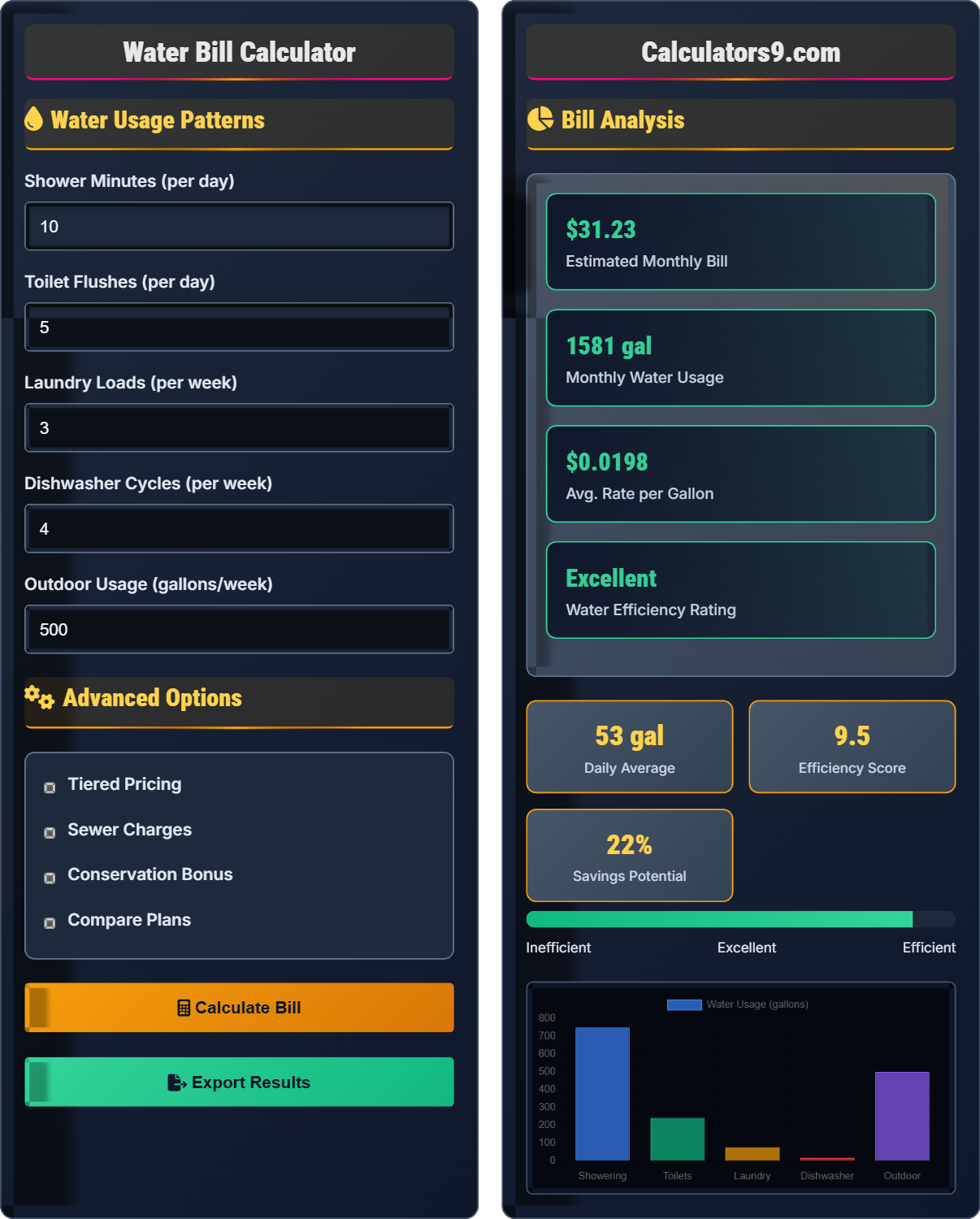
Water Bill Calculator
Water usage & cost tracker • 2026 rates
Water Bill Formula:
Show the calculator\( WB = (U \times R) + F + S + T \)
Where:
- \( WB \) = Total water bill ($)
- \( U \) = Total water usage (gallons)
- \( R \) = Rate per gallon ($)
- \( F \) = Fixed monthly fee ($)
- \( S \) = Sewer charges ($)
- \( T \) = Taxes and surcharges ($)
This formula calculates your total water bill based on consumption, rate structure, and additional fees. It helps users understand billing components and identify potential savings.
Example: For 6,000 gallons usage (\( R = 0.003 \) $/gallon, \( F = 25 \) $, \( S = 30 \) $, \( T = 0.05 \) of subtotal):
Subtotal = (6,000 × 0.003) + 25 + 30 = $73
Taxes = $73 × 0.05 = $3.65
Total bill = $73 + $3.65 = $76.65
Water Usage Patterns
Advanced Options
Bill Analysis
| Activity | Usage (gal) | Cost ($) | % of Total |
|---|
| Improvement | Monthly Savings | Annual Savings | Payback Period |
|---|
Water Efficiency Tips & Savings
Here are average water consumption rates for common activities:
- Shower: 2.5 gallons/minute (modern low-flow: 2.0 gal/min)
- Toilet Flush: 1.6 gallons (older models: 3.5-7 gal)
- Laundry Load: 25-40 gallons (efficient washers: 15-25 gal)
- Dishwasher Cycle: 3-6 gallons (efficient models: 2-4 gal)
- Outdoor Irrigation: 0.5-1.0 inches per week (1 inch = 0.62 gal/sq ft)
Follow these guidelines to reduce your water bill:
- Take shorter showers (5 minutes vs 10 minutes saves ~12.5 gal/day)
- Install low-flow fixtures and showerheads
- Fix leaks promptly (a dripping faucet can waste 3,000+ gal/year)
- Run full loads in dishwashers and washing machines
- Water lawns early morning or evening to reduce evaporation
Understanding the long-term benefits of water efficiency:
- Water-efficient homes use 20-30% less water than standard homes
- Low-flow fixtures can save 2,000-4,000 gallons annually
- Fixing leaks can save hundreds of dollars per year
- Water-efficient appliances pay for themselves in 2-3 years
- Water conservation helps preserve local water supplies
Water-Efficient Appliances
Water Usage & Efficiency Quiz
Which activity typically consumes the most water in a household?
The answer is D) Outdoor Irrigation. During summer months, outdoor irrigation typically accounts for 30-60% of residential water consumption. Indoor activities like toilets, showers, and laundry account for the remaining 40-70%, with toilets being the largest indoor consumer at about 24% of indoor usage. However, seasonal outdoor watering often exceeds all indoor uses combined.
Understanding which activities consume the most water helps prioritize efficiency improvements. Outdoor irrigation patterns vary significantly by season and climate, making it the most variable water use category. The seasonal nature of irrigation means its impact on monthly bills can vary dramatically throughout the year.
Gallons Per Minute (GPM): Measure of water flow rate
Water Budget: Target water usage based on climate and landscape
Irrigation Efficiency: Percentage of applied water that reaches plant roots
• Outdoor irrigation typically uses the most water seasonally
• Consumption varies by climate and season
• Seasonal usage affects total consumption significantly
• Remember: Outdoor irrigation is often the biggest water user
• Install rain sensors to prevent unnecessary watering
• Use drought-resistant plants to reduce irrigation needs
• Assuming indoor activities always consume more water than outdoor
• Not considering seasonal variations in irrigation
• Forgetting that climate affects irrigation requirements
If you take a 10-minute shower every day using a standard showerhead (2.5 GPM), and water costs $0.003 per gallon, what is the monthly cost? Show your work.
Step 1: Calculate daily usage = 2.5 GPM × 10 minutes = 25 gallons/day
Step 2: Calculate monthly usage = 25 gallons/day × 30 days = 750 gallons
Step 3: Calculate monthly cost = 750 gallons × $0.003/gallon = $2.25
Therefore, taking 10-minute daily showers costs $2.25 per month.
This calculation demonstrates how to determine water costs based on flow rates and usage patterns. Understanding the relationship between flow rate, time, and monthly duration helps predict water costs. The calculation shows how even daily activities can result in significant monthly expenses, highlighting the value of water-efficient fixtures.
GPM: Gallons Per Minute, measure of water flow rate
Water Flow Rate: Volume of water passing through a fixture per unit time
Conservation: Reducing water usage through efficient practices
• Flow Rate × Time = Volume
• Volume × Rate = Cost
• Lower flow rates reduce consumption and costs
• Check your water bill for actual rates
• Monitor daily usage patterns
• Install low-flow fixtures to reduce consumption
• Confusing flow rate with total volume
• Not accounting for actual flow rate of fixtures
• Forgetting to multiply by time period
You currently use a standard showerhead (2.5 GPM) for 10-minute showers daily. You're considering replacing it with a low-flow model (2.0 GPM). If water costs $0.003 per gallon, how much would you save annually? Show your calculations.
Step 1: Current daily usage = 2.5 GPM × 10 minutes = 25 gallons/day
Step 2: New daily usage = 2.0 GPM × 10 minutes = 20 gallons/day
Step 3: Daily savings = 25 - 20 = 5 gallons/day
Step 4: Annual savings = 5 gallons/day × 365 days = 1,825 gallons
Step 5: Annual cost savings = 1,825 gallons × $0.003/gallon = $5.48
Therefore, switching to a low-flow showerhead would save approximately $5.48 per year.
This calculation demonstrates the savings possible through water-efficient fixtures. While the annual savings may seem modest, they represent a 20% reduction in shower water usage. The example also shows how small daily savings compound to meaningful annual savings, making the investment in efficient fixtures worthwhile.
Water Efficiency: Using less water to perform the same function
Low-Flow Fixtures: Devices designed to reduce water consumption
Compounding Savings: Small daily savings accumulating over time
• Savings = (old usage - new usage) × rate
• Efficient fixtures provide same function with less water
• Annual savings = daily savings × 365
• Replace fixtures in frequently used areas first
• Look for EPA WaterSense certified products
• Combine multiple efficiency measures for greater savings
• Not accounting for actual fixture flow rates
• Assuming all fixtures have the same flow rate
• Forgetting to multiply by time period
You suspect you have a leak that drips once per minute. A single drip contains 0.05 mL of water. If water costs $0.003 per gallon, what would be your annual cost from this leak? (Note: 1 gallon = 3,785 mL). If fixing the leak costs $50, what is the payback period?
Step 1: Calculate drips per year = 1 drip/minute × 60 min/hr × 24 hr/day × 365 days = 525,600 drips
Step 2: Calculate water lost = 525,600 drips × 0.05 mL/drip = 26,280 mL
Step 3: Convert to gallons = 26,280 mL ÷ 3,785 mL/gallon = 6.94 gallons
Step 4: Calculate annual cost = 6.94 gallons × $0.003/gallon = $0.02
Step 5: Calculate payback period = $50 ÷ $0.02/year = 2,500 years
Actually, this is a very minor leak. Let's recalculate assuming 1 drip per second (more realistic for a noticeable leak):
Annual cost = $0.02 × 60 = $1.20 per year. Payback period = $50 ÷ $1.20 = 41.7 years
More realistically, a slow leak might be 1 drip every 2 seconds: $0.60 annual cost, 83.3 years payback.
This example demonstrates how to evaluate water loss from leaks using unit conversions. While a single drip per minute is negligible, more substantial leaks can waste significant water. The calculation shows that even seemingly small leaks can accumulate to meaningful losses over time, making prompt repair important for both conservation and cost reasons.
Leak Detection: Identifying and measuring unintended water loss
Unit Conversion: Converting between different measurement unitsWater Loss: Unintended discharge of water from plumbing system
• Convert units consistently in calculations
• More substantial leaks warrant immediate attention
• Regular inspections prevent major water loss
• Check your water meter regularly for unexplained usage
• Monitor monthly bills for unusual increases
• Fix even small leaks promptly to prevent escalation
• Incorrect unit conversions between mL and gallons
• Assuming all leaks are equally significant
• Not accounting for the cumulative effect of small leaks
Which of the following statements about residential water consumption is TRUE?
The answer is B) Toilets account for 24% of indoor water use. According to the EPA WaterSense program, toilets are the largest indoor water user, accounting for approximately 24% of indoor water consumption. Showers come second at about 20%, followed by washing machines at 21%. This makes toilets a prime target for water efficiency improvements.
This statistic helps prioritize water efficiency efforts. Since toilets account for the largest share of indoor water use, improvements in this area yield the greatest savings. This includes upgrading to low-flow or dual-flush toilets, which can reduce toilet water usage by 20-60% while maintaining functionality.
Indoor Water Use: Water consumption inside the home
Water Distribution: How water is allocated among different uses
Priority Areas: Uses with highest water consumption
• Focus efficiency efforts on highest consumption areas
• Toilets are the largest indoor water consumer
• Small improvements in high-consumption areas yield large savings
• Remember: Toilets = 24% of indoor use
• Prioritize improvements in high-consumption areas
• Use water audit to identify consumption patterns
• Focusing on low-impact areas while ignoring major consumers
• Assuming all appliances use equal amounts of water
• Not understanding the difference between indoor and outdoor use
FAQ
Q: How does water pricing work and what are the main components of my bill?
A: Water bills typically consist of several components:
- Water Supply Charge: Based on actual gallons consumed at a rate per gallon
- Sewer Charge: Costs for treating wastewater (often tied to water usage)
- Fixed Charge: Monthly service fee regardless of usage
- Taxes/Surcharges: Government fees and infrastructure programs
Mathematically, if \( U \) is usage in gallons and \( R \) is rate per gallon:
\( \text{Bill} = (U \times R) + \text{Sewer} + \text{Fixed Fee} + \text{Taxes} \)
Understanding these components helps identify opportunities for savings.
Q: What's the most effective way to reduce my water bill?
A: The most effective approach targets the largest water consumers:
- Toilets: Account for 24% of indoor use - install low-flow/dual-flush models
- Showering: 20% of indoor use - use low-flow showerheads
- Laundry: Run full loads in efficient washers
- Outdoor: Irrigate early morning/late evening, use drought-resistant plants
- Leaks: Fix promptly - a small leak can waste 10,000+ gallons annually
Research shows that targeting toilets and showers can reduce indoor water use by 20-30% with proper implementation.