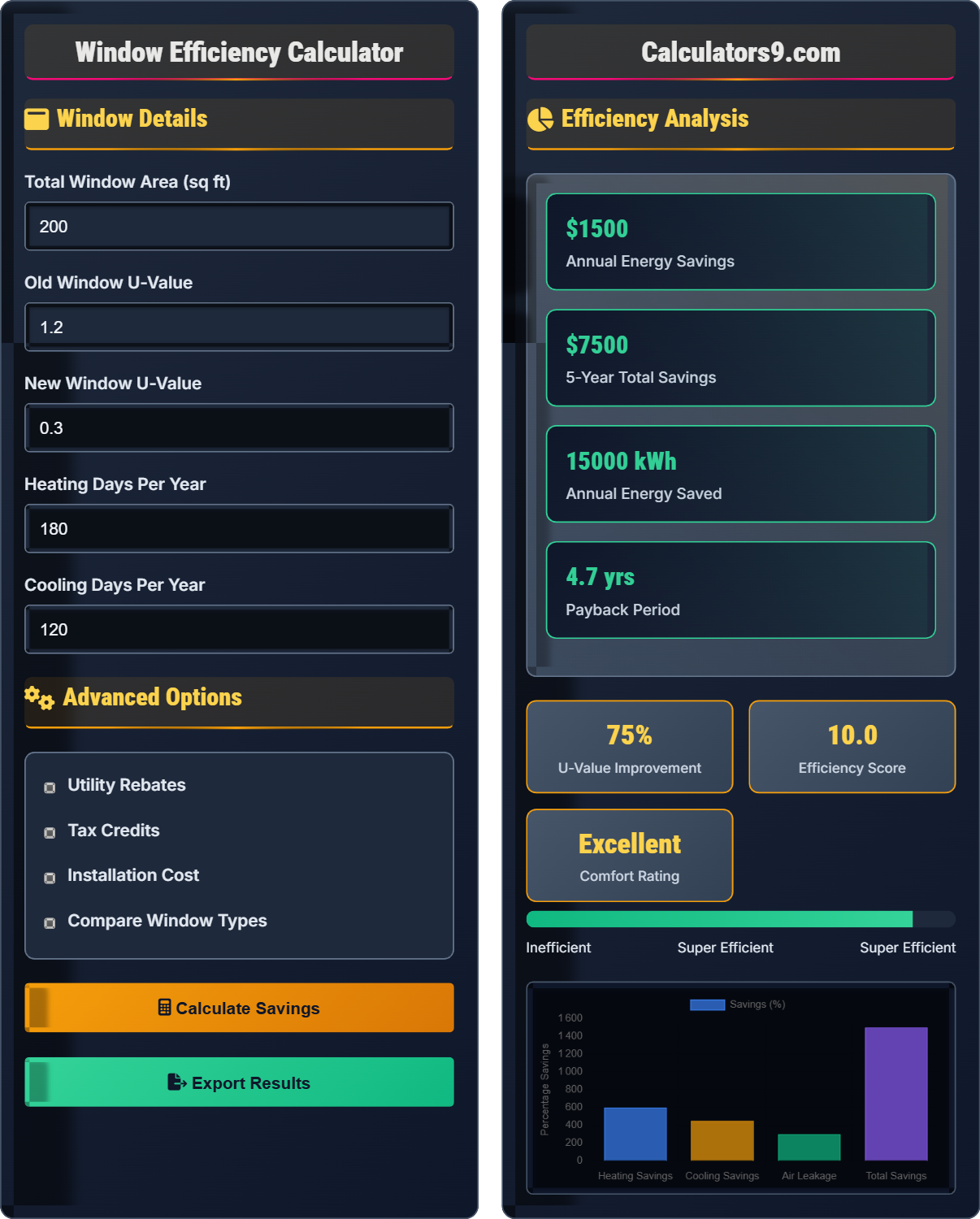
Window Efficiency Calculator
Window efficiency tracker • 2026 rates
Window Efficiency Formula:
Show the calculator\( S = A \times U_o \times HDD \times C_h \times (1 - E_g) \)
Where:
- \( S \) = Annual energy savings ($)
- \( A \) = Window area (square feet)
- \( U_o \) = Old window U-factor
- \( HDD \) = Heating degree days
- \( C_h \) = Cost per heating unit
- \( E_g \) = Efficiency gain from new windows
This formula calculates the annual energy savings from upgrading windows based on area, efficiency improvements, and climate factors. It helps quantify the financial benefits of window replacement.
Example: For 200 sq ft of windows with U-factor improvement from 1.2 to 0.3 (75% efficiency gain), 5,000 HDD, $0.02 per heating unit:
Savings = 200 × 1.2 × 5000 × 0.02 × (1 - 0.75) = $600 annually
Window Details
Advanced Options
Efficiency Analysis
| Component | Amount | Description |
|---|
| Measure | Before | After | Improvement |
|---|
Window Efficiency Tips & Savings
Key metrics for evaluating window efficiency:
- U-Value: Lower is better (0.2-1.2 range)
- SHGC: Solar Heat Gain Coefficient (0.2-0.7)
- VT: Visible Transmittance (0.4-0.7)
- Condensation Resistance: Higher is better (30-90)
- Energy Star: Look for certified products
Best practices for maximum window efficiency:
- Seal all gaps around window frames
- Use low-E coatings for climate control
- Consider argon or krypton gas fills
- Install storm windows for additional protection
- Proper sizing to minimize thermal bridging
Understanding the long-term benefits of efficient windows:
- Efficient windows save 12-33% on heating and cooling costs
- Typical payback period is 8-15 years
- Can increase home value by 3-10%
- Reduce carbon footprint by 1,000+ lbs CO₂ per year
- Improve comfort with consistent temperatures
Window Material Options
Window Efficiency & Savings Quiz
According to studies, what percentage of energy can efficient windows save on heating and cooling?
The answer is B) 12-33%. Studies by the U.S. Department of Energy and other organizations show that efficient windows can save 12-33% on heating and cooling costs. The savings depend on the climate, existing window condition, and the efficiency of the new windows. The higher savings occur in homes with very inefficient existing windows.
Understanding the potential energy savings from window upgrades helps set realistic expectations for investment returns. The 12-33% range reflects different factors: climate, existing window condition, and the specific efficiency improvements. Homes with single-pane windows in extreme climates typically see the highest percentage savings.
U-Value: Measure of heat transfer (lower = better insulation)
Energy Efficiency: Using less energy to maintain comfort
Thermal Performance: How well windows resist heat flow
• Efficient windows save 12-33% on HVAC costs
• Savings depend on climate and existing windows
• Lower U-values provide better insulation
• Remember: 12-33% savings on HVAC costs
• Homes with single-pane windows see higher savings
• Look for Energy Star certification
• Expecting savings that are too high or too low
• Not considering climate differences
• Assuming all window upgrades provide equal savings
If your annual heating and cooling bill is $1,500, and new windows save 20% annually, what are your annual savings? Show your work.
Step 1: Calculate annual savings = $1,500 × 20%
Step 2: Annual savings = $1,500 × 0.20 = $300
Therefore, the efficient windows would save $300 annually.
This calculation demonstrates how to determine potential savings based on current HVAC costs and expected efficiency gains. The percentage savings apply to the total HVAC bill, so homes with higher bills see greater dollar savings. This makes efficient windows particularly attractive for homes with high heating and cooling costs.
Percentage Savings: Efficiency gain expressed as a percentage
Dollar Savings: Actual monetary savings achieved
HVAC Bill: Total cost of heating and cooling
• Savings = Total cost × Percentage savings
• Higher bills mean higher dollar savings
• Percentage savings remain constant regardless of bill amount
• Convert percentage to decimal for calculations (20% = 0.20)
• Higher HVAC bills mean more dollar savings
• Check your actual bill for accurate calculations
• Forgetting to convert percentage to decimal
• Applying savings to total utility bill instead of HVAC portion
• Not considering seasonal variations in savings
You're considering buying efficient windows for $4,500. Your annual heating and cooling bill is $1,800, and the windows are expected to save 15% annually. What is the payback period for this investment? Show your calculations.
Step 1: Calculate annual savings = $1,800 × 15% = $1,800 × 0.15 = $270
Step 2: Calculate payback period = $4,500 ÷ $270/year = 16.67 years
The payback period for the efficient windows is approximately 16.7 years.
This example demonstrates how to calculate the payback period for window efficiency investments. The payback period is the time required for savings to equal the initial investment. In this case, the investment takes about 16.7 years to pay for itself, which is longer than typical ranges of 8-15 years. This shows that payback periods can vary significantly based on the investment cost and savings rate.
Payback Period: Time required for savings to equal investment cost
Return on Investment: Financial benefit relative to costInvestment Recovery: Process of earning back initial expenditure
• Payback Period = Investment ÷ Annual Savings
• Typical window payback is 8-15 years
• Consider ongoing savings after payback period
• Look for payback periods under 15 years for windows
• Consider the full lifetime of savings
• Factor in non-financial benefits like comfort
• Not considering the full lifetime of savings
• Forgetting to account for all savings factors
• Assuming savings stop after payback period
You're comparing two window options: Option A has U-Value of 0.4 and costs $30/sq ft, Option B has U-Value of 0.2 and costs $50/sq ft. You need 150 sq ft of windows. If each 0.1 improvement in U-Value saves 5% on energy costs, and your annual HVAC bill is $2,000, which option provides better value over 20 years? Assume both have the same installation cost.
Step 1: Calculate Option A cost = $30 × 150 = $4,500
Step 2: Calculate Option B cost = $50 × 150 = $7,500
Step 3: Calculate U-Value improvement for A = (1.2 - 0.4) = 0.8
Step 4: Calculate U-Value improvement for B = (1.2 - 0.2) = 1.0
Step 5: Calculate Option A savings = (0.8 ÷ 0.1) × 5% × $2,000 = 40% × $2,000 = $800/year
Step 6: Calculate Option B savings = (1.0 ÷ 0.1) × 5% × $2,000 = 50% × $2,000 = $1,000/year
Step 7: Calculate Option A total savings = $800 × 20 = $16,000
Step 8: Calculate Option B total savings = $1,000 × 20 = $20,000
Step 9: Calculate Option A ROI = ($16,000 - $4,500) ÷ $4,500 = 256%
Step 10: Calculate Option B ROI = ($20,000 - $7,500) ÷ $7,500 = 167%
Option A provides better ROI (256% vs 167%), despite lower U-value.
This example demonstrates that higher performance windows don't always provide better ROI. The calculation shows that the less expensive, moderately efficient option has a higher ROI despite lower performance. This is because the cost difference outweighs the additional energy savings. When evaluating window options, consider both performance and cost-effectiveness.
Cost-Effectiveness: Achieving goals at lowest possible cost
U-Value: Measure of heat transfer (lower = better)
Performance vs Cost: Balancing effectiveness with expense
• Higher U-value efficiency doesn't always mean better ROI
• Consider cost per unit of performance
• Evaluate total cost vs total benefits
• Calculate cost per unit of U-value improvement
• Consider diminishing returns on high-performance windows
• Focus on adequate performance at reasonable cost
• Assuming higher performance always provides better ROI
• Not considering cost differences
• Forgetting to calculate total project costs
Which of the following statements about window efficiency is TRUE?
The answer is B) Windows typically pay for themselves in 8-15 years. Studies show that efficient windows typically have a payback period of 8-15 years, depending on the climate, existing window condition, and type of windows. This makes window replacement a moderate-length investment with ongoing benefits for decades.
This statistic highlights the moderate payback period for window investments. The 8-15 year range reflects different factors like climate, existing window condition, and the specific efficiency of new windows. While the payback period is longer than some other efficiency improvements, windows provide ongoing benefits for 20-30 years after payback.
Payback Period: Time required for savings to equal investment
Energy Efficiency: Using less energy to achieve same results
Cost Recovery: Process of recovering investment through savings
• Windows typically pay for themselves in 8-15 years
• Savings continue for decades after payback
• Works in all climates (heating and cooling)
• Remember: 8-15 year payback period
• Windows work in both hot and cold climates
• Consider long-term benefits beyond payback
• Assuming windows take too long to pay back
• Thinking windows only work in cold climates
• Not considering long-term savings after payback
FAQ
Q: How much money can I really save with efficient windows?
A: The savings depend on your current windows, but here's what to expect:
- Average savings: 12-33% on heating and cooling costs
- Typical annual savings: $200-500 for most homes
- Payback period: 8-15 years for most installations
Mathematically, if \( E \) is your annual HVAC cost:
\( \text{Annual Savings} = E \times 0.12 \text{ to } 0.33 \)
Higher savings occur with inefficient existing windows or extreme climates.
Q: What's the best strategy for window replacement?
A: The most effective approach considers multiple factors:
- U-Value: Look for 0.2-0.4 for best efficiency
- SHGC: 0.25-0.40 for hot climates, 0.40-0.60 for cold
- Low-E: Essential for climate control
- Gas Fill: Argon or krypton improves performance
- Installation: Proper sealing is critical
Focus on windows with the highest heat loss first for maximum return on investment.