Concrete Volume Calculator
Fast yardage calculator • 2026 standards
Concrete Volume Formula:
Show the calculatorVolume = Length × Width × Depth
Cubic Yards = (Length × Width × Depth) ÷ 27
Where:
- Length = length in feet
- Width = width in feet
- Depth = thickness in feet
- 27 = cubic feet in one cubic yard
This formula calculates the volume of concrete needed for rectangular areas. For circular areas, use: Volume = π × radius² × depth. Always add 5-10% extra for waste and spillage.
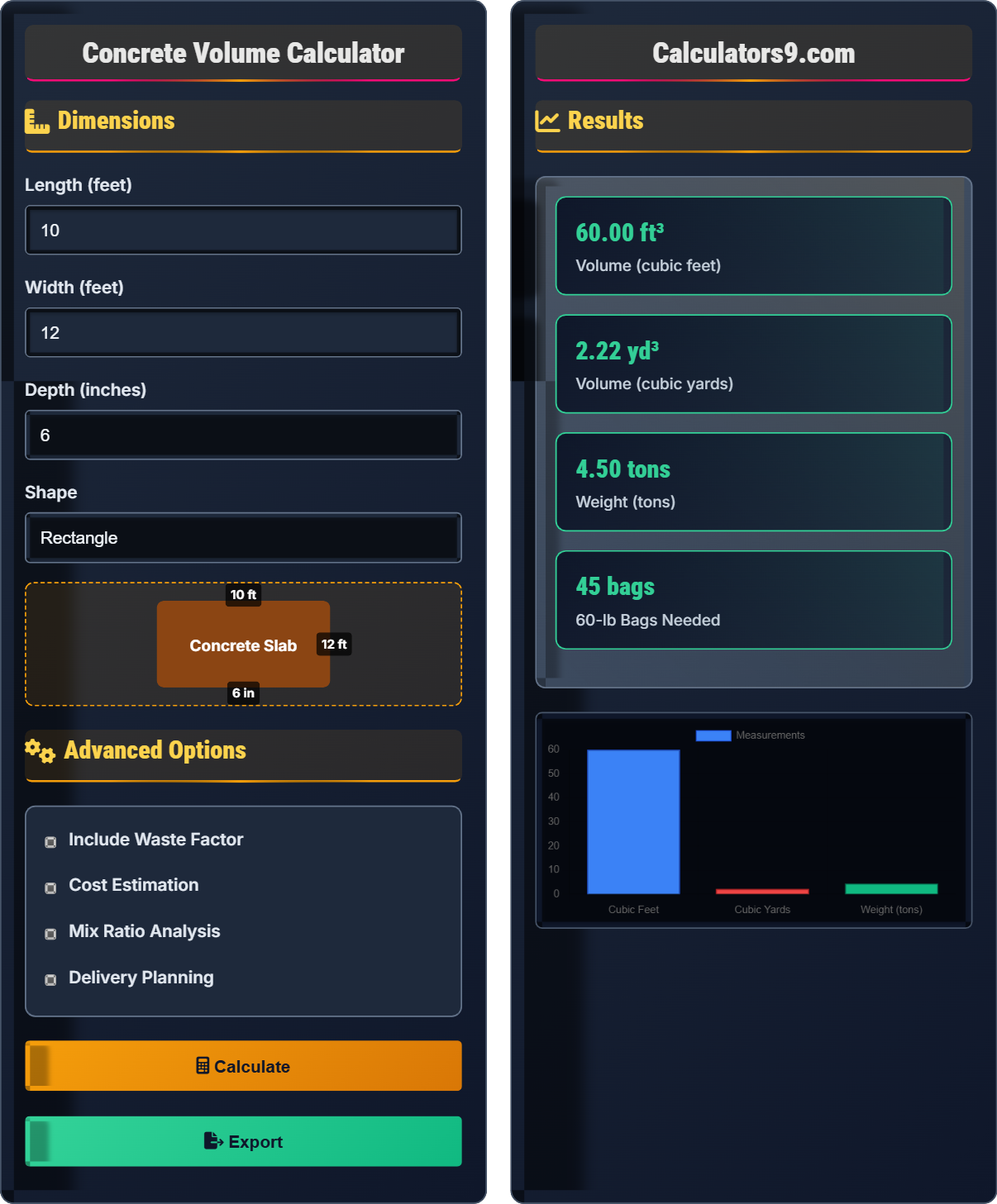
Example: For a slab 10ft × 12ft × 0.5ft (6 inches):
Volume = 10 × 12 × 0.5 = 60 cubic feet
Cubic Yards = 60 ÷ 27 = 2.22 cubic yards
With 10% extra: 2.22 × 1.10 = 2.44 cubic yards needed.
Dimensions
Advanced Options
Results
| Material | Quantity | Unit |
|---|
| Step | Duration | Notes |
|---|
Comprehensive Concrete Guide
Concrete is a composite material composed of fine and coarse aggregate bonded together with a fluid cement that hardens over time. Most concretes used are lime-based concretes such as Portland cement concrete or concretes made with other hydraulic cements, such as ciment fondu. Concrete is used as a building material due to its strength, durability, and relatively low cost.
The basic formula for calculating concrete volume is straightforward:
For circular areas: Volume = π × radius² × depth
Always convert measurements to feet before calculating, and remember that 1 cubic yard equals 27 cubic feet.
Key properties that affect concrete volume calculations:
- Density: Typically 150 lbs/ft³ (2,400 kg/m³)
- Shrinkage: 0.05-0.1% during drying
- Waste Factor: Add 5-10% for spillage and irregularities
- Yield: Actual volume may vary from theoretical due to air content
- Slump: Workability affects final volume and density
- Accurate Measurements: Measure twice, order once
- Timing: Concrete sets quickly, plan accordingly
- Weather: Avoid extreme temperatures during pouring
- Curing: Keep moist for 7-28 days for optimal strength
- Reinforcement: Use rebar or wire mesh for added strength
Concrete Basics
Mixture of cement, water, sand, and aggregate.
\( V = L \times W \times D \)
Convert to cubic yards: divide by 27.
- Always measure in feet
- Add 10% for waste
- Concrete weighs 150 lbs/ft³
Applications
1:2:4 ratio (cement:sand:aggregate)
- Calculate exact volume needed
- Add 10% waste factor
- Choose appropriate mix ratio
- Schedule delivery timing
- Check weather conditions
- Prepare forms and reinforcement
- Plan access for delivery truck
- Have crew ready for placement
Concrete Learning Quiz
How many cubic yards of concrete are needed for a rectangular slab measuring 20 feet by 30 feet at a depth of 6 inches?
The correct answer is B) 11.1 cubic yards. First convert depth to feet: 6 inches = 0.5 feet. Then calculate volume: 20 ft × 30 ft × 0.5 ft = 300 cubic feet. Finally, convert to cubic yards: 300 ÷ 27 = 11.1 cubic yards.
This problem tests understanding of unit conversion and the concrete volume formula. The key steps are: 1) Ensure all dimensions are in the same unit (feet), 2) Calculate volume in cubic feet, 3) Convert to cubic yards by dividing by 27 (since 1 cubic yard = 27 cubic feet).
Cubic Yard: Unit of volume equal to 27 cubic feet (3ft × 3ft × 3ft)
Concrete Volume: Length × Width × Depth
Waste Factor: Additional concrete ordered to account for spillage (typically 5-10%)
• Always convert inches to feet before calculating
• Divide by 27 to convert cubic feet to cubic yards
• Add 10% extra for waste and spillage
• Remember: 12 inches = 1 foot, 27 cubic feet = 1 cubic yard
• Use a calculator to avoid arithmetic errors
• Double-check all measurements before ordering
• Forgetting to convert inches to feet
• Using 36 instead of 27 for cubic yard conversion
• Calculating area instead of volume
A contractor needs to pour a circular patio with a diameter of 14 feet and a thickness of 4 inches. If concrete costs $110 per cubic yard and the contractor wants to add 10% for waste, what is the total estimated cost?
Step 1: Calculate radius
Radius = Diameter ÷ 2 = 14 ÷ 2 = 7 feet
Step 2: Convert thickness to feet
Thickness = 4 inches = 4 ÷ 12 = 0.333 feet
Step 3: Calculate volume using circular area formula
Volume = π × radius² × depth
Volume = 3.14159 × 7² × 0.333 = 3.14159 × 49 × 0.333 = 51.3 cubic feet
Step 4: Convert to cubic yards
Cubic Yards = 51.3 ÷ 27 = 1.9 cubic yards
Step 5: Add 10% waste factor
Adjusted Volume = 1.9 × 1.10 = 2.09 cubic yards
Step 6: Calculate total cost
Total Cost = 2.09 × $110 = $229.90 ≈ $230
The total estimated cost is approximately $230.
This problem combines geometric calculations with practical construction applications. The key is recognizing that for circular areas, we use the formula Area = πr², then multiply by depth for volume. The waste factor is applied to the final volume before cost calculation.
Circular Volume: π × radius² × depth
Waste Factor: Percentage added to account for spillage (decimal multiplier)
Cost Estimation: Volume × Price per unit volume
• For circles: Area = πr²
• Always convert all measurements to feet
• Apply waste factor to volume, not cost
• Use 3.14159 for π in calculations
• Remember diameter ÷ 2 = radius
• Convert waste percentage to decimal (10% = 0.10)
• Using diameter instead of radius in area calculation
• Forgetting to convert inches to feet
• Applying waste factor to cost instead of volume
FAQ
Q: How do I calculate concrete volume for irregular shapes?
A: For irregular shapes, break the area into simpler geometric shapes (rectangles, triangles, circles) and calculate each separately, then sum the volumes.
For complex shapes, you can use the average dimension method: measure the longest and shortest lengths, average them, and multiply by the average width and depth.
Alternatively, for L-shaped areas, divide into rectangles. For triangular sections, use: Volume = ½ × base × height × depth.
For curved or organic shapes, consider using CAD software or consulting with a structural engineer for precise calculations.
Q: What factors affect the actual yield of concrete compared to theoretical calculations?
A: Several factors affect actual concrete yield:
Air Content: Concrete typically contains 1-3% entrained air, reducing volume
Compaction: Vibrating or tamping removes air voids, increasing density
Slump: Higher slump (more water) can affect final volume after settling
Aggregate Shape: Rounded aggregates pack differently than angular ones
Water-Cement Ratio: Affects both workability and final volume
For this reason, it's standard practice to add 5-10% to theoretical calculations to ensure sufficient material.