Electrical Power Calculator
Circuit analysis tool • Ohm's law & power calculations
Ohm's Law and Power Equations:
Show CalculatorOhm's Law:
\( V = I \cdot R \)
Power Equations:
\( P = V \cdot I = I^2 \cdot R = \frac{V^2}{R} \)
AC Power (with power factor):
\( P = V \cdot I \cdot \cos(\phi) \)
Where: V = voltage, I = current, R = resistance, P = power, φ = phase angle
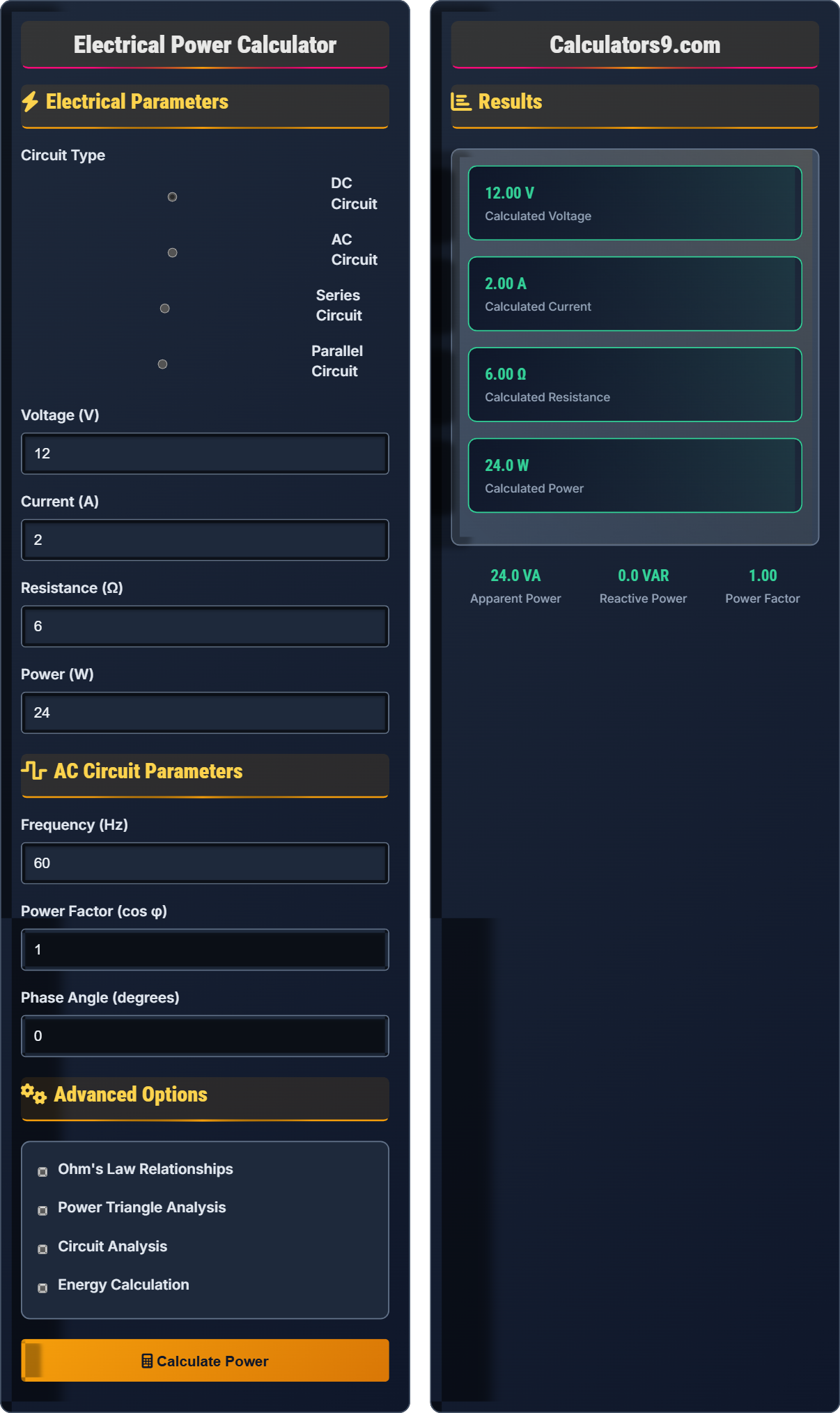
Example: 12V battery connected to 6Ω resistor:
\( I = \frac{V}{R} = \frac{12}{6} = 2 \) A
\( P = V \cdot I = 12 \times 2 = 24 \) W
Electrical Parameters
AC Circuit Parameters
Advanced Options
Results
Electrical Power Fundamentals
Electrical power is the rate at which electrical energy is transferred by an electric circuit. It's calculated as the product of voltage and current (P = VI) and is measured in watts (W).
Fundamental electrical equations:
- DC: Direct Current (constant voltage)
- AC: Alternating Current (varying voltage)
- Series: Components connected end-to-end
- Parallel: Components connected side-by-side
Power Analysis
In AC circuits, power has three components: real power (P), reactive power (Q), and apparent power (S). The power factor relates these quantities: PF = P/S = cos(φ).
The relationship between power components:
Where S is apparent power, P is real power, Q is reactive power.
- Unity (1.0) for purely resistive loads
- Lagging for inductive loads
- Leading for capacitive loads
- Between 0 and 1 for mixed loads
Electrical Power Learning Quiz
A circuit has a voltage of 24V and a current of 3A. Calculate the resistance, power dissipated, and energy consumed in 2 hours. Show all calculations using Ohm's law and power equations.
Step 1: Calculate resistance using Ohm's Law
Step 2: Calculate power using power equation
Step 3: Calculate energy consumed in 2 hours
Results: R = 8Ω, P = 72W, E = 0.144 kWh
This problem demonstrates the fundamental relationships in electrical circuits. Ohm's Law (V = IR) defines the relationship between voltage, current, and resistance.
The power equations (P = VI, P = I²R, P = V²/R) are all equivalent and can be used interchangeably depending on known quantities.
Energy is power multiplied by time, showing how much work the circuit can do over a period.
Ohm's Law: V = I × R (voltage equals current times resistance)
Power: Rate of energy transfer (P = VI)
Energy: Power × Time (E = P × t)
• Always use consistent units in calculations
• Power is directly proportional to current and voltage
• Energy is power integrated over time
• Resistance opposes current flow
• Use the power triangle for AC circuits
• Remember that P = I²R means power increases with square of current
• Higher resistance dissipates more heat
• Using wrong units in calculations
• Confusing power with energy
• Not accounting for power factor in AC circuits
• Mixing series and parallel circuit rules
An AC motor draws 10A at 240V with a power factor of 0.8 lagging. Calculate the real power, reactive power, apparent power, and phase angle. Explain the significance of the power factor in this context.
Step 1: Calculate apparent power
Step 2: Calculate real power
Step 3: Calculate reactive power
Step 4: Calculate phase angle
Results: P = 1920W, Q = 1440VAR, S = 2400VA, φ = 36.87°
Significance: The power factor of 0.8 means only 80% of the current delivers useful work, while 60% returns to the source.
This problem illustrates AC power concepts where voltage and current are out of phase. The power factor represents the cosine of the phase angle.
Real power (P) does the useful work, reactive power (Q) creates magnetic fields, and apparent power (S) is the vector sum of both.
Inductive loads like motors cause current to lag voltage, resulting in a lagging power factor.
Real Power (P): Power that does useful work (Watts)
Reactive Power (Q): Power stored and returned by reactive components (VAR)
Apparent Power (S): Vector sum of real and reactive power (VA)
• Power factor = cos(phase angle)
• S² = P² + Q²
• Lagging PF: inductive loads, current lags voltage
• Leading PF: capacitive loads, current leads voltage
• Use power triangle for AC power calculations
• Motors typically have lagging power factors
• Capacitors can improve power factor
• Confusing real power with apparent power
• Not accounting for power factor in AC calculations
• Using DC formulas for AC circuits
• Forgetting to use RMS values for AC
Engineering FAQ
Q: What's the difference between real, reactive, and apparent power in AC circuits?
A: The three types of AC power are:
Real Power (P):
- Measured in Watts (W)
- Power that performs actual work
- Consumed by resistive loads
- Equals V × I × cos(φ)
Reactive Power (Q):
- Measured in Volt-Amperes Reactive (VAR)
- Power that creates magnetic/electric fields
- Stored and returned by inductive/capacitive loads
- Equals V × I × sin(φ)
Apparent Power (S):
- Measured in Volt-Amperes (VA)
- Total power supplied to circuit
- Vector sum of real and reactive power
- Equals V × I
The relationship is: S² = P² + Q²
Q: Why is power factor important in electrical systems?
A: Power factor is crucial for several reasons:
System Efficiency:
- Low power factor increases current flow
- Higher current causes more I²R losses
- Reduces system capacity utilization
Utility Billing:
- Utilities may charge penalties for low PF
- Industrial customers often face PF surcharges
- Capacitor banks improve PF and reduce costs
Equipment Sizing:
- Transformers sized for apparent power
- Low PF requires larger equipment
- Reduces available capacity for useful work
Target PF is typically 0.95 or higher.