Resistor Color Code Calculator
Fast resistance calculator • 2026 standards
Resistor Color Code Formula:
Show the calculatorFor 4-band resistors: \( R = (10 \times \text{Band1} + \text{Band2}) \times 10^{\text{Band3}} \pm \text{Tolerance} \)
Where:
- Band1 = First significant digit
- Band2 = Second significant digit
- Band3 = Multiplier
- Band4 = Tolerance
For 5-band resistors: \( R = (100 \times \text{Band1} + 10 \times \text{Band2} + \text{Band3}) \times 10^{\text{Band4}} \pm \text{Tolerance} \)
This formula calculates the resistance value based on the color bands of a resistor, following international standards.
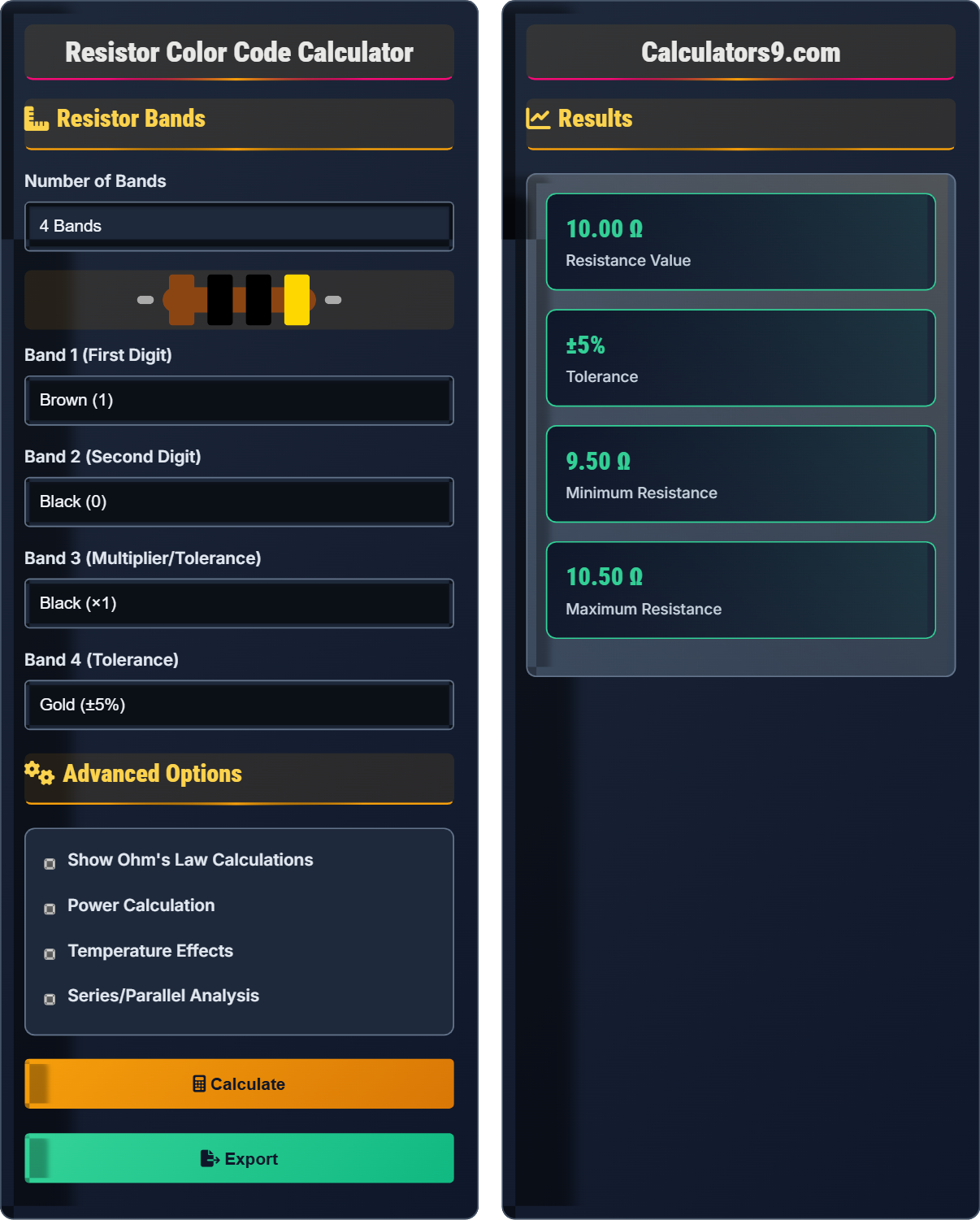
Example: For a resistor with bands: Brown, Black, Red, Gold
- Brown = 1
- Black = 0
- Red = 2 (multiplier of 10² = 100)
- Gold = ±5% tolerance
Resistance: \( R = (10 \times 1 + 0) \times 10^2 = 10 \times 100 = 1000 \Omega = 1k\Omega \pm 5\% \)
Thus, the resistor value is 1kΩ ±5%.
Resistor Bands
Advanced Options
Results
Comprehensive Resistor Guide
A resistor is a passive two-terminal electrical component that implements electrical resistance as a circuit element. Resistors act to reduce current flow, and, accordingly, the voltage across the resistor. They are common elements in electrical networks and electronic circuits, serving various functions including voltage division, current limiting, and signal conditioning.
The standard resistor color code follows specific mathematical formulas:
Where Band1-Band3 represent significant digits, Band4 is the multiplier, and Band5 is the tolerance.
Ohm's Law defines the fundamental relationship between voltage, current, and resistance:
- Voltage (V): V = I × R (Volts = Amps × Ohms)
- Current (I): I = V ÷ R (Amps = Volts ÷ Ohms)
- Resistance (R): R = V ÷ I (Ohms = Volts ÷ Amps)
- Power (P): P = V × I = I² × R = V² ÷ R (Watts)
- Current Limiting: Protecting LEDs and other sensitive components
- Voltage Division: Creating reference voltages
- Signal Conditioning: Filtering and shaping waveforms
- Termination: Matching impedance in transmission lines
- Feedback: Controlling gain in amplifiers
Resistor Basics
Opposition to current flow measured in ohms (Ω).
4-Band: \( R = (10 \times D_1 + D_2) \times 10^{M} \pm T \)
Where D₁,D₂=digits, M=multiplier, T=tolerance.
- Read from left to right
- Gold/Silver bands indicate tolerance
- 6-band adds temperature coefficient
Applications
Voltage = Current × Resistance (V = I × R)
- P = V × I
- P = I² × R
- P = V² ÷ R
- Verify power rating
- Always check tolerance
- Consider temperature effects
- Verify power dissipation
- Account for series/parallel combinations
Resistor Learning Quiz
What is the resistance value of a resistor with the color bands: Red, Red, Orange, Gold?
The correct answer is C) 22 kΩ ±5%. Using the resistor color code: Red=2, Red=2, Orange=3 (multiplier of 10³=1000), Gold=±5%. So the calculation is: (22 × 1000) ±5% = 22,000 Ω = 22 kΩ ±5%.
Understanding resistor color codes is fundamental to electronics work. The key is to remember that the first two bands represent significant digits, the third band is the multiplier (power of 10), and the fourth band indicates tolerance. In this case, we have 22 followed by 3 zeros (from orange), giving us 22,000 Ω or 22 kΩ.
Significant Digits: The first two bands that form the base number
Multiplier: The third band that determines how many zeros to add
Tolerance: The fourth band showing the accuracy range
• Always read color bands from left to right
• Gold and silver bands are never the first band
• The multiplier band determines the number of zeros
• Remember the sequence: Black, Brown, Red, Orange, Yellow, Green, Blue, Violet, Gray, White (0-9)
• Use the mnemonic "Big Boys Race Our Young Girls But Violet Gets Wise" to remember the colors
• Confusing the multiplier band with another digit
• Reading the bands from right to left instead of left to right
• Forgetting that gold/silver bands indicate tolerance, not digits
A resistor with color bands Brown, Black, Red, Gold is connected to a 12V power supply. Calculate the expected current through the resistor and the power dissipated by it.
Step 1: Determine resistance value
Brown=1, Black=0, Red=2 (multiplier of 10²=100), Gold=±5%
Resistance = (10 × 100) ±5% = 1000 Ω = 1 kΩ ±5%
Step 2: Calculate current using Ohm's Law
I = V ÷ R = 12V ÷ 1000Ω = 0.012A = 12mA
Step 3: Calculate power dissipation
P = V × I = 12V × 0.012A = 0.144W = 144mW
OR: P = V² ÷ R = (12V)² ÷ 1000Ω = 144 ÷ 1000 = 0.144W
The expected current is 12mA and the power dissipated is 144mW.
This problem combines knowledge of resistor color codes with Ohm's Law applications. It demonstrates how understanding basic resistor values allows us to predict circuit behavior. The power calculation is important for ensuring the resistor can handle the dissipated energy without overheating.
Ohm's Law: The fundamental relationship V = I × R
Power Dissipation: Energy converted to heat in a resistor P = V × I
Rated Power: Maximum power a resistor can safely dissipate
• Always verify the resistor can handle the calculated power
• Use appropriate units (V, A, Ω, W) consistently
• Account for tolerance in critical applications
• Remember three forms of power equation: P=VI, P=I²R, P=V²/R
• Convert units properly (mA to A, kΩ to Ω) before calculating
• Use the power triangle to remember relationships
• Forgetting to convert kiloohms to ohms before calculating
• Using the wrong form of Ohm's Law for the given variables
• Not accounting for tolerance in precision applications
FAQ
Q: How do I interpret a 5-band resistor color code compared to a 4-band resistor?
A: The main difference between 4-band and 5-band resistors is precision. A 4-band resistor has two significant digits, while a 5-band resistor has three significant digits, providing more accurate resistance values.
For a 4-band resistor: \( R = (10 \times \text{Band1} + \text{Band2}) \times 10^{\text{Band3}} \pm \text{Band4} \)
For a 5-band resistor: \( R = (100 \times \text{Band1} + 10 \times \text{Band2} + \text{Band3}) \times 10^{\text{Band4}} \pm \text{Band5} \)
For example, a 4-band resistor with Brown, Black, Red, Gold would be (10 × 1 + 0) × 10² = 1000Ω = 1kΩ. A 5-band resistor with Brown, Black, Black, Brown, Gold would be (100 × 1 + 10 × 0 + 0) × 10¹ = 1000Ω = 1kΩ, but with higher precision.
Q: What does the temperature coefficient band mean in 6-band resistors?
A: The sixth band in 6-band resistors indicates the temperature coefficient, which specifies how much the resistance changes with temperature. This is measured in parts per million per degree Celsius (ppm/°C).
For example, if a resistor has a temperature coefficient of 100 ppm/°C, its resistance will change by 100Ω per 1MΩ for each degree Celsius of temperature change. For a 1kΩ resistor, this would be 0.1Ω per °C.
Temperature coefficients are important in precision applications where temperature stability is critical. Typical values are: Brown=100 ppm/°C, Red=50 ppm/°C, Orange=15 ppm/°C, Yellow=25 ppm/°C, Blue=10 ppm/°C, Violet=5 ppm/°C.