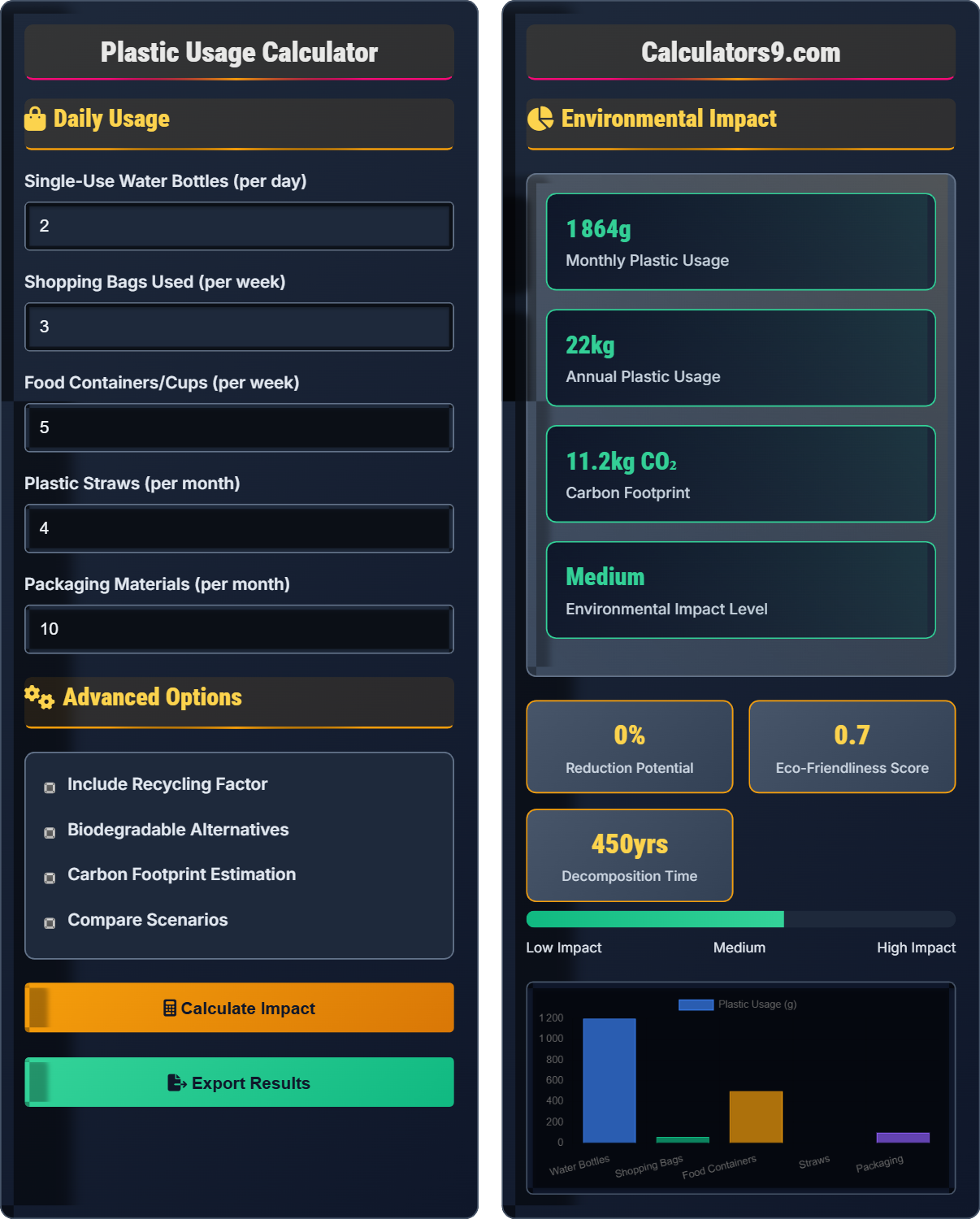
Plastic Usage Calculator
Eco impact tracker • 2026 metrics
Plastic Usage Formula:
Show the calculator\( PU = \sum (C_i \times U_i \times D_i) \)
Where:
- \( PU \) = Total plastic usage (grams/month)
- \( C_i \) = Consumption frequency of item i (times/month)
- \( U_i \) = Usage amount per instance (grams)
- \( D_i \) = Disposal factor (0-1, representing % disposed)
This formula calculates your monthly plastic consumption based on usage patterns and disposal habits. It helps quantify environmental impact and identify areas for reduction.
Example: For water bottles (\( C = 30 \) times/month, \( U = 20 \) grams, \( D = 1.0 \)):
\( PU = 30 \times 20 \times 1.0 = 600 \) grams/month
For food containers (\( C = 10 \) times/month, \( U = 50 \) grams, \( D = 0.8 \)):
\( PU = 10 \times 50 \times 0.8 = 400 \) grams/month
Total monthly plastic usage: 1,000 grams (1 kg).
Daily Usage
Advanced Options
Environmental Impact
| Item Type | Monthly Usage | Weight (g) | Impact % |
|---|
| Category | Current | Target | Improvement |
|---|
Eco-Friendly Alternatives & Tips
Implement these practical strategies to minimize your plastic footprint:
- Use reusable water bottles and coffee cups
- Bring cloth shopping bags to stores
- Choose products with minimal packaging
- Opt for glass or metal containers over plastic
- Support businesses that use sustainable packaging
Follow these guidelines for responsible plastic waste management:
- Clean containers before recycling
- Separate different plastic types
- Participate in local recycling programs
- Upcycle plastic items when possible
- Dispose of hazardous plastics properly
Understanding the environmental consequences of plastic usage:
- Plastic takes 450+ years to decompose
- Marine life is severely affected by plastic pollution
- Microplastics enter the food chain
- Production contributes to carbon emissions
- Landfills become overwhelmed with plastic waste
Sustainable Alternatives
Plastic Usage & Environmental Impact Quiz
Approximately how long does it take for a plastic bottle to decompose completely?
The answer is C) 450 years. A plastic bottle can take approximately 450 years to decompose completely in a natural environment. This highlights the long-term environmental impact of single-use plastics and underscores the importance of reducing plastic consumption and improving recycling practices.
Understanding decomposition times helps contextualize the environmental impact of our daily choices. Unlike organic materials that decompose within months or years, plastics persist in the environment for centuries. This persistence leads to accumulation in landfills and ecosystems, causing long-term harm to wildlife and habitats.
Decomposition: The process by which organic substances are broken down by other organisms
Biodegradable: Capable of being decomposed by bacteria or other living organisms
Persistence: The ability of a substance to remain in the environment for extended periods
• Plastics do not biodegrade like organic materials
• They photodegrade into smaller fragments (microplastics)
• Microplastics continue to pollute the environment indefinitely
• Remember: 450 years for plastic bottles
• Use the mnemonic "4-5-0 = Forever" to remember decomposition time
• Think about the lifetime implications before using single-use plastics
• Underestimating the time it takes for plastics to decompose
• Confusing biodegradable with recyclable materials
• Not considering the cumulative effect of daily plastic use
If a person uses 3 plastic water bottles per day (each weighing 20g), how much plastic waste does this generate in a year? Show your work.
Step 1: Daily plastic usage = 3 bottles × 20g = 60g/day
Step 2: Annual plastic usage = 60g/day × 365 days = 21,900g
Step 3: Convert to kilograms = 21,900g ÷ 1,000 = 21.9kg
Therefore, this person generates 21.9kg of plastic waste annually from water bottles alone.
This calculation demonstrates how small daily habits accumulate into significant environmental impacts over time. Using reusable water bottles instead of single-use ones can eliminate this entire category of plastic waste. The calculation also illustrates the concept of compound environmental effects - small individual actions, repeated consistently, create large collective impacts.
Accumulation: The gradual gathering or increase in amount over time
Compound Effect: The result of repeated small actions that build upon each other
Individual Impact: Environmental effect caused by one person's actions
• Small daily actions multiply significantly over a year
• Individual contributions to global problems matter
• Reusable alternatives eliminate recurring waste
• Calculate daily habits × 365 to see annual impact
• Multiply by 7 billion to see global impact
• Focus on high-frequency items for maximum reduction
• Forgetting to account for leap years in calculations
• Not considering the weight of caps and labels
• Underestimating the cumulative effect of repeated actions
Sarah produces 15kg of plastic waste per year. If she increases her recycling rate from 20% to 60%, how much plastic waste will be diverted from landfills annually?
Step 1: Current recycled amount = 15kg × 20% = 15kg × 0.20 = 3kg
Step 2: New recycled amount = 15kg × 60% = 15kg × 0.60 = 9kg
Step 3: Additional waste diverted = 9kg - 3kg = 6kg
Therefore, increasing her recycling rate by 40 percentage points diverts an additional 6kg of plastic from landfills annually.
This problem shows the direct relationship between recycling rates and waste diversion. Improving recycling habits can significantly reduce the amount of plastic that ends up in landfills or the environment. The calculation also demonstrates that proportional improvements in recycling have linear effects on waste diversion.
Waste Diversion: Redirecting waste from disposal to recycling or other beneficial uses
Recycling Rate: Percentage of waste that is processed for recycling
Landfill Diversion: Preventing waste from entering landfills
• Waste diversion = Total waste × Recycling rate
• Higher recycling rates directly reduce landfill burden
• Recycling effectiveness depends on proper sorting
• Remember: Recycling rate is a percentage of total waste
• Focus on easily recyclable items first
• Learn local recycling guidelines for maximum effectiveness
• Confusing percentage points with percent increase
• Forgetting to convert percentages to decimals in calculations
• Not accounting for contamination in recycling streams
Tom's current plastic usage creates 8.5kg of CO₂ equivalent annually. If he reduces his plastic consumption by 35% and increases his recycling rate from 25% to 55%, what would be his approximate new carbon footprint? (Assume recycling reduces carbon footprint by 30% of recycled material)
Step 1: Reduced plastic usage = 8.5kg × (1 - 0.35) = 8.5kg × 0.65 = 5.525kg
Step 2: Recycled portion = 5.525kg × 55% = 5.525kg × 0.55 = 3.039kg
Step 3: Carbon reduction from recycling = 3.039kg × 30% = 0.912kg
Step 4: New carbon footprint = 5.525kg - 0.912kg = 4.613kg CO₂ equivalent
Therefore, Tom's new carbon footprint would be approximately 4.6kg CO₂ equivalent annually.
This example demonstrates the compound benefits of combining multiple waste reduction strategies. Reducing consumption has the greatest impact, while recycling provides additional environmental benefits. The calculation shows how integrated approaches to plastic reduction can achieve significant environmental improvements.
Carbon Footprint: Total greenhouse gas emissions caused by an individual or activity
Integrated Approach: Combining multiple strategies for maximum environmental benefit
Compound Benefits: Cumulative positive effects from multiple actions
• Reduce consumption first, then improve recycling
• Combined strategies yield greater environmental benefits
• Recycling effectiveness varies by plastic type
• Prioritize reduction over recycling
• Track both quantity and recycling rate for comprehensive impact
• Combine multiple strategies for maximum benefit
• Calculating recycling benefits before consumption reduction
• Not accounting for the energy used in recycling processes
• Assuming all plastics have equal carbon footprints
Which of the following statements about global plastic waste is TRUE?
The answer is B) Less than 10% of all plastic ever produced has been recycled. According to research, only about 9% of all plastic waste ever generated has been recycled, while the majority ends up in landfills, incinerators, or the natural environment. This statistic highlights the urgent need for improved recycling infrastructure and reduced plastic consumption.
This statistic reveals the scale of the global plastic waste problem. Despite decades of recycling efforts, the vast majority of plastic produced continues to accumulate in the environment. Understanding these statistics helps contextualize individual actions within the broader environmental challenge and emphasizes the importance of both reducing consumption and improving waste management systems.
Global Plastic Waste: Total amount of plastic waste generated worldwide
Recycling Infrastructure: Systems and facilities for processing recyclable materials
Waste Accumulation: Buildup of waste materials over time
• Recycling alone cannot solve the plastic waste crisis
• Reduction in consumption is critical for environmental impact
• Individual actions contribute to global environmental outcomes
• Remember: Only 9% of plastic is recycled globally
• Focus on the "reduce" part of "reduce, reuse, recycle"
• Support policies that encourage plastic reduction
• Overestimating the effectiveness of current recycling systems
• Believing that recycling eliminates environmental impact
• Not considering the full lifecycle of plastic products
FAQ
Q: How does reducing plastic usage help the environment beyond just reducing waste?
A: Reducing plastic usage has multiple environmental benefits beyond waste reduction:
- Carbon Emissions: Plastic production releases significant CO₂. For example, producing 1kg of plastic generates approximately 2-3kg of CO₂. Reducing usage directly cuts these emissions.
- Marine Protection: Less plastic means fewer ocean pollutants. Studies show 8 million tons of plastic enter oceans annually, harming marine life.
- Resource Conservation: Plastic production consumes fossil fuels. Reducing demand preserves these non-renewable resources.
- Microplastic Prevention: Degraded plastic forms microplastics that contaminate food chains and ecosystems.
Mathematically, if \( P \) is plastic usage and \( E \) is emissions:
\( E = k \times P \)
Where \( k \) represents the emission factor (typically 2-3 kg CO₂ per kg plastic). Thus, reducing \( P \) proportionally reduces \( E \).
Q: What's the most effective way to reduce my plastic footprint?
A: The most effective approach follows the "Refuse, Reduce, Reuse, Recycle" hierarchy:
- Refuse: Decline unnecessary plastic items (e.g., single-use bags, straws)
- Reduce: Minimize plastic purchases (buy in bulk, choose minimal packaging)
- Reuse: Repurpose plastic items when possible
- Recycle: Properly sort plastic waste for recycling
Studies indicate refusing and reducing have 80-90% more environmental impact than recycling alone. For example, refusing 1 plastic water bottle per day prevents 21.9kg of plastic waste annually (2g × 365 days).