Tree Planting Offset Calculator
Carbon sequestration tracker • 2026 metrics
Tree Carbon Sequestration Formula:
Show the calculator\( CS = \sum (T_i \times S_i \times G_i \times L_i) \)
Where:
- \( CS \) = Total carbon sequestered (kg CO₂/year)
- \( T_i \) = Number of trees of species i
- \( S_i \) = Sequestration rate per tree per year (kg CO₂)
- \( G_i \) = Growth factor (0-1, representing maturity level)
- \( L_i \) = Location factor (0.8-1.2, representing growing conditions)
This formula calculates the total carbon dioxide captured by planted trees annually. It considers species-specific sequestration rates, tree maturity, and environmental factors that affect growth.
Example: For 10 Oak trees (\( S = 22 \) kg CO₂/year, \( G = 0.7 \), \( L = 1.0 \)):
\( CS = 10 \times 22 \times 0.7 \times 1.0 = 154 \) kg CO₂/year
For 5 Maple trees (\( S = 18 \) kg CO₂/year, \( G = 0.6 \), \( L = 1.1 \)):
\( CS = 5 \times 18 \times 0.6 \times 1.1 = 59.4 \) kg CO₂/year
Total annual carbon sequestration: 213.4 kg CO₂.
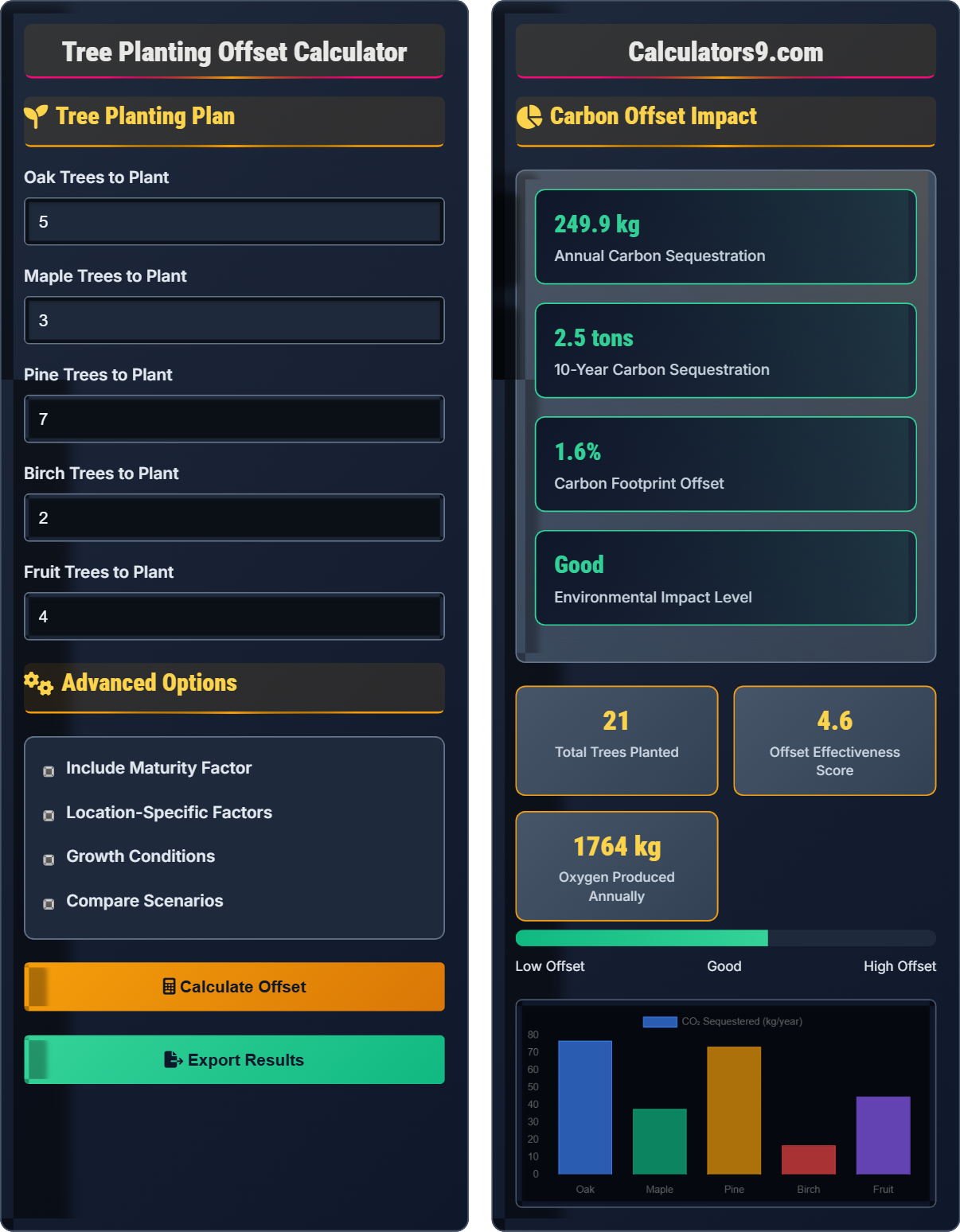
Tree Planting Plan
Advanced Options
Carbon Offset Impact
| Species | Trees | CO₂/year | % Contribution |
|---|
| Time Period | Carbon Sequestration | Oxygen Production | Offset Percentage |
|---|
Tree Planting Benefits & Tips
Trees provide multiple environmental benefits beyond carbon sequestration:
- Absorb 48 lbs of CO₂ annually per mature tree
- Produce enough oxygen for 2 people per year
- Reduce air pollution by filtering particulates
- Provide habitat for wildlife
- Reduce urban heat island effect
Follow these guidelines for successful tree planting:
- Choose native species adapted to local climate
- Plant in spring or fall for optimal growth
- Ensure adequate spacing between trees
- Provide sufficient water during establishment
- Mulch around base to retain moisture
Understanding the long-term environmental benefits of tree planting:
- One tree can sequester 1 ton of CO₂ over its lifetime
- Forests can offset 10-15% of global CO₂ emissions
- Urban forests reduce energy consumption by 20-50%
- Tree cover prevents soil erosion and flooding
- Green spaces improve mental health and wellbeing
High-Impact Tree Species
Tree Planting & Carbon Sequestration Quiz
How much carbon dioxide does a mature oak tree typically absorb annually?
The answer is C) 48 pounds. A mature oak tree typically absorbs approximately 48 pounds (about 22 kg) of CO₂ annually. This makes oak trees among the most effective carbon sequestering species. Over its lifetime, a single oak can sequester about 1 ton of CO₂, making it an excellent choice for long-term climate impact.
Understanding the specific carbon sequestration rates of different tree species helps optimize planting strategies. Oaks are particularly effective due to their large size, long lifespan (often 200+ years), and dense wood. The sequestration rate increases as trees mature, peaking when they reach middle age (typically 10-40 years old).
Carbon Sequestration: The process of capturing and storing atmospheric carbon dioxide
Mature Tree: A tree that has reached reproductive age and full growth capacity
Photosynthesis: The process by which trees convert CO₂ and sunlight into glucose
• Larger, older trees sequester more carbon than young saplings
• Different species have varying sequestration rates
• Trees continue sequestering carbon throughout their lives
• Remember: 48 lbs CO₂ per mature oak annually
• Use the mnemonic "Oak = Outstanding Carbon Keeper" to remember effectiveness
• Plant long-lived species for maximum lifetime sequestration
• Underestimating the carbon sequestration potential of mature trees
• Confusing absorption with permanent storage
• Not considering the age factor in sequestration rates
If you plant 10 oak trees (sequestering 22kg CO₂/year each) and 5 maple trees (sequestering 18kg CO₂/year each), what is your total annual carbon sequestration? Show your work.
Step 1: Oak trees contribution = 10 trees × 22kg CO₂/year = 220kg CO₂/year
Step 2: Maple trees contribution = 5 trees × 18kg CO₂/year = 90kg CO₂/year
Step 3: Total annual sequestration = 220kg + 90kg = 310kg CO₂/year
Therefore, these trees will sequester 310kg of CO₂ annually.
This calculation demonstrates how different tree species contribute differently to carbon sequestration. By multiplying the number of trees by their specific sequestration rates, we can estimate the total environmental impact. This approach allows for strategic planning of tree planting projects based on available space and desired environmental outcomes.
Species-Specific Rates: Carbon sequestration values unique to each tree type
Annual Sequestration: Amount of CO₂ absorbed in one year
Aggregation: Combining contributions from multiple sources
• Multiply number of trees by sequestration rate per tree
• Sum contributions from all species for total impact
• Different species have different sequestration potentials
• Calculate each species separately, then sum totals
• Research local species with highest sequestration rates
• Consider biodiversity alongside carbon impact
• Using average rates instead of species-specific values
• Forgetting to account for tree age and maturity
• Not considering location-specific growth factors
Average American produces 16 tons of CO₂ annually. If someone plants 20 oak trees (22kg CO₂/year each), what percentage of their annual carbon footprint does this offset? Show your calculations.
Step 1: Annual sequestration from 20 oaks = 20 trees × 22kg CO₂/year = 440kg CO₂/year
Step 2: Convert annual footprint to kg = 16 tons × 1,000kg/ton = 16,000kg CO₂/year
Step 3: Calculate percentage offset = (440kg ÷ 16,000kg) × 100% = 2.75%
Therefore, these 20 oak trees offset approximately 2.75% of the person's annual carbon footprint.
This calculation puts individual tree planting efforts into perspective against average carbon footprints. While 2.75% may seem modest, it demonstrates that meaningful carbon offsetting requires significant tree planting efforts or combination with other mitigation strategies. It also shows the scale of the climate challenge individuals face.
Carbon Footprint: Total greenhouse gas emissions caused by an individual
Percentage Offset: Fraction of emissions compensated by sequestration
Scale of Challenge: Magnitude of emissions relative to mitigation capacity
• Percentage offset = (sequestered ÷ total emissions) × 100%
• Convert units to match (tons to kg or vice versa)
• Individual actions must be scaled up for significant impact
• Always convert units before calculating percentages
• Remember: 1 ton = 1,000 kg
• Consider community-wide planting for larger impact
• Mixing units (tons vs kg) in calculations
• Forgetting to multiply sequestration by time period
• Expecting individual tree planting to fully offset lifestyle emissions
You have space for 30 trees and want to maximize carbon sequestration. Oak trees sequester 22kg CO₂/year but cost $50 each. Maple trees sequester 18kg CO₂/year but cost $30 each. If your budget is $1,200, what combination maximizes annual sequestration? (Hint: Set up constraints and find optimal allocation)
Let O = number of oak trees, M = number of maple trees
Constraints: O + M ≤ 30 (space constraint), 50O + 30M ≤ 1200 (budget constraint)
Objective: Maximize 22O + 18M (total sequestration)
From budget constraint: M ≤ (1200 - 50O)/30 = 40 - (5O/3)
Substituting into space constraint: O + (40 - 5O/3) ≤ 30
Solving: O + 40 - 5O/3 ≤ 30 → -2O/3 ≤ -10 → O ≥ 15
Testing boundary: If O=15, then M=15, sequestration = 22(15)+18(15) = 600kg
Testing extremes: If O=24, M=0, sequestration = 22(24) = 528kg
If O=0, M=30, sequestration = 18(30) = 540kg
Therefore, planting 15 oak trees and 15 maple trees maximizes sequestration at 600kg CO₂/year.
This optimization problem demonstrates how resource constraints affect environmental impact. The solution shows that diversifying species while staying within budget constraints can sometimes yield better results than focusing solely on the highest-performing species. This reflects real-world challenges in environmental planning where multiple factors must be balanced.
Optimization: Finding the best solution under given constraints
Constraint: Limitation that restricts possible solutions
Resource Allocation: Distributing limited resources for maximum benefit
• Set up mathematical constraints before optimizing
• Test boundary conditions and extreme values
• Consider multiple factors beyond just performance
• Define variables and constraints clearly
• Graph constraints to visualize feasible region
• Test corner points of feasible region for optima
• Forgetting to consider all constraints simultaneously
• Assuming the highest-performing option is always optimal
• Not testing boundary conditions
Which of the following statements about forest carbon sequestration is TRUE?
The answer is B) Forests absorb about 30% of human-produced CO₂. Global forests act as a critical carbon sink, absorbing approximately 30% of the CO₂ emissions from human activities. This makes forest conservation and reforestation essential strategies for climate change mitigation. Without this natural carbon sink, atmospheric CO₂ concentrations would be significantly higher.
This statistic demonstrates the crucial role of forests in the global carbon cycle. Forests serve as one of Earth's primary mechanisms for removing excess atmospheric CO₂, making them vital for climate stability. Understanding this scale helps contextualize individual tree planting efforts within the broader climate system and highlights the importance of protecting existing forests while expanding tree cover.
Carbon Sink: Natural or artificial reservoir that accumulates and stores carbon
Global Carbon Cycle: Movement of carbon between atmosphere, land, and oceans
Natural Carbon Storage: Long-term sequestration in biomass and soils• Forests are net carbon absorbers, not emitters
• Both conservation and expansion are needed
• Old-growth forests continue sequestering carbon
• Remember: Forests absorb ~30% of human CO₂ emissions
• Support both forest conservation and new planting
• Understand the global context of local actions
• Underestimating the global impact of forests
• Thinking forests only matter locally
• Believing old forests don't contribute to sequestration
FAQ
Q: How does tree planting compare to other carbon offset methods in terms of effectiveness?
A: Tree planting is one of the most effective and accessible carbon offset methods:
- Effectiveness: Forests sequester ~30% of human-produced CO₂, making them critical carbon sinks.
- Longevity: Trees store carbon for decades to centuries, unlike some offsets that are temporary.
- Additional Benefits: Trees provide oxygen, habitat, air purification, and temperature regulation.
- Cost-Effective: Planting costs range from $0.15-$2 per tree depending on species and location.
Mathematically, if \( S \) is sequestration rate and \( T \) is tree count:
\( C = S \times T \times t \)
Where \( C \) is cumulative carbon sequestered over time \( t \). Trees provide exponential benefits as they mature.
Q: What's the most effective strategy for maximizing carbon sequestration through tree planting?
A: The most effective approach combines several strategies:
- Species Selection: Choose high-sequestration species like oaks (22kg CO₂/year) and pines (15kg CO₂/year)
- Location: Plant in areas with optimal growing conditions and protection from threats
- Density: Balance spacing for growth with maximum coverage
- Maintenance: Ensure survival through watering, mulching, and protection
- Scale: Coordinate with community efforts for larger impact
Research indicates that survival rates of 80-90% and optimal spacing can increase sequestration by 50-100% compared to random planting.