Composting Yield Estimator
Organic waste transformation • Sustainability tracker
Organic Waste Input
Composting Conditions
Advanced Options
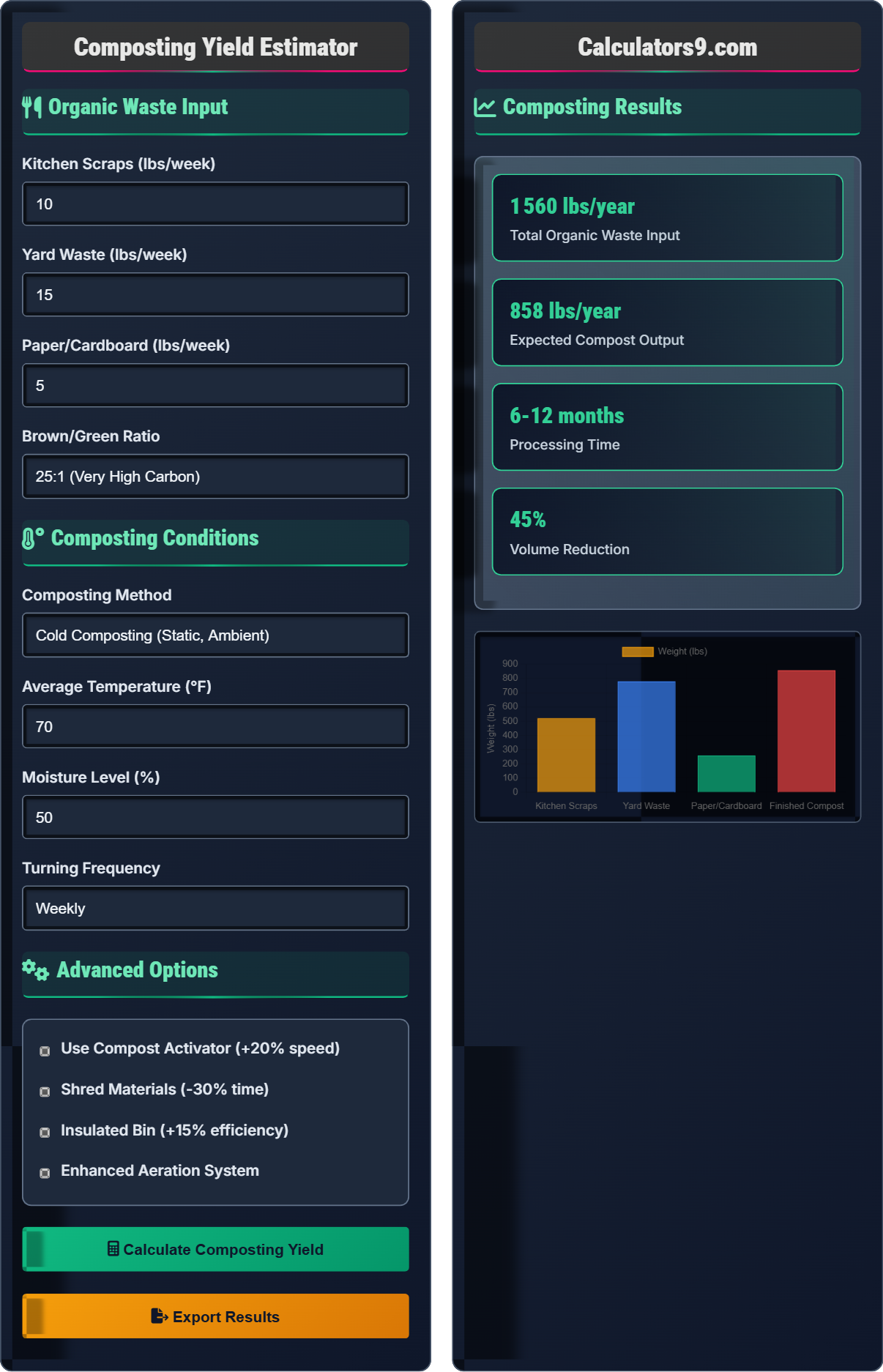
Composting Results
| Material Type | Weekly Input | Annual Input | Expected Output |
|---|---|---|---|
| Kitchen Scraps | 10 lbs | 520 lbs | 260 lbs |
| Yard Waste | 15 lbs | 780 lbs | 390 lbs |
| Paper/Cardboard | 5 lbs | 260 lbs | 130 lbs |
| Environmental Benefit | Annual Impact | Comparison |
|---|---|---|
| Landfill Diversion | 1,560 lbs | 1.56 tons diverted |
| Methane Reduction | 0.78 tons CO₂e | Equivalent to car emissions |
| Soil Enhancement | 780 lbs compost | Improves soil health |
| Fertilizer Savings | $156 | Value of commercial compost |
Composting Fundamentals
Composting is the controlled biological decomposition of organic matter into nutrient-rich humus. Microorganisms break down organic materials in the presence of oxygen, producing heat, water, and carbon dioxide. The process transforms kitchen scraps, yard waste, and other organic materials into valuable soil amendment that improves soil structure, water retention, and fertility.
Effective composting relies on several key factors:
Composting provides multiple environmental and economic benefits:
- Waste Reduction: Diverts 30-50% of household waste from landfills
- Soil Health: Improves soil structure, water retention, and nutrient content
- Greenhouse Gas Reduction: Prevents methane emissions from anaerobic decomposition
- Cost Savings: Reduces need for commercial fertilizers and soil amendments
- Plant Growth: Enhances root development and disease resistance
Composting Knowledge Quiz
What is the optimal carbon-to-nitrogen ratio for efficient composting?
The answer is B) 25-35:1. This ratio provides the optimal balance of carbon (energy source) and nitrogen (protein for microorganisms) for efficient decomposition. Too much nitrogen causes odors and ammonia loss; too much carbon slows decomposition significantly.
This question highlights the fundamental chemistry of composting. The C:N ratio determines the rate and efficiency of decomposition. Understanding this ratio helps composters balance "brown" (high carbon) and "green" (high nitrogen) materials for optimal results.
Carbon (Browns): Dry leaves, paper, cardboard, wood chips
Nitrogen (Greens): Kitchen scraps, grass clippings, manure
Microbial Activity: Bacterial and fungal decomposition processes
• Maintain 25-35:1 C:N ratio for best results
• Mix browns and greens in proper proportions
• Adjust ratio based on decomposition rate
• Layer browns and greens alternately
• Shred materials for better mixing
• Monitor temperature to gauge activity
• Adding too much nitrogen (greens)
• Not mixing materials properly
• Ignoring the C:N ratio completely
Describe the stages of the composting process and explain the role of temperature in each stage.
The composting process occurs in four distinct stages:
1. Initiation Stage (Days 1-3): Mesophilic bacteria begin decomposing easily available materials. Temperature rises to 100-110°F.
2. Thermophilic Stage (Days 3-15): Thermophilic bacteria dominate, reaching 140-160°F. Pathogens and weed seeds are destroyed.
3. Cooling Stage (Days 15-45): Temperature drops to 100-110°F as easily decomposable materials are consumed.
4. Maturation Stage (Days 45+): Actinomycetes and fungi finish decomposition. Temperature approaches ambient.
Temperature is critical for pathogen destruction and optimal decomposition rates. The thermophilic stage is essential for safe, effective composting.
This question emphasizes the biological nature of composting. Different microorganisms thrive at different temperatures, and each stage serves a specific purpose in transforming organic waste into stable compost. Understanding these stages helps composters troubleshoot problems and optimize conditions.
Mesophilic Bacteria: Microorganisms thriving at moderate temperatures (68-113°F)
Thermophilic Bacteria: Heat-loving microorganisms (113-176°F)
Pathogen Destruction: Elimination of harmful microorganisms at high temperatures
• Achieve 140°F+ for pathogen destruction
• Maintain thermophilic stage for 3+ days
• Allow proper maturation time
• Monitor temperature with a compost thermometer
• Turn pile when temperature drops below 100°F
• Ensure pile is large enough to retain heat
• Not achieving adequate temperatures
• Turning too frequently, cooling pile
• Ending process too early (incomplete decomposition)
A household generates 12 lbs of kitchen scraps and 18 lbs of yard waste per week. If hot composting is used with a 30:1 C:N ratio, what is the expected annual compost yield? Assume 45% reduction in volume and 50% moisture content in finished compost.
Step 1: Calculate weekly total input
Weekly input = 12 lbs + 18 lbs = 30 lbs
Step 2: Calculate annual input
Annual input = 30 lbs/week × 52 weeks = 1,560 lbs
Step 3: Apply volume reduction factor
Volume reduction = 45%
Compost yield = 1,560 lbs × (1 - 0.45) = 1,560 × 0.55 = 858 lbs
Step 4: Adjust for moisture content
Assuming 50% moisture content in finished compost, dry matter = 858 lbs × 0.5 = 429 lbs
Therefore, the expected annual compost yield is approximately 858 lbs of finished compost with 50% moisture content.
This problem demonstrates the mathematical relationships in composting. Volume reduction occurs due to the breakdown of organic matter and release of carbon dioxide. The calculation shows how initial organic waste transforms into a more concentrated, valuable soil amendment.
Volume Reduction: Decrease in mass due to decomposition and CO₂ release
Finished Compost: Stable, mature compost ready for use
Moisture Content: Water percentage in compost affecting bulk density
• Expect 30-60% volume reduction during composting
• Finished compost typically 40-60% moisture
• Higher temperatures accelerate volume reduction
• Weigh materials before and after composting
• Monitor moisture content regularly
• Account for volume reduction in planning
• Not accounting for volume reduction
• Overestimating final compost quantity
• Ignoring moisture content effects
A compost pile smells bad and is not heating up properly. The pile consists of 70% kitchen scraps (nitrogen-rich) and 30% dry leaves (carbon-rich). What is the likely problem and how should it be corrected?
The problem is an imbalanced C:N ratio with too much nitrogen (greens) and insufficient carbon (browns). The 70:30 ratio results in a C:N ratio of approximately 15:1, which is too low. This causes:
1. Anaerobic decomposition due to oxygen depletion
2. Ammonia release causing foul odors
3. Lack of proper heating due to imbalanced nutrition
Correction steps:
1. Add carbon-rich materials (dry leaves, shredded paper, cardboard)
2. Aim for 50:50 mix by volume or 30:1 C:N ratio by weight
3. Turn the pile to introduce oxygen
4. Check moisture level (should be 40-60%)
After correction, the pile should heat up properly and eliminate odors.
This problem demonstrates how to diagnose and solve common composting issues. Bad odors and lack of heating are classic signs of an imbalanced C:N ratio. Understanding the cause-and-effect relationships in composting helps troubleshoot problems effectively.
Anaerobic Decomposition: Decomposition without oxygen, producing odors
Ammonia Release: Result of excess nitrogen and improper C:N ratio
Proper Aeration: Oxygen supply for aerobic decomposition
• Balance C:N ratio at start of process
• Add browns when pile smells bad
• Turn pile regularly for aeration
• Keep carbon materials nearby for balance
• Layer materials for better mixing
• Test temperature regularly
• Adding too many nitrogen-rich materials
• Not adjusting ratio when problems arise
• Assuming all organic waste is equal
Which combination of factors most significantly accelerates the composting process?
The answer is B) Proper C:N ratio and regular turning. The correct carbon-to-nitrogen ratio (25-35:1) provides optimal nutrition for decomposers, while regular turning supplies oxygen for aerobic decomposition and maintains proper temperature. These two factors work synergistically to accelerate the process significantly compared to other methods.
This question emphasizes the interconnected nature of composting factors. While individual factors can influence composting, the combination of proper nutrition (C:N ratio) and adequate oxygen (turning) creates optimal conditions for rapid decomposition. This demonstrates the importance of integrated composting management.
Aerobic Decomposition: Oxygen-dependent breakdown of organic matter
Decomposer Organisms: Bacteria, fungi, and other microorganisms
Integrated Management: Coordinated approach to multiple composting factors
• Proper C:N ratio is fundamental
• Oxygen is essential for rapid decomposition
• Factors work together synergistically
• Plan for both nutrition and aeration
• Monitor multiple factors simultaneously
• Adjust management based on conditions
• Focusing on single factors instead of integration
• Neglecting oxygen requirements
• Assuming more nitrogen always speeds process
Composting Essentials
Optimal C:N ratio: 25-35:1. Volume reduction: 30-60%. Processing time: 2-12 months depending on method.
Compost Yield ≈ Input × (1 - Volume Reduction Factor). Time = Function(Method, C:N, Temperature).
- Balance carbon and nitrogen materials
- Maintain 40-60% moisture content
- Provide adequate aeration
Optimization Strategies
Hot composting with 30:1 C:N ratio, regular turning, and proper moisture can produce finished compost in 2-3 months with 50% volume reduction.
- Maintain optimal C:N ratio
- Turn pile regularly
- Shred materials
- Insulate bin
- Seasonal temperature variations
- Local climate conditions
- Available space and materials
- Time investment preferences
FAQ
Q: How do I know when compost is ready?
A: Ready compost is dark brown, crumbly, earthy-smelling, and has no recognizable original materials. Temperature should be close to ambient. The "bag test": seal compost in bag for 24 hrs - no ammonia smell = ready.
Q: What shouldn't I compost?
A: Don't compost meat, dairy, oils, pet waste, diseased plants, or weeds with seeds. These can attract pests, create odors, or spread diseases/weeds. Stick to plant materials, paper, and approved organic scraps.