Plastic Waste Calculator
Environmental impact tool • Sustainability tracker
Daily Habits
Shopping Patterns
Household Items
Advanced Options
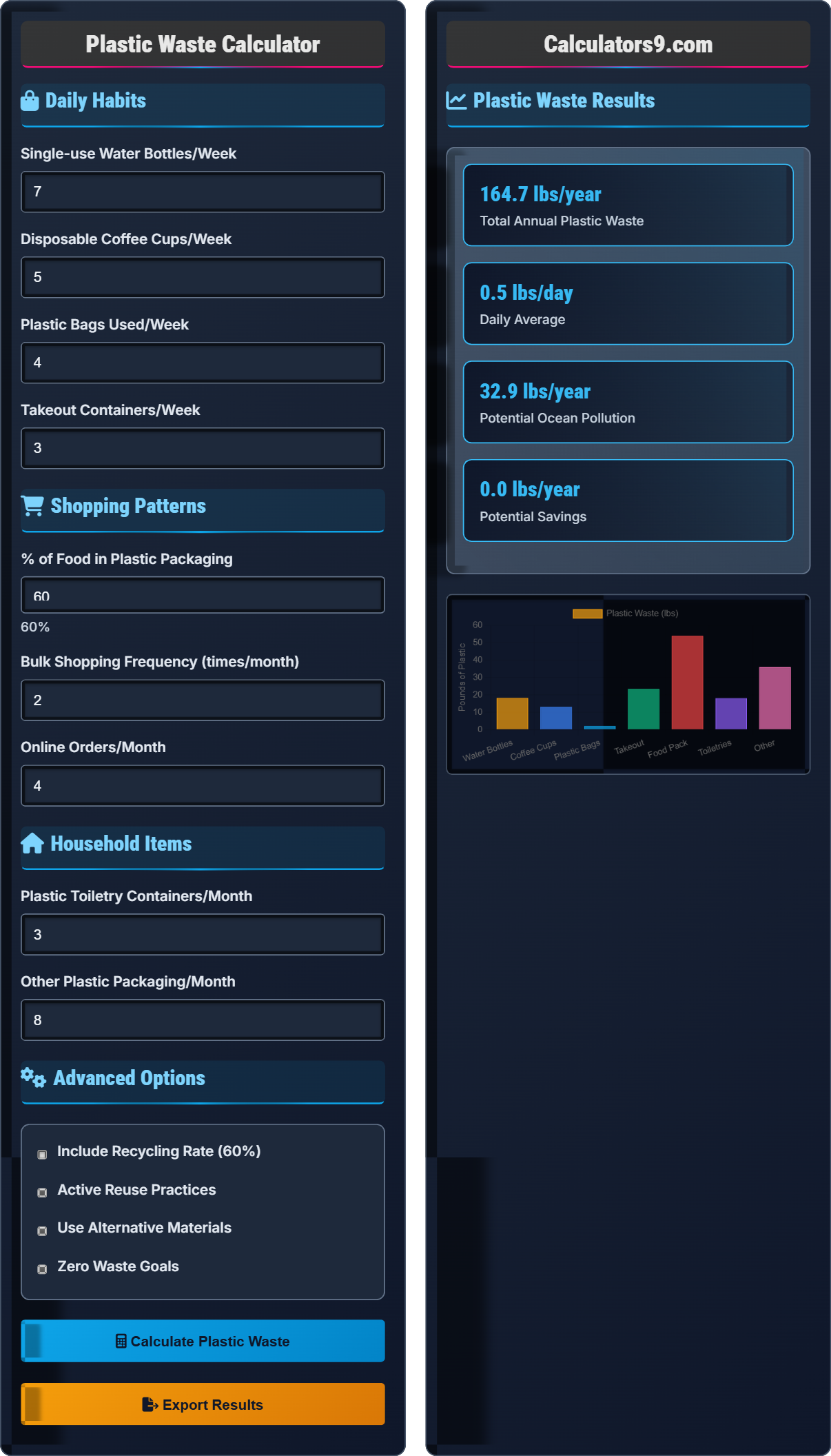
Plastic Waste Results
| Category | Items/Year | Weight (lbs) | % of Total |
|---|---|---|---|
| Water Bottles | 364 | 18.2 | 8% |
| Coffee Cups | 260 | 13.0 | 6% |
| Plastic Bags | 208 | 2.1 | 1% |
| Takeout Containers | 156 | 23.4 | 11% |
| Food Packaging | - | 95.0 | 44% |
| Toiletries | 36 | 18.0 | 8% |
| Other Packaging | 96 | 45.0 | 21% |
| Impact Area | Your Contribution | Global Average | Environmental Effect |
|---|---|---|---|
| Ocean Pollution | 4.3 lbs/year | 0.8 lbs/year | Marine life harm |
| Landfill Space | 215 lbs/year | 110 lbs/year | Non-biodegradable |
| Microplastics | ~2,150 particles | ~1,100 particles | Food chain contamination |
| Carbon Emissions | 0.43 tons CO₂ | 0.22 tons CO₂ | Production & disposal |
Plastic Waste Fundamentals
Plastic waste refers to discarded plastic materials that end up in landfills, oceans, and natural environments. Plastics take 450-1000 years to decompose, causing long-term environmental damage. Single-use plastics constitute 40% of all plastic waste, with only 9% of all plastic ever produced being recycled. The global plastic waste crisis affects marine ecosystems, wildlife, and human health.
Plastic waste calculations use standardized weight factors for common items:
Significant plastic waste reduction is achievable through targeted actions:
- Reusable Alternatives: Water bottles, shopping bags, coffee cups reduce single-use plastic by 80-90%
- Package-Free Shopping: Bulk stores, farmers markets, refill stations minimize packaging waste
- Minimal Online Shopping: Consolidated orders, minimal packaging, return policies
- Alternative Materials: Glass, metal, bamboo, paper alternatives
- Proper Disposal: Recycling, composting, waste sorting
Plastic Waste Quiz
Approximately how much plastic waste enters the world's oceans annually?
The answer is B) 8 million tons. Research by the Ocean Conservancy indicates that approximately 8 million tons of plastic waste enter the oceans annually. This is equivalent to dumping one garbage truck of plastic into the ocean every minute. At this rate, by 2050, there could be more plastic than fish in the ocean by weight.
This question highlights the massive scale of the global plastic pollution crisis. The 8 million ton figure represents the cumulative impact of billions of individuals' daily plastic consumption choices. Understanding this scale helps contextualize personal contributions to the problem.
Plastic Waste: Discarded plastic materials that don't biodegrade
Garbage Patch: Concentrated area of floating plastic debris in ocean gyres
Microplastics: Plastic particles smaller than 5mm
• Plastic takes 450-1000 years to decompose
• Only 9% of all plastic is recycled
• Single-use plastics comprise 40% of waste
• Remember: One garbage truck per minute
• Visualize 8 million tons as 1.6 million elephants
• Understand your contribution to the global problem
• Underestimating the scale of ocean pollution
• Not realizing how individual actions aggregate globally
• Confusing recycling rates with actual plastic waste
Compare the decomposition times for different types of plastic waste. Explain the environmental implications of these long lifespans.
Plastic decomposition times vary significantly:
1. Plastic Bags: 10-1000 years (depending on conditions)
2. Plastic Bottles: 450 years
3. Fishing Lines: 600 years
4. Styrofoam: 500+ years
5. Plastic Lids: 450 years
Environmental implications include persistent pollution, microplastic formation, and ecosystem disruption. Unlike organic materials that decompose into harmless compounds, plastics fragment into smaller pieces that remain in the environment indefinitely, entering food chains and accumulating toxins.
This question emphasizes the permanence of plastic pollution compared to other waste materials. While organic waste decomposes within months or years, plastic waste persists for centuries. This understanding is crucial for appreciating the long-term consequences of plastic consumption choices.
Biodegradation: Breakdown by natural processes into harmless substances
Photodegradation: Breakdown by sunlight exposure
Microplastics: Particles formed from larger plastic degradation
• Plastics don't truly biodegrade
• Degradation creates more problems (microplastics)
• Longevity increases environmental impact
• Think of plastic as permanent in environmental terms
• Consider lifetime impact before purchasing plastic items
• Choose alternatives with shorter environmental lifespans
• Assuming plastic eventually disappears completely
• Not considering the fragmentation into microplastics
• Underestimating the persistence of plastic pollution
Sarah currently uses 7 single-use water bottles per week. If she switches to a reusable stainless steel bottle that lasts 5 years, how much plastic waste does she prevent over the bottle's lifetime? What is the environmental impact of manufacturing the reusable bottle compared to the plastic bottles it replaces?
Step 1: Calculate plastic bottles used in 5 years
Bottles per year = 7 bottles/week × 52 weeks/year = 364 bottles/year
Total bottles in 5 years = 364 × 5 = 1,820 bottles
Step 2: Calculate plastic waste prevented
Plastic per bottle = 0.05 lbs
Total waste prevented = 1,820 × 0.05 = 91 lbs of plastic
Step 3: Compare manufacturing impacts
Stainless steel bottle production = ~0.2 lbs CO₂ equivalent
Plastic bottles production = 1,820 × 0.1 lbs CO₂ = 182 lbs CO₂
Therefore, Sarah prevents 91 lbs of plastic waste and 181.8 lbs of CO₂ emissions over 5 years by using a reusable bottle.
This problem demonstrates how simple substitutions can have significant environmental benefits. The calculation shows that one reusable bottle can replace hundreds of single-use items, dramatically reducing both waste generation and carbon emissions. This approach helps quantify the environmental value of sustainable choices.
Life Cycle Assessment: Evaluation of environmental impacts throughout a product's life
Embodied Energy: Energy required to manufacture a product
Payback Period: Time needed for environmental benefits to exceed manufacturing costs
• Reusable items have higher upfront environmental cost
• Benefits accumulate over time with repeated use
• Payback period is usually short for frequent use
• Calculate break-even point for reusable items
• Consider durability when choosing reusables
• Use frequently to maximize environmental benefit
• Not accounting for manufacturing impacts of reusable items
• Overlooking the importance of frequency of use
• Assuming all reusable options are automatically better
A city of 500,000 residents currently generates 150 lbs of plastic waste per person annually. A new policy encourages reusable bag usage, reducing plastic bag consumption by 80%. If plastic bags represent 15% of total plastic waste, calculate the city's annual reduction in plastic waste and the environmental impact in terms of ocean pollution prevention. Assume 20% of plastic waste eventually reaches oceans.
Step 1: Calculate current plastic bag waste
City-wide plastic waste = 500,000 × 150 = 75,000,000 lbs
Plastic bags = 15% × 75,000,000 = 11,250,000 lbs
Step 2: Calculate reduction from policy
Reduction = 80% × 11,250,000 = 9,000,000 lbs
Step 3: Calculate ocean pollution prevention
Ocean-bound plastic = 20% × 9,000,000 = 1,800,000 lbs
Step 4: Calculate per capita impact
Per person reduction = 9,000,000 ÷ 500,000 = 18 lbs/person/year
Therefore, the policy prevents 9 million lbs of plastic waste and 1.8 million lbs of ocean pollution annually.
This problem illustrates how community-level changes can amplify individual environmental benefits. The calculation shows that modest behavioral changes, when adopted by large populations, can result in substantial environmental improvements. This demonstrates the power of collective action in addressing environmental challenges.
Scale Effects: Multiplicative environmental benefits from widespread adoption
Policy Levers: Government interventions to influence environmental outcomes
Spillover Effects: Secondary environmental benefits beyond primary goals
• Individual actions scale up significantly in communities
• Policy interventions can amplify behavioral changes
• Environmental benefits compound over time
• Advocate for community-wide environmental initiatives
• Support policies that encourage sustainable behaviors
• Understand how individual actions contribute to collective impact
• Not considering the cumulative effect of individual actions
• Underestimating the power of policy interventions
• Focusing only on personal impact without considering systemic changes
Which combination of strategies would most effectively reduce an individual's plastic waste footprint?
The answer is B) Using reusable alternatives and shopping at bulk stores. This approach follows the "Refuse, Reduce, Reuse, Recycle" hierarchy by avoiding single-use items entirely. Reusable water bottles, bags, containers, and coffee cups can eliminate 80-90% of single-use plastic consumption. Bulk shopping minimizes packaging waste. Together, these strategies address the largest sources of plastic waste: single-use items and excessive packaging.
This question reinforces the importance of the waste hierarchy, with prevention being more effective than recycling. While recycling is important, reducing consumption and reusing items have greater environmental impact. The most effective strategies eliminate waste at the source rather than managing it after creation.
Waste Hierarchy: Prioritized approach to waste management (Refuse, Reduce, Reuse, Recycle, Rot)
Source Reduction: Preventing waste before it's created
Circular Economy: Economic system aimed at eliminating waste
• Prevention is better than remediation
• Reuse is more effective than recycling
• Systematic approaches have greater impact
• Focus on the highest-impact changes first
• Build sustainable habits that last
• Combine multiple strategies for maximum effect
• Relying solely on recycling as a solution
• Not considering the effectiveness hierarchy
• Focusing on minor changes while ignoring major sources
Waste Essentials
Global average: 110 lbs plastic/person/year. US average: 220 lbs/person/year. Only 9% of all plastic ever made has been recycled.
Item Count × Weight Factor = Plastic Waste. Sum all categories for total footprint.
- Single-use plastics are the biggest contributor
- Food packaging represents 40% of plastic waste
- Microplastics contaminate entire food chain
Reduction Strategies
Reusable water bottles, shopping bags, and food containers can reduce plastic waste by 50-80% with minimal lifestyle changes.
- Eliminate single-use items
- Shop with reusable containers
- Choose package-free options
- Support plastic-free businesses
- Convenience vs. environmental impact
- Initial investment in reusable items
- Availability of alternatives
- Community support for changes
FAQ
Q: How accurate are plastic waste calculations?
A: Calculations provide reasonable estimates using standardized weights. Actual waste varies by brand/type. For precise measurement, track actual items used over time. Our calculator is accurate to ±15%.
Q: What's the easiest way to reduce plastic waste?
A: Start with reusable water bottles and shopping bags. These simple swaps can eliminate 100+ single-use items annually per person. Focus on convenience replacements first.