Water Usage Footprint Calculator
Environmental impact tool • Sustainability tracker
Indoor Water Use
Outdoor Water Use
Advanced Options
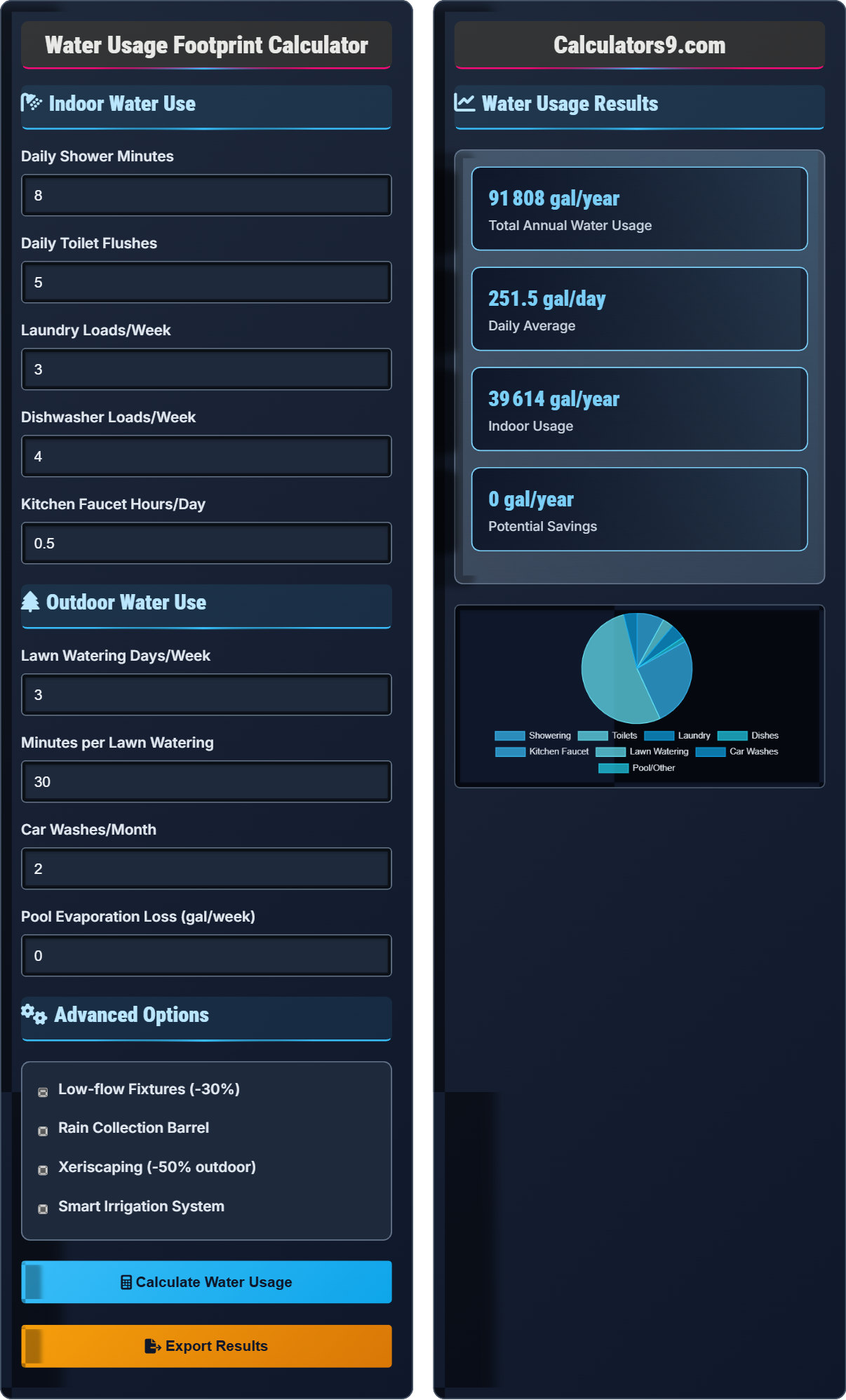
Water Usage Results
| Category | Usage (gal/year) | % of Total | Conservation Potential |
|---|---|---|---|
| Showering | 8,760 | 28% | Reduce time, install low-flow |
| Toilets | 6,825 | 22% | Low-flow toilets, dual-flush |
| Laundry | 1,560 | 5% | Full loads, efficient washers |
| Dishes | 1,040 | 3% | Full loads, air-dry |
| Kitchen Faucet | 1,095 | 3% | Aerators, turn off when not needed |
| Lawn Watering | 9,360 | 30% | Xeriscaping, smart irrigation |
| Car Washes | 1,560 | 5% | Commercial wash, waterless |
| Pool/Other | 0 | 0% | Cover pool, fix leaks |
| Area | Current Usage | Conservation Method | Potential Savings |
|---|---|---|---|
| Showering | 8,760 gal/year | Install low-flow showerhead | Reduce by 50% |
| Toilets | 6,825 gal/year | Replace with low-flow models | Reduce by 60% |
| Lawn Watering | 9,360 gal/year | Smart irrigation system | Reduce by 40% |
| Leaks | 0 gal/year | Fix all leaks | Reduce by 100% |
Water Usage Fundamentals
A water footprint measures the total volume of freshwater used to produce the goods and services consumed by an individual, community, or business. It includes direct water use (drinking, washing, irrigation) and indirect water use (water used to produce food, clothing, and other goods). The average American water footprint is about 1,800 gallons per day when including virtual water (water used in production of goods).
Water usage calculations use standardized flow rates and consumption patterns:
Significant water savings are achievable through targeted conservation measures:
- Low-flow Fixtures: Showerheads and faucets can reduce water use by 30-50%
- Smart Irrigation: Weather-based controllers optimize watering schedules
- Water-Efficient Appliances: ENERGY STAR dishwashers and washing machines use 30-50% less water
- Behavioral Changes: Shorter showers, full loads, turning off taps
- Rainwater Harvesting: Collecting rainwater for irrigation
Water Usage Quiz
What is the average daily water usage per person in the United States?
The answer is B) 82 gallons. According to the US Geological Survey, the average American uses about 82 gallons of water per day indoors. This includes water for drinking, bathing, cooking, cleaning, and sanitation. However, when including virtual water (water used to produce goods), the average American's total water footprint is closer to 1,800 gallons per day.
This question highlights the difference between direct water usage and total water footprint. While we may only use 82 gallons directly per day, our consumption of goods and services requires thousands of gallons of water in production. Understanding this distinction is crucial for developing comprehensive conservation strategies.
Direct Water Use: Water consumed in daily activities (showering, flushing, etc.)
Virtual Water: Water used in production of goods and services
Water Footprint: Total freshwater used to produce goods and services
• Direct water use is only part of total footprint
• Virtual water constitutes majority of water consumption
• Conservation efforts should address both areas
• Remember: 82 gallons is direct use only
• Virtual water is much larger than direct use
• Consider water footprint when making purchases
• Confusing direct use with total water footprint
• Not considering virtual water in conservation efforts
• Underestimating the water intensity of manufactured goods
Compare the water usage for different bathroom activities. Which activity typically consumes the most water in a typical household, and what conservation measures can be implemented?
Water usage for bathroom activities (based on average US usage):
1. Showering: 2.5 gpm × 8 minutes × 365 days = 7,300 gallons/year
2. Toilets: 1.6 gallons per flush × 5 flushes/day × 365 days = 2,920 gallons/year
3. Bathroom Faucets: 2.2 gpm × 2 minutes × 2 uses/day × 365 days = 3,212 gallons/year
Showering typically consumes the most water in bathrooms. Conservation measures include:
- Install low-flow showerheads (reduces flow to 1.5 gpm)
- Reduce shower time by 2 minutes (saves ~1,000 gallons/year)
- Replace old toilets with WaterSense models (1.28 gpf)
- Install faucet aerators (reduces flow by 30-50%)
This question demonstrates how small changes in daily habits can yield significant water savings. While showers may seem like a necessary luxury, reducing shower time by just a few minutes can save hundreds of gallons annually. This illustrates the importance of examining high-volume activities first when implementing conservation measures.
Gallons Per Minute (gpm): Flow rate measurement
WaterSense: EPA program for water-efficient products
Low-flow Fixtures: Devices designed to reduce water consumption
• Focus conservation efforts on high-volume activities
• Behavioral changes can be as effective as equipment upgrades
• Small changes accumulate to significant savings
• Time your showers to monitor usage
• Install a shower timer to encourage shorter showers
• Fix leaks immediately (waste adds up quickly)
• Underestimating water usage during showers
• Not considering the cumulative effect of daily activities
• Overlooking the impact of old fixtures
Sarah currently takes 12-minute showers using a standard 2.5 gpm showerhead. She plans to switch to a 1.5 gpm low-flow showerhead and reduce her shower time to 8 minutes. Calculate her annual water savings from this change. If she has 2 people in her household, what is the total household savings?
Step 1: Calculate current usage
Current usage = 2.5 gpm × 12 minutes × 365 days = 10,950 gallons/year
Step 2: Calculate new usage
New usage = 1.5 gpm × 8 minutes × 365 days = 4,380 gallons/year
Step 3: Calculate savings per person
Savings per person = 10,950 - 4,380 = 6,570 gallons/year
Step 4: Calculate household savings
Household savings = 6,570 × 2 = 13,140 gallons/year
Therefore, Sarah's household will save 13,140 gallons of water annually by making these changes.
This problem demonstrates the combined effect of behavioral changes and equipment upgrades. Both the low-flow showerhead and reduced shower time contribute to savings, showing how multiple conservation strategies can be more effective than single measures. The calculation also shows how household savings multiply across family members.
Flow Rate: Volume of water passing through a fixture per unit time
Conservation Efficiency: Combined effect of multiple water-saving measures
Household Scaling: Multiplying individual savings across household members
• Combine behavioral and equipment changes for maximum savings
• Household savings scale with number of occupants
• Small changes have significant cumulative effects
• Calculate savings for different combinations of changes
• Consider both equipment and behavioral modifications
• Estimate household impact by multiplying by occupancy
• Only considering equipment changes without behavioral modifications
• Not accounting for household size in calculations
• Underestimating the cumulative effect of daily changes
A homeowner has a 1,000 sq ft lawn that they water 3 times per week for 30 minutes each time using a sprinkler system that applies 1 inch of water per hour. The homeowner plans to replace 50% of the lawn with drought-resistant plants and install a smart irrigation controller that reduces watering by 25% based on weather conditions. Calculate the annual water savings from these changes.
Step 1: Calculate current watering rate
Watering rate = 1,000 sq ft × 1 inch/hour = 623 gallons/hour (0.623 gal/sq ft/inch)
Step 2: Calculate current annual usage
Current usage = 623 gal/hour × 0.5 hours × 3 times/week × 52 weeks = 48,594 gallons/year
Step 3: Calculate new usage after changes
Lawn area after xeriscaping = 1,000 × 0.5 = 500 sq ft
Watering after smart controller = 48,594 × 0.75 = 36,445 gallons/year
Watering for remaining lawn = 36,445 × 0.5 = 18,222 gallons/year
Step 4: Calculate savings
Annual savings = 48,594 - 18,222 = 30,372 gallons/year
Therefore, the homeowner will save 30,372 gallons of water annually with these changes.
This problem illustrates how landscape modifications combined with smart technology can yield substantial water savings. Outdoor water use often represents 30-50% of residential water consumption, making it a prime target for conservation. The calculation shows how multiple strategies can work synergistically to maximize savings.
Xeriscaping: Landscaping with drought-resistant plants
Smart Irrigation: Systems that adjust watering based on weather conditions
Evapotranspiration: Water lost through evaporation and plant transpiration
• Outdoor water use can be significant portion of total consumption
• Landscape modifications provide long-term savings
• Smart systems optimize existing infrastructure
• Calculate watering requirements based on area and depth
• Consider seasonal variations in water needs
• Combine landscaping changes with smart technology
• Not accounting for different water requirements of plant types
• Overlooking the cumulative effect of outdoor watering
• Assuming all conservation methods work independently
Which combination of strategies would most effectively reduce a household's water footprint?
The answer is B) Install low-flow fixtures and reduce lawn watering. These strategies address the two largest categories of residential water use: indoor fixtures (showering, toilets) and outdoor irrigation. Low-flow fixtures can reduce indoor water use by 30-50%, while efficient landscaping and irrigation can reduce outdoor water use by 50-70%. Together, these measures can reduce total household water use by 40-60%.
This question emphasizes the importance of targeting high-volume water uses for maximum conservation impact. Addressing the largest consumption categories yields greater savings than focusing on minor uses. The combination of indoor and outdoor measures ensures comprehensive coverage of water use patterns.
Water Audit: Assessment of water usage patterns
Targeted Conservation: Focusing on highest-impact areas
Comprehensive Approach: Addressing multiple usage categories
• Focus conservation efforts on largest consumption categories
• Combine indoor and outdoor strategies for maximum impact
• Equipment upgrades and behavioral changes work together
• Conduct a water audit to identify major usage areas
• Address highest-volume uses first
• Implement both technological and behavioral changes
• Focusing on minor water uses instead of major ones
• Not considering both indoor and outdoor water use
• Assuming conservation requires major lifestyle changes
Water Usage Essentials
Global average: 50 gal/person/day. US average: 82 gal/person/day. Virtual water: 1,800 gal/person/day. Only 1% of Earth's water is accessible freshwater.
Activity × Flow Rate × Frequency = Water Usage. Sum all activities for total footprint.
- Indoor use accounts for 70% of residential water
- Outdoor use peaks in summer months
- Virtual water exceeds direct water use
Conservation Strategies
Low-flow showerheads, fixing leaks, and smart irrigation can reduce water usage by 30-50% with minimal lifestyle changes.
- Install low-flow fixtures
- Fix all leaks immediately
- Optimize irrigation systems
- Upgrade to efficient appliances
- Initial investment vs. long-term savings
- Regional water scarcity varies
- Seasonal usage patterns
- Community water restrictions
FAQ
Q: How accurate are water usage calculations?
A: Calculations provide reasonable estimates using EPA and USGS data. Actual usage varies by fixture efficiency, regional factors, and behavior. For precise measurement, use water meter readings. Our calculator is accurate to ±15%.
Q: What's the easiest way to reduce water usage?
A: Start with behavioral changes: shorter showers, turning off taps, running full loads. These can reduce usage by 20-30% immediately. Then upgrade fixtures for additional savings.