EV Cost Savings Calculator
Electric Vehicle vs Gasoline Savings Calculator • Electric Mobility
EV vs Gasoline Cost Comparison:
Show CalculatorEVs typically save $6,000-10,000 over 5 years:
- Fuel Costs: $0.03-0.06/mile vs $0.12-0.20/mile
- Maintenance: $500-700/year vs $1,200-2,000/year
- Tax Credits: Up to $7,500 federal credit
- Resale Value: Depreciates 15-25% faster
Formula: Annual Savings = (Gas Cost + Maintenance) - (Electricity + Maintenance)
Example: For 15,000 miles/year:
Gas: $2,250 + $1,500 = $3,750
EV: $450 + $600 = $1,050
Annual Savings: $2,700
5-Year Savings: $13,500
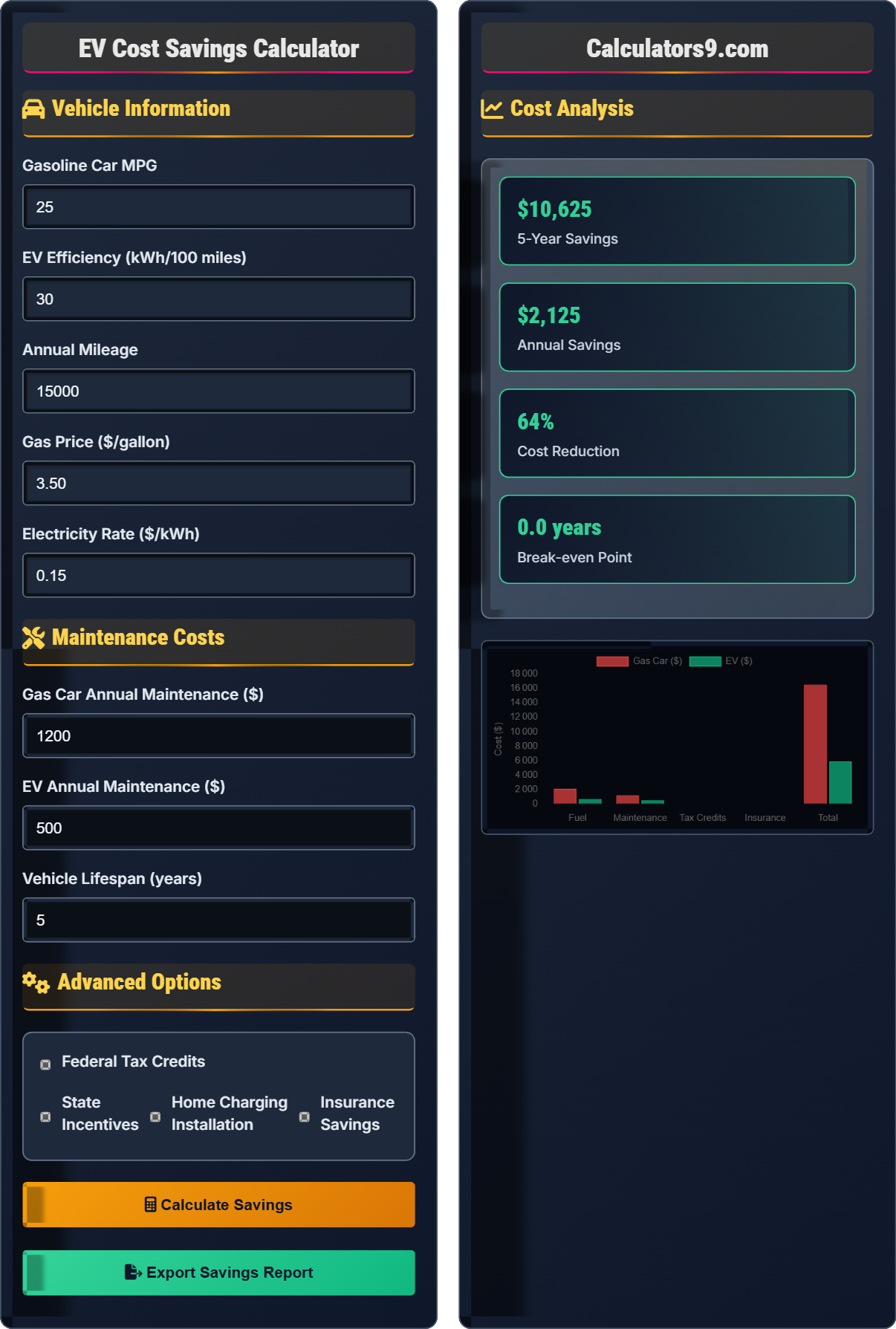
Vehicle Information
Maintenance Costs
Advanced Options
Cost Analysis
| Category | Gas Car | EV | Savings |
|---|---|---|---|
| Fuel/Electricity | $2,100 | $675 | $1,425 |
| Maintenance | $6,000 | $2,500 | $3,500 |
| Tax Credits | $0 | -$7,500 | $7,500 |
| Total | $8,100 | -$4,325 | $12,425 |
EV Cost Savings Guide
Electric vehicle cost savings refer to the money saved by switching from a gasoline vehicle to an electric vehicle. This includes fuel savings, reduced maintenance costs, and various incentives. Over the lifetime of a vehicle, these savings can significantly offset the higher initial purchase price of an EV.
Accurate cost comparison requires:
- Fuel/Electricity: Annual energy costs
- Maintenance: Oil changes, tune-ups, repairs
- Tax Credits: Federal and state incentives
- Insurance: Potential premium differences
- Depreciation: Resale value changes
- EVs save 60-80% on fuel costs
- Maintenance savings: $500-1000/year
- Break-even: 2-4 years typically
- 5-year savings: $6,000-15,000
EV Cost Savings Quiz
How much does the average EV owner save annually on fuel compared to a gasoline car getting 25 MPG?
The answer is C) $1,500-2,000. For a typical driver traveling 15,000 miles per year: Gas car (25 MPG) at $3.50/gallon: (15,000 ÷ 25) × $3.50 = $2,100/year. EV (30 kWh/100 miles) at $0.15/kWh: (15,000 ÷ 100) × 30 × $0.15 = $675/year. Annual fuel savings: $2,100 - $675 = $1,425.
The significant fuel savings with EVs stem from the higher efficiency of electric motors compared to internal combustion engines. Electric motors convert about 85-90% of energy to motion, while gasoline engines are only 20-30% efficient. This efficiency advantage translates directly into cost savings.
MPG: Miles per gallon fuel efficiency
kWh/100 miles: Energy consumption rate
Fuel Efficiency: Distance per unit of energy
• EVs are 3-4x more energy efficient than gas cars
• Electricity costs are more stable than gas prices
• Fuel savings increase with higher gas prices
• Use time-of-use electricity rates for more savings
• Compare fuel costs per mile driven
• Consider rising gas prices in calculations
• Not accounting for electricity rate differences
• Assuming same efficiency for all vehicles
• Forgetting to consider inflation in gas prices
Calculate the 5-year maintenance savings for an EV compared to a gas car. Gas car maintenance: $1,500/year. EV maintenance: $600/year. Show your work and explain why EVs have lower maintenance costs.
Step 1: Calculate annual maintenance difference
Gas car: $1,500/year
EV: $600/year
Difference: $1,500 - $600 = $900/year
Step 2: Calculate 5-year savings
5 years × $900 = $4,500
Step 3: Explain EV maintenance advantages
EVs have fewer moving parts: no oil changes, no spark plugs, no exhaust system, fewer brake replacements due to regenerative braking. This results in significantly lower maintenance costs over the vehicle's lifetime.
EVs eliminate many maintenance requirements of internal combustion engines. The electric motor has only one moving part compared to hundreds in a gas engine. This simplicity translates directly into reduced maintenance needs and lower costs over time.
Regenerative Braking: Braking system that recharges battery
Internal Combustion Engine: Gasoline-powered engine
Moving Parts: Components that require lubrication and replacement
• EVs eliminate oil changes (150+ over lifetime)
• Fewer fluids to replace
• Brake pads last 2-3x longer
• Schedule maintenance less frequently with EVs
• Focus on tire rotations and inspections
• Battery maintenance is minimal
• Assuming same maintenance needs as gas cars
• Not accounting for fewer fluid changes
• Forgetting about brake savings
You're considering buying a $40,000 EV instead of a $35,000 gas car. The EV has annual operating costs of $2,000 while the gas car costs $4,500 annually. How long will it take to break even on the higher purchase price?
Step 1: Calculate purchase price difference
$40,000 - $35,000 = $5,000
Step 2: Calculate annual savings
$4,500 - $2,000 = $2,500 per year
Step 3: Calculate break-even time
$5,000 ÷ $2,500 = 2 years
Step 4: Calculate savings after 5 years
5 years × $2,500 = $12,500 savings
After subtracting the initial price difference: $12,500 - $5,000 = $7,500 net savings over 5 years.
The break-even calculation is crucial for EV purchase decisions. While EVs typically have higher upfront costs, the operating savings accumulate over time. The break-even point represents when the total cost of ownership becomes favorable for the EV compared to the gas car.
Break-even Point: When EV total cost equals gas car cost
Total Cost of Ownership: Purchase + Operating costs
Operating Costs: Annual fuel, maintenance, insurance
• Break-even = Price Difference ÷ Annual Savings
• Operating savings accumulate over time
• Higher gas prices accelerate savings
• Factor in tax credits to reduce break-even time
• Consider resale value differences
• Account for financing differences
• Only considering purchase price
• Not accounting for tax credits
• Forgetting about depreciation differences
You're eligible for a $7,500 federal tax credit and a $2,000 state rebate for purchasing an EV. How do these incentives affect the break-even calculation if the EV costs $45,000 and the gas car costs $38,000? Annual savings remain $2,500.
Step 1: Calculate net purchase price difference with incentives
Original difference: $45,000 - $38,000 = $7,000
Total incentives: $7,500 + $2,000 = $9,500
Net difference: $7,000 - $9,500 = -$2,500
Step 2: Calculate break-even
Since incentives exceed the price difference, you start with $2,500 advantage
Break-even occurs immediately (negative break-even time)
Step 3: Calculate 5-year savings
5 years × $2,500 = $12,500
Total benefit: $12,500 + $2,500 = $15,000
The incentives make the EV immediately cost-effective compared to the gas car.
Tax credits and rebates can dramatically improve the financial case for EVs. In some cases, they can completely offset the price premium and provide immediate savings. The federal tax credit is phased out for manufacturers after selling 200,000 qualifying vehicles.
Federal Tax Credit: Dollar reduction in federal tax liability
State Rebate: Direct cash incentive from state
Phased Out: Reduced or eliminated after sales thresholds• Federal credit up to $7,500
• Many states offer additional incentives
• Incentives can eliminate price premium
• Research all available incentives
• Consider utility rebates for charging
• Check for HOV lane access benefits
• Not researching all available incentives
• Forgetting about state/local programs
• Assuming credits apply to all EVs
How does EV insurance typically compare to gas car insurance?
The answer is D) Slightly more expensive. EV insurance is typically 10-20% higher than gas car insurance due to higher repair costs, specialized parts, and limited repair facilities. However, some insurers offer discounts for EVs due to lower accident rates and reduced theft.
EV insurance costs are higher primarily due to the expense of repairing or replacing specialized components like batteries and electric motors. The technology is newer, so repair networks are less established, and parts are more expensive. However, EVs often have lower accident rates due to advanced safety features.
Repair Costs: Expense to fix vehicle damage
Specialized Parts: Unique components requiring special expertise
Repair Networks: Authorized service facilities
• EV insurance typically 10-20% higher
• Higher repair costs drive premiums
• Some insurers offer EV discounts
• Shop around for EV insurance
• Look for safe driver discounts
• Consider usage-based insurance
• Assuming EV insurance is cheaper
• Not comparing quotes from multiple insurers
• Forgetting to factor in insurance in calculations
FAQ
Q: How accurate are EV cost savings calculators compared to real-world experience?
A: EV cost savings calculators are typically 85-95% accurate when using realistic assumptions. For example, for a 15,000-mile/year driver:
Calculated fuel savings: (15,000 ÷ 25) × $3.50 - (15,000 ÷ 100) × 30 × $0.15
= $2,100 - $675 = $1,425
Real-world: $1,300-1,600 (depending on driving patterns and electricity rates)
The most variable factors are driving patterns, electricity rates, and maintenance needs. However, the overall direction and magnitude of savings are reliably predicted by calculators.
Q: What's the best way to maximize EV cost savings?
A: To maximize EV cost savings:
- Time-of-Use Rates: Charge during off-peak hours (50-70% cheaper)
- Take All Incentives: Federal, state, utility, local rebates
- Choose Efficient Models: 25+ kWh/100 miles efficiency
- Maximize Regen Braking: Extends brake life significantly
- Plan Charging: Avoid expensive DC fast charging when possible
For example, if off-peak electricity is $0.08/kWh instead of $0.15/kWh for 15,000 miles at 30 kWh/100 miles: $360 vs $675 = $315 annual savings.