EV Range Calculator
Electric Vehicle Range & Battery Life Calculator • Electric Mobility
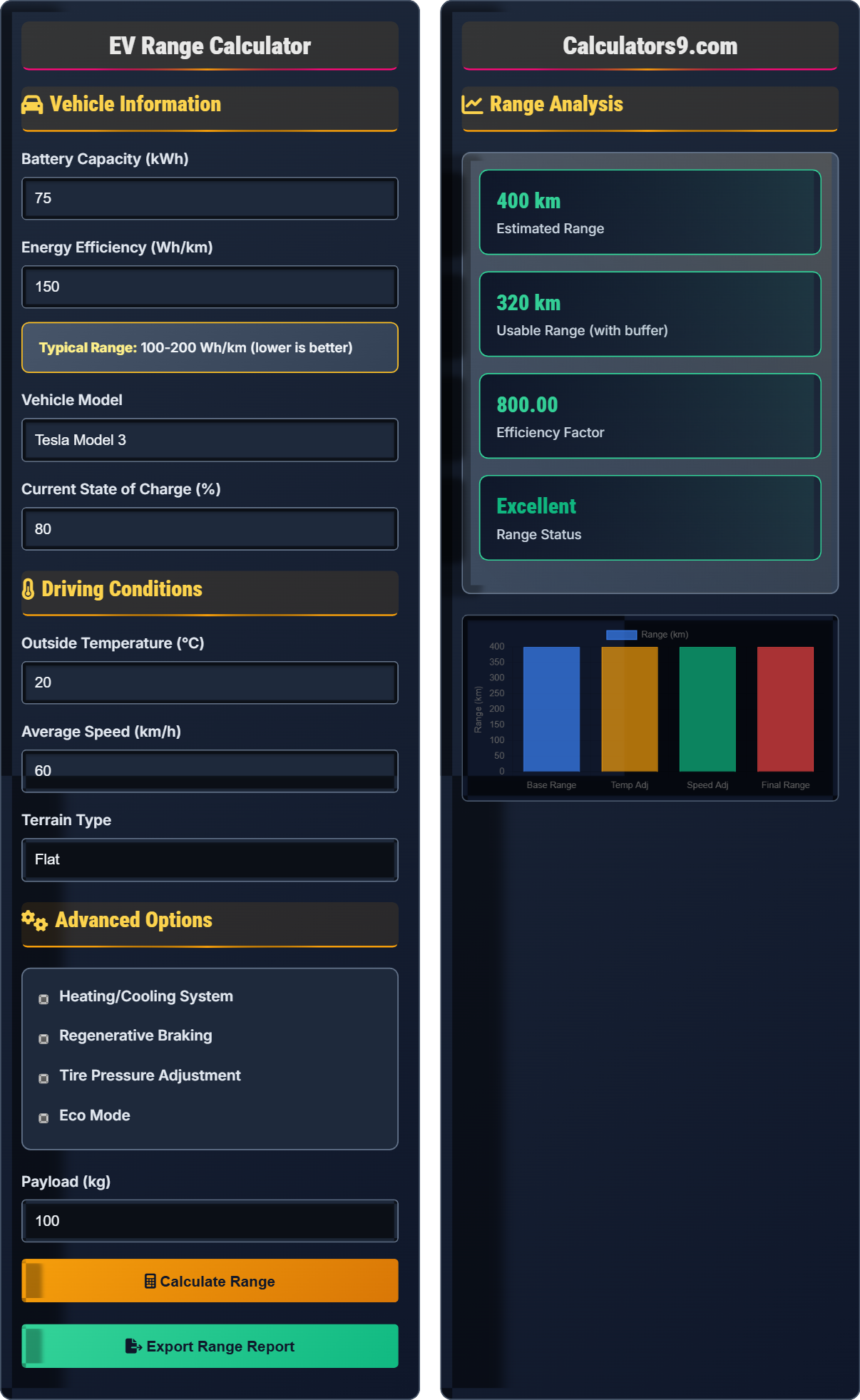
EV Range Calculation:
Show CalculatorEV range depends on several factors:
- Battery Capacity: kWh rating of the battery pack
- Efficiency: Wh/km (watt-hours per kilometer)
- Driving Conditions: Temperature, terrain, speed
- Vehicle Weight: Including passengers and cargo
Basic Formula:
Range (km) = (Battery Capacity (kWh) × 1000) / Energy Consumption (Wh/km)
Example: For a Tesla Model 3 with 75 kWh battery and 150 Wh/km consumption:
Range = (75 × 1000) / 150 = 500 km
Adjustments for real-world conditions: 15-30% reduction for cold weather, 10-20% for highway speeds.
Vehicle Information
Driving Conditions
Advanced Options
Range Analysis
| Factor | Impact | Value |
|---|---|---|
| Battery Capacity | Base Range | 75 kWh |
| Efficiency | Consumption Rate | 150 Wh/km |
| Temperature | Adjustment Factor | 20°C (0%) |
| Speed | Drag Effect | 60 km/h (0%) |
EV Range Optimization Guide
Electric vehicle range is the distance an EV can travel on a single charge. It's affected by battery capacity, driving conditions, and efficiency. Range anxiety is a common concern for EV owners, making accurate range estimation crucial for planning trips.
Effective range optimization includes:
- Preconditioning: Climate control while plugged in
- Eco Driving: Smooth acceleration and braking
- Route Planning: Efficient routes with charging stops
- Tire Maintenance: Proper inflation reduces drag
- Load Management: Minimize unnecessary weight
- Cold weather reduces range by 15-40%
- High speeds increase energy consumption
- Regenerative braking extends range
- Tire pressure affects efficiency
EV Range & Efficiency Quiz
What is the theoretical range of an EV with a 60 kWh battery and an efficiency of 180 Wh/km?
The answer is C) 333 km. Using the basic range formula: Range = (Battery Capacity × 1000) / Energy Consumption. Range = (60 × 1000) / 180 = 60,000 / 180 = 333.3 km. This calculation gives the theoretical range under ideal conditions.
The fundamental range equation is based on energy conservation. The total energy stored in the battery (kWh) is converted to distance traveled (km) based on the vehicle's efficiency (Wh/km). The conversion factor of 1000 accounts for the units (kWh to Wh). This formula assumes ideal conditions without environmental factors.
Range: Distance an EV can travel on a single charge
Efficiency: Energy consumed per unit distance
kWh: Kilowatt-hour, energy storage unit
• Range = (Battery Capacity × 1000) / Consumption
• Lower consumption means greater range
• Units must be consistent
• Remember: 1 kWh = 1000 Wh
• Lower Wh/km is better efficiency
• Add 15-30% buffer for real conditions
• Forgetting to convert kWh to Wh
• Confusing energy units
• Not accounting for real-world factors
Calculate the adjusted range for an EV with 400 km theoretical range at 20°C when driving in -10°C weather. Show your work and explain the physics behind the temperature effect.
Step 1: Calculate temperature difference
From 20°C to -10°C = 30°C difference
Step 2: Apply cold weather penalty
Cold weather typically reduces range by 15-40%
Assuming 25% reduction for -10°C: 400 km × 0.75 = 300 km
Step 3: Account for heating system
Heating system can consume 2-4 kW, further reducing range
Adjusted range: ~280-300 km
The physics involve battery chemistry slowing down in cold temperatures and increased energy needed for cabin heating.
Battery performance degrades in cold temperatures due to reduced ion mobility in the electrolyte. The battery's internal resistance increases, reducing available energy. Additionally, the cabin heating system draws significant power from the battery, especially when using resistive heating rather than heat pumps.
Ion Mobility: Movement of charged particles in battery
Internal Resistance: Opposition to current flow
Heat Pump: Efficient heating system using ambient heat
• Cold weather reduces range by 15-40%
• Heating systems consume 2-4 kW
• Battery performance decreases below 0°C
• Precondition battery while charging
• Use seat heaters instead of cabin heating
• Drive in Eco mode in cold weather
• Not accounting for heating system draw
• Assuming same range in all temperatures
• Forgetting battery warming effects
You're planning a 300 km highway trip with an EV that has a 65 kWh battery and 160 Wh/km efficiency at 60 km/h. At highway speeds (100 km/h), efficiency increases by 30%. What's the expected range at highway speed, and can you complete the trip without charging?
Step 1: Calculate theoretical range at 60 km/h
Range = (65 × 1000) / 160 = 406.25 km
Step 2: Calculate highway efficiency
Increased by 30%: 160 × 1.3 = 208 Wh/km
Step 3: Calculate highway range
Range = (65 × 1000) / 208 = 312.5 km
Step 4: Account for real-world factors
With 15% buffer: 312.5 × 0.85 = 265.6 km
You cannot complete the 300 km trip without charging, as the effective range is only 266 km.
At higher speeds, aerodynamic drag increases significantly (proportional to the cube of velocity). This dramatically increases energy consumption. For EVs, this means significantly reduced range at highway speeds compared to city driving. The relationship is not linear, so small speed increases can cause large efficiency drops.
Aerodynamic Drag: Resistance from air movement
Energy Consumption: Power used per distance
Real-World Factors: Environmental conditions
• Highway speeds reduce range by 20-40%
• Drag increases with cube of speed
• Always plan with buffer range
• Maintain steady speeds for best efficiency
• Use cruise control on highways
• Plan charging stops for long trips
• Not accounting for speed efficiency loss
• Assuming same range at all speeds
• Forgetting aerodynamic effects
How does regenerative braking affect EV range? If regenerative braking recovers 20% of energy during city driving, calculate the effective range improvement for an EV with 350 km theoretical range. Explain the mechanism and limitations.
Regenerative braking recovery:
• Recovers 15-25% of kinetic energy during deceleration
• Most effective in stop-and-go traffic
• Limited by battery acceptance rate
Effective range improvement calculation:
For 20% energy recovery: 350 km × 1.20 = 420 km
However, this is theoretical maximum. Real-world improvement is typically 10-15% due to:
- Not all braking opportunities
- Battery charging efficiency
- Motor efficiency losses
Expected real-world range: ~375-385 km
Regenerative braking converts kinetic energy back to electrical energy during deceleration. The motor acts as a generator, creating resistance that slows the vehicle while charging the battery. The effectiveness depends on driving patterns, with city driving offering more opportunities than highway driving.
Regenerative Braking: Energy recovery during deceleration
Kinetic Energy: Energy of motion
Motor Efficiency: Energy conversion effectiveness
• Recovery: 15-25% of kinetic energy
• City driving: Better regen opportunities
• Limited by battery acceptance rate
• Use maximum regen setting in city
• Anticipate stops to maximize regen
• Understand one-pedal driving
• Assuming 100% energy recovery
• Not accounting for driving patterns
• Forgetting battery limitations
How does proper tire inflation affect EV range?
The answer is B) Increases range by 3-5%. Proper tire inflation reduces rolling resistance, which accounts for 10-15% of total energy consumption in EVs. Underinflated tires increase rolling resistance significantly, requiring more energy to maintain speed. Proper inflation maintains optimal contact patch and minimizes energy loss.
Rolling resistance is the force required to keep a tire moving. It's caused by deformation of the tire and road surface. Underinflated tires have a larger contact patch and more deformation, increasing energy required to move the vehicle. Proper inflation maintains the designed contact patch for optimal efficiency.
Rolling Resistance: Force opposing motion
Contact Patch: Area of tire touching ground
Tire Deformation: Shape change under load
• Proper inflation: 3-5% range improvement
• Underinflation: Significant efficiency loss
• Check monthly for optimal performance
• Check tire pressure monthly
• Use manufacturer-recommended PSI
• Adjust for temperature changes
• Neglecting regular pressure checks
• Assuming all-weather tires are optimal
• Not accounting for temperature effects
FAQ
Q: How accurate are EV range calculators compared to real-world driving?
A: Modern EV range calculators are typically 85-95% accurate when properly configured with real conditions. For example:
For a Tesla Model 3 with 75 kWh battery:
Theoretical range: (75 × 1000) / 150 = 500 km
Real-world factors: -15% for temperature, -20% for highway
Adjusted range: 500 × 0.65 = 325 km
Actual range: 310-340 km
Accuracy depends on incorporating real driving conditions, weather, and terrain. The most significant variables are temperature and driving speed.
Q: What's the best way to maximize EV range?
A: Range optimization strategies include:
- Preconditioning: Heat/cool battery while charging
- Smooth driving: Gradual acceleration and braking
- Route planning: Efficient routes with charging stops
- Tire maintenance: Proper inflation (3-5% gain)
- Load management: Remove unnecessary weight
- Speed control: Maintain moderate speeds
These strategies can improve range by 15-25% in real-world conditions. For example, if your EV has a 400 km range, proper application of these techniques could extend it to 460-500 km.