Budget Allocator
Professional event planning • Financial management
Budget Allocation Formula:
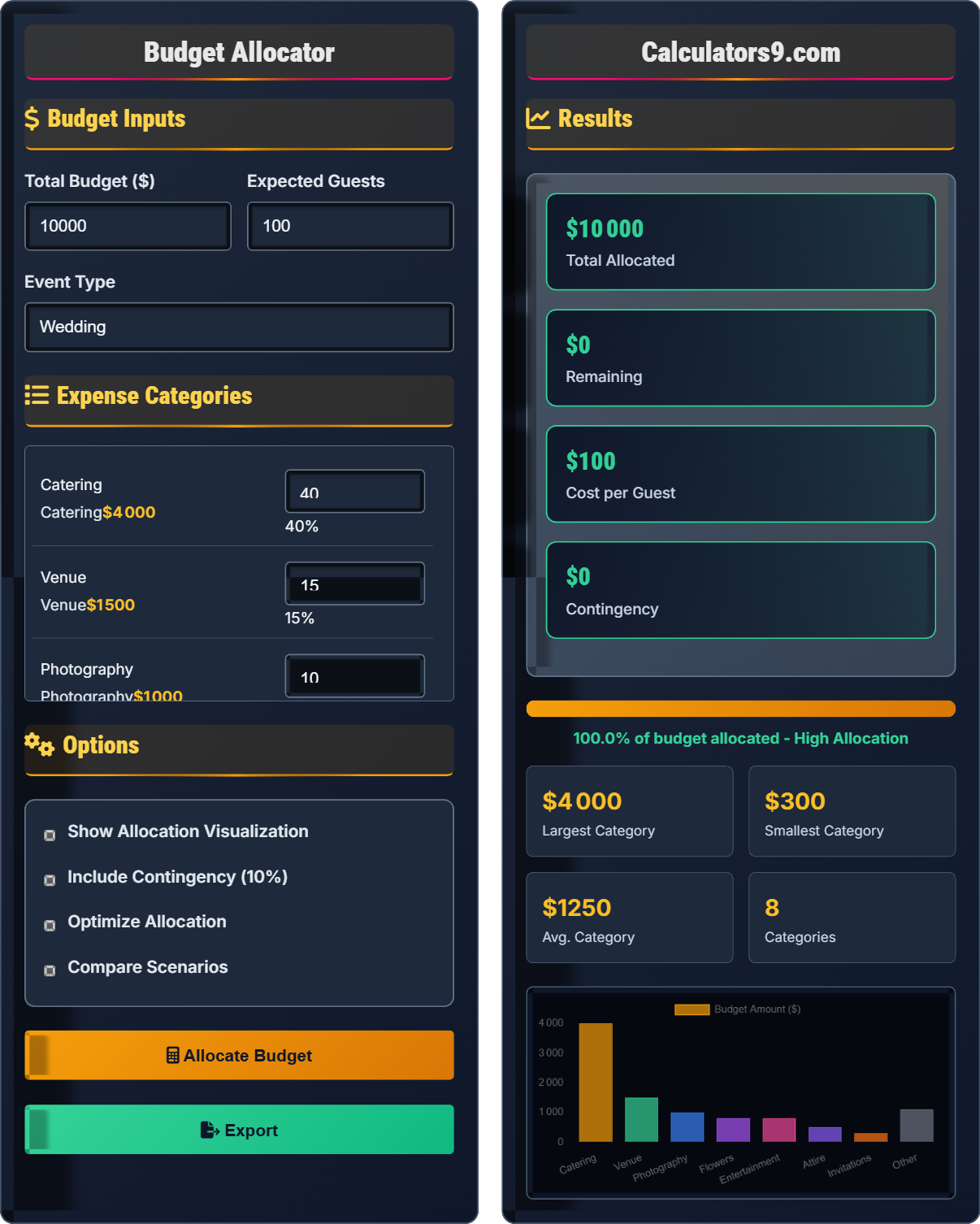
Show the calculatorCategory Budget = Total Budget × Percentage Allocation
Where:
- Total Budget = Available funds for the event
- Percentage Allocation = Recommended or custom percentage for each category
This formula calculates how to distribute the total event budget across different expense categories based on their relative importance and necessity.
Example: For a $10,000 event budget with 40% for catering:
Catering Budget = $10,000 × 0.40 = $4,000
Thus, $4,000 should be allocated to catering expenses.
Budget Inputs
Expense Categories
Options
Results
| Category | Percentage | Amount | Per Guest |
|---|
Comprehensive Event Budget Planning Guide
Budget allocation is the process of distributing available funds across different expense categories for an event. It involves determining the appropriate percentage or amount to spend on each aspect of the event to ensure financial success while meeting all requirements and expectations.
The fundamental calculation for budget allocation is:
Where:
- Total Budget: The total amount of money available for the event
- Percentage Allocation: The proportion assigned to each expense category
Successful event budget management includes:
- Contingency Fund: Reserve 10-15% for unexpected expenses
- Tracking System: Monitor spending in real-time
- Vendor Contracts: Fixed pricing to avoid surprises
- Payment Schedule: Align with cash flow
- Expense Categories: Detailed breakdown for accountability
- Early Booking: Discounts for advance reservations
- Off-Peak Dates: Lower venue and vendor costs
- DIY Elements: Reduce labor costs
- Group Purchasing: Bulk discounts
- Virtual Components: Hybrid events to reduce costs
Budget Planning Fundamentals
Process of distributing available funds across event expense categories.
Category Budget = Total Budget × Percentage Allocation
Where percentage allocation varies by event type and priorities.
- Reserve 10-15% for contingency
- Track expenses regularly
- Align budget with event goals
Financial Tips
Reserve 10-15% of budget for unexpected expenses and emergencies.
- Set clear budget limits per category
- Get multiple vendor quotes
- Negotiate contracts
- Monitor spending weekly
- Event type affects allocation
- Guest count impacts per-person costs
- Seasonal factors influence prices
- Location affects many costs
Event Finance Learning Quiz
What percentage of an event budget should typically be reserved for contingency?
The answer is C) 10-15%. Event professionals recommend reserving 10-15% of the total event budget for contingency. This fund covers unexpected expenses, last-minute changes, or emergency situations that may arise during event planning and execution. Having this reserve ensures that the event can proceed smoothly even when unplanned costs occur.
Contingency planning is a critical aspect of event budgeting that many beginners overlook. The 10-15% rule provides a safety net for unexpected costs such as weather-related changes, vendor no-shows, or additional guest requests. This percentage represents industry best practice based on historical data showing that most events incur unplanned expenses within this range. Without contingency reserves, events can quickly go over budget, leading to stress and potentially compromising quality.
Contingency Fund: Reserved budget for unexpected expenses
Event Budget: Total financial resources allocated for an event
Unexpected Expenses: Costs not planned for during initial budgeting
• Reserve 10-15% for contingency
• Track all expenses carefully
• Document all budget changes
• Keep contingency funds in separate account
• Only use for true emergencies
• Replenish if funds are used
• Using contingency for planned expenses
• Underestimating contingency needs
Calculate the catering budget for a $15,000 wedding where 40% is allocated to catering. Also determine how much each of the 120 expected guests contributes to the catering budget. Show your work.
Step 1: Apply Budget Allocation Formula = Total Budget × Percentage Allocation
Catering Budget = $15,000 × 0.40 = $6,000
Step 2: Calculate Cost Per Guest = Catering Budget ÷ Number of Guests
Cost Per Guest = $6,000 ÷ 120 = $50 per guest
Therefore, the catering budget is $6,000, with $50 allocated per guest.
This calculation demonstrates the practical application of the budget allocation formula. Wedding catering typically represents the largest expense category, often ranging from 35-50% of the total budget. The per-guest calculation helps determine the feasibility of menu options and ensures that the allocated amount aligns with vendor quotes. This example shows how percentage allocations translate into actual dollar amounts and per-person costs, which is essential for vendor negotiations.
Budget Allocation Formula: Category Budget = Total Budget × Percentage
Cost Per Guest: Individual contribution to specific category
Percentage Allocation: Proportion of budget assigned to category
• Catering typically 35-50% of wedding budget
• Calculate per-guest costs for vendor comparisons
• Verify allocations add up to 100%
• Get detailed catering quotes per person
• Consider beverage costs separately
• Factor in service charges
• Not accounting for gratuity
• Miscalculating per-guest costs
Sarah is planning a corporate event with a $20,000 budget for 150 attendees. The company requires 25% for venue, 30% for catering, and 15% for audio/visual. What is the total allocated amount, and how much remains for other expenses?
Step 1: Calculate Allocated Percentages = 25% + 30% + 15% = 70%
Step 2: Calculate Allocated Amount = $20,000 × 0.70 = $14,000
Step 3: Calculate Remaining Budget = $20,000 - $14,000 = $6,000
Step 4: Calculate Remaining Percentage = 100% - 70% = 30%
Therefore, $14,000 is allocated to specified categories, leaving $6,000 (30%) for other expenses.
This problem demonstrates how to manage partial budget allocations. In many corporate events, certain categories have predetermined percentages based on company policy or industry standards. The calculation shows how to account for these fixed allocations while determining the flexibility available for other expenses. The remaining 30% could cover entertainment, marketing, staffing, or other operational costs. This approach ensures compliance with budget constraints while maintaining planning flexibility.
Partial Allocation: Budgeting for specific categories only
Remaining Budget: Funds left after required allocationsFlexible Allocation: Budget available for various uses
• Required allocations take priority
• Verify total allocations don't exceed 100%
• Plan remaining budget carefully
• List all required allocations first
• Prioritize remaining budget by importance
• Keep contingency within remaining budget
• Not reserving contingency from remaining budget
• Allocating more than 100% of budget
John has a $12,000 wedding budget with 40% for catering ($4,800). He can save 15% by booking the caterer during off-peak season instead of peak season. How much will he save, and what percentage of his total budget does this represent?
Step 1: Calculate Savings Amount = Catering Budget × Savings Percentage
Savings = $4,800 × 0.15 = $720
Step 2: Calculate Savings as Percentage of Total Budget = (Savings ÷ Total Budget) × 100
Percentage Savings = ($720 ÷ $12,000) × 100 = 6%
Step 3: Calculate New Catering Budget = $4,800 - $720 = $4,080
John will save $720, which represents 6% of his total budget.
This example demonstrates the significant impact of timing on event costs. Seasonal variations can dramatically affect vendor pricing, with peak seasons commanding premium rates. The 15% savings on catering translates to 6% of the total budget, showing how strategic timing can free up substantial funds. This saved amount could be redirected to other categories or contribute to the contingency fund, providing greater financial flexibility for the event.
Seasonal Pricing: Price variations based on demand periods
Peak Season: High-demand period with premium pricing
Off-Peak Season: Low-demand period with discounted pricing
• Off-peak bookings can save 10-25%
• Peak seasons typically include holidays and summer
• Savings can be redirected to other categories
• Book vendors during off-season for better rates
• Consider weekday events instead of weekends
• Negotiate seasonal discount packages
• Assuming all vendors have similar seasonal patterns
• Missing opportunities for bulk discounts
What is the most important factor to monitor when managing an event budget?
The answer is D) All of the above. Successful event budget management requires monitoring the total budget amount to ensure you don't exceed available funds, tracking category spending versus allocations to identify potential overruns, and managing vendor payment schedules to align with cash flow. Each element is crucial for maintaining financial control throughout the event planning process.
Effective budget management is multifaceted and requires attention to several key areas simultaneously. Monitoring total budget prevents overall overspending, while category tracking identifies where adjustments may be needed. Payment schedule management ensures that funds are available when needed and helps maintain positive vendor relationships. This holistic approach to budget tracking provides the comprehensive oversight necessary for successful event financial management.
Budget Tracking: Ongoing monitoring of expenses against allocations
Cash Flow: Timing of money inflows and outflows
Payment Schedules: Planned timing of vendor payments
• Monitor all budget aspects consistently
• Update tracking weekly during planning
• Document all budget changes immediately
• Use spreadsheet or budget software
• Set up automated alerts for budget thresholds
• Review budget weekly with team
• Not updating budget regularly
• Failing to track payment schedules
FAQ
Q: How do I allocate my event budget across different categories?
A: Use the Budget Allocation Formula:
\(\text{Category Budget} = \text{Total Budget} \times \text{Percentage Allocation}\)
For example, in a $10,000 wedding with 40% for catering:
Catering Budget = $10,000 × 0.40 = $4,000
Standard allocations:
- Wedding: Catering (40%), Venue (15%), Photography (10%)
- Corporate: Venue (25%), Catering (30%), AV (15%)
- Conference: Venue (20%), Catering (25%), Speakers (20%)
Always reserve 10-15% for contingency.
Q: What are the key factors to consider when creating an event budget?
A: Key factors include:
- Event Type: Different events have different cost structures
- Guest Count: Many costs scale with attendance
- Location: Geographic factors affect many costs
- Timing: Seasonal and day-of-week variations
- Quality Level: Premium services cost more
Also consider contingency (10-15%), payment schedules, and tracking systems.