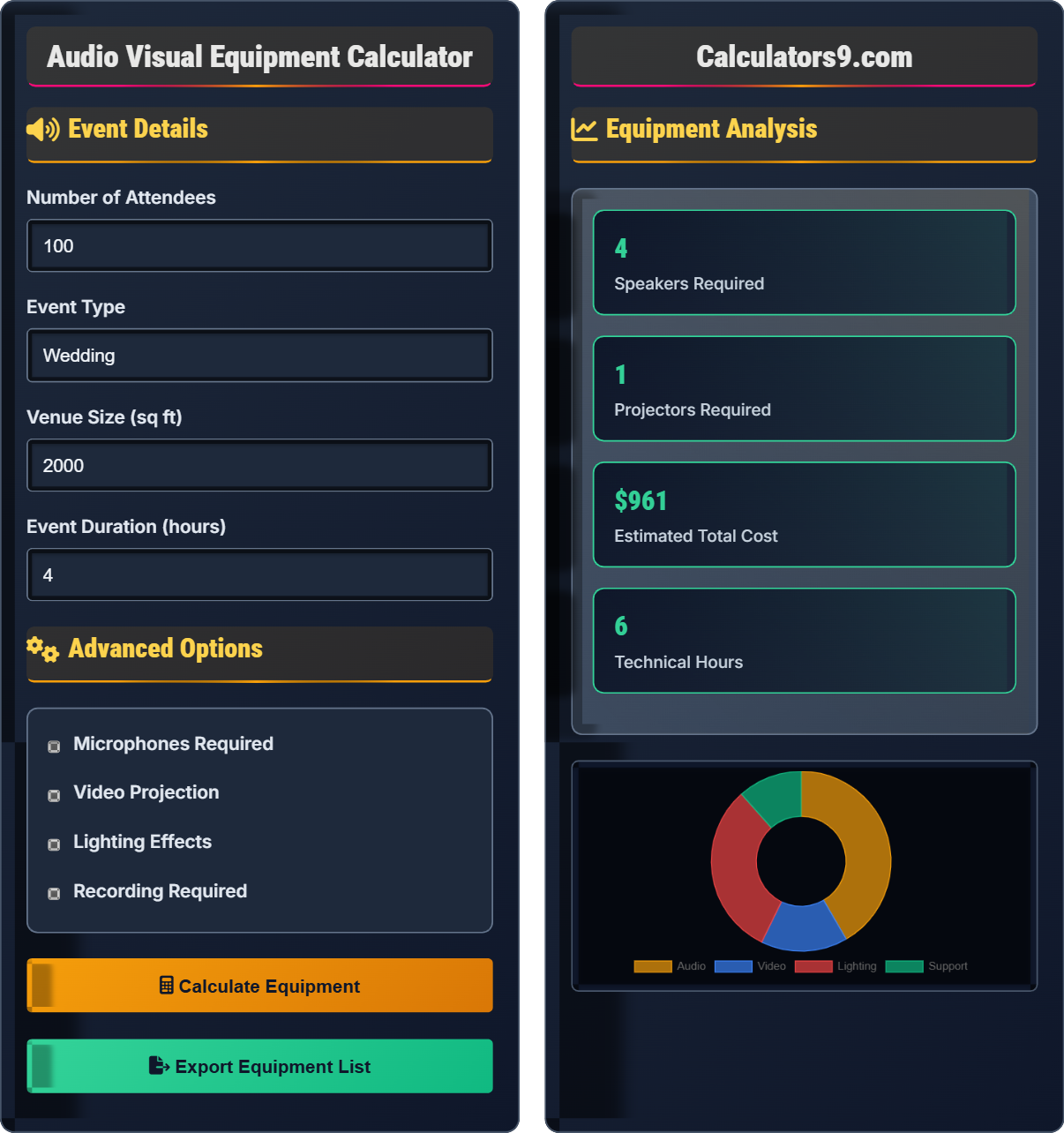
Audio Visual Equipment Calculator
Tech planning & rental tools • 2026 edition
Event Details
Advanced Options
Equipment Analysis
| Equipment | Quantity | Cost | Notes |
|---|
| Category | Estimated | Actual | Remaining |
|---|
AV Equipment Planning Guide
Audio-visual equipment requirements vary significantly by event type and venue size. Industry standards recommend 2 speakers per 50 guests for indoor events, with additional considerations for acoustics and ambient noise. Video projection requires 1 projector per 100-150 guests depending on content complexity.
Key AV equipment categories include:
- Audio Systems: Speakers, microphones, amplifiers, mixers, wireless systems
- Video Equipment: Projectors, screens, cameras, streaming equipment, monitors
- Lighting: Uplights, pin spots, moving heads, LED panels, control systems
- Recording: Cameras, audio recorders, streaming solutions, memory devices
- Support Equipment: Stands, cables, adapters, extension cords, power conditioners
- Test Equipment: Conduct sound and video checks before event
- Backup Plans: Have spare microphones and cables available
- Power Requirements: Verify electrical capacity meets equipment needs
- Technical Staff: Hire qualified technicians for complex setups
- Equipment Delivery: Schedule setup time (2-4 hours before event)
AV Equipment Planning Learning Quiz
According to industry standards, how many speakers are typically needed for a 150-person indoor presentation?
The answer is C) 6 speakers. Industry standards recommend 2 speakers per 50 guests for indoor events. For 150 guests: 150 ÷ 50 = 3, then 3 × 2 = 6 speakers. This ensures even sound distribution throughout the venue.
Understanding speaker ratios is fundamental to effective audio planning. The 2:50 ratio accounts for sound dispersion and audience coverage. In larger venues, additional speakers prevent dead zones and ensure all attendees hear clearly. This calculation is essential for event planners to communicate equipment needs to technicians.
Sound Dispersion: How audio waves spread throughout a space
Dead Zones: Areas with poor audio coverage
Audio Coverage: Uniform sound distribution throughout venue
• Use 2 speakers per 50 guests for indoor events
• Add 1 speaker for every 20dB of ambient noise
• Position speakers at 8-10 feet height for optimal coverage
• Test audio levels before event starts
• Consider venue acoustics in speaker placement
• Have backup speakers available for critical events
• Not accounting for venue acoustics
• Placing speakers too close together
If you're planning a corporate presentation for 200 people, how many projectors do you need according to industry standards? Show your work.
Step 1: Identify number of attendees = 200
Step 2: Apply industry standard = 1 projector per 100 guests
Step 3: Calculate required projectors = 200 ÷ 100 = 2 projectors
You need 2 projectors for a 200-person presentation.
Projector calculations depend on audience size and content visibility requirements. The 1:100 ratio ensures all attendees can see the presentation clearly. For complex visual content or presentations with fine details, consider 1:50 ratio. This calculation helps determine rental costs and technical setup requirements.
Projector Ratio: Number of attendees per projection device
Visibility Requirements: Clarity standards for audience viewing
Resolution: Image sharpness and detail capability
• Standard: 1 projector per 100 guests
• Detailed content: 1 per 50 guests
• Consider screen size for resolution requirements
• Use brighter projectors for well-lit rooms
• Consider backup projector for critical presentations
• Test projection quality before event
• Not considering ambient lighting conditions
• Forgetting to account for screen aspect ratio
Sarah is organizing a corporate event with 5 speakers and expects 150 attendees. She needs microphones for the speakers and possibly for audience Q&A. How many microphones should she plan for, including backups?
Step 1: Calculate microphones for speakers = 5 speakers
Step 2: Add backup microphones = 1 per speaker = 5 backups
Step 3: Add audience microphones = 2 for Q&A
Step 4: Calculate total = 5 + 5 + 2 = 12 microphones
Sarah should plan for 12 microphones.
This problem demonstrates the importance of redundancy in AV planning. The 1:1 backup ratio ensures continuity if primary microphones fail. Additional microphones for audience participation account for interactive elements. This comprehensive approach prevents technical disruptions during critical speaking moments.
Redundancy: Backup equipment to prevent failures
Interactive Elements: Audience participation components
Continuity: Uninterrupted operation during event
• 1 backup mic per primary mic
• Add 1-2 mics for audience interaction
• Consider wireless mics for mobility
• Use wireless mics for panel discussions
• Test all mics before event begins
• Assign technician to monitor audio levels
• Forgetting audience interaction needs
• Not testing microphone quality beforehand
Mike needs to power a setup with 4 speakers (200W each), 2 projectors (300W each), 6 microphones (50W total), and lighting equipment (500W). If each circuit can handle 1800W, how many circuits does he need?
Step 1: Calculate speaker power = 4 × 200W = 800W
Step 2: Calculate projector power = 2 × 300W = 600W
Step 3: Calculate microphone power = 50W
Step 4: Calculate lighting power = 500W
Step 5: Calculate total power = 800 + 600 + 50 + 500 = 1,950W
Step 6: Calculate circuits needed = 1,950W ÷ 1,800W = 1.08 → Round up = 2 circuits
Mike needs 2 circuits to safely power his equipment.
This calculation demonstrates the importance of electrical planning in AV setups. Circuit capacity must exceed total power draw to prevent overloads. The 80% rule (loading circuits to only 80% of capacity) provides safety margin. Understanding power requirements prevents equipment damage and ensures reliable operation.
Power Draw: Electrical load consumed by equipment
Circuit Capacity: Maximum electrical load a circuit can handle
Safety Margin: Extra capacity to prevent overloads
• Load circuits to 80% capacity maximum
• Calculate total power before connecting equipment
• Use power strips with surge protection
• Use dedicated circuits for sensitive equipment
• Label all cables and connections
• Have electrician verify venue capacity
• Overloading circuits without safety margin
• Using damaged or undersized extension cords
For a 200-person wedding reception, what percentage of the total AV budget should be allocated to lighting?
The answer is B) 15-20%. For wedding receptions, lighting typically represents 15-20% of the total AV budget. This includes uplighting, pin spots, and special effects. Lighting enhances ambiance and creates memorable visual experiences for guests.
Understanding budget allocation ratios is crucial for event planning. Lighting, though not essential for audio, significantly impacts guest experience. The 15-20% allocation reflects the importance of visual ambiance in social events. This percentage may vary based on event type and guest expectations.
AV Budget: Total allocation for audio-visual equipment
Visual Ambiance: Atmospheric lighting effects
Budget Allocation: Percentage distribution across categories
• Lighting: 15-20% of AV budget for weddings
• Audio: 40-50% of AV budget
• Video: 20-30% of AV budget
• Focus lighting on key areas (dance floor, head table)
• Use LED options for energy efficiency
• Consider color schemes in lighting selection
• Not considering lighting as part of overall experience
• Forgetting to budget for lighting technician
Equipment Basics
2 speakers per 50 guests. 1 projector per 100 guests. 1 mic per speaker + 1 backup. 15-20% budget for lighting.
Audio: (attendees ÷ 50) × 2. Video: attendees ÷ 100. Mics: speakers + backups.
- Always include backup equipment
- Verify power capacity before setup
- Test all equipment before event
Planning Tips
Consider venue acoustics, power availability, setup time, and technical support requirements.
- Match equipment to venue size
- Consider audience expectations
- Plan for backup solutions
- Account for setup and teardown time
- Outdoor events require weather protection
- Wireless equipment needs license verification
- High-end events may need specialized equipment
- Transportation and delivery costs apply
FAQ
Q: Should I rent or buy AV equipment?
A: For most events, renting is more cost-effective. Equipment costs $500-2000+ to purchase vs $100-300 to rent. Only buy if you host events regularly.
Q: What if equipment fails during event?
A: Always have backup equipment on-site. Maintain contact with rental company for quick replacement. Have technician available for troubleshooting.