Decoration Cost Calculator
Event design & budgeting tools • 2026 edition
Event Details
Advanced Options
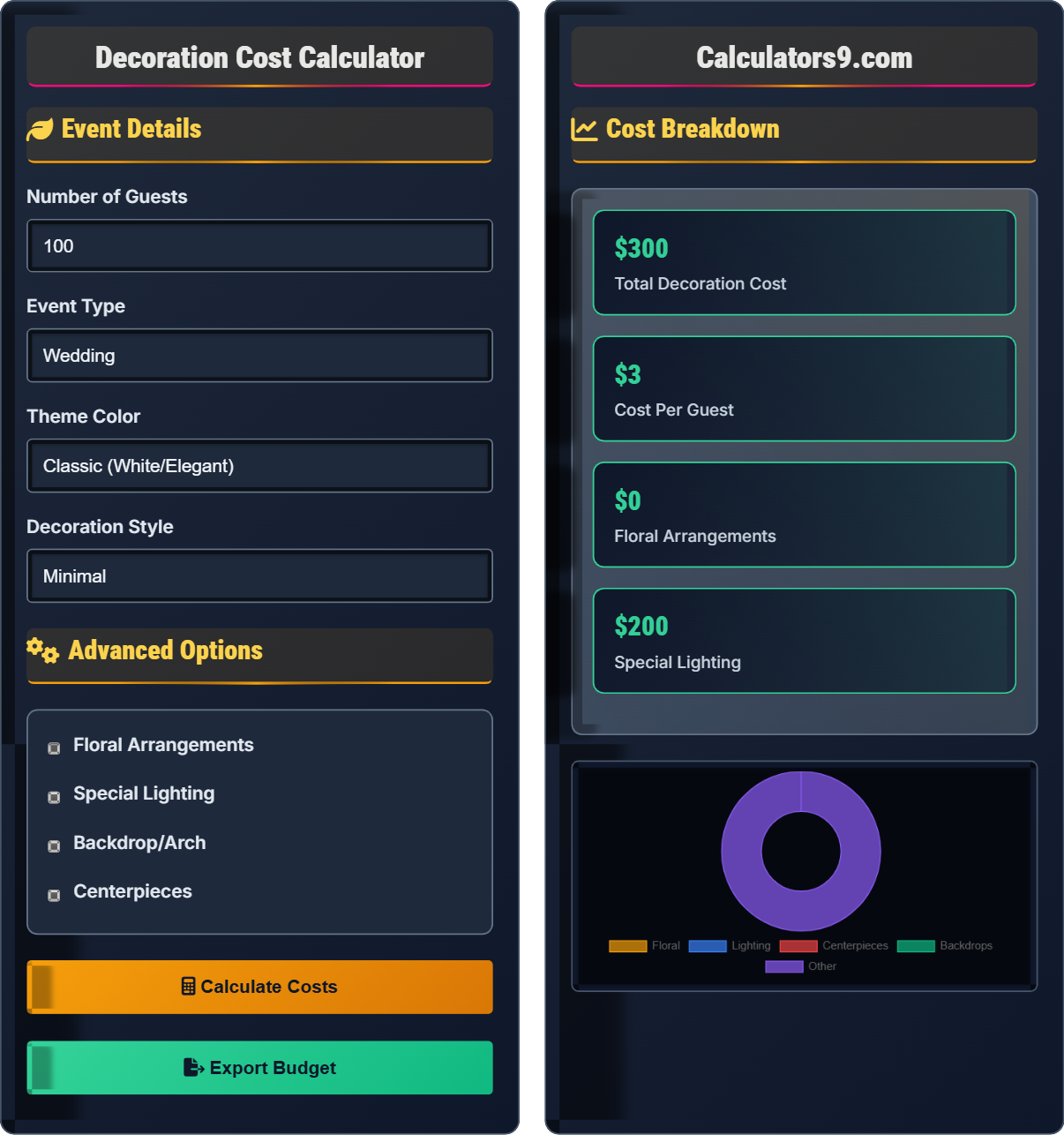
Cost Breakdown
| Category | Estimated | Actual | Remaining |
|---|
| Item | Quantity | Unit Cost | Total |
|---|
Decoration Cost Planning Guide
Decoration costs typically range from $2-5 per guest for basic events to $20-50 per guest for luxury events. The industry standard for weddings is 10-15% of total event budget. Floral arrangements average $50-150 each, while special lighting ranges from $100-300 for basic setups to $500-1000 for elaborate displays.
Key decoration cost categories include:
- Floral Arrangements: $50-150 per arrangement (centerpieces, bouquets, entrance displays)
- Lighting: $100-300 for basic uplighting, $500-1000 for elaborate setups
- Centerpieces: $20-50 each (flowers, candles, themed items)
- Backdrop/Arch: $200-500 for rentals, $500-1000 for custom builds
- Table Settings: $5-15 per place setting (linens, runners, chair covers)
- Special Effects: $100-300 for fog machines, sparklers, projection mapping
- Shop Around: Get quotes from multiple decorators and florists
- Seasonal Savings: Use in-season flowers and decorations
- DIY Elements: Consider DIY for simple items to save costs
- Reuse Items: Repurpose ceremony decorations for reception
- Bulk Purchases: Buy items in bulk to reduce per-unit costs
Decoration Cost Planning Learning Quiz
According to industry standards, what percentage of the total event budget should be allocated to decorations?
The answer is B) 10-15%. Industry standards recommend allocating 10-15% of the total event budget to decorations. This range allows for quality decorations while maintaining budget balance across all event elements.
Understanding budget allocation percentages is fundamental to event planning. The 10-15% standard reflects years of industry experience balancing guest experience with cost management. This allocation ensures adequate decoration quality while preventing overspending in one category at the expense of others.
Budget Allocation: Percentage of total budget assigned to specific categories
Industry Standard: Commonly accepted percentage distribution
Cost Management: Balancing quality with budget constraints
• Allocate 10-15% of budget to decorations
• Adjust based on event type and guest expectations
• Consider decoration impact on overall guest experience
• Negotiate package deals with decorators
• Consider DIY options for simple elements
• Repurpose ceremony decorations for reception
• Not considering seasonal flower pricing
• Forgetting to budget for setup and teardown
If an event has 120 guests and the decoration budget is $3,600, what is the cost per guest for decorations? Show your work.
Step 1: Identify total decoration budget = $3,600
Step 2: Identify number of guests = 120
Step 3: Calculate cost per guest = $3,600 ÷ 120 guests = $30 per guest
The decoration cost per guest is $30.
Cost per guest calculations are essential for budget planning and comparison. This calculation helps determine if decoration costs are reasonable for the event type. The $30 per guest figure falls in the moderate range for wedding decorations ($20-40), indicating a well-balanced budget allocation.
Cost Per Guest: Total cost divided by number of attendees
Budget Planning: Allocating funds based on per-person metrics
Reasonable Range: Industry-accepted cost standards
• Calculate per-guest costs for comparison purposes
• Compare to industry standards for reasonableness
• Consider guest expectations in cost planning
• Use per-guest costs to compare different venues
• Adjust based on guest demographics and expectations
• Factor in setup and teardown labor costs
• Not accounting for delivery and setup fees
• Calculating only for dining areas, not ceremony spaces
Sarah is planning a wedding with 100 guests and wants to have a centerpiece on each of 12 tables. If she allocates $1,200 for floral arrangements, how much can she spend per centerpiece? If seasonal flowers cost $75 each, how much will she need to budget for flowers?
Step 1: Calculate budget per centerpiece = $1,200 ÷ 12 tables = $100 per centerpiece
Step 2: Calculate cost for seasonal flowers = 12 centerpieces × $75 = $900
Step 3: Calculate remaining budget = $1,200 - $900 = $300
Sarah can spend $100 per centerpiece, and seasonal flowers will cost $900.
This problem demonstrates the importance of calculating per-item costs within the overall budget. The $100 per centerpiece is in the moderate range for wedding centerpieces ($50-150). Using seasonal flowers saves $300, which could be redirected to other decoration elements or serve as a buffer for unexpected costs.
Centerpiece: Decorative element placed in table center
Seasonal Flowers: Flowers available at lower cost during growing season
Budget Allocation: Distributing total budget across specific items
• Calculate per-item costs within total budget
• Consider seasonal pricing for flowers
• Plan for setup and delivery costs
• Mix seasonal and specialty flowers for budget balance
• Consider potted plants as centerpieces for reuse
• Order flowers in bulk for additional savings
• Forgetting to include labor costs for floral arrangements
• Ordering too few flowers for the desired effect
Mike is planning a corporate event with 200 guests. He initially budgets $4,000 for decorations. If he decides to upgrade from moderate to elaborate style (which costs 1.5x more), what will be his new decoration budget? How does this compare to the industry standard of $3 per guest?
Step 1: Identify initial budget = $4,000
Step 2: Apply elaborate style multiplier = $4,000 × 1.5 = $6,000
Step 3: Calculate industry standard = 200 guests × $3 = $600
Step 4: Calculate per-guest cost = $6,000 ÷ 200 = $30 per guest
Mike's new budget is $6,000, which is $30 per guest compared to the $3 standard.
This example shows how style choices dramatically impact decoration costs. The $30 per guest figure is significantly higher than the basic $3 standard, reflecting the elaborate style choice. However, it's within the acceptable range for corporate events where professional presentation is important. The calculation demonstrates the exponential cost impact of style upgrades.
Style Multiplier: Factor applied to adjust costs based on decoration complexity
Corporate Standards: Higher decoration expectations for professional events
Cost Impact: How style choices affect overall budget
• Apply style multipliers to base costs
• Consider event type in style selection
• Balance guest expectations with budget constraints
• Focus elaborate elements on key areas (entrance, head table)
• Use moderate decorations for less visible areas
• Consider phased decoration setup for budget management
• Applying same style level to all event areas
• Forgetting to adjust other budget categories for style changes
For a basic uplighting setup at a wedding reception, what is the typical cost range?
The answer is B) $100-300. Basic uplighting for a wedding reception typically costs $100-300. This includes several colored lights aimed at walls to create ambiance. More elaborate setups with moving lights, pin spots, and special effects cost significantly more.
Understanding lighting cost ranges is important for realistic budget planning. Basic uplighting provides significant visual impact for a reasonable cost. The $100-300 range covers equipment rental and basic programming. Professional lighting designers may charge more for custom setups and programming, but this provides the foundation for most wedding reception lighting.
Uplighting: Lights aimed upward to illuminate walls and ceiling
Pin Spotting: Focused lighting on specific objects
Lighting Designer: Professional specializing in event lighting
• Basic uplighting: $100-300
• Add $200-500 for special effects
• Include setup and tear-down in costs
• Use uplighting to transform plain walls
• Consider LED options for energy efficiency
• Plan lighting to complement color scheme
• Not considering power requirements for electrical
• Forgetting to budget for lighting designer fees
Cost Basics
10-15% of budget. $2-5 per guest. Floral: $50-150 each. Lighting: $100-300.
Per-guest: Total budget ÷ attendees. Category: Sum all decoration elements.
- Always include setup/teardown costs
- Consider seasonal pricing variations
- Factor in delivery and installation fees
Planning Tips
Get multiple quotes, negotiate respectfully, and set aside 10-15% contingency.
- Use seasonal flowers for savings
- Mix fresh and artificial elements
- Repurpose ceremony decorations
- DIY simple items yourself
- Delivery costs for fragile items
- Setup time and labor costs
- Insurance for expensive items
- Storage for reusable elements
FAQ
Q: How do I handle decoration budget overruns?
A: First, identify which elements are most important to the client. Consider simplifying designs, using fewer but larger arrangements, or switching to seasonal alternatives. Always communicate changes early.
Q: What if I need to cut decoration costs?
A: Focus on key areas like entrance and head table. Use simple, elegant arrangements rather than complex ones. Consider DIY centerpieces or borrowing items from friends.