Event Budget Calculator
Financial planning & cost management • 2026 edition
Event Details
Advanced Options
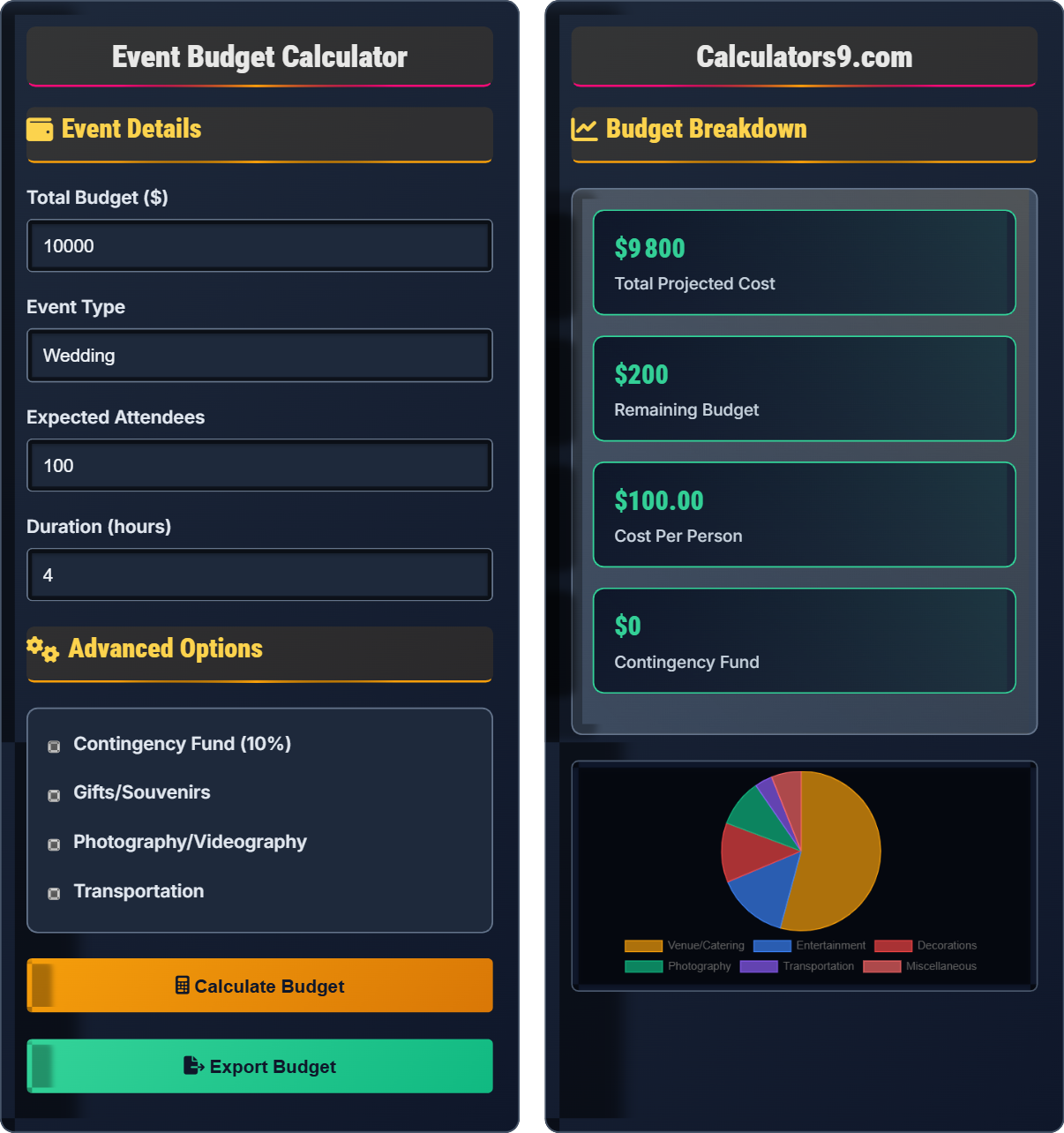
Budget Breakdown
| Category | Estimated | Actual | Remaining |
|---|
| Vendor | Category | Amount | Status |
|---|
Event Budget Planning Guide
Event budget allocation varies by type, but general guidelines exist. Weddings typically spend 40-50% on venue and catering, while corporate events may allocate more to technology and speakers. The 50-20-15-10-5 rule provides a good starting point: 50% venue/catering, 20% entertainment, 15% decor, 10% contingency, 5% miscellaneous.
Key expense categories for events include:
- Venue & Catering: 40-50% of budget (rent, food, beverages)
- Entertainment: 10-20% of budget (music, performers, activities)
- Decorations: 10-15% of budget (floral, lighting, signage)
- Photography: 5-10% of budget (photos, video, albums)
- Transportation: 5-10% of budget (limos, shuttles, parking)
- Gifts/Favors: 5-10% of budget (souvenirs, thank-you gifts)
- Start Early: Begin budgeting 6-12 months before event
- Track Everything: Record all expenses in real-time
- Plan Contingency: Set aside 10-15% for unexpected costs
- Negotiate: Shop around and negotiate vendor prices
- Review Regularly: Update budget weekly as event approaches
Event Budget Planning Learning Quiz
According to industry standards, what percentage of a wedding budget should be allocated to venue and catering?
The answer is C) 40-50%. Industry standards recommend allocating 40-50% of a wedding budget to venue and catering, as these are typically the largest expenses. This covers both the rental of the ceremony and reception venues as well as all food and beverage services.
Understanding standard budget allocations helps event planners and clients set realistic expectations. The 40-50% allocation for venue and catering reflects the significant costs associated with securing premium locations and providing food service for large groups. This standard has been established through decades of industry experience.
Budget Allocation: Distribution of funds across expense categories
Industry Standard: Commonly accepted percentage distribution
Expense Categories: Groupings of related costs
• Venue and catering typically represent largest expenses
• Percentages may vary based on event type
• Always include contingency funds in planning
• Negotiate package deals with venues
• Consider off-season discounts
• Look for all-inclusive venues to reduce costs
• Underestimating venue and catering costs
• Not accounting for service charges and gratuities
• Failing to budget for alcohol if not included
If an event budget is $15,000 and you want to allocate 12% for contingency, what is the contingency amount? Show your work.
Step 1: Identify total budget = $15,000
Step 2: Identify contingency percentage = 12% = 0.12
Step 3: Calculate contingency = $15,000 × 0.12 = $1,800
The contingency fund should be $1,800.
Contingency funds are essential for handling unexpected expenses that commonly arise during event planning. The 12% calculation demonstrates how to convert a percentage to a decimal (12% = 0.12) and multiply it by the total budget. This simple calculation ensures adequate funds are reserved for unforeseen circumstances.
Contingency Fund: Reserved money for unexpected expenses
Unforeseen Circumstances: Unexpected situations requiring additional funds
Percentage Calculation: Converting percentage to decimal for multiplication
• Contingency funds should be set aside immediately
• Typical range is 10-15% of total budget
• Use contingency only for genuine emergencies
• Keep contingency funds in separate account
• Document all contingency expenditures
• Reassess contingency needs as event approaches
• Using contingency for planned expenses
• Calculating contingency based on individual categories
Sarah is planning a corporate event with a budget of $20,000 for 150 attendees. She allocates 45% to venue and catering, 20% to entertainment, 15% to decorations, and 10% to contingency. What is the cost per person for the event, and how much is allocated for decorations?
Step 1: Calculate total percentage allocated = 45% + 20% + 15% + 10% = 90%
Step 2: Calculate remaining budget = 100% - 90% = 10% for miscellaneous expenses
Step 3: Calculate decoration allocation = $20,000 × 0.15 = $3,000
Step 4: Calculate cost per person = $20,000 ÷ 150 = $133.33 per person
Sarah allocates $3,000 for decorations, and the cost per person is $133.33.
This problem demonstrates multiple budget calculations simultaneously. It shows how to calculate individual category allocations from percentages, determine cost per person, and verify that all allocations add up to 100%. The cost per person calculation is particularly useful for comparing with industry benchmarks and negotiating vendor contracts.
Cost Per Person: Total budget divided by number of attendees
Allocation: Distribution of funds to specific categories
Percentage Calculation: Converting percentages to dollar amounts
• All percentage allocations should sum to 100%
• Cost per person helps with vendor negotiations
• Always account for all budget components
• Use cost per person to compare vendor quotes
• Research industry benchmarks for your event type
• Build in flexibility for category reallocation
• Not calculating cost per person for comparison purposes
• Over-allocating to one category at expense of others
Mike has allocated $4,000 for photography for his wedding. The photographer quotes $4,500. If Mike wants to stay within budget, by what percentage must the photographer reduce their quote? Alternatively, what percentage of his total $25,000 budget would the $4,500 represent?
For the percentage reduction:
Step 1: Calculate difference = $4,500 - $4,000 = $500
Step 2: Calculate percentage reduction = ($500 ÷ $4,500) × 100 = 11.11%
For the budget percentage:
Step 1: Calculate percentage of total budget = ($4,500 ÷ $25,000) × 100 = 18%
The photographer must reduce their quote by 11.11% to meet Mike's budget, or the photography would represent 18% of his total budget.
This example demonstrates practical budget management skills. The percentage reduction calculation shows how to determine the discount needed to meet a specific budget. The budget percentage calculation helps assess whether an expense fits within industry standards. Photography typically represents 8-12% of wedding budgets, so 18% would be quite high.
Vendor Negotiation: Discussing price adjustments with service providers
Percentage Reduction: Calculating discount needed to meet budget
Benchmark Percentage: Industry standard for expense categories
• Compare vendor quotes to budget allocations
• Negotiate respectfully and professionally
• Consider value vs. cost in vendor selection
• Ask for package deals or off-season discounts
• Consider newer vendors for competitive pricing
• Bundle services to reduce overall costs
• Not researching industry pricing benchmarks
• Sacrificing quality for cost savings
For a corporate conference with 200 attendees and a $50,000 budget, which expense category typically requires the largest allocation?
The answer is B) Speakers/Audio-Visual. Corporate conferences typically allocate the largest portion (25-35%) to speakers, audio-visual equipment, and technology needs. These elements are critical for the educational/training purpose of the event and often represent the highest costs.
Understanding that budget allocations vary by event type is crucial for effective planning. Corporate conferences prioritize educational content delivery, making speakers and AV equipment the largest expense. This contrasts with social events where venue and catering dominate. Recognizing these differences ensures appropriate budget distribution.
Corporate Conference: Business-focused event for education/networking
Audio-Visual Equipment: Technology for presentations and sound
Expense Prioritization: Allocating funds based on event purpose
• Budget allocations should match event objectives
• Research industry standards for your event type
• Prioritize expenses that support event goals
• Research industry benchmarks for your specific event type
• Prioritize expenses that directly support event objectives
• Consider hybrid options to reduce venue costs
• Not prioritizing expenses based on event goals
• Underestimating technology needs for corporate events
Budget Basics
50% venue/catering, 20% entertainment, 15% decor, 10% contingency, 5% misc.
Total budget × category percentage = category allocation. Cost per person = total budget ÷ attendees.
- Always include contingency funds
- Track expenses regularly
- Allocate based on event type
Planning Tips
Get multiple quotes, negotiate respectfully, and sign contracts with clear payment terms.
- Use spreadsheets or budget apps
- Record expenses immediately
- Update budget weekly
- Review with team regularly
- Seasonal pricing affects costs
- Weekend events cost more than weekdays
- Peak seasons command premium prices
- Early booking often saves money
FAQ
Q: How do I handle budget overruns?
A: First, identify which categories exceeded budgets. Look for reallocation opportunities in under-spent categories. If contingency is exhausted, prioritize critical expenses and negotiate with vendors for payment extensions.
Q: What if I need to reduce my budget?
A: Reduce guest count first (biggest impact), then consider less expensive venue, simpler catering, or DIY decorations. Always keep priority items that define your event vision.