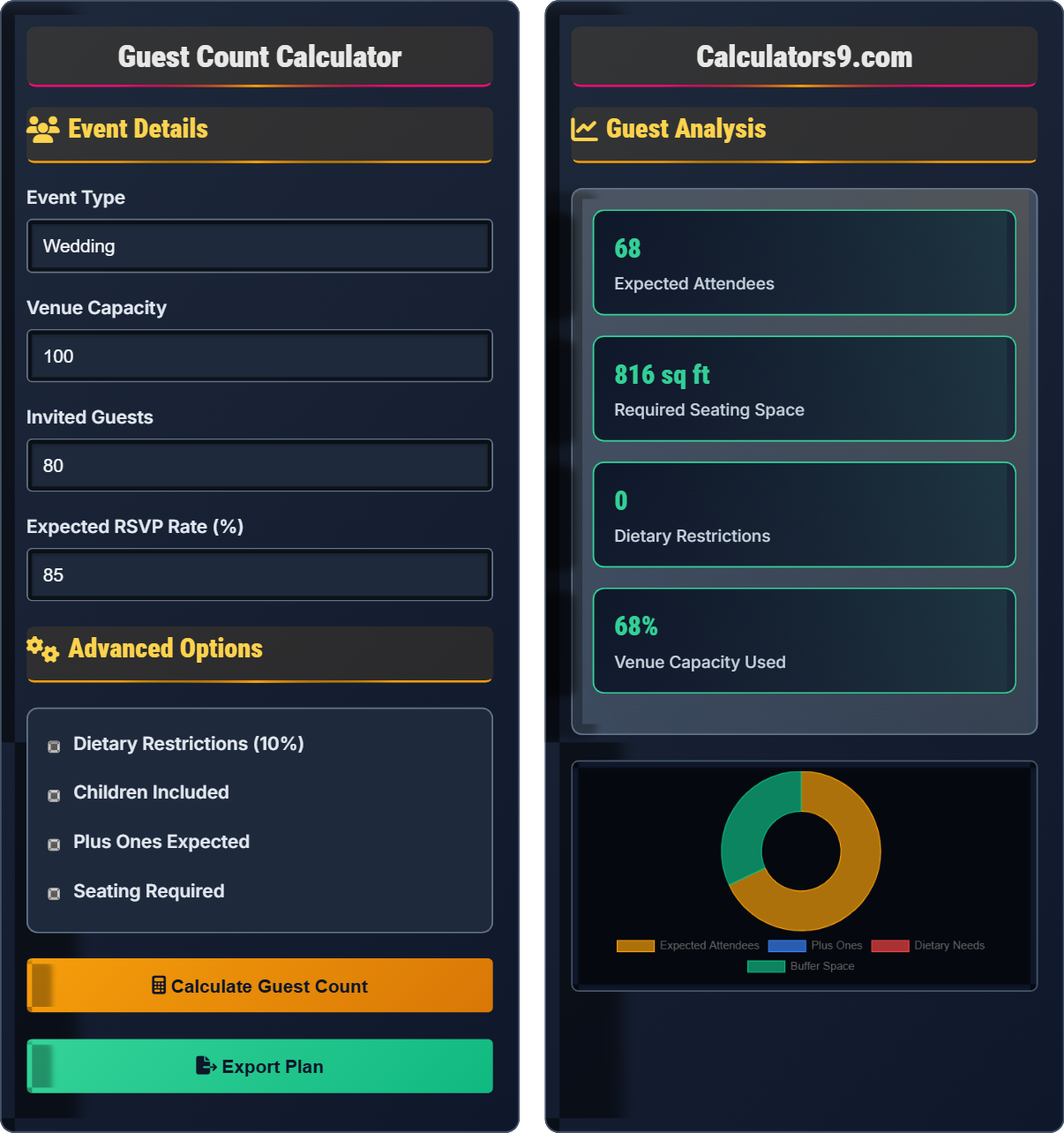
Guest Count Calculator
Event capacity & planning tools • 2026 edition
Event Details
Advanced Options
Guest Analysis
| Category | Count | Percentage | Notes |
|---|
| Item | Calculation | Result | Impact |
|---|
Event Planning & Guest Management Guide
Accurate guest counting is critical for successful event planning. The industry standard assumes 80-90% attendance for formal events like weddings, while casual events typically see 70-80% attendance. Proper guest counting affects venue capacity, catering quantities, seating arrangements, and overall budget planning.
Different event types require different approaches to guest counting:
- Weddings: High RSVP rates (85-95%), plus-ones common, formal dining requirements
- Birthday Parties: 70-85% RSVP rate, children included, casual seating
- Corporate Events: 75-90% RSVP rate, business attire, networking setup
- Social Gatherings: 60-80% RSVP rate, flexible timing, casual atmosphere
- Holiday Parties: 60-75% RSVP rate, family groups, special dietary needs
- Early Planning: Send invitations 6-8 weeks ahead for casual events, 8-12 weeks for formal
- RSVP Tracking: Use digital tools to track responses and send reminders
- Dietary Survey: Ask about restrictions early in the planning process
- Flexible Seating: Plan for mixed seating arrangements and standing areas
- Backup Plans: Have contingency plans for weather or unexpected attendance
Event Planning Learning Quiz
What is the typical RSVP rate for formal wedding invitations sent 8 weeks in advance?
The answer is C) 80-95%. Formal wedding invitations sent 8 weeks in advance typically receive RSVPs from 80-95% of invitees. This high rate is due to the formal nature of weddings, the advance notice period, and the significant effort involved in planning the event.
Understanding RSVP rates is crucial for accurate guest counting. Wedding planners use historical data to predict attendance. The 8-week notice period is considered optimal for destination weddings, while 6-8 weeks works well for local events. The formal invitation format and significant personal investment increase response likelihood.
RSVP: French abbreviation meaning "please respond"
Response Rate: Percentage of invitees who reply to invitations
Formal Event: Structured occasion with established protocols and etiquette
• Formal events have higher RSVP rates than casual gatherings
• Advance notice period affects response rates
• Follow up with non-responders closer to event date
• Send digital RSVPs to increase response rates
• Include clear deadlines and consequences for late responses
• Track responses weekly as deadline approaches
• Assuming 100% attendance for any event
• Not following up with non-responders
• Failing to account for last-minute changes
If you expect 120 guests at a seated dinner and allocate 12 square feet per person, how much total seating space do you need? Show your work.
Step 1: Identify number of guests = 120
Step 2: Identify space per guest = 12 sq ft
Step 3: Calculate total space needed = 120 guests × 12 sq ft/guest = 1,440 sq ft
You need 1,440 square feet of seating space for 120 guests.
This calculation demonstrates the importance of spatial planning in event management. The 12 sq ft per person standard ensures adequate space for tables, chairs, and movement. Event planners often recommend 10 sq ft for cocktail events and 15 sq ft for formal dining. The calculation is straightforward but critical for venue selection.
Seating Space: Area required for guests to sit comfortably
Space Allocation: Square footage assigned per person
Venue Capacity: Maximum number of people a space can safely hold
• Always measure actual venue space before confirming capacity
• Account for aisles, restrooms, and service areas
• Verify fire marshal capacity limits
• Include 10-15% extra space for comfort and movement
• Consider furniture dimensions in space calculations
• Plan for accessibility compliance
• Not accounting for service staff and equipment
• Ignoring safety regulations and egress requirements
Sarah is planning a corporate event for 200 guests. Based on industry standards, 8% have vegetarian preferences, 3% have gluten-free needs, and 2% have other dietary restrictions. How many special meal options should she plan for?
Step 1: Calculate vegetarian needs = 200 × 0.08 = 16 guests
Step 2: Calculate gluten-free needs = 200 × 0.03 = 6 guests
Step 3: Calculate other restrictions = 200 × 0.02 = 4 guests
Step 4: Calculate total special needs = 16 + 6 + 4 = 26 guests
Sarah should plan for 26 special meal options.
This example highlights the importance of dietary planning in event management. Corporate events often have diverse attendee populations with varying dietary needs. The 8-15% range for dietary restrictions is an industry standard based on surveys and experience. Planning for these needs improves guest satisfaction and avoids potential health issues.
Dietary Restrictions: Food limitations due to health, religious, or personal reasons
Special Meals: Alternative menu options for restricted diets
Food Allergies: Medical conditions requiring specific food avoidance
• Always ask about dietary needs during RSVP process
• Label all food items clearly for guests
• Have backup options available for last-minute requests
• Provide online forms for detailed dietary information
• Work with caterers experienced in special diets
• Prepare separate preparation areas for allergen-free foods
• Not verifying ingredients with caterers
• Failing to have emergency medical information available
Mike invited 150 people to his wedding, expecting 85% attendance. He knows that historically 20% of guests bring a plus-one. If each plus-one takes up the same space and resources as a regular guest, how many total seats and meals should he plan for?
Step 1: Calculate expected attendees = 150 × 0.85 = 127.5 ≈ 128 guests
Step 2: Calculate plus-ones = 128 × 0.20 = 25.6 ≈ 26 plus-ones
Step 3: Calculate total guests = 128 + 26 = 154 total
Mike should plan for 154 seats and 154 meals.
This demonstrates the compounding effect of plus-ones on event planning. When calculating for plus-ones, you must apply the percentage to the expected attendees (not the total invitations) since not everyone will attend. This creates a multiplier effect: 150 invites → 128 attending → 26 plus-ones → 154 total. This calculation is essential for accurate budgeting and logistics.
Plus-One: Additional guest brought by invited attendee
Compounding Effect: When one factor affects another in multiplication
Resource Planning: Allocating materials based on expected usage
• Apply plus-one percentage to expected attendees, not total invitations
• Charge extra for plus-ones to cover additional costs
• Clearly communicate plus-one policy on invitations
• Limit plus-ones to reduce uncertainty in planning
• Ask for plus-one names to track attendance
• Consider age restrictions for plus-ones
• Not accounting for plus-ones in venue capacity
• Failing to collect plus-one information in advance
What is the recommended maximum capacity utilization for a safe and comfortable event?
The answer is B) 80-85%. Event planners recommend utilizing 80-85% of venue capacity for a comfortable and safe experience. This allows for adequate space for movement, service access, and emergency egress while maximizing venue efficiency.
Capacity utilization is a critical safety and comfort metric. While venues have maximum occupancy limits, operating at 100% capacity creates crowding, safety hazards, and poor guest experience. The 80-85% range balances efficiency with comfort, allowing for service staff movement, guest circulation, and emergency access. Fire codes and safety regulations often require this buffer.
Capacity Utilization: Percentage of maximum capacity being used
Maximum Occupancy: Legal limit for people in a space
Safety Buffer: Extra space reserved for emergency access
• Never exceed legal maximum occupancy limits
• Maintain 15-20% buffer for safety and comfort
• Verify fire marshal regulations for specific venue
• Plan for different capacity needs in various event areas
• Consider peak traffic times during event
• Coordinate with venue management on capacity requirements
• Not accounting for service staff in capacity calculations
• Ignoring emergency exit requirements
Guest Counting Basics
RSVP rate: 80-95% for formal events. Space: 10-15 sq ft per guest. Dietary: 5-15% restrictions.
Expected guests = Invitations × RSVP rate. Then add plus-ones and dietary considerations.
- Always plan for 10-15% more than expected
- Verify venue capacity before finalizing guest count
- Track RSVPs weekly as event approaches
Planning Tips
Use RSVP platforms, spreadsheets, and mobile apps to track guest information efficiently.
- 8-12 weeks: Send invitations
- 2-3 weeks: Finalize headcount
- 1 week: Confirm dietary restrictions
- Day of: Last-minute adjustments
- Children count differently than adults for space
- Consider accessibility needs
- Plan for weather contingencies
- Have emergency contact information
FAQ
Q: How do I handle last-minute guest additions?
A: Maintain a 10-15% buffer capacity. Have relationships with caterers for last-minute additions. Prepare flexible seating arrangements that can accommodate small increases.
Q: What if RSVPs exceed venue capacity?
A: Have a waitlist system ready. Negotiate with venue for additional space. Prioritize close family and friends. Consider splitting event into multiple smaller sessions.