Timeline Planner Calculator
Event scheduling & coordination tools • 2026 edition
Event Details
Advanced Options
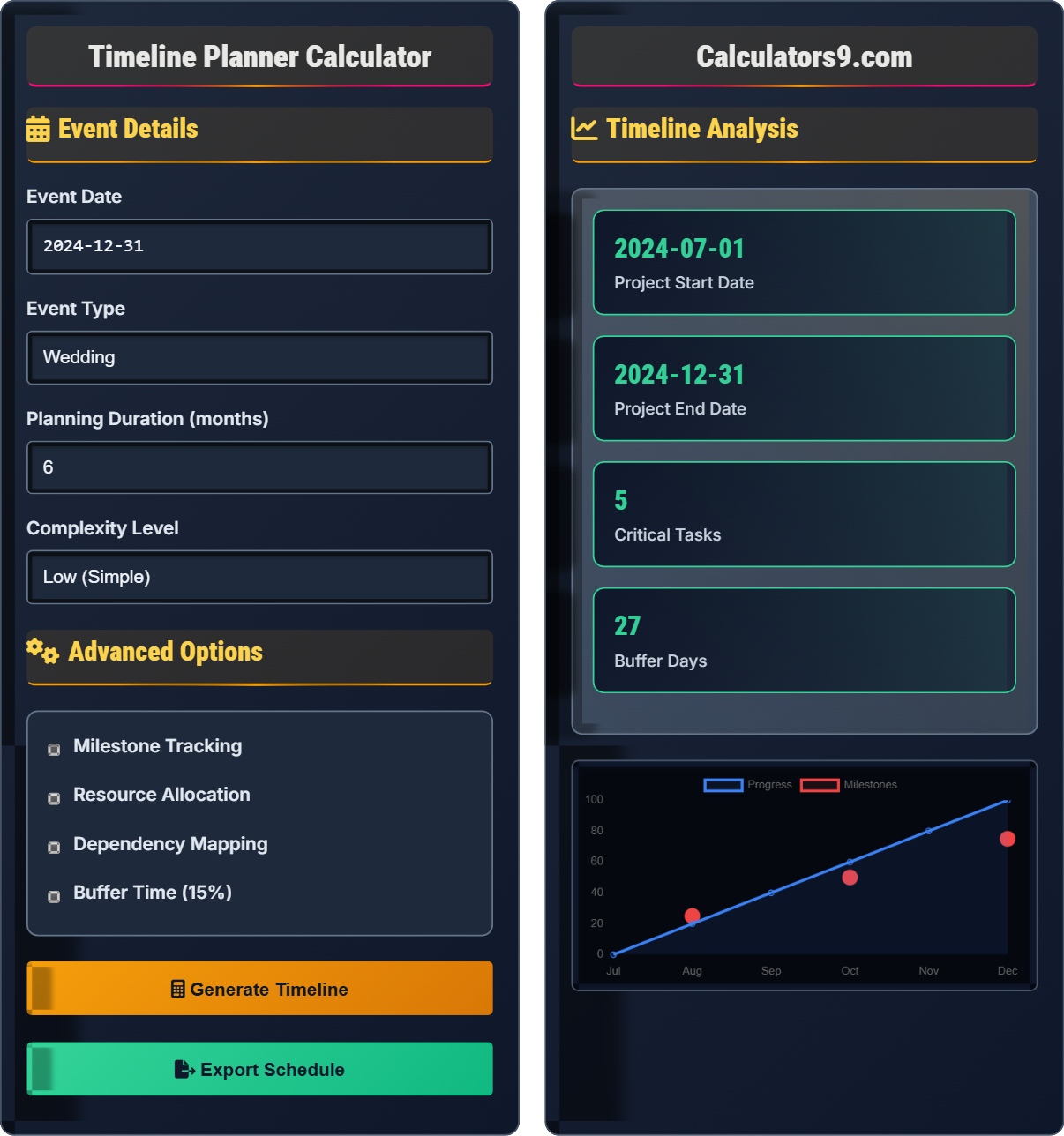
Timeline Analysis
| Task | Start Date | End Date | Status |
|---|
| Milestone | Date | Progress | Dependencies |
|---|
Timeline Planning Guide
Effective timeline planning is crucial for successful event execution. The industry standard recommends starting planning 6-12 months before the event, depending on complexity. Critical path methodology identifies the longest sequence of dependent tasks that determines the minimum project duration.
Understanding task dependencies is essential for accurate timeline planning:
- Finish-to-Start (FS): Task B cannot start until Task A finishes
- Start-to-Start (SS): Task B cannot start until Task A starts
- Finish-to-Finish (FF): Task B cannot finish until Task A finishes
- Start-to-Finish (SF): Task B cannot finish until Task A starts
- Lead/Lag Time: Time gaps between dependent tasks
- Start Early: Begin planning as soon as event date is confirmed
- Identify Critical Tasks: Focus on tasks that directly impact the timeline
- Set Milestones: Create checkpoints to monitor progress
- Plan Buffers: Include extra time for potential delays
- Review Regularly: Update timeline weekly as event approaches
Timeline Planning Learning Quiz
According to industry standards, how far in advance should you begin planning a complex wedding?
The answer is C) 6-12 months. Complex weddings typically require 6-12 months of planning to secure venues, vendors, and handle all the intricate details. This timeframe allows for proper vendor research, booking, and contingency planning.
Understanding appropriate planning timelines is fundamental to successful event management. The 6-12 month standard for complex weddings reflects the need to coordinate multiple vendors, secure prime dates, and handle detailed logistics. This timeframe also provides adequate buffer for unexpected challenges that commonly arise during wedding planning.
Planning Timeline: Period from initial planning to event execution
Complex Event: Event requiring multiple vendors and coordination
Vendor Booking: Securing services from suppliers
• Complex events require longer planning periods
• Prime dates book quickly, requiring advance notice
• Vendor availability affects planning timeline
• Book venues first as they have limited availability
• Research vendors early in the planning process
• Create a planning checklist to track progress
• Starting planning too late
• Not accounting for vendor lead times
• Underestimating complexity of tasks
If Task A takes 5 days, Task B takes 3 days and depends on Task A, and Task C takes 4 days and depends on Task A, what is the critical path duration? Show your work.
Step 1: Identify parallel paths: A→B and A→C
Step 2: Calculate path A→B: 5 days (A) + 3 days (B) = 8 days
Step 3: Calculate path A→C: 5 days (A) + 4 days (C) = 9 days
Step 4: Identify critical path: A→C takes longer (9 days)
The critical path duration is 9 days.
The critical path method identifies the longest sequence of dependent tasks that determines the minimum project duration. In this example, even though Task B finishes earlier, Task C creates the bottleneck that extends the overall timeline. Understanding this concept helps prioritize tasks that directly impact the event date.
Critical Path: Longest sequence of dependent tasks
Dependent Tasks: Tasks that require completion of previous tasks
Bottleneck: Task that limits overall project speed
• Critical path determines minimum project duration
• Focus resources on critical path tasks
• Delays in critical path delay the entire project
• Use software tools to visualize critical paths
• Identify parallel tasks to optimize timeline
• Monitor critical path tasks closely
• Not accounting for task dependencies
• Focusing resources on non-critical tasks
Sarah is planning a 6-month event. She wants to set milestones at 25%, 50%, and 75% completion. If her planning starts on January 1st, what are the milestone dates?
Step 1: Calculate total planning period = 6 months = approximately 180 days
Step 2: Calculate 25% milestone = 180 × 0.25 = 45 days → Feb 15
Step 3: Calculate 50% milestone = 180 × 0.50 = 90 days → April 1
Step 4: Calculate 75% milestone = 180 × 0.75 = 135 days → May 16
The milestone dates are: Feb 15 (25%), April 1 (50%), and May 16 (75%).
This example demonstrates how to create meaningful checkpoints throughout a project timeline. Setting milestones at regular intervals allows for progress evaluation and course correction. The 25%-50%-75% pattern provides adequate checkpoints without overwhelming the planning process with too many reviews.
Milestone: Significant checkpoint in project timeline
Progress Evaluation: Assessment of completed work
Course Correction: Adjustments made based on progress
• Milestones should be measurable and achievable
• Set milestones at regular intervals
• Use milestones for progress reporting
• Align milestones with major deliverables
• Use calendar tools to highlight milestone dates
• Schedule review meetings around milestones
• Not defining measurable criteria for milestones
• Failing to review progress at milestone dates
Mike has planned a 4-month event with a critical path of 120 days. He wants to include a 15% buffer for unexpected delays. What is the total project duration including the buffer, and what percentage of the total timeline is dedicated to the buffer?
Step 1: Calculate buffer time = 120 days × 0.15 = 18 days
Step 2: Calculate total project duration = 120 days + 18 days = 138 days
Step 3: Calculate buffer percentage = (18 ÷ 138) × 100 = 13.04%
The total project duration is 138 days, with approximately 13% dedicated to buffer time.
This problem demonstrates the importance of buffer time in project planning. The 15% buffer is a common industry standard that accounts for unexpected delays, vendor issues, or scope changes. The calculation shows that while the buffer appears as 15% of the original timeline, it represents approximately 13% of the total project duration.
Buffer Time: Extra time allocated for unexpected delays
Scope Changes: Modifications to original project requirementsIndustry Standard: Commonly accepted practice in field
• Buffer time should be calculated based on project complexity
• Communicate buffer time to stakeholders
• Use buffer time only for genuine emergencies
• Increase buffer for complex projects
• Distribute buffer throughout timeline rather than at end
• Document reasons for using buffer time
• Using buffer time for planned activities
• Underestimating complexity of project
Which dependency type means that Task B cannot start until Task A finishes?
The answer is B) Finish-to-Start (FS). This is the most common dependency type where Task B cannot begin until Task A is completed. For example, you cannot start decorating a venue until the venue is secured and prepared.
Understanding dependency types is crucial for accurate timeline planning. Finish-to-Start is the most intuitive and common relationship where one task must complete before the next can begin. This creates the sequential chain of activities that forms the backbone of any project timeline.
Dependency Type: Relationship between tasks
Sequential Activities: Tasks that follow one after another
Project Timeline: Chronological sequence of tasks
• FS is the most common dependency type
• Dependencies determine task sequence
• Identify all dependencies during planning phase
• Map all dependencies before creating timeline
• Use project management software for complex dependencies
• Consider lead/lag times between dependent tasks
• Missing critical dependencies
• Not accounting for parallel tasks
Timeline Basics
Critical path, milestones, dependencies, buffer time, and resource allocation.
Backward planning: event date → planning duration → start date. Critical path: longest dependent task sequence.
- Always include buffer time
- Identify critical path early
- Set regular milestones
Planning Tips
Use Gantt charts, project management software, and timeline visualization tools for complex projects.
- Update timeline weekly
- Track milestone completion
- Monitor critical tasks
- Adjust for changes promptly
- Vendor availability affects timeline
- Seasonal factors impact planning
- Stakeholder availability matters
- Legal/regulatory requirements
FAQ
Q: How do I handle timeline changes?
A: First, assess impact on critical path. Update dependencies and notify stakeholders. Use buffer time if available, or adjust non-critical tasks. Document changes for future reference.
Q: What if I need to compress the timeline?
A: Consider crashing (adding resources) or fast-tracking (parallel tasks). Increase budget and risk awareness. Focus on critical path tasks only.