Fertility Window Calculator
Conception Probability & Ovulation Tracker • Reproductive Health
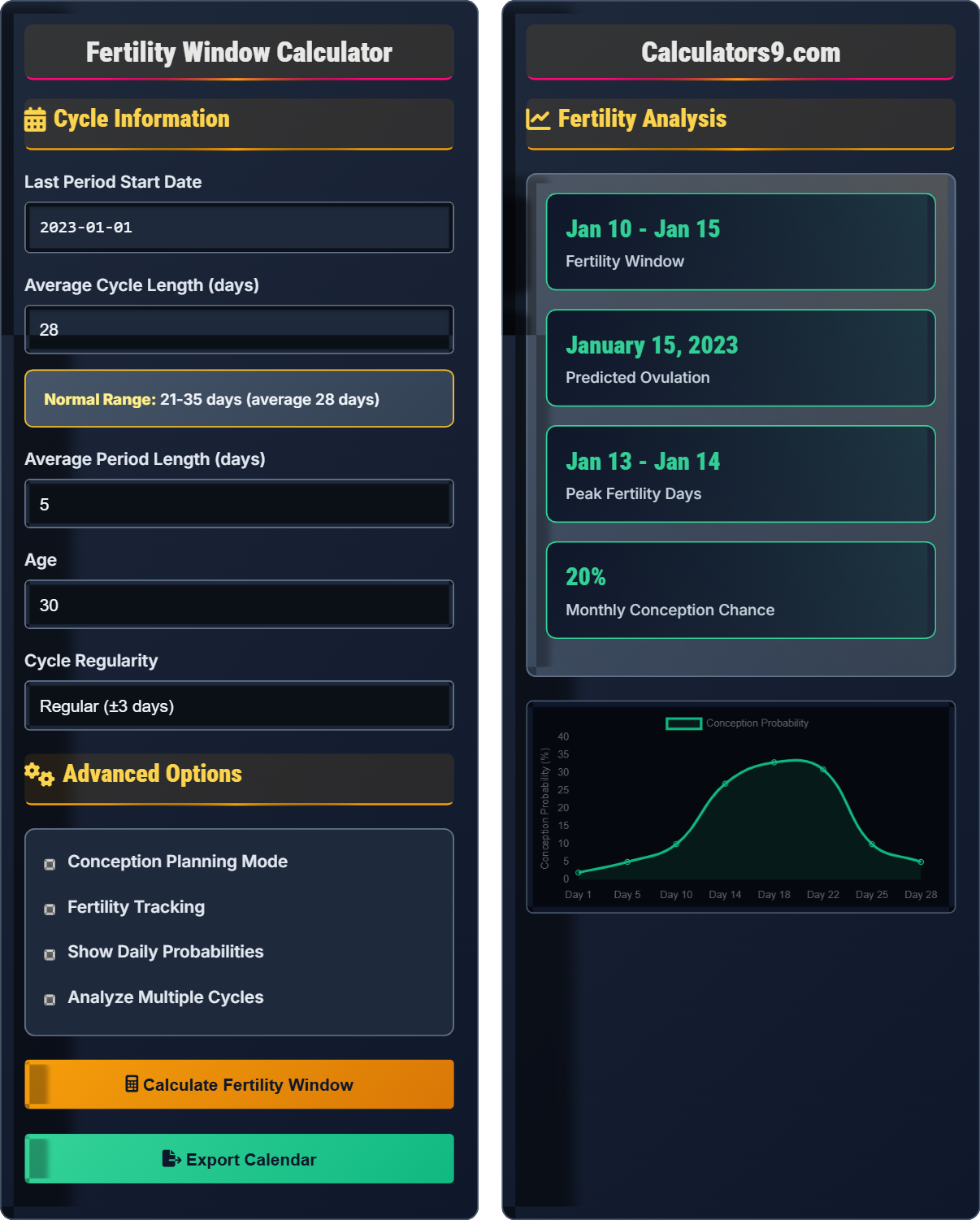
Fertility Window Calculations:
Show CalculatorThe fertility window is the period when conception is most likely to occur:
- Fertility Window: 5-6 days ending on ovulation day
- Peak Fertility: 2 days before ovulation (highest conception probability)
- Conception Probability: 20-30% per cycle during fertile window
- Ovulation Timing: Typically 14 days before next period
Conception Probability by Day:
5 days before ovulation: 10%
4 days before: 16%
3 days before: 27%
2 days before: 33%
1 day before: 31%
Day of ovulation: 10%
Example: For a 28-day cycle starting January 1st:
Fertility window: January 9-14
Peak fertility: January 12-13
Next period: January 29th
Cycle Information
Advanced Options
Fertility Analysis
| Day | Conception Probability | Fertility Level |
|---|---|---|
| Jan 1 | Minimal | |
| Jan 8 | Low | |
| Jan 12 | High | |
| Jan 14 | Medium |
Fertility Window Overview
The fertility window is the 5-6 day period during a woman's menstrual cycle when conception is possible. This includes the 5 days leading up to ovulation and the day of ovulation itself. Sperm can survive in the female reproductive tract for 3-5 days, while the egg is only viable for 12-24 hours after ovulation.
Several approaches can help identify and optimize the fertility window:
- Calendar Method: Tracking cycle patterns
- Cervical Mucus: Observing egg-white consistency
- Basal Body Temperature: Detecting post-ovulation rise
- Ovulation Predictor Kits: Measuring LH surge
- Saliva Ferning: Detecting estrogen changes
- Peak fertility: 2 days before ovulation
- Conception probability: 20-30% per cycle during fertile window
- Sperm survival: 3-5 days in reproductive tract
- Egg viability: 12-24 hours after ovulation
Fertility Window & Conception Quiz
What is the optimal timing for intercourse to maximize conception chances?
The answer is B) 2-3 days before ovulation. Research shows that the highest probability of conception occurs when intercourse happens 2-3 days before ovulation. This timing ensures that sperm are present in the reproductive tract when the egg is released, as sperm can survive 3-5 days while the egg is only viable for 12-24 hours.
The optimal timing for conception balances the survival times of both gametes. Sperm can live in the female reproductive tract for 3-5 days under ideal conditions, while the egg remains viable for only 12-24 hours after ovulation. Having intercourse 2-3 days before ovulation ensures maximum sperm presence when the egg is released.
Conception: Fertilization of egg by sperm
Gamete: Reproductive cell (sperm or egg)
Fertility Window: Days when conception is possible
• Peak fertility occurs 2-3 days before ovulation
• Sperm survive 3-5 days in reproductive tract
• Egg viable for 12-24 hours after ovulation
• Have intercourse every other day during fertile window
• Focus on 2-3 days before ovulation
• Track cervical mucus changes for ovulation signs
• Only having intercourse on ovulation day
• Missing the optimal timing window
• Not accounting for sperm survival time
Calculate the daily conception probabilities for a woman with a 30-day cycle whose last period started on January 1st. Show your work and explain the significance of these probabilities.
Step 1: Calculate ovulation date
Ovulation typically occurs 14 days before next period
Next period: January 1 + 30 days = January 31
Ovulation: January 31 - 14 = January 17
Step 2: Calculate fertility window
Fertility window: January 12 - January 17 (5 days before ovulation + ovulation day)
Step 3: Assign daily probabilities
January 12 (5 days before): 10% probability
January 13 (4 days before): 16% probability
January 14 (3 days before): 27% probability
January 15 (2 days before): 33% probability (peak)
January 16 (1 day before): 31% probability
January 17 (ovulation day): 10% probability
The significance is that these probabilities help couples time intercourse optimally for conception.
Conception probability follows a bell-shaped curve centered around ovulation. The highest probability occurs 2 days before ovulation because this timing aligns with peak sperm presence and egg viability. The probabilities decrease as you move away from this optimal timing due to either insufficient sperm presence or egg deterioration.
Conception Probability: Likelihood of pregnancy per sexual encounter
Fertility Window: 5-6 days ending on ovulation day
Peak Fertility: Highest probability of conception
• Peak probability occurs 2 days before ovulation
• Probability decreases as you move away from peak day
• Sperm must be present when egg is released
• Use ovulation predictor kits to identify peak fertility
• Track cervical mucus for additional signs
• Maintain regular intercourse during fertile window
• Assuming equal probability throughout cycle
• Not accounting for individual cycle variations
• Missing the 2-day peak fertility window
A couple has been trying to conceive for 6 months. The woman has a 26-day cycle with regular ovulation. She is 28 years old with no known fertility issues. What is their expected chance of conception this month, and how long should they continue trying before seeking medical advice?
Step 1: Calculate expected monthly conception probability
For a healthy 28-year-old woman with regular cycles: 20-25% per month during fertile window
Step 2: Assess timeline
After 6 months of regular, timed intercourse: Expected cumulative probability = 1 - (0.75)^6 = 82%
Step 3: Guidance
They should continue trying for a full year before seeking medical advice (or 6 months if over 35). At 28 years old with regular cycles, they are within normal expectations.
Recommendations: Continue timed intercourse during fertile window, maintain healthy lifestyle, consider fertility tracking methods.
Monthly conception probability represents the chance of pregnancy per cycle for couples having regular, timed intercourse during the fertile window. Cumulative probability increases over time but follows a diminishing returns pattern. The general guideline is to seek medical advice after 12 months of trying (or 6 months if over 35) for healthy couples.
Monthly Conception Rate: Probability of pregnancy per cycle
Cumulative Probability: Overall chance over multiple cycles
Fertility Evaluation: Medical assessment for conception difficulties
• Healthy couples: 20-25% monthly conception rate
• Seek medical advice after 12 months of trying
• 6-month timeline if woman is over 35
• Track ovulation to ensure proper timing
• Maintain healthy weight and lifestyle
• Reduce stress and maintain regular intercourse
• Expecting immediate conception
• Seeking medical advice too early
• Not optimizing intercourse timing
A woman has irregular cycles ranging from 24 to 32 days. How should she identify her fertility window, and what methods would be most effective for conception planning? Explain the challenges and solutions.
Challenges with irregular cycles:
• Difficult to predict ovulation using calendar methods
• Fertility window timing becomes unpredictable
• May miss ovulation entirely with calendar-based approaches
Effective solutions:
1. Ovulation predictor kits (OPKs) - detect LH surge 24-36 hours before ovulation
2. Basal body temperature (BBT) tracking - confirms ovulation after it occurs
3. Cervical mucus monitoring - identifies estrogen surge and peak fertility
4. Saliva ferning tests - detect estrogen changes
5. Transvaginal ultrasound monitoring - direct follicle tracking
Recommendation: Combine calendar tracking with physical signs (mucus and OPKs) for best results.
Irregular cycles have variable follicular phases while the luteal phase remains relatively constant at about 14 days. This means ovulation can occur at different times in the cycle, making calendar predictions unreliable. Physical signs provide real-time information about ovulation timing rather than relying on historical patterns.
Irregular Cycles: Variation of more than 7 days between cycles
Ovulation Predictor Kits (OPKs): Detect LH surge
Basal Body Temperature (BBT): Morning temperature tracking
• Calendar methods unreliable for irregular cycles
• Physical signs more accurate than predictions
• Consider medical evaluation if cycles remain irregular
• Start OPKs based on shortest cycle length
• Track multiple signs for confirmation
• Consider fertility awareness apps for pattern recognition
• Relying solely on calendar calculations
• Not using ovulation detection methods
• Missing ovulation windows due to unpredictability
How does maternal age affect monthly conception probability?
The answer is D) Both B and C are correct. Fertility begins to decline gradually starting around age 30, with a more pronounced decline after age 35. Monthly conception probability for healthy women is approximately: Age 20-25: 25%, Age 30-35: 20%, Age 35-40: 15%, Age 40-45: 5-10%. The decline is due to decreased egg quality and quantity over time.
Female fertility follows a gradual decline pattern starting in the late 20s, accelerating after age 35. This is primarily due to the aging of eggs, which have been dormant since fetal development. As women age, both the quantity and quality of eggs decrease, leading to lower conception rates and higher miscarriage rates.
Ovarian Reserve: Number of remaining eggs
Egg Quality: Chromosomal integrity of eggs
Fertility Decline: Decrease in conception probability with age
• Fertility decline begins in late 20s
• Accelerated decline after age 35
• Monthly probability drops significantly after 40
• Women over 35 should seek evaluation after 6 months of trying
• Consider fertility preservation options
• Optimize timing and frequency during fertile window
• Assuming fertility remains constant with age
• Not adjusting expectations for age-related decline
• Delaying evaluation despite age factors
FAQ
Q: How accurate are fertility window calculators for predicting conception chances?
A: Fertility window calculators are most accurate for women with regular cycles (26-32 days). For regular cycles, they can predict the fertile window with 70-80% accuracy. However, conception probability varies significantly based on several factors:
Age-related monthly conception rates:
- Ages 20-30: 20-25% per month
- Ages 30-35: 15-20% per month
- Ages 35-40: 10-15% per month
- Ages 40+: 5-10% per month
For a regular 28-day cycle, the highest probability occurs 2 days before ovulation (approximately 33%), with the fertile window spanning 5-6 days. Combining calculator predictions with physical signs (cervical mucus, BBT, ovulation tests) improves accuracy significantly.
Q: How long should we try before seeing a doctor about fertility concerns?
A: General guidelines for fertility evaluation are:
- Under 35: Try for 12 months before evaluation
- 35-40: Seek evaluation after 6 months
- Over 40: Consult after 3-6 months
- Known issues: Seek earlier if irregular cycles, PCOS, endometriosis, or male factor concerns
For a healthy 30-year-old couple with regular cycles, monthly conception probability is approximately 20-25%. After 6 months of trying, the cumulative probability is about 75%. After 12 months, about 85% of couples will have conceived naturally.
However, if there are known risk factors (irregular cycles, previous pelvic infections, male factor issues), earlier evaluation is recommended.