Menstrual Cycle Calculator
Ovulation Tracker & Fertility Calendar • Reproductive Health
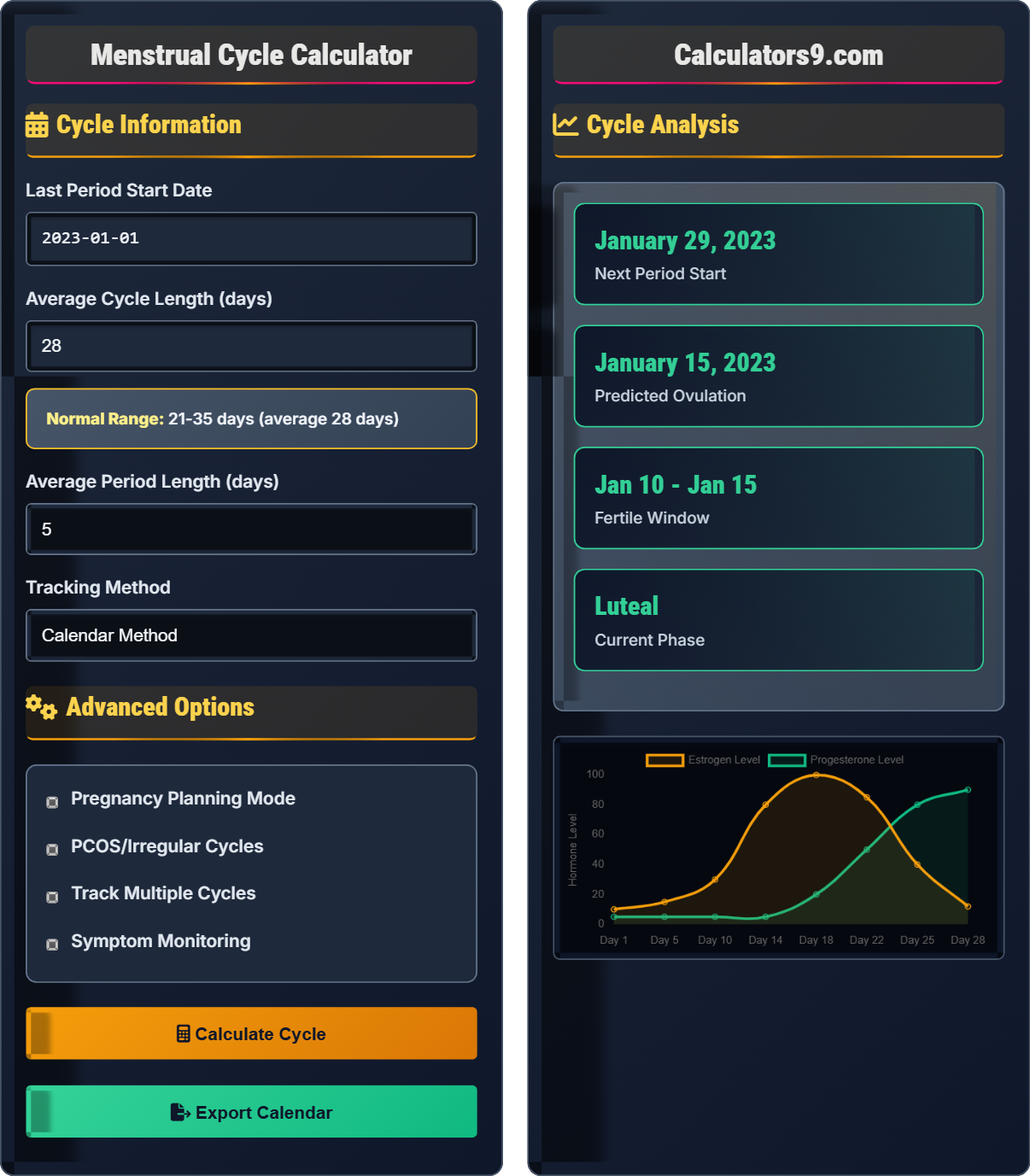
Menstrual Cycle Calculations:
Show CalculatorThe menstrual cycle consists of several phases with distinct hormonal changes:
- Menses Phase: Days 1-5, uterine lining shedding
- Follicular Phase: Days 1-13, follicle development
- Ovulation: Around day 14, egg release
- Luteal Phase: Days 15-28, progesterone dominance
Ovulation Prediction: Occurs approximately 14 days before next period start
Fertile Window: 5 days before ovulation + ovulation day (highest conception probability)
Example: For a 28-day cycle starting January 1st:
Ovulation occurs around January 14th
Fertile window: January 9th-14th
Next period: January 29th
Cycle Information
Advanced Options
Cycle Analysis
| Phase | Days | Description | Hormones |
|---|---|---|---|
| Menses | 1-5 | Uterine lining shedding | Low estrogen/progesterone |
| Follicular | 1-13 | Follicle development | Rising estrogen |
| Ovulation | 14 | Egg release | LH surge |
| Luteal | 15-28 | Progesterone dominance | Rising progesterone |
Menstrual Cycle Overview
The menstrual cycle is a monthly series of physiological changes in the female reproductive system, preparing the body for potential pregnancy. The average cycle lasts 28 days but can range from 21 to 35 days. It consists of four main phases: menses, follicular, ovulation, and luteal phases.
Several methods can help predict ovulation:
- Calendar Method: Counting days from period start
- Basal Body Temperature: Tracking morning temperature rise
- Cervical Mucus: Observing changes in consistency
- Ovulation Tests: Detecting LH hormone surge
- Ultrasound Monitoring: Tracking follicle development
- Most fertile: 2-3 days before ovulation
- Egg survives: 12-24 hours after ovulation
- Sperm survives: 3-5 days in reproductive tract
- Best conception timing: 2-3 days before ovulation
Menstrual Cycle & Fertility Quiz
During which phase of the menstrual cycle does ovulation typically occur?
The answer is C) Ovulation Phase. Ovulation occurs during its own distinct phase, typically around day 14 of a 28-day cycle. During this phase, the mature egg is released from the ovary and travels down the fallopian tube. This is the most fertile time of the cycle when conception is most likely to occur.
The menstrual cycle is divided into four distinct phases, each with specific hormonal changes and physiological events. Ovulation marks the transition from the follicular phase to the luteal phase. The timing of ovulation is controlled by a surge in luteinizing hormone (LH), which triggers the release of the mature egg from the dominant follicle.
Ovulation: Release of a mature egg from the ovary
Menstrual Cycle: Monthly reproductive cycle in women
Luteinizing Hormone (LH): Hormone that triggers ovulation
• Ovulation typically occurs around day 14 in a 28-day cycle
• Ovulation is triggered by an LH surge
• Egg is viable for 12-24 hours after ovulation
• Remember: Ovulation = Egg release
• Most fertile: 2-3 days before ovulation
• Track cervical mucus changes for ovulation signs
• Confusing ovulation with other cycle phases
• Assuming ovulation always happens on day 14
• Not accounting for cycle length variations
Calculate the expected ovulation date and fertile window for a woman with a 30-day cycle whose last period started on January 1st. Show your work and explain the significance of these dates.
Step 1: Determine ovulation date
Ovulation typically occurs 14 days before the next period
Next period date: January 1 + 30 days = January 31
Ovulation date: January 31 - 14 days = January 17
Step 2: Calculate fertile window
Fertile window: 5 days before ovulation + ovulation day
Fertile window: January 12 - January 17
Step 3: Next period start: January 31
These dates are significant because they represent the optimal timing for conception attempts, with the highest probability occurring 2-3 days before ovulation.
The key principle in menstrual cycle calculations is that ovulation occurs consistently about 14 days before the next period, regardless of the total cycle length. This is because the luteal phase (after ovulation) is typically fixed at 14 days. Therefore, to find ovulation, subtract 14 from the total cycle length to find when ovulation occurs relative to the last period start.
Fertile Window: Days when conception is possible
Luteal Phase: Fixed-length phase after ovulation
Menstrual Cycle: Days from start of one period to next
• Ovulation = 14 days before next period
• Fertile window = 5 days before ovulation + ovulation day
• Luteal phase is typically 14 days
• Subtract 14 from cycle length to find ovulation day
• Count backward from next expected period
• Track multiple cycles for pattern recognition
• Assuming ovulation always occurs on day 14
• Not accounting for different cycle lengths
• Confusing cycle length with ovulation day
A couple wants to conceive. The woman has a 26-day cycle and her last period started on February 10th. When should they have intercourse to maximize conception chances? Explain the biological rationale behind your recommendation.
Step 1: Calculate ovulation date
Ovulation = 14 days before next period
Next period: February 10 + 26 days = March 8
Ovulation: March 8 - 14 days = February 22
Step 2: Determine fertile window
Fertile window: February 17 - February 22
Recommendation: Have intercourse daily from February 17-22, especially February 20-22.
Biological rationale: Sperm survive 3-5 days in the reproductive tract, while the egg is only viable for 12-24 hours. Having intercourse before ovulation ensures sperm are present when the egg is released. Peak fertility occurs 2-3 days before ovulation.
Optimal conception timing balances the lifespan of both gametes. Sperm can survive in the female reproductive tract for up to 5 days, while the egg remains viable for only 12-24 hours after ovulation. Therefore, the highest probability of conception occurs when intercourse happens before ovulation, allowing sperm to wait for the egg.
Gamete: Reproductive cell (sperm or egg)
Viable: Capable of fertilization
Conception: Fertilization of egg by sperm
• Sperm survive 3-5 days in reproductive tract
• Egg survives 12-24 hours after ovulation
• Peak fertility 2-3 days before ovulation
• Have intercourse every other day during fertile window
• Focus on 2-3 days before ovulation
• Maintain healthy lifestyle for optimal fertility
• Only having intercourse on ovulation day
• Missing the fertile window
• Not accounting for sperm survival time
A woman has irregular cycles ranging from 24 to 32 days over the past 6 months. Her last three periods started on January 5th, February 2nd, and March 1st. How would you estimate her ovulation date, and what additional methods could help identify her fertile window?
Step 1: Analyze cycle patterns
January 5 to February 2: 28 days
February 2 to March 1: 27 days
Estimated next period: March 1 + 27 days = March 28
Estimated ovulation: March 28 - 14 = March 14
However, given irregularity, ovulation could occur between day 10-21 of the cycle.
Additional methods: Basal body temperature tracking, cervical mucus monitoring, ovulation predictor kits, and follicular ultrasound monitoring. These methods detect actual ovulation rather than predicting it based on historical data.
Irregular cycles make ovulation prediction challenging because the follicular phase (before ovulation) varies in length while the luteal phase (after ovulation) remains relatively constant at about 14 days. Physical signs like cervical mucus changes and basal body temperature shifts provide real-time indicators of ovulation that are more reliable than calendar predictions in irregular cycles.
Irregular Cycles: Variation of more than 7 days between cycles
Basal Body Temperature: Resting body temperature that rises after ovulation
Cervical Mucus: Vaginal discharge that changes during cycle
• Luteal phase is typically constant at 14 days
• Follicular phase varies in irregular cycles
• Physical signs more reliable than calendar in irregular cycles
• Track multiple cycles to identify patterns
• Use physical signs for ovulation detection
• Consider consulting healthcare provider for irregular cycles
• Applying standard calendar calculations to irregular cycles
• Ignoring physical fertility signs
• Not seeking medical evaluation for persistent irregularity
Which hormone surge is the primary trigger for ovulation in the menstrual cycle?
The answer is C) Luteinizing Hormone (LH). The LH surge is the primary trigger for ovulation. When estrogen levels reach a critical threshold, it causes a positive feedback loop that results in a dramatic surge of LH from the anterior pituitary gland. This LH surge directly causes the mature follicle to rupture and release the egg within 24-36 hours.
The hormonal regulation of ovulation involves a complex feedback system. During the follicular phase, rising estrogen levels initially provide negative feedback to suppress LH. However, when estrogen reaches peak levels (just before ovulation), it switches to positive feedback, triggering the LH surge. This surge is what ovulation predictor kits detect.
LH Surge: Sudden increase in luteinizing hormone that triggers ovulation
Positive Feedback: Hormone increase leads to more hormone production
Ovulation Predictor Kits: Detect LH surge in urine
• LH surge triggers ovulation within 24-36 hours
• Estrogen switches from negative to positive feedback before ovulation
• Ovulation tests detect the LH surge
• Ovulation tests detect the LH surge 24-36 hours before ovulation
• Test in afternoon for best results
• Start testing based on your shortest cycle length
• Confusing FSH with LH function
• Thinking ovulation happens immediately after LH surge
• Misunderstanding estrogen's dual feedback role
FAQ
Q: How accurate are ovulation calculators for predicting fertility windows?
A: Ovulation calculators are most accurate for women with regular cycles (26-32 days). For a regular 28-day cycle, calculators can predict ovulation within 2-3 days of the actual event in about 75-80% of cases.
However, accuracy decreases significantly for irregular cycles. The fertile window (5 days before ovulation + ovulation day) represents the period when conception is possible.
For example, in a 28-day cycle starting January 1st:
Ovulation typically occurs around January 14th
Fertile window: January 9-14th
Peak fertility: January 12-13th
Physical signs (cervical mucus, BBT, ovulation tests) combined with calendar methods provide the most accurate prediction.
Q: My cycles vary between 25 and 35 days. Can I still predict ovulation accurately?
A: With irregular cycles (varying more than 7 days), calendar-based ovulation prediction becomes less reliable. In your case, ovulation could occur anytime between cycle days 11-21 (assuming a 14-day luteal phase).
More reliable methods for irregular cycles include:
- Basal Body Temperature (BBT): Track morning temperatures that rise 0.4-0.6°F after ovulation
- Cervical Mucus: Observe egg-white consistency indicating peak fertility
- Ovulation Predictor Kits: Detect the LH surge 24-36 hours before ovulation
- Saliva Ferning Tests: Detect estrogen surge
Consider consulting a healthcare provider if cycles remain irregular, as this may indicate underlying conditions affecting fertility.